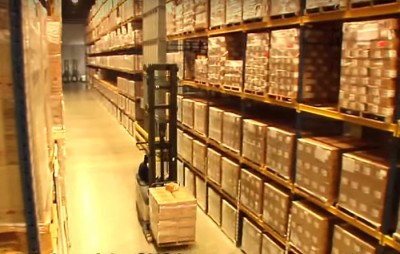
It sounds like something out of a Cold War era movie. Boxes of medical supplies stacked high in government warehouses to help citizens in the event of a public health emergency.
However, this huge stockpile is very real. It is called the Strategic National Stockpile, and “Once Federal and local authorities agree that the SNS is needed, medicines will be delivered to any state in the U.S. in time for them to be effective. Each state has plans to receive and distribute SNS medicine and medical supplies to local communities as quickly as possible.”
For security reasons, the location and the number of warehouses that comprise the SNS are classified information – as is much of what is in them. “If everybody knows exactly what we have, then you know exactly what you can do to us that we can’t fix,” Greg Burel, director of the program told National Public Radio in a recent interview. “And we just don’t want that to happen.”
The SNS started in 1999 with an approximate $50 million budget. Since then, it has built an inventory in multiple warehouses that is valued at just over $7 billion. “If you envision, say, a Super Walmart and stick two of those side by side and take out all the drop ceiling, that’s about the same kind of space that we would occupy in one of these storage locations,” Burel said.
The SNS extensive inventory includes massive amounts of small pox vaccines, antivirals in case of deadly flu pandemic, medicines to treat radiation burns and sickness, chemical agent antidotes, wound care supplies, antibiotics and IV fluids.
NPR science writer Nell Greenfieldboyce recently visited an SNS. She was told she was the first reporter ever to visit the secret warehouses, and she had to sign a confidentiality agreement not to describe the location or the exterior of the facility.
A locked section of the warehouse stocks painkillers than can be addictive. A giant freezer is filled with medicines that need to be kept frozen. Greenfieldboyce described a humming sound that comes from the rows of ventilators that are charged once a month and sent out for maintenance once a year.
With an annual budget of more than half a billion dollars, the SNS is charged with deciding what to purchase for the stockpile. In order to do so, officials must determine which threats are realistic and which are not.
“That’s where we have a huge, complex bureaucracy trying to sort through that,” Irwin Redlener, director of the National Center for Disaster Preparedness at Columbia University, told Greenfieldboyce.
The government recently hired a firm called Gryphon Scientific to analyze how well the stockpile could respond to a range of health disaster scenarios.
Although he said he could not be specific on results of the study, Gryphon Scientific’s Rocco Casagrande told the NPR reporter, “One thing we can say is that across the variety of threats that we examined, the Strategic National Stockpile has the adequate amount of materials in it and by and large the right type of thing.”
However, he pointed out that the studies were based upon a single type of attack at a time or a single type of weapon.
The brief shelf life of some of the newer medicines is a problem for the SNS. “These are often very powerful, very exciting and useful new medicines, but they are also very expensive and they expire after a couple years,” explained Dr. Tara O’Toole, a former Homeland Security official who is now at In-Q-Tel, a nonprofit that helps bring technological innovation to the U. S. intelligence community.
Another problem is the time it would take to get the medicines from the warehouses to the people who need them in the event of real emergency. “It is not going to be easy or simple to put medicines in the hand of everybody who wants it,” O’Toole told NPR.
“While they do have plans for emergencies, and lists of volunteers, they’re volunteers,” said Paul Petersen, director of emergency preparedness for Tennessee. “And they’re not guaranteed to show up in the time of need.”
Local public health officials have had severe budget cuts and are underfunded, Petersen told NPR. “Over and over, I heard worries about this part of the stockpile system.”
O’Toole said, “We have drastically decreased the level of state public health resources in the last decade. We’ve lost 50,000 state and local health officials. That’s a huge hit.” She commented that emergency drills would be helpful, adding, “The notion that this is all going to be top down, that the feds are in charge and the feds will deliver, is wrong.”
Meanwhile, the secret warehouses continue to stockpile supplies. “We have the capability, if something bad happens, that we can intervene in a positive way, but then we don’t ever want to have to do that. So it’s kind of a strange place,” Burel told NPR.
“But we would be foolish not to prepare for those events that we could predict might happen.”
I want to present you one of the most interesting sites, where you will see new articles daily! www.321gold.com
This article was originally published a year ago. It’s worth reiterating – with a few edits.
“Various types of belief can be implanted in many people, after brain function has been sufficiently disturbed by accidentally or deliberately induced fear, anger or excitement. Of the results caused by such disturbances, the most common one is temporarily impaired judgement and heightened suggestibility. Its various group manifestations are sometimes classed under the heading of “herd instinct,” and appear most spectacularly in wartime, during severe epidemics, and in all similar periods of common danger, which increase anxiety and so individual and mass suggestibility.”
– from Tavistock Institute psychiatrist Dr. William Sargant’s 1957 book, Battle for the Mind [emphases added] –
The Tavistock is the UK-spawned globalist psychological warfare centre. The UK has over time made many contributions to human civilisation. The Tavistock Institute isn’t one of them.
Please note, Sargent says during wars and “during severe epidemics,”
In other words, the mass psychology boyos know that a sudden shock such as a pandemic followed by a succession of further shocks such as the sudden confiscation of cultural norms, freedoms etc tend to render human beings suggestible.
The operative word here is “sudden”. As time goes on, the shock wears off and people come out of it. They “wake up” so to speak.
Once awake, they are likely to get very angry at those perceived to have been playing mind games with them.
We are at the point now where then shock “wears off” and people come out of the slightly hypnotic/suggestible state induced by the shock. Hence the psyop wallahs work hard to try to deliver more shocks (another lockdowm, false but alarming “pandemic” stats, Climate Change fears etc) the psychological equivalent of being repeatedly punched in the head
The Tavistock was the UK’s psychological warfare HQ during WW2. It was run by psychiatrist JR Rees, the UK counterpart of Germany’s Goebbels.
Much was learned about psychological warfare. After the war it was put to use against the People.
It still operates, which accounts for the “military grade” psychological warfare that has been inflicted on The People..
Sargent (see quote above) was a colleague of Rees.
Another colleague sand fellow psychological warrior was psychiatrist G Brock Chisholm.
G Brock Chisholm. Chisholm WAS THE FIRST DIRECTOR GENERAL OF THE WHO when it was founded in 1948.
HE WAS ALSO THE FOUNDER OF THE PSYCHIATRIC FRONT GROUP THE WFMH WHEN IT WAS FOUNDED – ALSO IN 1948.
And here is a nice quote from that particular arch-exponent of psychological warfare:
“To achieve world government, it is necessary to remove from the minds of men their individualism, loyalty to family tradition, national patriotism, and religious dogmas.”
The WHO and WFMH have been promoting one another’s agenda and working in concert ever since.
In WW2 the “philosophy” that drove the regime of Adolf Hitler was based on the psychiatry-led bogus science of “eugenics”. Eugenics’ purpose is to provide a “scientific” justification for humanitarian crimes and mass murder.
Bill Gates is a eugenicist from a family of eugenicists and primary donor to the psychiatric/pharmaceutical front group WHO.
Gates also donates heavily to “mental health” programs (see WFMH above).
Gates’ eugenics concerns centre on the notion the planet is over populated and the population must be reduced.
Gates heavily promotes vaccines which are claimed to prolong life and thus contribute to the growth in world population.
These last two points are contradictory.
So what are vaccines really intended to do?
Well by now we already know that.
I want to present you one of the most interesting sites, where you will see new articles daily! www.321gold.com
The mantra of Guns, Bullets, and Beans is a reasonably common one but bullets go both ways. Almost everyone who has served in active duty involving gunshot injuries or has been involved in treating them will tell you never to engage in a fire fight unless you have no other choice. Rather than focusing on building a fortress to defend your supplies it is safer to build a home you can walk away from without compromising your supplies or getting on the wrong end of a gunshot wound.
Rule One: Do not get shot.
Rule Two: Get shot in a leg or arm without any bone involvement.
Rule Three: If you have to be in a fire fight make sure you kill them all before they can return fire.
I have never been shot and I have only had two guns pointed at me but I have nursed a fair number of shot ICU patients over the years. In SHTF things will be different and trauma care for shooting patients (I dislike the term ‘victims’ as it implies powerlessness) needs a hard look at especially if you live in an area of the world that has a lot of armed people around you. This article will have some biology (science is fun!) and I am not talking about body armor or types of ammunition (not my specialty but here are penetration estimates. If Pat uses them there will be graphic photos and I hope these will not trigger anyone but knowledge is power.
The article is long and I am not going into lung, abdominal, brain care as basically you are likely dead. Please look up lung injuries as knowing what tension pneumothorax, septic shock, and paralytic ileus are good ideas.
Basic Field Care if you are Shot
Avoid being shot again. Disengage and get to the safe area. All home and bug out locations should have a stocked and safe area away from the main buildings that is believed to be safe in the event of an attack.
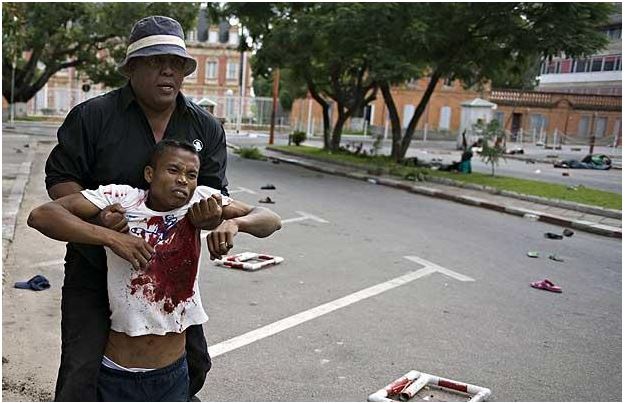
A wounded man is helped to get away from gun shots Picture: AFP
Do not scream “medic!” or “I’m hit!” There is a fire fight going on so do not give tactical information to the enemy or distract your side. Everyone on your team is a field medic and has practiced for this so no one helping you needs to be screaming for help either. You and/or they deal with it until after the fire fight. Stay off the radio until the fire fight is over and give no tactical details if summoning help. “Jimmy I’m at X and I’d like to see you” is better than “Jimmy! They shot me in my leg. It hurts. I need help now”
Look for the entrance area and check if there is an exit area. Survey yourself quickly for other injuries. Entry wounds can look insignificant and exit wounds can look dramatic. The actual issue is what was in the way and what is happening beneath these entry and exit points.
Exit wounds can look dramatic
Cover the wound’s entry and exit points with thick cloth or blood stopper bandage as soon as you can. Limit the blood flow by partial or a full tourniquet if you have knowledge to safely use one. Blood looks dramatic and it is hard to assess the amount. Pulse rising, blood pressure dropping, consciousness failing are signs of massive blood loss. Without intravenous infusions and/or blood transfusions you will likely die. I know some are prepping to give blood transfusions but this is a really dangerous and specialized intervention. Giving a basic intravenous of normal saline (0.9% sodium chloride) is simple and easily learned. Both are illegal to use but not to learn unless you are a medical doctor.
Leave this initial thick pad on no matter how wet it gets. Add more and do not remove any. I do not feel a blood clotter like the Israeli Bandage should be applied at this stage unless you have several in reserve. If you have one only consider using it after the next phase of care or buy more than one. Technology keeps evolving but if you use it can you remove it without an Operating Room?
If possible elevate the wound above your heart. This lowers the blood pressure locally and should decrease bleeding. Realistically it probably will be easier to raise your heart above the wound site.
If bone is injured splint it as it is for transport and apply the initial pad over the splint.
If it is not an abdominal injury drink as much water as you can and keep drinking one pint an hour. Sports mixes are a good idea as well. If abdominal you will likely die but stay nil by mouth (NPO) as you might get lucky and abdominal trauma is always worse if you take anything by mouth.
It is going to get painful quickly so use the brief pain-free period to move away from the bullets and get to safety.
Basic Field Care if you are the Medic
Yeah! We won and all the bad guys and girls are dead. As in all First Aid situations assess the area for possible threats prior to giving care. Any snipers waiting as your team-mate was screaming for help giving away his location? Has the shooter who did the hit been dealt with or are you next? Consider dragging the injured away from the scene before doing anything else.
When safe have a look and verify if they are alive or just barely alive? If dead or barely alive then do not waste time, energy, and supplies.
Reasonable signs of potential viability are that they are conscious and can talk to you in sentences. If they are able to do this has the wound caused abdominal contents to become free?
Sorry but without a surgeon and a good hospital/surgical set up your friend’s dead if you can see bits of their bowels. Brains oozing out of the wound, eyes, nose, or mouth are equally untreatable in SHTF so do not waste supplies on a futile attempt.
Then follow the steps you would take if you had been shot. Starting to go beyond these in the field is just not a good idea. Get them to the safe zone.
Safe Zone Preliminary Care
Everyone in your group should know how to do this as you might have to do it for yourself.
Emergency War Surgery: The Survivalist’s Medical Desk Reference
Unlike every film you have ever seen getting shot is extremely painful and shock is likely for the pain alone even if blood loss is minimal. Get calm and practice deep breathing techniques to slow and steady your breathing and your heart rate. If you have alcohol available do not drink it if you are shot. If you are the medic have a small amount. Seriously, I have a small bottle of brandy in my kit for me to swig if I am facing a major injury and it can also be used to sterilize instruments and your hands.
Okay. Now what are we facing here? If they are unconscious check for other wounds as there are many cases where the obvious and none fatal wound gets all the care while the insignificant and overlooked wound slowly kills the patient.
Strip them naked. Use scissors or a knife but get them fully naked unless they are conscious and are sure they have only one wound. Even so I am stripping them and doing a quick body search. Note where all the wounds are and where you see swelling and bruising. Is this survivable? If there is flank and/or side deep bruising from an abdominal wound likely means the spleen is damaged if on their left side or the liver if on their right side. Frankly they are going to die unless you can do surgical repair which is highly unlikely and is highly skilled. Wounds that go through the body are more survivable than those where the bullet remains inside but a through shot going through the deep abdominal area or chest is likely not one you can treat. No worries they will die quickly from blood loss or lack of oxygen.
If the decision to treat is made then clean the area around the wound and your exposed arms and forearms with something. Clean water if that is all you have or use the remaining brandy to clean your hands carefully. Soap and water is awesome hence having a stocked safe area previously set up for major injuries away from the areas likely to be in a fire fight is a good move. You can use multiple different liquids but the aim is to pour the external stuff AWAY from the wound and never towards it.
Having done that move them onto a fresh laundered sheet or have one placed under them. If possible have the room warm to avoid cold shock but you need the area naked to do this care. Avoid using beds as they are too low and the mattress will be ruined. A massage table or a folding plastic table is a good idea.
Using a powerful flash light (have a head lamp if you cannot get an assistant) pick out and remove everything you can see in the wound that is unattached to the patient. Clothing and bullet and bone fragments have to be removed or infection will occur for sure.
Now reassess blood loss. Is it arterial (bright red maybe but you can see it pulsing) or venous (dark for sure and steady stream)? If arterial use a tourniquet between the wound and the heart if possible, get sterile gloves on, and go in. Find the sight of bleeding and suture it. This can result in limb loss but most arteries can be sealed and blood flow can take alternative routes. At a pinch you can seal it with a hot piece of metal from a fire but frankly you likely will have the patient die of shock. This is not the movies. Still I’d consider it for a wound in a limb that cannot stop bleeding no mater my digging around in there.
Yes you can use back powder but only if it is a limb and the bleeding cannot be stopped. This will hurt and inflict a severe burn on top of the other injuries.
Set bones if you can and have to at this stage. The wound is as clean as you can get it and you have flushed it out with loads of cooled boiled water after adding a bit of salt. 0.9% sodium chloride is normal for the human body but flush it out a lot until most of the bleeding has stopped. You have removed every bit of dirt, clothing, and bullet you can see in there. You have stopped all major bleeding. Doing this on yourself is unrealistic despite the movies so everyone in your group needs to know how to do this not just the doctor or the nurse. They might be the one shot.
Start broad spectrum antibiotics and ensure 3-4 liters so fluid intake a day. Use the intravenous if you have to but keep them hydrated.
Broad Spectrum Antibiotics:
Amoxillin
Levofloxacin
Gatifloxacillin
Streptomycin
Tetracycline
Chloramphenicol
If bone involvement it is very important to use a broad spectrum antibiotic to avoid issues later on with chronic bone infection. If you have antibiotics then use them if the wound penetrated deep into the body. Hopefully their tetanus is up to date especially if soil has entered the wound which in SHTF is likely from clothing in a fire fight. Antibiotics will not help tetanus and it basically kills people horribly.
Ongoing Care
Evacuate them to a hospital with a trained doctor as soon as possible. If you can do this within 60 minutes you dramatically increase their chance of living. Okay if you cannot then try this!
Wound Care
If the outside of the dressing is clean and dry and there is no obvious smell, swelling, or severe pain then leave it on for 7 days. Do not peek! Change the dressing using clean materials if sterile ones are unavailable. Laundered sheets work fairly well for this so have a supply kept aside for health care use. Unopened packs of baby wipes can also be considered very clean. Wash your hands and arms well with soap and water before and after giving all care and especially wound care. You do not need a face mask but do not breathe into the wound even if you are wearing one. The outsides of face masks are extremely contaminated and the human mouth is as well even if you floss frequently. Use cooled boiled salt water to soak and dressing that are stuck and take them off gently.
If the wound is bulging or leaking pus (yellow smelly stuff) then remove one or two sutures and let it be open to drain. Be aware that 7-14 days afterwards this can occur and the entire wound site might burst open. Flush everything with loads of cooled boiled salt water and attempt to push gently back into the body and then suture really well. Probably will die but worth a try if you have got this far. Open it carefully being sterile if possible and remove obviously dead tissue and wash everything out. Have a good look for any debris you missed the first time you treated this. This is a wound infection and needs 12-24 hour dressings until it heals (once or twice a day). Change the antibiotic given if you can at this point. Do not use triple antibiotic cream, honey, or anything inside the body. Just don’t ever no matter the temptation. Flush with cooled boiled water and if open and you need to pack it use cooled boiled water-soaked sterile gauze.
General Care
Use limited bed rest. However sick they are turn them every 1-2 hours in bed and get them up in a chair as soon as possible and totally ignore their complaints about this. Immobility kills. Keep them hydrated well and use higher protein foods if available. Add a stool softener into the mix early on if they are immobile. Metamucil works fine if used early on. Let them rest a lot and avoid strain on the wound area but also make them feel useful. They can cut up clothing for toilet paper and other chores so make them earn their keep.
They will out of commission for a long time so have stored food available and firewood and drinks they can reach even in a weakened state. You might not be able to do this for them.
I want to present you one of the most interesting sites, where you will see new articles daily! www.321gold.com
The people of India suffered through a difficult December, caused by a sudden action of their government.
On 8 November 2016, Prime Minister Narendra Modi announced that as of midnight the 500 and 1,000 rupee notes would no longer be valid. As their replacement, the new 500 and 2,000 rupee note didn’t hit circulation until weeks later, it left people in a bind.
There’s a lesson to be learned here; and that is that our money isn’t safe.
The move was made in an effort to curb corruption, forcing both wealthy people who were keeping their assets in cash and criminals who avoid banks to either deposit their money or lose its value.
It’s germane to note that the government stands to make a tidy profit on this move, as people who have been avoiding paying their taxes will be easily caught when they make those deposits.
But in the mean time, it’s left people in a bind. While India is a much poorer country than the United States, with many people dealing only in cash, they are still an industrialized nation, with modern banking, including ATM machines. Just like the rest of the world, electronic money is replacing the paper kind in many places, so people were lined up at ATM machines, with the obvious result, as they tried to get what cash they could.
ATM machines can hold a lot of money; much more than they typically do. Even so, with the massive number of people who were trying to get their hands on cash, even a full ATM machine will run out of bills quickly.
And that’s exactly what happened in India, as ATM machine after ATM machine ran out of money and went out of service, leaving a line of people who had waited to withdraw money that was temporarily unavailable.
Even with all the consternation that the people of India were going through, trying to get their hands on funds to use in their daily lives, it was nothing more than a temporary inconvenience.
It was nothing like the problems faced by the citizens of Cyprus, when the government froze citizens’ assets and stole a percentage of them. Then, they limited how much people could withdraw, so that there wouldn’t be a run on the banks.
How Safe Is Our Money?
I’m saying it again: our money isn’t safe.
Money in the bank can be seized by the government. Money we keep at home can be made worthless at a moment’s notice by the government, canceling denominations, just like they did in India. Our accounts can be locked up and our access to our own money can be denied.
Then there’s the risk of the whole system collapsing. Most money today is electronic, rather than paper or coin. All it takes to make it disappear is erasing a number.
While there are many failsafes in place to protect our money, there are some things which are bigger than those failsafes. Whether they would impede our access to our money temporarily or permanently, any of them would make life more difficult.
Many people put their confidence in the money they have as their security. They figure that no matter what happens, they’ll always be able to buy what they need.
While that might work in normal times, what would those people do, if they couldn’t access their money? A financial crash, the ATM system going down, an EMP attack or a terrorist attack taking out the power grid could all make that happen. Those people would literally go from financially comfortable to financially broke in a moment’s time.
As a society, we have become largely dependent upon our modern conveniences. Unlike emerging countries, where the infrastructure is unreliable, we’ve learned that ours is… at least, most of the time. Since we expect it to be reliable, we live our lives as if it is, putting ourselves at risk.
This is the antithesis of being a prepper, as prepping is all about becoming self-sufficient. Yet I’ve even met preppers who have large bank accounts, filled with money to use on that proverbial rainy day. Yes, they stockpile supplies as well, but they also stockpile money; after all, the dollar is accepted around the world.
But what would happen if that rainy day shut down our financial system? What will those people do then?
The truth is, we can’t depend on any money that’s not in our hands, and we can’t even depend on that. As the Indian people just learned, the government that prints that money can declare it worthless at any time. So, what we need isn’t money, it’s something of universally understood value. That limits us considerably.
For most, that means investing in precious metals. Those are much more secure than any nation’s currency. Gold and silver transcend time, with a long history of being accepted as valuable currency in trade, going back even before written history.
But precious metals aren’t the only thing of value. I’ve said for quite some time that my favorite investment for the average person is non-perishable food. Not only doesn’t it lose value, but inflation is hitting food harder than many other things. Then, of course, you can eat it to keep alive in an emergency. In that sense, food is the ultimate investment.
I seriously doubt that if an EMP struck, you could buy much with good old greenbacks, even if you had them. Nobody would be accepting them, simply because they wouldn’t be sure that they could buy anything with them themselves.
Oh, you might be able to use those dollars for a few days, but all it would take is one person refusing to accept cash as a medium of exchange and the whole system would come crashing down.
Our financial system, like that around the world, is based upon the belief that money has value. As long as everyone believes that it has value, it does. But the moment people stop believing, the value of that money will plummet. For this reason, preppers tend to put their money into something of lasting value, like the gold, silver and food I just mentioned.
Do you Remember the Argentinian Crisis?
When cash loses its value, people turn to other means of exchange. Rather than accepting money in trade for goods, they want something that will be of value to them. So, they quickly go back to the barter system.
That’s what happened in the Argentinean economic collapse of 1998 to 2002. Groups of people even set up barter co-ops, so that they could trade things they had, for things they needed.
It wasn’t until the country had recovered from the financial collapse, four long years later, that people started trusting their nation’s money again. In the mean time, they did what they had to do, in order to stay alive. In many cases, that meant avoiding the government and the government’s money.
What Would This Crisis do to America?
So, what will happen here? I’m afraid that we might not fare as well as Argentina and Cypress did.
Americans are much more accustomed to everything working and have little idea what to do, when it is not. Without access to money or the ability to use the money in their bank accounts, most Americans will find their options severely limited.
Of course, a large percentage of our society has been infected with the entitlement mentality. So, rather than help themselves, they will expect the Nanny State government to take care of them. Some will even die waiting for that help to come. Others will see that no help is coming and demand that those who have share what they have with them.
This is the point at which society will begin to break down and things will begin to get ugly. It will be a mere three days to a week after the cash stops flowing.
By then, those people with the entitlement mentality will have eaten what is in their homes and will be getting hungry. Some will try begging for food. Others will shoplift. Stores will be looted, both for useful things like food and also for alcohol, tobacco and drugs. Crime will run rampant, as people’s baser instincts take over.
When the stores are empty, these people will start looking in other directions. Some smarter ones will seek out warehouses and other places where there is a likelihood of an inventory of food.
Others will look to their neighbors, trying to see who might have something they can beg, borrow or steal. As they get more desperate, they will even be willing to kill for that food.
Those of us who have prepared for such an eventuality will have to make a choice. We either use the supplies we have to help others, ensuring the demise of our own families, or we shut those people out, condemning them to suffering and death, so that we can protect our children.
As the situation continues, violence will increase. That’s what happened in Argentina. Law abiding citizens had to lock themselves in their homes to defend themselves. Children were no longer able to play outdoors, unsupervised.
Those who were still driving would run red lights, merely slowing to ensure that it was safe to go through the intersection. They had to, as stopping at an intersection opened them up to attack. Anyone they didn’t know personally became a potential enemy, as crime rates surged.
We can expect the same… and even worse. The larger number of guns in the United States and their ready availability will mean that those who turn rogue in their search for food will have the capability of greater violence. An equally high amount of violence will be needed to stop or subdue them.
Those of us who are prepared will use our guns to protect our families. But what of those who are not?
Only a small percentage of Americans, even American conservatives are preppers. So the number of conservative gun owners who have guns but aren’t preppers outnumber those of us who are. While conservatives tend to use their guns to protect, rather than to commit crimes, all bets are off when their children are hungry.
Desperate people, as they say, do desperate things. Some of those people, even though they were the best of honest, law-abiding citizens all their lives, will snap, when their children start crying for food.
It will be ugly; that’s for sure. We depend on money too much, to live without it. Oh, we can live without it if we prepare to live without it, but that requires time and work. Few are making that effort; too few.
I want to present you one of the most interesting sites, where you will see new articles daily! www.321gold.com
The cashless society is a necessary step in preparation for the mark of the beast.
The mark of the beast, btw, is a concept based on a couple of short passages from The Revelation (end of chapter 13 and start of chapter 14), which say that there will eventually be a one world government just before Jesus returns, and the spiritual leader of that government will cause people everywhere to get a mark put in their right hand or in their forehead, without which they will not be able to buy or sell.
What we have used for centuries for buying and selling is cash (or checks). We have also progressed to credit cards.
So all of these would need to be replaced with the mark, in order for the prophecy to come true.
Is cashless society in World a bad step?
Cashless Means Automatic
If money is easy to spend, it is also easy to take. Convenience can easily become tyranny. Automatic payments that come directly from your bank account illustrate the point.)
Below Is First 9 Major Risks of a Cashless Society:
1.Risk of Confiscation
The convenience of digital money that allows you to spend your money more easily, also makes it easier for banks, governments and thieves to take it.The message to depositors is clear- when you put money in a bank you are a creditor of the bank and if it goes bust you are at the bottom of the list of creditors. Your money** will be seized as part of any approved plan, perhaps even before the broke bank files for bankruptcy.
Your bank account can be raided by government authorities, like the Internal Revenue Service (IRS) without notice or reason given. If the IRS believes your bank account deposit and/or withdrawals activity is suspicious and/or may involve a pattern designed to avoid reporting requirements, they may seize your account.
Think your money is safe in the bank? Think again.
2. Risk of Theft
Digital cash a bit of Trap-it can be stolen.Think digital money is safer than cash and can’t be stolen?
3.Crime is Easier
Some actually believe that in a cashless society that crime will go down and drug dealers will go out of business. Think again.
In a cashless society, theft will occur on line and in far larger amounts than cash heists. An online thief never has to confront his victim, commit violence, crack a safe, get past an alarm system, dog or armed guards and carry away his loot. Rather, in a cashless society, the cyber thief merely has to hack the systems where the ‘money” is. The online heist involves no risk of death or threat to the thief’s personal safety and can be done from anywhere in the world.
4. Risk of System Failure
Without cash, the value of currency would have no independent value outside a functioning banking system to which you have access. Your money wouldn ‘work’ without a functioning banking system. If the banking system is down due to a power outage, solar flare, financial crisis, Internet failure, hack or network crash, your money is unavailable and potentially lost. If back up files are lost how do you prove you had $15,000 in your account?
5. Risk of Being Exiled From the System
Even if the digital banking system was 100% fool proof, you may end up being shut out of the system for wrong doing (actual or alleged), bad credit or failure to pay banking fees. Or you may be the victim of identity theft and as a “precaution” your account may be closed. Without access to the banking system, how will you pay your bills and buy items you need?
While going cashless may be convenient when you choose to buy something, but if a purchase is thrust officiously upon you by government order, your money can be removed from your account to pay for it, conveniently of course. This type of forced convenience results in a removal of freedom of choice of how you may wish to spend your money.
7. Loss of property rights
Property rights are the foundation of a free society. If you don’t have control, ready access or the ability to spend your money when and as you please, you do not really own it.Rather, you are a co-owner with the currency issuer (the bank) who has veto rights over your use of the currency.
8. Loss of Privacy
In a cashless society there is the loss of privacy. Digital money offers the convenience of allowing you to track and budget your money online. Such a system, however, also leaves a permanent digital foot print of where you spent your money, accesible to just about anyone who has access to your account. (crimminal hackers and government agencies). A common objection to this privacy invasion is that “If you have nothing to hide you have nothing to worry about”.
Without cash, consumers are no longer market participants that evaluate tangible value based on how much cash they have in their wallets, but mindless spenders without a sense of the value of the items they are purchasing or a sense of understanding of their actual cost after incurring bank and credit card interest fees. (still sky high even after years of zero interest rate policies across the globe).
In a society that uses cash, acts like making change and giving tips provide market participants with a tangible sense of economic value. Children that grow up saving money in piggy banks and counting their pennies, nickels and dimes learn the value of money through the tactil experience of handling money.
A cashless society turns money and value into digital abstractions as defined and controlled by the banks and central planners.
I want to present you one of the most interesting sites, where you will see new articles daily! www.321gold.com
Financial planning is the process that helps in managing your financial resources to achieve your long-term or short-term goals. It entails assessing your current financial situation, establishing financial goals and risk appetite, and devising a strategy to achieve those goals. It helps you in making informed decisions to allocate your funds. By: Tinesh Bhasin
Whether you’re a committed prepper or just thinking about living more strategically, creating a financial plan is essential to prepare for a time when you may no longer have a job, and the banking system — and perhaps the government — no longer function like it does today.
Why might you be facing such a time? Because threats pile up every day. Cyber crime and cyber theft are on the rise. If hackers can steal your identity, is it really a stretch that they could cause a collapse of the banking system or the government?
ATMs could become disabled around the globe as cyber-hackers gain control of your accounts. Governments could be disabled and unable to function — and that’s just the beginning.
Let’s face it. We’ve already seen situations where people have lost their homes in natural disasters, like floods and hurricanes. Others have become sick and unable to work because of radiation, like those in Japan.
WARNING: Watching The Following Video Will Give You Access To Knowledge The Government Does NOT Want You To Know About
Job loss alone is a reason to have a financial plan, but across the world, people have been displaced by war, bombs and carnage. Think it can’t happen here? Think again.
On top of that, approximately half the people in the United States wouldn’t be able to come up with $500 for an emergency.
What would you do if any of the crisis scenarios above occurred? You need a financial plan. Here are three tips on how to create one.
Get a Handle on Your Expenses
Your first order of business is to create a budget. If you don’t know how much you spend every month, you can’t plan to either cut expenses or save.
If you don’t already have a budget, start with a spreadsheet. Enter all your fixed monthly expenses, like mortgage, utilities, groceries and any debts. Then, assess your budget. Sometimes, people find their budgets are fine and have disposable income to allocate to savings. But other times, people find they need to cut back on spending.
There are many ways to reduce your expenses. Simplify your cable package and stick to Netflix, or rent DVDs and books from your local library. Start a garden and grow your own food to cut back on grocery bills. Always shop on sale. Sew your own clothes. Reduce the number of times you eat out each week. Choose less expensive get-together and recreational activities. Can you hike with your family instead of going to a fancy lunch, for example?
The more you consider less expensive ways, the more cash you’ll be able to save. Plus, many of these methods will benefit you as a barter skill later on.
Create a Prepper Budget
Once you get a handle on how much you’re spending, you’ll need to create a prepper budget — that means you’re going to start saving and preparing for upheaval.
First, if you don’t already have a category for saving, start one. Your first goal is to have a three-month cash cushion in case you lose your job or banks are inaccessible. And, by the way, when we say cash, we mean cash — not digits in your bank account. Long and green and in a safe place.
Second, focus on paying down debt. You can either use the debt avalanche method or the debt snowball method. If you do a debt avalanche, you pay down the smallest amount of debt first. As soon as that is paid off, you move the debt service money to the next-smallest debt. If you do a debt snowball, you concentrate on the debt with the highest interest rate, as those cost more over the long run.
Third, start putting money toward what you’ll need to survive. Most people put between two and four percent of their income toward prepper activities. If you absolutely cannot save, consider taking a second job to generate income or relocating to a less expensive living area.
Stock Up on What You’ll Need
Once you’ve got your finances under control and a prepper budget started, it’s time to start stocking up on what you’ll need when a crisis happens.
Money
Although the banking system and the very governments that issue money may collapse, the fact is you’ll need some money, at least at first. Think about World War II in Europe, for example. People who had money to pay for transportation and even to bribe officials were better off than those who didn’t. If cities become uninhabitable here, you may need money to get to where it’s safer, to buy a home there and to buy whatever food and other supplies are available.
After your first three months of savings, keep your saving in cash. Ideally, you want at least a year’s worth of expenses.
Be sure to keep it in a secure place. It’s best to save a combination of small bills — for smaller purchases — and large bills — for deposits and more substantial expenses.
Precious Metals and Jewels
In times of peril throughout history, precious metals like gold and silver and precious stone jewelry have come to people’s aid. Why? Because you can use them as currency. Gold, silver and jewelry like diamonds hold their value throughout time, so you can trade them for items you need. Plus, they have a universal value — every society accepts them, no matter their currency.
You can save gold or silver in bars or coins. Silver is cheaper than gold, but both can be bought in small amounts. If you have jewelry, such as diamond rings or other precious stones, store them in a very safe place.
Bitcoin
Bitcoins are coins that can be used to pay for goods and services through a ledger called block-chain. Bitcoins are one of a class of crypto-currencies that rose considerably in value last year. They have been more volatile since then. Preppers who buy and hold bitcoin and other crypto-currencies do so because these exchange mediums are independent of government control. Although few merchants accept them as payment now, their usage might rise in the future.
Barter Skills
Banks and lending institutions like credit unions are, right now, the way we get what we need. We get money to pay for food, clothing, shelter and everything else. But what if we don’t have banks? What do we do when the money runs out, or if we’re trying to save for a more significant emergency?
The answer is simple. We will barter to get what we need. Bartering is a system people have used for centuries. Even during the Great Depression of the 1930’s, people traded chickens or produce in exchange for doctor visits.
Think about something you can offer other people in a crisis. Some examples are:
Planting a garden
Sewing, repairing clothing, tents, sleeping bags
Hunting for game
Wound care, holistic medical treatments
Gunsmithing, teaching survival skills
Food and Other Supplies
Stock up on food and other supplies, as well. Ideally, you should have a year’s worth of nonperishable food items. Other supplies include:
First aid kits and expendable contents
Hunting gear, to include spare rifle and pistol parts and ammunition
Survival gear like flashlights, binoculars, tents, solar batteries and rechargers
Water and food
Mobility gear, walking shoes, boots, walking aids
Knives, sharpening stones
A strong financial plan will see you through any crisis that comes. Stay strong and follow these three tips to always be prepared!
I want to present you one of the most interesting sites, where you will see new articles daily! www.321gold.com
With the global economy hanging on by one rusty and wobbling wheel to the triple loop roller-coaster rails we are on; paper money is no longer a wise investment. For those who see the writing on the wall and even the less pessimistic, holding precious metals in the form of Gold and Silver are a time-tested hedge against inflation, currency manipulation and bank defaults. You can’t help but hear the advice of financial professionals who are saying you should buy gold at the very least as part of a diversification strategy. There are numerous opinions about this and I for one am convinced that at some point in our future, the dollars in my bank will either be worthless or unobtainable for a variety of reasons. If the economy finally does go off the rails, precious metals are what we in the prepping community are looking to as our monetary bumper guard.
When this happens, people who have prepared by purchasing Gold and Silver for their financial security will be all set, right? That is what we all think about but it got me to thinking. Let’s take the hypothetical scenario that you have purchased 10,000 silver American Eagles and they are hidden safely away somewhere that only you and your spouse know about. You wake up tomorrow morning and we are hit with a Weimar Republic type of scenario. Banks are closed for weeks and thousands of dollars won’t buy a loaf of bread. The way of life we once knew is completely gone and now you have one of the only forms of money that will buy anything. You figure you can go down to the local market and buy or barter for anything you want with some of your shiny American Eagles. There may be a few problems though.
How do you know if the metals you are trading for are real?
One of the first issues I can foresee with a new economy based upon precious metals is the risk of forgery. I assume this has been the case throughout time since money was invented and began to be circulated as a suitable method for payment. Do you know how to test a gold coin to make sure it isn’t fake? What if a total stranger offers you a gold coin for two of your best shotguns you were keeping for barter. Will you know if the yellowish coins he is giving you are real? What if a woman offers you two old-looking silver coins with some woman on the face and tells you that they have been in her family for years. Will you know if they are real or forgeries from China? These could be more risks with bartering that you need to consider.
Testing precious metals is fairly easy if you have the knowledge and supplies. There are several methods for each and I will go into a couple for Gold and Silver. If you think you may encounter a situation where you might be faced with trading large or even small amounts of precious metals, it may be wise to invest in a digital scale to verify the weight. A silver (troy) ounce coin should weigh 31.10 grams and simply being able to verify that the coin someone is trying to trade you for weighs close to what it should weigh could give you a quick indication as to the authenticity.
To quickly test gold you can purchase a Gold testing kit which comes with a variety of acids. These acids are in marked bottles and each reacts differently to different types of metals. With one of these relatively cheap kits you can test Gold, Silver and Platinum and even know the quality of the metal from 10K to 22K.
To test the gold you simply drop a small drop of the acid onto the coin or bar and the acid reacts when the gold is real and the correct acid will react to the correct Karat or purity of gold.
You can test Silver with the same kit mentioned above or there are some other less sophisticated methods that are supposed to work also. I found a nice article that describes 3 quick ways to help tell real Silver from Fake Silver.
The Ring Test
Silver has a nice ringing sound when it is tapped. If it is a coin, you can flick it into the air. Alternatively, you can gently tap it with another coin. In both instances, you should hear a high-pitched bell-type ring that lasts about 1-2 seconds. A fun way to try this is with a U.S. quarter from the years 1932-1964, which is 90% silver, and with a modern U.S. quarter (post 1965), which is 91.67% copper and 8.33% nickel. The silver quarter ring will be much higher-pitched compared to the dull ring of the copper quarter. Be careful when doing this with whatever coin you are testing so as not to ding or damage it.
The Ice Test
In addition to having the highest electrical conductivity of any element, silver also has the highest thermal conductivity of any metal. If you place an ice cube on a silver coin or bar, the ice will begin to melt immediately. Obviously, ice will melt if placed on anything at room temperature, for example, but if placed on silver it will melt much more quickly and impressively. Try it!
The Magnet Test
Silver is not magnetic. If you place a strong, rare-earth magnet called a Neodymium magnet on a silver coin or bar, it should not easily stick to it. If you are testing bars, you can angle one at 45 degrees and let the magnet slide down. It should slide down very slowly. If it sticks or it slides very quickly, it is not silver. However, keep in mind that just because the magnet does not stick does not necessarily mean that it is silver.
How will you carry your Gold and Silver?
OK, now you know how to verify if gold or silver is fake but in a post collapse world there will still be risks that you might want to consider. You will be your own ATM because there won’t be a strong building to store your precious metals in until you need them. You will be responsible for storing, hiding most likely and keeping your wealth safe from people who want to take it. There will no longer be the illusion of safety that the FDIC provides to your deposits. If someone steals your gold and silver, it’s gone. There isn’t any getting it back unless you find the person who stole your money and take it back.
There are a lot of strategies for hiding your money but probably the most important concept would be to make sure you do not hide everything in one place. If you are going to hide your silver, make sure there are several locations. I would recommend a minimum of 3 locations with varying sizes in there.
For example if you were bugging out on foot and had to take all of your money with you the risk that you might be confronted on the road is higher after the SHTF. Do you want to have all of your silver in one pack? Probably not. If you aren’t alone, you could have different caches of your money so that if the bad guys ask for your money you could give up one bag but the other two would be OK. I might recommend having three so when you give them the first bag and they inevitably ask for the second you still have your third in reserves. Who knows if this will work but it does give you options. You could do the same with weapons, food or any other survival cache you have planned.
Hopefully this gives you something to think about as you prepare for whatever is in our future. If you are considering stocking up on precious metals, the points above may help you out one day.
If the catastrophic event you’ve been preparing for does one day come about, it will be a fearsome test of your survivalism. Like any test, some will not pass. But in this case the consequences for valued loved ones might be heart-rending. Preparation may be the answer, but whether it’s civil war, war with a foreign power, economic collapse, or social unrest, centralized money will have in one way or another been the root cause. Because whatever the event that tears apart the fabric of this country, the policies fueled by our fractional-reserve banking system-inflated fiat currency, and its petrodollar role, will certainly have taken us there.
Individual interests tend to focus in different directions than centralized ones. There are few parents, for example, who if given a choice would elect to have their children go hungry, thirsty, sick, or uneducated so they could spend money-making war with their neighbor. Their interests are naturally aligned to prioritize the well-being of their children. In a centralized government the vast majority of decision-making power does not rest with us or the people around us. In the absence of this authority decisions must by necessity follow money. And wherever the money is, whether it is in governments, corporations, or private individuals, if it is not with us it is always by definition aligned separately from our interests.
Through currency inflation, centralized money is not only then a means of extracting wealth from all who use it, but also a tool to further the interests of the centralized entities controlling it. Because money naturally moves public policy and broad societal and cultural changes in the direction in which the money flows; like an irresistible tide. There will of course be broad patterns to the directions that the flow of corporate money causes both popular culture and public policy to move in. Centralized money will flow towards policies and social changes that lead to the further centralized accumulation of money. A broad swath of society drifting with this current will move with amazing synchronicity, as if connected to invisible strings all pulled by the same hand. In the bigger picture, compared to this centralization, the leader, party, or system of government you believe you are electing may not even matter. It doesn’t have to be a conspiracy. Every act of this centralized tide of money will be in its own interest. That power will centralize this way should not be hard to imagine. It’s already doing so.
Decentralized money is a key part of any model capable of ensuring a better alignment between the decision-making process and individual interests, the alignment that best ensures a tangible focus on the well-being of the people and environment immediately around us. This may seem like a radical idea, but it was only this century that bank promissory notes (in effect a type of currency issued by each bank) gave way to the centralized Federal Reserve system.
This finer point of decentralizing cash among different currencies is often lost. Though currencies like Bitcoin may be decentralized in their technical operation, they are still single currencies that permit one individual’s stored value to be speculated away by another person who did not earn it. They are still a means of wealth extraction.
A truly decentralized system of currency carries its value around with it independently of the guarantee of any centralized entity or of any single network to uphold that value. Gold and silver are options of course, but gold is heavy and having the waiter at your favorite restaurant divide your gold bar into change is inconvenient.
Technology may soon come to the rescue, enabling individuals to store and exchange value using a sophisticated system of IOU exchange in which value is stored in terms of IOU contracts held between members of the community. Such a system would track the collective collateral of the community, using that aggregate value to back the value of an IOU between two parties so that value can be transferred to a third. This system will allow the value of the currency to be guaranteed by the community itself as a whole when trading externally. During actual physical exchange the existence of sufficient collateral to cover an IOU document could easily be verified. In the absence of a telecommunications or other network the recipient will simply choose whether or not they trust the certificate embedded into the IOU, and whether they trust the community that issued it before deciding to accept the IOU as payment in a transaction. Like we do now.
These IOUs will of course be documents you can print out. But imagine they look like dollars. And the certificate of authenticity from your community, the community guaranteeing the value of the IOU … imagine that certificate looks just like the fraud protection features of the dollar. And finally, imagine that your signature is a serial number. All of this brings us to a pretty counter-intuitive realization. The ideal system of currency is printing your own money.
Printing your own money is a key part of the peer-to-peer, decentralized, user-centric, and collaborative economy we’ll have to depend on to create stable prosperous employment that can survive a currency collapse.
How specifically will a peer-to-peer, decentralized, user-centric, and collaborative economy serve your local community?
Design of products for local manufacturability by unskilled workers will create a more inclusive economy.
Design to allow for operation in areas disconnected from any infrastructure will create more equitable development.
Injustice results when demographics are under served. Key requirements of massive collaboration are algorithms that harvest the collective wisdom and motivations of groups. Collaborative motivation algorithms will identify the most powerful interests of each demographic to align services with their collective interests. Collective intelligence algorithms will quickly identify the most effective services to achieve those interests for each demographic. After identifying the most effective services for each demographic, peer-to-peer, user-centric, decentralized infrastructure would enable separately customized services to be deployed regardless of infrastructure limitations, thereby best serving the needs of each individual in each demographic.
In addition, we need to simplify work and simplify collaboration in ways that lower the bar to involving more people in internships and other training programs, as well as simplify the deployment of business models for collaborations that allow participants to earn a living wage. This will benefit all demographics through, for example, making education more effective, cost efficient, and accessible, through the creation of job opportunities, and through increased access to services like health care.
With this blueprint, independent communities can quickly build all the services they need in a way that’s customized directly for them, and that prioritizes their own family and loved ones rather than the interests of centralized bureaucracy that undermines their needs.
In this article I’ve laid out a vision for taking back control of a country that’s gone way off course. For me, this vision was one that demanded to be shared. As part of the audience who understands the magnitude of what may be coming, if this vision inspires you, take the opportunity to share and inspire others as well. Some of them just might be the makers who dream big enough to build it. The blueprint is there. The next step is yours.
I want to present you one of the most interesting sites, where you will see new articles daily! www.321gold.com
What would you say is the number one threat to lead to an end-of-the-world-like scenario? A terrorist attack? An EMP strike? A natural disaster? An economic collapse?
All of these are possibilities, but in each one, a thick population density will make it far worse. There’s no denying that people panic when a crisis occurs, and that panic is only multiplied when more people are living closely to one another.
More people will be killed in a shorter period of time in the major cities, the roads will be clogged as people and families try to escape, and furthermore, just look at the other threats that we listed first. Many of them are directly connected to population density.
If an economic collapse were to occur, then urbanized cities would be simply unable to rebuild their economies as fast as more rural areas (with coal mining, logging, farmer’s markets, etc.) could.
There are other factors that make certain areas in America unsafe and unsuitable for outlasting an apocalypse:
Strong natural disaster risks
A weak economy
High crime rates
Strict gun laws
A high cost of living
High taxes
Heavy traffic
Unfertile land for growing crops
Close proximity to nuclear/chemical power plants
Low populations of wild game and edible plants
Limited fresh water
In this story, we’re going to list out the five very worst retreat areas in the United States. These are the areas where you will definitely not want to be when disaster strikes, and if you live in or near any of these areas now, you may want to consider moving or have an alternate plan:
As a general rule of thumb, avoid anywhere along the East Coast if you can. It’s simply not a safe place if you want to survive a disaster. If you do live on or near the East Coast, fall back to retreat areas in the Appalachian Mountains or northern New England, like New Hampshire or Maine, when worst comes to worst.
2. West Coast
Many of our concerns expressed with the East Coast apply to the West Coast as well. The largest state along the West Coast, California, is already an economic disaster and thus not somewhere you would want to be in an economic collapse. Washington and Oregon are both, by far, better off economic-wise, but they still have their problems with high taxes, tough regulations and large government spending. The major cities of San Diego, Los Angeles, San Francisco and Seattle have extremely high population densities and are potential terrorist/nuclear targets.
In addition, the West Coast lies along the Ring of Fire, which adds earthquakes to the list of natural disaster risks to worry about. If you don’t think earthquakes are that big of a deal, well, just look at what happened to Japan in 2011. Plus, in Washington, you have volcanoes. All in all, both the East and West Coasts are dangerous hotspots in an apocalyptic-type scenario and are not recommended.
3. Florida
Florida, in general, is not somewhere you will want to be during a disaster. Not to mention the ever looming threat of hurricanes in the state, Florida also endures a high crime rate, a collapsed housing market and high costs of living, a very dense population, and the fact that much of the state is actually below sea level (the parts of the state that are higher aren’t above it by much).
There’s no denying that Florida has nice weather, which is why many people move there in the first place, but its negatives far outweigh its positives to the point that it’s one of the worst retreat locations you could be in for outlasting a long-term disaster.
4. Alaska
Woah, woah, wait, Alaska? The so-called “last frontier” in America is one of the worst places to survive an apocalypse? First of all, Alaska does have a few positives (not to mention the beauty of its geography) that would make it an initially attractive place to live for someone who wants to be in a safe region from a major disaster. It is true that Alaska has the lowest population density of all 50 states, along with low tax rates. It also has a great abundance of rivers, lakes, wildlife and edible plants.
But when we come to economics, Alaska is practically cut off from the rest of the United States. A lot of the supplies that Alaskans rely on are either flown or shipped into the state. In a disaster scenario, these planes and ships will likely no longer be making shipments, greatly limiting available resources. Furthermore, those who live more inland in Alaska will be extremely limited in what they can do with commerce.
Remember when we noted that the West Coast of the USA is prone to earthquakes due to being situated along the Ring of Fire? Well, so is Alaska. There’s also very limited transportation to get oil from the North Slope to where it needs to go, and much of the fuel that Alaskans use is already brought in from the Lower 48 states. The winters in Alaska can also be quite cold and brutal.
Alaska may seem like the prepper’s haven, but on closer inspection it becomes apparent that you’re going to have a much tougher time surviving there than you would think. This is one place you may want to avoid, unless you know how to live 100 percent off the grid.
5. Hawaii
Like Florida, Hawaii may be a great place to vacation, but it’s an utterly terrible location to be in during an apocalyptic scenario. Most of Hawaii’s resources, as with Alaska, are shipped in. This includes food and fuel. That’s on top of a very high cost of living in the state coupled with generally poor farming soil.
Gun laws are very strict in the state, and there are many military bases on the islands that could be the targets of enemy attacks. Let’s also not forget one more thing: Should a big enough natural disaster ever happen to Hawaii, how will you escape? After all, it’s a series of islands in the middle of the Pacific Ocean. Unless you have access to a plane or a ship, you may be toast.
Every region in the US certainly has its pros and cons, but these are the areas where the cons outweigh the positives the most.
I want to present you one of the most interesting sites, where you will see new articles daily! www.321gold.com
Recessions are a natural part of any economic cycle, but they can still result in serious financial hardship. Luckily, even during a recession, smart money habits can help you protect your finances and weather the storm.
Believe it or not, there is an upside to all of the current recession confusion. The opportunities have never been more exciting for people to venture out of their current jobs and reclaim authority and control over their personal finances to secure financial freedom and independence. But if you are currently concerned with how you can save money in this economy there are some great options for you to consider immediately.
Here are the Top 4 Ways to Save Money and Make Money During the Recession:
1) Stay Informed
If you want to know how to overcome the recession, you will need to keep alert as to what is happening in the financial industry. A recession can disrupt things very quickly, causing old industries to collapse (like the housing, automobile and travel industries), new industries to be born (like the alternative energy market) and existing industries to suddenly do even better than ever (like the Online Marketing Industry). The information you acquire could save you a significant amount of money as well as lead you to new money-making opportunities. Make it a part of your daily routine to read a few current events articles each day and a few books each year. Being prepared for financial opportunities may be the best defensive strategy you can have.
2) Create a Budget and Reduce Debt
If you do not already have a budget, then now is the time to create one. Use your budget to determine and reduce your unnecessary expenses. Pay down your debt and build a savings account of three to six months of your living expenses. Get out of consumer debt as fast as you can. Your mortgage payment is likely to be your largest monthly bill. You can reduce your mortgage with one of many options including downsizing, doubling up, renting, refinancing or even foreclosing.
3) Cut Food Costs
Reduce your food costs, by eating out less and buying more food from the grocery store. Plant a small fresh salad and vegetable garden this summer to increase your health and save some money. Food costs are going up for many reasons: Ethanol, population growth, rising cost of oil (falling dollar), increase in natural disasters, etc. A small garden investment could result in a large savings.
4) Create Another Income Stream
To do this you may consider taking a second job for a month or two or selling unneeded household items on ebay, but these options are not likely to bring in a significant enough income to really help you out. What if you really want to be proactive and do something that won’t just be a partial fix? Well, one of the most profitable ways to supplement and increase your income especially in our current economy may be with the Internet. Many online businesses have low-start up cost, are convenient and you can work at home on your own schedule and still have the time to spend with your families and do the things you love. Times like these are absolutely ideal for making the decision to start your own online business and take control of your financial future. There is so much freedom and relief in not having to count on a paycheck as your only means of providing for your family during times of financial and economic strain.
While the recession is certainly nothing to celebrate, it may give many enterprising people the opportunity and freedom to examine other methods of earning money. For those people, it may prove to be a blessing in disguise and the beginning of a bright and prosperous future!
I want to present you one of the most interesting sites, where you will see new articles daily! www.321gold.com








 Preppgroup