10 Most Likely Ways You Can Die During an Economic Crisis (Shipping volume has fallen, and everything is lining up with the numbers of 2008.)

Who really has their pulse on the conditions of the market and the economy? Every day we get “flash signs” of things to come. Jobless claims go up, consumer confidence goes down and economists toss the economic crisis ball back and forth.

Shipping volume has fallen, and everything is lining up with the numbers of 2008.

This is the messaging we get on a daily basis. I think most economists and financial bloggers are doing their best to keep us ahead of another crash like in 2008. However, the next economic crisis isn’t going to look anything like 2008

When you take an armed nation that has so overspent itself for the last 50 years and threaten a situation like economic collapse, it doesn’t get any worse. We have clear modern-day examples of what an economic crash can look like. See Venezuela. However, history knows nothing about what the American economic crisis will look like.

The numbers of those dead will look, to historians, like the greatest war ever waged on Earth’s soil. We are a nation divided that seems to be looking for a reason to get at each other’s throats. With the onset of things like resource scarcity and inflation, your life will be at risk.

So how will you die in during an economic crisis?

#1. Early Stage Riots

The early days of the economic crisis will be calm in comparison to what is to come. We will see national riots that encompass every major city across the nation. These riots will be brought on by massive job loss, bank runs, exorbitant cost of goods and the rebellious nature of the American people.

These will be violent, bloody riots that are much different than anything we have seen in this nation. If you get swept up into one of these riots it could be your life. However, this is just the beginning.

#2. Robbery

While riots may satisfy the desperate and the unprepared during the daytime hours, they will get hungry and even more angry at night. Just as with any disaster we will see robbery after the collapse of the economy. However, robbery and the murder associated with it will be at such a massive scale, as people scrounge for food, cash and valuables, local authorities will be overwhelmed.

You might die at the hands of a robber. Or you might die at the hands of a home owner. Remember, it only takes one robbery while you are at work to steal all your stored food and supplies. Then you will be one of the desperate, as well.

#3. Ransom

Another hot new market will be kidnapping. If you have any money or influence you can bet you are going to be targeted for ransom. Kidnapping for ransom is a popular practice in places like Mexico. It’s a tool of the cartels. The radical Mideast and African Muslims also use it to fund their failing Jihad.

There is no telling just how bad life can get for you if you get kidnapped and your family does not have the money to pay the ransom. It won’t be a fun way to go.

#4. Disease

As the nation dives deeper into collapse, we will see important infrastructure fall along with it. Trash collection, water treatment and waste management in general will come to a halt. The pests and disease that will come next will undoubtedly be the biggest killer of all.

Human waste and pests will spread disease like wild fire and there will be no doctors to help.

#5. Starvation

Large scale agriculture will stop. Farmers are already shutting down operations left and right due to the low profit margins. If government subsidies stopped, it would literally be impossible to afford. That means the world would face widespread starvation or the American heartland might even be occupied by foreign nations that handle food production.

#6. Hospital Blackout

The high-risk population of those hooked up to machines at the hospital will also be in grave danger. While hospitals have backup generators, they run on fuel and when that fuel runs out all those machines will go out.

A hospital blackout, for those in places like the ICU is a certain death sentence. It’s scary but it’s a very real situation that could come from the blackouts associated with an economic crisis.

#7. Desperate Hordes

Those who survive will be nothing but desperate, starving people who have seen and done most anything to stay alive. These people will be very different from the early rioters. They will do whatever it takes to stay alive.

#8. On The Bugout

Maybe you were one of the smart people who saw all this coming. You could have escaped to a remote bugout location that was stocked with food, water and resources to start a life of self-sufficiency. You might exist in peace, for a while, till some people start to notice your situation. The thing we all worry about in the remote bugout is that you can be quickly overpowered by a larger group and there is no one out there to help you.

#9. Martial Law

If the government or, worse, the international community tries to regain order, they will create some form of martial law. They will try to instill curfew, order and confiscate guns. If this happens late in the game, it will basically be a war between those imposing order and those unwilling to comply.

Even if you aren’t fighting in this war you could become a civilian casualty.

#10. Lack of Medications

A large percentage of Americans are on meds that they take daily. Things like blood pressure meds to insulin for controlling blood sugar levels. What about all those people on bi polar, anti-schizophrenics and anti-depressants.

During an economic collapse the movement and production of medications will come to a halt. That means all those who need that kind of help will have to self-medicate however they can or die. Are you one of those Americans on medications? Is there someone you love who is?

When Does It All Begin?

The answer is: Now.

Maybe the riots don’t start now. Maybe the markets don’t completely crash, right now. However, you can start preparing right now.

Forget about everything else and focus on preparedness. Take small steps each week or month to get yourself in a better position. Food, water, backup power, security, first aid and evacuation are some great places to start.

Maybe its economic collapse or maybe its something else. The reality is, we cannot live on eternal prosperity. What you prepare for today will decide how you survive the future.

All Warnings Have Come True! Why Societies Grow More Fragile And Vulnerable to Collapse As Time Passes

Even some of our brightest scientific minds are projecting that there is absolutely no positive future for our civilization if we stay on our current course.  Perhaps one of the reasons why our society has become so obsessed with short-term results is because most of us can’t bear to think about the long-term consequences of our actions.  I have a website that focuses on “economic collapse”, but it isn’t just the economy that is headed for catastrophe.  Virtually every aspect of our society is coming apart at the seams all around us, and the era that we are moving into will be more nightmarish than most people would dare to imagine.  But our political leaders continue to insist that everything is going to work out just fine somehow, and most people choose to believe them.

This week, an old MIT study from 1972 that projected that our civilization will collapse at some point during the 21st century made headlines on several major news sites…

In 1972, a team of MIT scientists got together to study the risks of civilizational collapse. Their system dynamics model published by the Club of Rome identified impending ‘limits to growth’ (LtG) that meant industrial civilization was on track to collapse sometime within the 21st century, due to overexploitation of planetary resources.

In particular, the study identified a period of time “around 2040” when societal collapse would be very likely…

The study was published in the Yale Journal of Industrial Ecology in November 2020 and is available on the KPMG website. It concludes that the current business-as-usual trajectory of global civilization is heading toward the terminal decline of economic growth within the coming decade—and at worst, could trigger societal collapse by around 2040.

Of course events are not going to transpire exactly as they foresaw, but as far as the big picture is concerned they were right on the money.

Our society is now in the process of collapsing all around us, and you can see evidence of this everywhere that you look.

This week, civil unrest is causing widespread chaos in the streets in Cuba, South Africa, Beirut and Paris.  We have entered a period of time when it seems like people are perpetually angry, and the wild scenes that are playing out around the globe are absolutely shocking.

Here in the United States, we are in the midst of a crazy crime wave.  Murder rates in our major cities rose by an average of 30 percent in 2020, and they are up another 24 percent so far in 2024.  Extreme violence has become a way of life in many of our largest metropolitan areas, and this is particularly true in the city of Chicago…

A Chicago rapper died after suffering as many as 64 bullet wounds to his head and other parts of his body in what police are calling an ambush shooting just as he was released from jail.

Londre Sylvester, 31, who is known by his stage name KTS Dre, was one of three people who were shot just outside Cook County Jail in the Little Village section of Chicago on Saturday.

Chicago police seem powerless to stop the endless violence, but of course the same could be said about many other police departments around the country.

The streets of our biggest cities are becoming war zones, and what we have experienced so far is just the beginning.

Meanwhile, we are dealing with the worst epidemic of illegal drugs in our history.  If you can believe it, drug overdose deaths were up nearly 30 percent last year…

Drug-overdose deaths in the U.S. surged nearly 30% in 2020, the tragic result of a deadlier supply and the destabilizing effects of the Covid-19 pandemic, according to preliminary federal data and public health officials.

The estimated 93,331 deaths from drug overdoses last year, a record high, represent the sharpest annual increase in at least three decades, and compare with an estimated toll of 72,151 deaths in 2019, according to provisional overdose-drug data released Wednesday by the Centers for Disease Control and Prevention.

Drug overdose deaths were already at an all-time high coming into 2020.

So for the number of deaths to rise 30 percent above that level in just one year is really, really tragic.

At the same time, our system of public education continues to rapidly deteriorate.

Earlier today, I was shocked to learn that 41 percent of all high school students in Baltimore have a grade point average that is below 1.0…

Project Baltimore obtained a chart assembled by Baltimore City Schools. The chart shows the average GPA for every high school grade in the city – freshman through senior. In the first three quarters of this past school year, according to the chart, 41% of all Baltimore City high school students, earned below a 1.0 grade point average. In other words, nearly half of the 20,500 public high school students in Baltimore earned less than a D average.

“It’s heartbreaking,” said Patterson. “If almost half of our kids are failing, what options do they have after high school? This is really disheartening. It’s sad to see this.”

I don’t just want to single out Baltimore, because that isn’t fair.

All across this once great country of ours, public schools are completely and utterly failing our kids.  The vast majority of our high school graduates cannot read, write or speak coherently, and that simply should not be happening in the wealthiest nation on the entire planet.

Switching gears, authorities up in Canada are dealing with a different form of social decay.  For years, I have been warning that Christians in the western world would soon face the same sort of extreme persecution that Christians in other parts of the globe are forced to endure, and now it is starting to happen.

In recent weeks, individuals that are apparently motivated by a deep hatred for Christians have been setting churches on fire all over Canada…

Terrorists are attacking and burning down churches across Canada with impunity.

It’s a reality most Canadians only thought possible for Middle Eastern countries like Syria, where ISIS has bombarded and razed dozens of Christian heritage sites in the name of Islam.

We haven’t seen anything quite like this before.  According to Keean Bexte, a total of 45 Canadian churches have been burned just since the beginning of June…

The Counter Signal has kept a close eye on these terrorist attacks, reporting on the scene just hours after a fire in a refugee church.

Our information shows that since June, there have been 45 attacks on Christian and mainly Roman Catholic congregations. Of those, 17 of them have been scorched or burnt to a crisp in suspicious circumstances.

The corporate media should accept responsibility for their role in provoking these attacks.

For years, the corporate media has been relentlessly demonizing conservative Christians, and churches are the most visible symbols of conservative Christian culture in our society.

As the corporate media continues to blame conservative Christians for society’s ills, it is inevitable that there will be more attacks on churches in the future.

But of course there will be more violence everywhere around us as our society continues to steadily unravel.

I have never seen as much anger, frustration and hate as I am seeing right now, and there is no future for a society in which virtually everyone is filled with rage.

The years ahead are going to be extremely chaotic, and I would suggest that you plan accordingly.

If you have any dissatisfaction with my content, you can tell me here and I will fix the problem, because I care about every reader and even more so about your opinion!

The Foundation Of Preparedness Goes Back to The Beginning Of Time: 5 Things the Bible Can Teach Us about Preparedness

While modern society likes to pretend we are somehow more advanced than previous generations, I believe we lack the knowledge, and many of the skills that helped past generations not only survive, but thrive.

What does the Bible say about Prepping?

The foundation of preparedness goes back to the beginning of time; its principles are found throughout the Bible, with numerous passages dedicated to preparedness, planning, and survival. For those that are Christian, many of these passages might sound familiar; for those that aren’t, there are still many truths that can be discovered by reading them.

Noah didn’t wait until it started raining to build the ark

Unfortunately, this is how most people live today, waiting until the last possible moment to prepare for what’s coming. On a small scale, this can be seen at your local grocery store every time a natural disaster warning is issued. Time after time, the unprepared masses descend on local supermarkets like locust, only to find the store has already been wiped clean by other unprepared people before them.

Genesis 6:21 (KJV)
And take thou unto thee of all food that is eaten, and thou shalt gather it to thee; and it shall be for food for thee, and for them.

The wise prepare, the fool goes blindly ahead to suffer the consequences

This concept of preparedness is nothing new; in fact, long before the word Prepper or survivalist became part of the modern lexicon, the Bible encouraged the wise man to study the dangers ahead, and then take precautions to protect themselves and their family from those threats.

Proverbs 27:12 (KJV)
A prudent man foreseeth the evil, and hideth himself; but the simple pass on, and are punished.

The Wise man takes food storage seriously

Root Cellars

Even during short-term disasters, food supplies can be cutoff in an instant. If that happens, you’re going to have to live off the supplies you currently have on hand in your home for weeks, maybe longer. During a long-term disaster, your food supplies, and your ability to acquire and preserve new supplies are going to be determining factors in whether or not you make it through the crisis.

Proverbs 21:20
The wise store up choice food and olive oil, but fools gulp theirs down.

Be Strong, and Stand Strong in the Faith

Father and Son

We live in a time where being a man and standing strong are frowned upon. Day after day our young boys are being brainwashed into thinking being a man is something to be ashamed of.

Our girls are told they don’t need men. They are told manly behavior is old-fashioned and outdated; they are bombarded with propaganda like “toxic masculinity” and other buzzwords in the media designed to make you think being a man is somehow evil.

Even our military has been assaulted with the idea that there’s no difference between men and women, as physical training requirements are constantly cutback so women can be included in the Special Forces – something that will have disastrous consequences.

I believe this perversion in teaching is a dangerous precedent that sets everyone up for disaster. We need Strong Men who want to love and protect the women in our society; to teach otherwise does nothing to ensure our survival.

1 Corinthians 16:13
Be on the alert, stand firm in the faith, act like men, be strong.

You need to be alert and don’t let society dull your senses

We have a huge problem in today’s society;. People have allowed modern culture turn them into walking zombies; blindly chasing immorality and worldly passions, while totally checking out of the real world. People have become so blinded by their lust and greed for worldly possessions that they have become blind to the very real dangers that are out there.

I’m often asked why I cover the news on a survival site. The reason we focus on current events and news is because we need to be alert.

We need to be awake and on guard to fight back against those that wish to destroy life and take our freedoms. We need to be prepared to protect our families and guide them through times of crisis. We need to stand watch!

We can’t blindly follow the zombies into the pits of hell; we must be alert, and ready for the very real evils that are out there.

1 Thessalonians 5:6
Therefore let us not sleep, as others do, but let us watch and be sober.

While I’m sure there are going to be a number of people who may not agree with the topic, I wanted to talk about it because when it comes to preparedness and survival, I think salvation is the most important survival topic we can talk about. In the end, if Christians are right, it’s the only way one can ensure their ultimate survival.

If you have any dissatisfaction with my content, you can tell me here and I will fix the problem, because I care about every reader and even more so about your opinion!

SHTF Support Gear- The Most Essential Prepper Guns For All Scenarios

Your weapon of choice could mean the difference between life and death when the shit hits the fan. Having the ability to protect yourself and put food on the table whether it’s the next hurricane Katrina, terrorist strike, or zombie apocalypse, is one of the most important considerations for any survivalist.

Whether you’re new to survival or are a seasoned prepping expert, you may not know what to look for in a survival gun. The best firearms for survival have the capability to serve multiple purposes, so try to keep that in mind going forward.

When looking at the best survival guns for when SHTF, it’s important to keep a few things in mind. First, your guns need to be low maintenance with the ability to run dirty if necessary. If I have to clean my gun after each use, it’s not worthy for my survival stash.

Second, how popular is the ammunition? Owning guns in popular cartridges is an important aspect to consider. If you can’t find ammo for it, it’ll be useless for you. It’s really only necessary to have so many survival guns, because you’ll only fit so many in you bug out bag. If none of them are in the calibers we’re about to discuss, chances are good that you may find yourself up that paddless creek.

Finally, what is the purpose of the gun? Each survival firearm you have should serve you in some way. Is it good for hunting? Home protection? Patrolling? All three? You need to have a solid understanding of this, going forward.

We’ve broken this short list of the best survival guns down into main caliber categories, with a few sub-categories where actual guns are listed. I do feel like I need to say that you don’t need to run out and buy all of these, but one or two of them should suffice. Then again, buying all of them sounds like a good idea, too.

Also, this is a list of suggestions. You may substitute as you feel necessary. Here are some of the best survival guns on the market:

.22:

The .22 Long Rifle is one of, if not the most, abundant cartridges in these United States. Why? Because everyone and their uncle owns one. And, chances are already good that you own at least one firearm chambered in this fun to shoot caliber, too.

Make no mistake about it, the .22 is nothing to sneeze at and is more capable than you might realize.

A good friend of mine put a deer down with a well-placed shot from a Ruger 10/22 rifle. While not ideal to hunt big game or in self-defense, the guns chambered in .22 will suffice if it is what you have. Furthermore, they are excellent for taking small game, and the ammo is insanely easy to stockpile, even at inflated prices like we’ve been seeing in past years.

I have also listed a gun chambered in .22 Magnum, as well, hopefully for obvious reasons. While .22 WMR is harder to find because it isn’t as popular, it has its own unique benefits, which is why I chose to include it, here.

Ruger 10/22 —

This is currently one of the most abundant .22 rifles out there, and with good reason. It’s accurate, easy to shoot, inexpensive, and even comes in a model that breaks down into a backpack. This rifle is a great pick for teaching younger shooters how to plink around, learn the mechanics of shooting, and build confidence.

Henry Lever Action —

It doesn’t get any more basic than a lever action firearm. And, one chambered in .22LR is perfect for many applications. Once again, this is a good firearm for teaching a newer shooter the basic mechanics, and building confidence. In fact, my 9-year-old girl has one in our gun safe that she’s currently learning on right now.

Ruger SP101 —

A lot of people automatically allow their minds to drift to the rifle platform when thinking of the .22LR cartridge. There is so much more to it than that, though. One platform that comes to my mind, is a .22 revolver. These, once again, are great for teaching mechanics to newer shooters in your prepping community, and are also fine for taking smaller game at shorter distances. These revolvers have an 8-round capacity, so that leaves a lot to be desired when compared with the next gun on the list …

Kel Tec PMR 30 —

I suspect some of you to be rolling your eyes right now, thinking, how does this guy include a Kel Tec with the likes of Henry and Ruger? It’s simple, really. When was the last time you held a factory 30-round handgun? Another thing you have to remember, is that sometimes you need a shorter gun that’s easily maneuvered through the house, by someone who is recoil sensitive. The .22 Magnum chambered PMR 30 is great for people newer to shooting who still want protection, or those who are unable to handle the recoil of a bigger cartridge. Oh, and they’ve got 30 rounds to put holes into bad guys with, and target re-acquisition is easy as hell with this one.

9mm:

Firing a Handgun

Moving on to 9mm, if for no other reason than the abundance of the cartridge. Think about it–some police units use it, the military use it, and the FBI just switched to it. 9mm is also one of the most carried cartridges available today. Therefore, if you don’t have at least one gun in 9mm, you need to. It’s also cheap enough to stock up on, so you’ve got some for when it counts.

Glock, Springfield, and Sig … Oh my!

If you weren’t sure by the cheesy throwback to the Wizard Of Oz in the subheading above, all it’s saying is that it doesn’t really matter what kind of 9mm pistol you have, as long as you have one. Oh, it should also be reliable and not need to be insanely clean all the time.

As a side note, I don’t own a gun unless it runs dirty. After all, I may not always have access to gun cleaning gear, but will always need my guns to work flawlessly in case I need to use them.

Beretta CX4 Storm —

One thing that many people don’t think of the 9mm as is a hunting cartridge. Well, that’s likely because it isn’t actually a hunting caliber. But, a 9mm carbine can be used in a pinch if you’re starving. Oh, they’re also great tactical weapons, and the longer barrel does a good job of pushing an already fast-moving projectile even faster. Good for home-defense and patrols–and okay for hunting up to medium sized game with a well-placed shot, even though there will be associated meat damage.

5.56/.223:

The 5.56 NATO cartridge has come under a lot of scrutiny over the last few years. After the latest wars, many have said it’s insufficient to stop a charging man. As someone who was an active duty Marine for 4 years, I’m still forming my opinion. One thing I can say, however, is that ammunition will be abundant, and is relatively cheap. Plus, the rifles are easily cared for, accurate, and don’t beat the hell out of your shoulder.

AR-15 —

I feel like this should be a no-brainer at this point. If you don’t have at least one AR-15 style firearm you’re behind the curve. The main idea, is that these are popular firearms so if yours breaks, you can find parts to fix it, or locate a different one altogether. Plus, ammunition is widely available for it, because police and military use 5.56 NATO rifle cartridges, and so do most gun owners. As a bonus, an AR-15 can be used for patrols, self-defense, home-defense, and hunting. This is one of the most versatile weapons you can ever own. As a bonus, they can be highly customized to your heart’s content.

7.62X39:

When SHTF, one of the most abundant rifle cartridges will be 7.62X39, simply because of how cheap it currently is, and the AK’s recent spike in popularity. As a bonus, it’s a hard-hitting rifle cartridge that you can hunt with, do patrols, home-defense, etc.

AK-47–

The AK, or Automatic Kalashnikov, or Avtomat Kalashnikova, are abundant, suitable for hunting out to 50-75 yards, and are easy to fix in the rare occurrence one breaks. As an added bonus, they field-strip easily and can be dropped in the mud with the ability to still fire because of how they’re built.

PTR32–

This is a personal pick for me, because I like roller lock, delayed blowback firearms. The one I’ve got is actually a braced pistol, and it is accurate out to 150 yards. As a bonus, I’ve never had a malfunction with it in almost two years of abuse. As a downside, finding parts for something like this would not be easy to do, so keep that in mind.

12 Gauge:

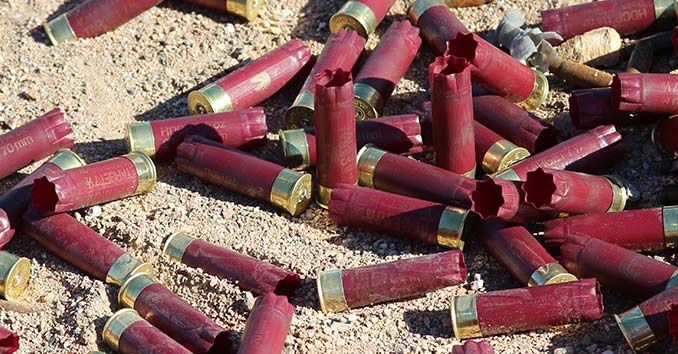
Shotgun Shells

A 12 gauge is great for just about anything you can think of. I own several: one for home defense, one for hunting, and a few for giggles … hehe. Anyway, the 12 gauge is a versatile weapon because they can shoot many different kinds of ammunition from bird and target shot, up to buck and slug. As a bonus, you can literally pick up a used Mossy 500 for about 300 bucks. Not too shabby.

Mossberg 500 or Remington 870–

Both of these are great choices, but I wouldn’t discount a pump or semi-auto 12 gauge from any known manufacturer.

Bonus:

I wanted to include a bonus, simply because of its versatility to shoot more than one type of cartridge, that is semi-popular among revolver enthusiasts. The .357 magnum revolver can shoot both .38 SPC and .357 Magnum. Both cartridges are fairly popular, and many gun owners own some ammo for one of them. They can be used for hunting and defense, but the ammo and guns can be expensive.

S&W 686–

These revolvers come in different sizes and barrel lengths, and one or two of them even come with a 7-round capacity. And hey, the ability to send more rounds downrange is always a good thing, in my opinion. These can be expensive, though, so keep that in mind.

Henry Big Boy–

I’ve got one of these, in brass, and it’s a blast to shoot. It’s a lever action rifle capable of shooting .38 or .357, and can be used for hunting and just about anything else you feel like. The one I’ve got is accurate at 100 yards, though the shiny receiver isn’t likely the best for survival situations where you need to stay hidden. To combat this, they do offer steel ones, as well.

Conclusion:

The best gun is always the one you have. Even if you don’t own a single gun from this list, but you’ve got something, you’re already ahead of those who don’t. Preparing is more than just stockpiling food. You also need to be able to protect it, and have the ability to bring more food home, as well. If you didn’t know where to start, this list of the best survival guns should hopefully help you on your journey to be more prepared.

If you have any dissatisfaction with my content, you can tell me here and I will fix the problem, because I care about every reader and even more so about your opinion!

FEMA Warns! There Are Very Few Areas In The US Safe From a Nuclear Attack (Half of The US Population Would Need to Take Shelter For a Few Days to 2 Weeks, or Risk Radiation Exposure In a 6,000 Warhead Strike.)

First take a look at one of the most shocking videos in the world! This video actually shows us what the secret of the Trump family is related to their expressive health!!! –FULL VIDEO HERE

Here is a 1990 FEMA prediction, the last one FEMA made during the Cold War.

Could parts of the USA survive a nuclear war?

Not just ‘could,’ parts of the country would. Allen E Hall’s answer shows the destructive capability from Russia’s current arsenal.

In 1990, a FEMA analysis of a 6,139 nuclear strike on the United States (about 3 times Russia’s current arsenal) had more than half of the country’s population not only experiencing less than a fatal shockwave, but experiencing low radiation fallout.

I am copying part of my reiteration of the report from here:

Brian Collins’s answer to What would the world be like after a nuclear war?

Here are screenshots from the report. About half the of the US had a medium to very high fallout risk:

So basically, half of the US population would need to take shelter for a few days to 2 weeks, or risk radiation exposure in a 6,000 warhead strike.

In the high fallout areas, where deadly radiation would be hitting people for more than a week, this is what fatality rates would look like:

The Very High Fallout Risk Areas consist of places like New Jersey, Colorado, Massachusetts, New York City, as well as some rural states with silos or downwind from silos like Nebraska, Montana, North Dakota.

In medium risk areas, the estimate looked like this:

Half of the US population is at risk of a blast of 2 pounds per square inch, a potentially fatal shock wave:

Some segment of the US population within the 2 PSI risk area will die. 50% was about 26% of the 1990s US population.

Today, the percentage would maybe be 10% higher, because the US is a bit more urban now than it was in 1990s, however Russia also has 4,000 fewer nukes than the 6,000 warhead estimate. I think blast casualties would be more than 10–15% of the US population, though much lower at night.

In American cities, most of the population is a daytime working population. Most Americans live at least 10 miles from where they work, with almost 10% of the population living more than 35 miles from work:

FEMA went off of 6,139 nuclear strikes in their estimate for the first strike.

After this strike, FEMA estimates the next generation of Americans born in very high radiation areas would look like this:

And in Medium Risk areas:

You can find the original documents here:

Originally FEMA made a collection of maps based on each state. I will try to turn this into a map someday, but for now… Here’s a graphic based on it:

A city like Los Angeles might experience multiple nuclear explosions, as one might hit the a government office, then another might hit the LA Air Force Base. The area around New York would also be hit multiple times: probably one in New York city and then several in New Jersey US military bases.

Most of the country though would not be hit with a saturated attack like that. My home state of Washington would probably be have been hit like this in 1990s:

Here’s what the fallout would look like:

And here’s California:

and here’s the fallout:

So, even if Russia had 6,134 nukes (instead of 1,800), and launched a counter value attack which deliberately targeted civilian areas, some parts of the country would survive.

Divide the number of nuke strikes in Washington and California by 3, and you are basically left with nothing but military bases, dams, and a few chemical plants (some military bases are in the middle of a city) being hit directly. Assuming Russia hit the city centres, the suburbs still survive.

If you have any dissatisfaction with my content, you can tell me here and I will fix the problem, because I care about every reader and even more so about your opinion!

The Golden Hour: What to Do in the First 60 Minutes of SHTF

Many people are convinced that civilization as we know it will collapse or, at best, experience a prolonged interruption. Very few of those people are actually planning for it and even less are preparing for it in advance. For those of us actually preparing we have forums, books, videos, and meetings to help us get ready for SHTF.

A few are even likely hoping for it for various reasons. What if this collapse occurs in a matter of minutes as well it might in various SHTF scenarios; nuclear war, terrorism, EMP, pandemic, conventional war, civil unrest becoming civil war? I am sure you can add a few to this list. Using the Golden Hour concept from trauma medicine I am proposing a few unusual ways of handling the first hour of SHTF.

In this Golden Hour things you do and do not do will have a profound effect on your chances of a decent survival outcome. The Golden Hour is getting a major trauma victim to a trauma center within an hour. Survival rates plummet by minute 61. What will you do in the first 60 minutes of a sudden SHTF? I expect disagreement and hope the comments will give me some good ideas.

SHTF Happens and you are at Home

Reacting rather than data gathering is the key to all of these situations. As humans used to experiencing normal conditions the sudden ending of the normal is a shock and many react to it by standing still and trying to find out what is going on. The lights go out, you check your phone, you look out the window, and you try to find your battery radio and the flashlights. You are in bed and the loud bang shakes the house violently and the power goes out. You use your phone, you turn on the TV, and you go outside to find out what is going on. You might even go through these actions several times!

WaterBob Emergency water storage holds up to 100 gallons

I am not saying these responses are always wrong. Geography etc. has an input into your plan which is a pre-written plan. If you are hundreds of miles from cities then your response might be different especially if you have large volumes of water stored. What I am saying is to get moving early and start using the Water Bob, the clean rain barrels from storage within minutes of any alert that normal no longer might exist. Finding out what has happened is a secondary concern to preparing to survive. Who cares if Russia has attacked the USA or if it was a terrorist bomb? Listen to your gut not to CNN.

Even worse is leaving the home to collect wife (or husband) and kids. During the opening hour, you have to prepare the home for a possible prolonged end of normal life. The wife (or husband) and kids have a plan and they will use it. It might be to hunker down and wait for you knowing it might be a day or two or come home immediately but they know it and you know it. Fight the very human desire to gather the loved ones immediately at the time of crisis unless is your plan and they know it. If you (or they) are at home then the preparing of the home is the best thing you can do for them in the opening hour. You have no idea how long the water or electricity will last.

Obviously, if your children are young you need a plan to collect them but do you need to go immediately? If yes, then go. But the decision is a logical one, not an emotional one. Emotional reactions to sudden shocks often lead to faulty decision-making. It might be best to protect your food and water supplies while the electricity and water remain on before heading out to collect your child from school. An hour or two’s delay in setting out means they get to eat and drink for sure.

If it is a temporary thing you have at worst wasted the water bob and will have to buy a new one (people say you can reuse it but I am not sure water safety is worth the risk). Other things you may consider doing during the first hour is nailing tarps over your raised garden beds and moving supplies into the house or bug out vehicle. What you do not want to be doing is chatting to neighbors or wasting time trying to get information. Something bad seems to have happened so deal with it. How much you know about it is a human desire but preparing is the essential thing in the first hour.

SHTF Happens and you are on the Road

This is the hardest of all situations to experience sudden SHTF yet it is the most common one in society. Motor Vehicle Collisions (they are not ‘accidents’) kill and maim many people each and every day. Plan for this in advance and have a seat belt cutter stored.

However in a sudden SHTF of major local, national, or international scope what is your plan if you are in the vehicle? If the vehicle works get fuel as soon as possible and buy food and water in the first gas station you see using cash but only if it is safe and uncrowded. Then get home or to the preplanned bug out location using the vehicle. Do not delay at all. In a sudden SHTF people literally drive miles in one direction, usually to collect family, and then end up being directed the opposite way by Police. When they finally get home it is burned down or looted. As ever everyone in your family know to stay in place or come home in an SHTF and when to do so. You are not their savior. Your role is to trust them and the written and discussed plan. Get home or to the bug out location and get busy.

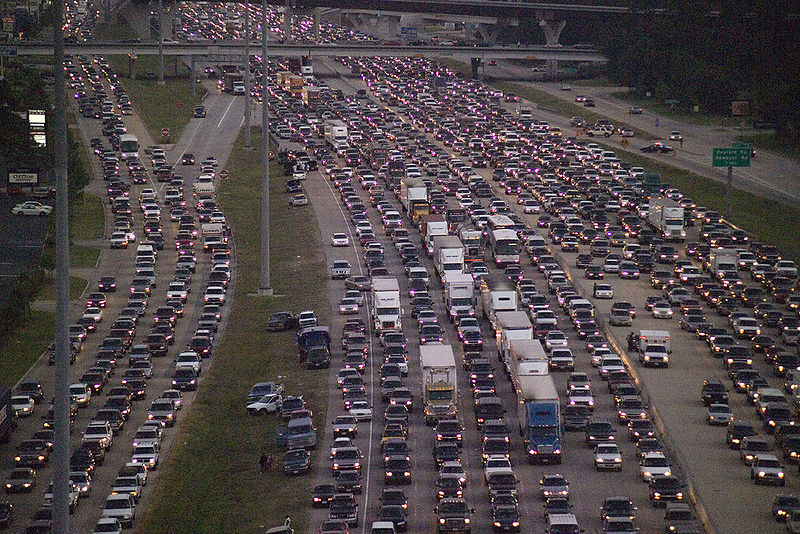
Roads in major cities will quickly become impassable.

Some SHTF scenarios will see the vehicle fail or be blocked in its progress. Abandon the vehicle immediately gathering all useful supplies and get moving away from people and towards home or the bug out location. Drive alternative routes if possible but a vehicle is not going to last long in a major SHTF so try not to be attached to it! Again chatting to people, trying their phones, and wondering what is going on is pointless. It is bad and that is all you need to know. Use the sides of highways to move away from the groups of scared, annoyed, and confused people on the road. No need to walk up the exit ramps as you have the physical ability to use less usual routes. You always have a paper map however basic and a get home bag in the car.

Transit by boat, plane, or train in a sudden SHTF is problematic. In your Golden Hour gather supplies, learn exits, and start thinking how best to get out and home. Water in train, boat, and plane washrooms is not drinkable but empty a recycling bin and fill up those bottles with it. You should have a few water purification tablets on you at all times. Do not bother washing out those bottles. People are not really that infectious (this advice is NOT to be followed in a pandemic) and you can easily get 10 liters or more of okay water stored up in the first few minutes of the SHTF while everyone else is shouting into dead phones. By Day Two you will be very happy you did this in those first few minutes.

As a rule, I never travel by boat other than short ferry rides and I cannot see a good outcome in SHTF on a cruise ship but if you cruise at least carry your own flotation vests and survival kit.

Experiencing a sudden and dreadful SHTF on a plane might be interesting. If it falls out of the sky then all the prepping you have done will hopefully be used by your loved ones. However, diversion and being kept in an airport is more likely in a sudden SHTF. Carry cash in large amounts and try to carry some cash that can be used in the countries you are flying over or near. If the power is on and you can use credit cards to immediately start an alternative route home. In 9-11 people were stuck in Canada for up to four days when they could have got home via train and bus if they had started immediately. A few hours later and there were no seats available! If a small nuclear war is the cause of air travel suspension imagine how long you might be stuck somewhere and how likely is it you will be well treated?

If a SHTF is likely I’d advise you to call sick and stay at home even if you have a cruise booked but SHTF can happen with almost no warning and what you do immediately can make or break your survival chances.

SHTF Happens and you are at Work, School, or the Mall

Ideally using your preplanned route(s) and get home bag you will immediately start home. If the car park is a mess or the car will not work immediately abandon it after getting the supplies. In sudden and serious SHTF roads and car parks likely will be both slower than walking and less safe.

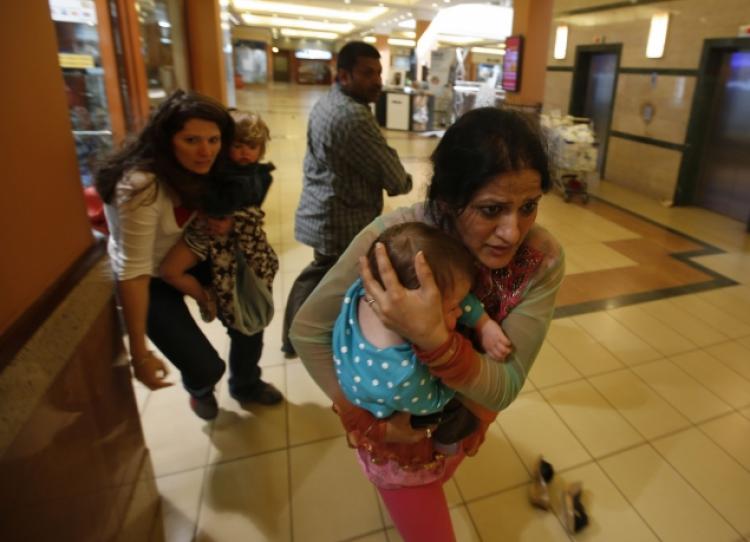
kenya-attack-army

If it is a chemical or nuclear SHTF you might need to shelter in place. Know where the washrooms are especially those deep in the building and infrequently used. If mushroom clouds bloom on the horizon people will mainly rush to their cars and attempt to flee home not that home is a magically safe place. Go to the nearest couple of recycling bins, open them, and carry the trash bags loaded with cans and bottles to the washroom (preferably one on a lower level). Dump them out and start filling them with tap water. Don’t bother cleaning them out. Try to get 50 liters or more. Do this immediately and you can store up 4 weeks’ worth in minutes. Store it in a cubical, lock it, and climb out. At this point try to buy food as you head for the car but do not if it will take time. At the car grab everything useful and back to the washroom. Bunker in and trust your loved ones are similarly safe.

It is unlikely people will use the washrooms in Malls and schools in these scenarios especially those out-of-the-way ones. If they do all your stuff is in a locked cubical. Food and warmth are not the priority in the Golden Hour but water and security are. Consider breaking all the lights in your washroom after securing the water and jamming the door. Consider breaking all the lights in the corridor outside and pulling stuff into it. Initially, people will not take hard routes.

Looting supplies is reasonable once people have gone and Security has left. Before then the chances of getting into trouble make it not worth the risk. Most fast food places have the food (such as it is) in the back. Mall, workplace, and School offices have lockers and many will have something to eat inside if you take your time looking through them. At work know who keeps food at their desks (you do I hope!). Most people will grab their keys and bags and flee towards home leaving behind a lot of food and useful items.

Many people think about using coins to raid vending machines. Maybe this is a good idea but water is from the washroom taps and the recycling bins and lining up slowly buying chocolate bars might make you a target. In a sudden SHTF, it is more than likely you can use your small crowbar from your get home bag to access the vending machines the next day. You are going to be sitting in dark for at least a week but I’d try to do this for four weeks. Then you go home. Radiation will hopefully not kill you in four weeks but likely will the first day.

Many places have drapes and carpets that you can cut up to make sleeping ‘bags’ and this is the sort of re-purposing you need to do in SHTF. Keep active and do whatever you need to do to optimize your survival chances.

A Major Scientific Warning- We Have A Less Than 10 Percent Chance Of Avoiding “An Irreversible Collapse of Our Civilization”

A 1970s publication caused a big stir when it showed that continuing on business-as-usual population and consumption growth trajectories would likely lead to societal collapse within a century. Were the scientists behind it right?

A major scientific warning

If you’re a Population Connection supporter, you’re most likely familiar with The Limits to Growth (LtG), a seminal scientific report published in 1972 by think-tank The Club of Rome. Using computer models developed at the Massachusetts Institute of Technology (MIT), the authors demonstrated the danger of ignoring the finiteness of our planet. They warned,

“If the present growth trends in world population, industrialization, pollution, food production, and resource depletion continue unchanged, the limits to growth on this planet will be reached sometime within the next one hundred years. The most probable result will be a rather sudden and uncontrollable decline in both population and industrial capacity.”

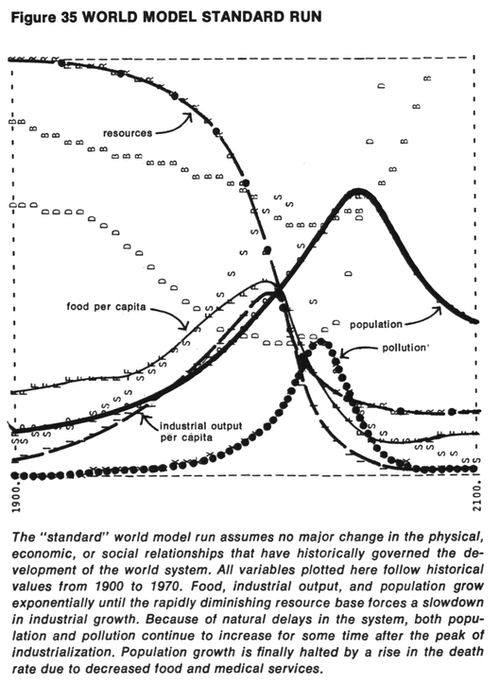
The Limits to Growth standard model, Meadows et al 1972

In the LtG researchers’ “standard” model, which reflects business-as-usual, population, food production, and industrial output (a measure of economic growth) increase exponentially until rapidly diminishing natural resources cause an economic slowdown beginning around 1970. Population and pollution continue to increase for some time after peak industrialization, but decreased food and medical services cause death rates to rise from around 2020 onward, leading to a rapid fall in population beginning around 2030.

According to the LtG standard model, we are now roughly at the beginning of the end. The authors pointed out that given the many uncertainties in their model, it is not possible to accurately predict the date that things start going badly wrong, but that it is highly likely that growth will stop well before the year 2100. Is societal collapse this decade really that likely, and if so, can we still avert it? Let’s take a look at what experts think nowadays.

[As an aside, “collapse” does not necessarily mean human extinction. In his 2005 book, Collapse: How Societies Choose to Fail or Succeed, acclaimed scientist and author Jared Diamond defined it as “a drastic decrease in human population size and/or political/economic/social complexity, over a considerable area, for an extended time.”]

Accuracy of The Limits to Growth models

An independent 2014 analysis of the Limits to Growth models concluded that we had thus far been following the “standard,” business-as-usual scenario very closely, with world population and the global economy continuing to grow at roughly the same rates as in the decades before 1970.

The LtG researchers also ran several more optimistic models — some featured in their 1972 book, and some in later publications. A more recent, independent 2020 analysis of the accuracy of the LtG models found that the two scenarios that represented the closest fit to historical data were one in which natural resources are twice as abundant as in the standard model, and one that assumes rapid technological innovation.

The LtG authors included the doubled resources scenario in case their estimate of the global stock of resources was wrong. The scenario assumes technological discoveries and advances would double the amount of resources that can be extracted and used. In this scenario, collapse occurs, but is caused by pollution (interpreted in the 2020 analysis as including greenhouse gases leading to climate change), rather than resource depletion.

The technological innovation scenario, which also represented a close fit in the 2020 analysis, does avert collapse, but still leads to declines in human welfare because the cost of technology solutions becomes so high that not enough resources are left for food production and health and education services. The author also warned that even if extreme technofixes might prevent collapse, they probably won’t yield the kind of world most people desire:

“Why would we use our innovative powers to invent robot pollinators to replace the bees, if we also have the choice to invent agricultural practices that do not have the side effect of insecticide? Why use drones to plant new trees, when we could also restructure our economy so that existing forests are not cut and burned down?”

In her analysis, she also found that the most optimistic LtG scenario depicting a path to sustainability and stabilization of human welfare at a high level this century was the one that aligned the least closely with empirical data. She concluded that “humanity is on a path to having limits to growth imposed on itself rather than consciously choosing its own.”

In their 1972 book, the LtG authors made it clear that allowing infinite growth to continue would certainly result in a dire outcome. They noted,

“…if we want a stable system, it is not desirable to let even one of the two critical positive feedback loops [population and economic growth] generate uncontrolled growth. Stabilizing population alone is not sufficient to prevent overshoot and collapse; a similar run with constant capital and rising population shows that stabilizing capital alone is also not sufficient.”

Perversely, mainstream economists and governments generally act in opposition to this advice, striving for both continuous economic and population growth.

Is our environment at a breaking point?

Looking at the state of our environment, it’s not hard to imagine that collapse isn’t far off. Despite claims that growth can be decoupled from environmental damage through technological innovation, all our major environmental issues, from biodiversity loss to resource depletion to climate change, are still getting worse instead of better.

Recent scientific reports have warned that humanity has already breached the majority of critical planetary boundaries. In addition, climate data show we may exceed 1.5°C of global warming above pre-industrial levels within the next few years. Nations agreed to limit warming to 1.5°C under the 2015 Paris Agreement because scientists believe that exceeding this threshold could trigger irreversible, catastrophic consequences, such as the melting of the Greenland and Antarctic ice sheets, leading to major sea level rise.

We are increasingly seeing the disastrous impacts of the climate crisis unfolding around the world, from devastating floods in Pakistan, to famine-exacerbating drought in Ethiopia, to record-breaking wildfires in Canada.

While most of the attention is on climate change, all environmental issues have the potential to become disastrous. A 2020 study published in Nature Scientific Reports, for example, argued that we are on course for collapse driven by deforestation. Forests play a vital role in carbon storage, oxygen production, soil and biodiversity conservation, and water cycle regulation — countless lives and livelihoods depend on healthy forests. According to the study’s models, maintaining current rates of population growth and deforestation would mean we have a less than 10 percent chance of avoiding “an irreversible collapse of our civilization” within just a few decades.

Make or break factors

Of course, a deteriorating environment doesn’t necessarily have to lead to collapse. A paper published last year looked at which factors determined whether past societies survived environmental shocks. Looking at examples of historical societies, the authors concluded that whether a society collapses is not just a function of the type and severity of the stressors but also depends on existing cultural, political, and economic structures. In times of crisis these structures can either help build resilience and facilitate positive adaptation, or undermine collective action and lead to unrest, violence, and societal collapse.

In other words, stable societies with high cohesion and cooperation can potentially withstand even dramatic shocks, whereas it doesn’t take much to cause chaos in vulnerable societies. Needless to say, the fact that global inequality and political polarization are on the rise does not bode so well for the resilience of modern societies.

In his book Collapse, Jared Diamond identified two crucial choices that determined whether past societies failed or survived; long-term thinking and reconsidering core values.

Decisionmakers and industry leaders usually pursue what benefits them in the short term, even if it’s bad for society in the long-term. A current example is governments and fossil fuel companies choosing to expand fossil fuel production even though they know this will worsen the climate crisis. This type of short-termism is not compatible with a sustainable future.

Regarding core values, modern capitalist societies have been conditioned to value material wealth above other things, but caring for each other and nature needs to become the new priority if we are to prevent overshoot-driven collapse.

Many people are well aware of the need for systemic change, long-term thinking, and valuing people and the environment over profit, and it is encouraging to see growing movements at the community level. Whether these movements can grow strong enough to pull humanity back from the cliff edge remains to be seen. But what’s clear is that we’re rapidly running out of time to prevent things from getting very bad.

First 13 Places to Avoid Going When SHTF (In A Post SHTF World Where There’s Zero Power, Supply Trucks That Provide Essential Resources Will Stop Operations.)

When it comes to being prepared for a SHTF event, preppers are focused on threats from natural disasters to nuclear wars, EMPs, and devastating cosmic events.  The situations that people can focus on and become obsessed with preparing for and unpredictable and vary widely. There’s no way that one person or family could be completely prepared for every single type of event. So, most people choose one or several related events they believe are imminent and prepare as best they can for those.

But the less talked about threat that will be overwhelming no matter what the situation is that arises, is population density. For example, according to this map of population density by county shows that roughly two-thirds of the U.S population is located in the Eastern half of the United States. In fact, according to recent reports by the U.S. Census Bureau (2010 data), approximately half the population resided in just 146 counties out of 3000 counties in the United States.

That’s right. The biggest threat to your safety and the safety of your family is in fact, other people. They aren’t “bad” people out to get you. Some of them would likely give the shirt off the back to help others in normal circumstances. But in a SHTF situation, people just like you who are doing what they need to do to provide for their families can be a threat. Scared, and willing to do anything to get away from immediate danger, large numbers of these people can be the difference between life and death for your family.

So, when SHTF, how do you mitigate population density to increase your ability to keep yourself and your family safe? The easiest way is to plan to avoid other people as much as possible. The problem that most people run into during an emergency or SHTF situation is they are unprepared, and they panic. When you sense danger, the first instinct for most people is to flee. Sure, some people will naturally react with fight instead of flight, but the majority of people will flee first and fight only when cornered.

The best way to be prepared to avoid the crowds of desperate people is to know which places to avoid going when SHTF. We’ve listed some examples below:

1. Downtown

It goes without saying that downtown areas of any city should be avoided. This is especially true in mid to large cities where lack of regular sanitation services will create ideal conditions for diseases. The risk of rioting, looting, and violent attacks is also greater in downtown areas. City dwellers are statistically less prepared for a SHTF event as many families live paycheck to paycheck with very little stockpiled supplies.

In addition, because population density is highest in these areas, stores and other sources for supplies will be quickly cleaned out. Many city residents depend on public transportation on a daily basis and are less likely to have access to a vehicle to flee the city. Mass numbers of people in these areas will be desperately seeking food, water, and medical supplies, as well as transportation out of the city.

2. Main Roads, Intersections, and Freeways

If you are planning to bug out to an area outside of the city, or if you are caught away from home, it may seem like the shortest route is the best course of action. But, keep in mind that main roads and busy intersections will quickly become overwhelmed with people trying to flee just like you are.

Most people only know one or two ways to get out of the city and these are usually main roads. Those who are looking to steal supplies will see main roads and intersections as prime locations to ambush unwary travelers. Get a map of your area now and plan several routes out of the city and from work to home that use side roads rather than highways and state routes.

3. Bottleneck Points

A bottleneck can be any area that a majority of people must travel in order to get out of a cul de sac, neighborhood, city, county, or state. In most cases, this will be things such as bridges, overpasses, underpasses, freeway ramps, etc. If several hundred or thousands of people are fleeing the same area, and everyone must cross the same bridge to get out of town, that will quickly become a bottleneck point.

The same is true for any areas where there is only one road going in or out. Avoid these areas at all costs and look for alternative ways to get through or cross, even if it means taking a longer way around or traveling in a nontraditional way (motorcycle, private plane, bicycle, on foot, etc.).

4. Hospitals

It may seem weird to see hospitals on a list of places to avoid following a SHTF event because one would think this would be a place to find help. The reason to avoid hospitals if at all possible is because most people, especially those that are injured, will flock to them. Even people who aren’t injured may head for the hospitals to get help for family members who have been injured.

Emotions in this area will be high and the risk of violence is greater as people lose control. In addition, patients who are ill and/or patients dying from lack of resources will increase the risk of rampant infection and disease. The hospital and surrounding areas will be a petri dish environment for viruses and bacteria. With medical resources limited, you’ll want to avoid getting sick to increase your odds of long-term survival.

5. Prisons and Surrounding Areas

This one should be a no brainer. If there is a prison in your area or along the route to your bug out location (BOL), you’ll want to avoid the area as much as possible.

During a SHTF event, it’s likely that guards and staff may abandon their posts to care for their families which increases the likelihood that violent prisoners can escape and be on the roads. These prisoners will come out into the chaos without any supplies, they will be desperate to survive and could be more willing to use violence to commandeer your supplies or vehicle.

6. Police Stations and Military Bases

Like with hospitals, it may seem counterintuitive to avoid police stations and military bases following a SHTF event. Police and military are supposed to serve and protect citizens, right? But although it may seem like going to these locations would be a safer alternative, in most cases it will be a waste of precious time and may in fact get you killed or locked up instead.

Police stations and military bases will be among the most secure buildings. They will be heavily guarded, and they will not be opening their doors to the mass numbers of people who show up. Crowds outside these areas will be frustrated and angry at not being granted protection. The last thing you want is to step into the middle of that crowd with your BOB of supplies, food, and water.

7. Shelters or FEMA Camps

Although shelters are designed to help those people who find themselves without a place to sleep or food to eat, most shelters are understaffed and operating at or above capacity even in normal times. Homeless shelters and food banks will be quickly overrun by mass numbers of people. Some may be forced to close the doors to newcomers within days of a SHTF event.

These shelters and any publicized FEMA camps that spring up will have very poor conditions. Supplies will be rationed, tempers will be high, and violence will be rampant. As more people arrive, and conditions worsen, the buildings and surrounding areas will quickly become breeding grounds for infection and disease.

8. Grocery Stores and Shopping Plazas

For people who are not prepared, their first instinct will be to find food, water, and supplies. Humans are creatures of habit and thus many will flock to local grocery stores and shopping plazas and begin looting for needed supplies.

These areas will be picked clean within less than 24 hours of a SHTF event. Those that are left there will be the most desperate and scared for their lives. These crowds are unpredictable and often violent.

9. Gas Stations, Auto Parts, and Convenience Stores

The reason to avoid gas stations, auto parts, and convenience stores is similar to that of other stores and shopping areas. Desperate people are going to flock to the first places they think of to find supplies to get out of the area. Those trying to get of the city will want to try to gas up and/or get.

For all but those people who were quick to get on the road, getting gas will be nearly impossible. Lines at these places will be long, tempers will be high, and violence will be much more likely, especially when pumps run dry and shelves are bare.

10. Hardware and Sporting Goods Stores

One thing that people will be searching for when SHTF is guns, ammo, and other items to use for protection. Since sporting goods and hardware stores carry a lot of these items, these stores will be hot spots for looting. If you don’t already have your weapons ready when SHTF, you’re better off to look around your home for items you can use, rather than try for a quick trip to a hardware or sporting goods store.

11. Banks, Check-Cashing, & Pawn Shops

One thing just about everyone who isn’t prepared in advance will be looking to get first is accessing to cash. For this reason, banks, check cashing or loan offices, and pawn shops should be avoided following a SHTF event. This is where large numbers of people will flock toward first.

Many people in these areas will become trapped, unable to access their money, either because computers are down or because cash reserves were already depleted. When desperate people can’t get access to cash that they believe will help them get needed supplies, things will get ugly.

12. Large Shopping Malls and Public Squares

When things get chaotic just before a SHTF event, the last place you will want to be is in a public square or large shopping mall. These places can quickly become a gathering place for desperate, angry people. Rioting, looting, and violence will be high in these areas so it’s best to avoid them if possible.

13. Large Social Gatherings and Public Events

If you even suspect that things around you are getting chaotic. If you sense civil or economic unrest or have recognized other precursors to a SHTF event, you will want to avoid large social gatherings and public events. These events draw large crowds of people on the same date and time. Events or gathering that are tradition or annual events that can be predicted or are widely publicized are more dangerous. These are prime target events for terrorists.

What to do Instead:

Now that you know what places to avoid going when SHTF, here are some things you can do to make sure you can avoid these places and still have a good chance of surviving:

Starting today, make it a habit to keep your gas tank at least 3/4 full at all times. Take steps to properly store additional gasoline in approved containers so that you can fuel up at home and skip the last-minute trip to the gas station on your way out of town.

Follow a regular maintenance schedule for your vehicle to keep it in top running condition at all times. Proactively make vehicle repairs so that your risk of a breakdown is less when SHTF. Stockpile spare parts such as belts, spark plugs, wiper blades, washer fluid, transmission fluid, antifreeze, brake fluid, and engine oil so you can replenish as needed without that trip to the auto parts store.

Create safe storage places where you can begin to stockpile emergency cash so that you have it on hand when SHTF and do not need to make any last-minute runs to a bank, ATM, or pawnshop for cash.

Conduct a weapons inventory of any guns, ammo, knives, and personal self-defense weapons (mace, stun gun, etc.). Be sure to consider any other potential items (ball bats, shovels, chains, etc.) that could be used for weapons and protection during a SHTF event. Know what you have on hand and train yourself and family in how to use it if needed for protection.

Clearly mark danger zones in advance on a map or maps of your local area and surrounding areas. Plan several different escape routes so that you can quickly change course if needed due to unexpected danger or obstacles. Identify and plan to use alternative routes out of town including logging roads, railroad tracks, and power line easements if needed to avoid danger zones.

Locate and clearly map out any sources of fresh water that won’t be the first thought for others such as small lakes, ponds, private or public swimming pools, creeks, and rivers. Include a hand water pump and collapsible water jug in your BOB as well as a way to filter and boil water from these sources.

Stockpile lightweight food, ways to filter water, and medical suppliesso that you won’t be tempted to make a last run to grocery or other shopping areas. Create a system of hidden supply caches along your routes to your BOL so you can replenish supplies that are used, stolen, or confiscated along the way.

Planning a bug out can seem overwhelming. But the more you plan and prepare in advance, the more likely you will remember which places to avoid going when SHTF.

5 Signs Martial Law Is Coming (Civil Unrest, Food Shortages, Gas Rationing, And Eventually Martial Law Is Enacted When A Nation Falls)

When a state of National Emergency was declared on February 15, 2019, not many realized that we were closer to martial law than we had been in recent years.  The declaration of a National Emergency gives the office of the president additional power to institute Martial Law should he or she sees fit to do so.  Numerous other countries around the world have already experienced martial law and have seen first hand the harmful effects that follow.

In this article, we’ll discuss 5 signs that should be a warning that martial law may be coming and we’ll discuss how you can prepare.

What is Martial Law

Before we begin discussing the signs that lead to Martial Law, let’s first discuss what it is and how is it different from a National Emergency or the State of Emergency.

Martial Law at its most basic level is defined as a law that allows the military to take control of civilian functions in a state or country.  When implemented, the military becomes the state or the country’s governing body, resulting in civil laws, rights, and the habeas corpus being suspended.

It’s important to note that during a National Emergency your constitutional freedoms are suspended.  However, the main difference between a state of National Emergency and Martial Law is that during a National Emergency, the military doesn’t need to take control of civilian functions.  But you should keep in mind that Martial Law could quickly follow a declaration of National Emergency. During both of these scenarios, your civilian rights can be suspended allowing the government to impose its will, rules, and regulations on citizens.

When Has Martial Law been Implemented in the U.S.?

The U.S. President and the Congress can declare Martial Law on a federal level, while the Governors in each state can declare Martial Law within the borders of their respective states.  In 2006, H.R. 5122 or the John Warner National Defense Authorization Act was signed into law and it gave the president the power to declare martial law and take control of each state’s National Guard without consent from state governors.

The United States of America has also seen its fair share of martial law as a result of:

  • Foreign attacks
  • Civil violence and protests
  • And after major disasters

Has martial law been declared on a national level?  Yes, it was declared once during the Civil War when President Abraham Lincoln declared that the country was under military rule. 

On a regional level, Martial Law has been declared on several occasions.  Here are a few examples:

  • On December 7, 1941, the Hawaii Governor declared martial law on the Territory of Hawaii following the attacks of the Japanese on Pearl Harbor.
    • Subsequently, the Department of War expanded the martial declaration to Washington, Oregon, and California in February 1942.
      • In March 1942, the entire U.S. Pacific Coast was put under military rule.
  • On May 21, 1961, the Alabama State Governor declared martial law to prevent civil rights activists from demonstrating in the state.

There are many more cases where Martial Law was declared within different states resulting in some instances of reports of abuse of power and leaders not wanting to relinquish that power. 

Signs That Martial Law is Coming

As pointed out, Martial Law is usually declared following a crisis or emergency that is plaguing the country or state.  Usually, this is in the form of war, natural disaster, or civil unrest. But in this modern era in which we now live, there are other more looming threats, some that have only recently developed due largely to technical innovation, that could trigger Martial Law.  And unfortunately, some of these threats could be catastrophic, which shows that Martial Law would indeed be implemented if any one of these were to come to pass.

  1. Economic Crisis – Probably the most dangerous emergency that could cause a declaration of Martial Law is a severe economic crisis.  This is a major concern since so many of the world’s economies, including the U.S., are increasingly in a delicate balance of interconnectivity.  One major financial incident could potentially trigger an economic collapse in another country much like dominos. And with industrialized nations being more interconnected today than ever before, the incident doesn’t have to happen on U.S. soil for the country to feel the negative impact of that financial incident.  Like in 2007, when the U.S. experienced the subprime mortgage market crisis which developed into a full-blown international banking crisis affecting many countries around the world. A repeat of this incident in 2019 could be even more catastrophic and far-reaching as the impact would reverberate around the world. If the even spun out of control resulting in a collapse of the financial sector, Martial Law could be implemented to try and restore order to avoid panic and an all-out collapse.
    1. Fears that the U.S. economy could contract has intensified after several media outlets put forth damning reports just last week.  On August 14, 2019, a reliable indicator showing the possibility of a recession has appeared. That indicator is called inverted yield curve, which shows that the interest rates of short-term bonds, which are bonds that have a maturity of less than 5-years, are higher than the interest rates of long-term bonds, those with a maturity of 5-years and above.  An economy that is healthy would usually have high-interest rates for long-term bonds compared to short-term ones. This doesn’t bode well for the U.S. economy. CBN News reports that history has shown that recession follows within several months to two years after an inverted yield curve is spotted. This could lead the Federal Reserve to cut short-term interest rates to try and prevent the economy from plunging into a recession.
    2. The Washington Post also mentioned that the inverted yield curve is suggesting investors are losing faith in the economy in the short-term.  High-interest rates are normally given to long-term bonds so the government can attract more investors to them. But since the interest rates of short-term bonds are higher, this means that more people are investing in the bond market for the long-term, as they’re losing confidence in the economy’s short-term prospects.  The report also mentioned that a contraction of two large economies, the United Kingdom and Germany, and a slowdown of China’s growth is not making things any better for the U.S. It is also worth mentioning that global leaders are currently not collaborating to try and do something about the economic slowdown and contraction that are impacting numerous countries at the moment.
  2. Cyber Threat – The second dangerous emergency that could cause martial law is a cyberattack. Governments and corporations have obviously taken advantage of the advancement in technology and the rise of the internet.  The downside is that this makes them dependent on cyberspace and the internet leaving them vulnerable to a cyberattack. Forbes reported that last August 16, the State of Texas experienced a cyberattack that caused 23 government agencies to go offline.  The attack was identified as ransomware and it came from a single threat actor. This is the reality that a lot of agencies and companies face on a daily basis, especially if they’re dependent on the internet. If a coordinated attack coming from a single threat actor can take out 23 government agencies of a state, imagine what several threats can do to a country and how it can paralyze agencies and industries.  A large scale cyber threat resulting in a shutdown of the nation’s infrastructure and banking system (just to name a few) could be used as an emergency to declare martial law on a national level.
    1. The threat of a cyberattack is very real and it can happen anytime and sometimes without warning.  Working in the IT sector, in my opinion, this is one of the greatest threats our country currently faces but so few people are aware of.  This is why the director of Defense Intelligence Agency, Lt. Gen. Robert Ashley said in a cyber conference in Aspen last July that the immediate danger of a cyberattack is what keeps him awake at night.  The U.S. is already involved in cyber warfare with the Middle East, in particular, Iran. Then there’s also Russia and China, who are both large threats in cyberspace. The two countries are considered as the world’s leader in cyber warfare and we got a taste of them meddling in our last presidential election.  Though the U.S. military and government are well protected, the private sector doesn’t have this level of protection. They are vulnerable to these cyber threats and an attack on a major company will likely have a devastating effect on the country.
    2. If a cyber threat were to happen in the U.S., expect the government to do everything in its power to ensure that order will be maintained.  So much of our nation’s infrastructure depends on a delicate balance of everything working smoothly. A great example is the grocery store’s just-in-time delivery system.  If the systems that ensure our food inventories are shipped just-in-time is compromised, expect food shortages at your local grocery stores. As the saying goes, we’re just 3 meals away from anarchy.  Again, this is just one small example that could be the tipping point forcing Martial Law on the nation.
  3. EMP Attack – An EMP is another form of attack that could trigger the declaration of Martial Law. An EMP, or Electromagnetic Pulse, can decimate electrical devices within the vicinity of its burst, making it extremely dangerous given how dependent we are on our electrical devices as pointed out in the previous point.  Terror groups or any other hostile groups could use an EMP attack to return a city or region back to the dark ages, which is likely to cause panic, chaos, and riots as people would scramble for whatever supplies they can get their hands on. A declaration of martial law would surely follow if ever this kind of attack happens in the country.
    1. Though an EMP attack is possible, the probability of it happening is low. There are a lot of factors that terrorists or rogue nations need to accomplish to successfully launch an EMP attack on the U.S.  Many experts believe that the threat of an EMP attack is low on the list of credible threats. Possible, but not necessarily probable. Nevertheless, President Trump signed an Executive Order on March 23, 2019, with the intent to protect the country from an EMP attack.  The order established a policy with a stated goal of increasing the country’s resistance to such an attack in the event it should occur.
    2. Should a large enough EMP attack impact the entire country, the nation would effectively be returned to the stone age.  The outlook for survival for the general population would be low. The federal government would have no choice but to enact martial law to ensure the survival of its citizens.
  4. Civil Unrest – This is another emergency that could force the U.S. government to declare Martial Law.  Looking at the country’s history, you can see a lot of the reasons state governors have declared Martial Law in their respective states due primarily to riots and strikes, with some becoming violent.  Strikes are still prevalent in the U.S. even now and a large-scale strike or demonstration could still give the federal government reason to declare Martial Law in the country. Last August 17, 2019, Portland, Oregon almost became a battleground for civil unrest when the far-right white supremacist Proud Boys demonstrated on the city and they were met with a counter-demonstration from the anti-fascist group Rose City Antifa.  If it weren’t for the city’s police force keeping things under control, the demonstration could have become more violent.
    1. This demonstration in Portland, Oregon is just one of the many examples that show how divided the U.S. is right now.  Inflammatory rhetoric coming from both sides is dividing people even more based on party, mindset, and race.
    2. The media is not helping with this issue either.  Many of the news sites and outlets are shown to cater more or be biased towards certain ideas and groups, something that has been happening for years, but escalating more in the last several years.  News outlets on both ends of the spectrum are increasingly spinning their stories toward a specific political view that is more of a biased narrative than sticking to the facts. This is only deepening people’s biases and beliefs even more, forcing them to see the “other side” as their enemy.  This has resulted in keeping people divided, paving the way for more possible clashes similar to what transpired in Portland, Oregon last August 17. 
  5. Natural Disasters – The last emergency that could cause a martial law declaration are natural disasters. The U.S. has experienced a lot of natural disasters throughout its history.  In the last 3 years alone, the country experienced 9 natural disasters that claimed thousands of lives and trillions of dollars in damages.  History has also shown that the government is more than willing to declare Martial Law to ensure the safety and orderliness of the country, state, or city, in the aftermath of a disaster.  This is probably one of the emergencies that cannot really be prevented, but only be prepared for it. For example, here in Southern California, we’re constantly being warned about the “big one” and how we’re overdue for a large earthquake that normally happens every 150 years along the San Andreas fault.  While no one knows when it will exactly happen, experts warn that it will result in a large death toll.
    1. The fear of the Big One happening has been amplified lately, especially after the Earthquake Track recorded more than 3,000 small earthquakes happening in California just in the past 30 days.  The frequency of these small quakes has some asking if this is a sign the Big One is about to come.  Unfortunately, no one really knows when it is likely to occur other than it is far overdue. 
    2. While there are many other natural disasters our nation faces, such as hurricanes on a seasonal basis, it is not an unlikely scenario for the government to declare Martial Law in the aftermath of a devastating natural disaster.

How To Prepare for Martial Law

After seeing the signs that could end in Martial Law being declared in the U.S., it’s important to know how you can prepare yourself and your family to ensure that you are well-equipped in case it is declared.

  1. Monitor the news and keep up-to-date on what’s happening in your area.  This can be challenging prior to Martial Law being declared, especially if the flow of information is cut off or an emergency damages the communications infrastructure in your area.  With the recent events unfolding in Hong Kong, information to the citizens is getting throttled by the government. Being able to communicate outside of your area or region using conventional methods like the internet could be challenging, but even having a decent HAM radio would give you the ability to stretch far beyond your local area to get news from the outside.
  2. Next, be sure to keep supplies handy.  Food, water, and medical supplies are critical to have stored in advance.  In addition, be ready to be mobile if events beyond your control force you out of your home.  Depending on the severity of the event and your level of comfort with the military controlling your area, you should have options in the event staying in place is no longer an option.  Also, keep cash on hand since credit cards or atm machines might not work during this period. Be sure the cash that you have is not in large denominations so you can always give an exact amount of money when you purchase something.  When there’s an emergency and the power may be down, this is probably not the best time to ask someone if they can break a $100 dollar bill.
  3. In addition, be sure to have an evacuation plan ready on a physical map in case you need to move out of your house quickly.  This means that you already planned whatever route you’ll need to take and have alternatives in case the main roads are compromised.  Make sure your mode of transportation (whether it be a bike, car, motorcycle, or whatever) is available and ready anytime you need to leave.  In the event that everyone is not at home when a catastrophe happens, be sure to have a plan already defined with your family as to where you’ll meet and how you’ll communicate with each other.
  4. And last but not least, observe the Gray Man principle.  It is also important that you try not to stand out during these times to avoid becoming a target for the military or other groups who are trying to take control.  Keep your head down and blend in with the crowds as much as you can. And just as important, observe OPSEC. The less people know about your supplies and the fact that you are prepared, the less likely your home will be raided for supplies.  Loose lips sink ships.  

Should You Be Concerned?

While on the surface Martial law can be used for good to bring back order following an emergency, there is a strong potential for abuse of powers as a result of leaders not wanting to relinquish their newly expanded power, even after the crisis has abated.  As such, it’s important that you are aware of the signs and the events that could trigger them.

So should you be concerned?  I suppose I wouldn’t use the word concern as much as I’d recommend you stay informed, educated, and alert.  Most people go through life oblivious of their surroundings and by the time they decide to act, it’s too late.  As a prepper, well, we stay prepared. I choose not to be scared, but to be informed and ready at a moment’s notice to act in the best interest of myself, my family, and my community.

I’d love to get your thoughts and feedback in the comment section below.  Are you concerned about martial law? Do you think there’s a possibility in the near future for events to unfold allowing the government to overreach and take rights away from the citizens?

If you enjoyed this article, please share it on social media, and as always, be safe out there.

Debunking Conspiracy Theories Around Trump’s Assassination Attempt (Was Trump assassination attempt staged?)

I am the master of conspiracy theories at this point. I’ve studied and debunked flat earth, H denial, and 9/11 conspiracies.

Anyway, I want to be clear- no no no the assassination attempt was not staged.


Here is what we know. The shooter was a young man named Matthew Crooks. He was a registered Republican but also donated to left-wing campaigns. He took a rifle from his father, set up on the roof of a nearby building, and opened fire.

As he was setting up on the roof multiple witnesses saw him and pointed him out to nearby police and Secret Service members. It seems like they were sort of curious but failed to take these reports seriously. This was a security lapse and a rather poor performance by the secret security.

When the shooter opened fire the Secret Service returned fire right away given they already knew he was there and had just failed to to act.

Was this staged? No

  1. Trump was shot in the ear- mere centimeters away from his head. Anyone who thinks this was staged needs to realize that life is not a f%cking video game. Do you know how hard it is to shoot someone in the head from far away? Do you think Trump would pay a guy to shoot him in the ear and trust that this guy was going to hit his ear and not anything else?
  2. The shooter was SEEN by HUNDREDS of witnesses. They saw him set up, crawl across the roof, and begin to open fire. All of the accounts align, there is no indication of falsehood or manipulation.
  3. Yes, Trump did tell his Secret Service to wait so he could hold up his fist. However, the shooter was down and this was reported to Trump already. He knew the threat had likely ceased and chose to show strength.
  4. A bystander was also killed in the shooting. The shooter fired 5 times, hitting Trump and one other person in the crowd who died. Hard to stage a shooting with bullet wounds and a dead victim.

Put simply there is no evidence whatsoever that this was staged. It’s frankly one of the dumbest things I’ve heard in a while and that says something. People are just claiming this as a knee-jerk reaction. Just anger and nonsense.

No conspiracy is needed to explain this. Every media outlet, pundit, and politician has been repeating that Trump is the ultimate enemy of Democracy. He’s been compared to Hitler, he’s been called a tyrant, and he’s been framed as an enemy of the American people. People have been publically calling for his assassination for YEARS. Frankly, I am shocked it took this long to happen.

When Articles like this are posted, it is going to spur somebody to commit an act of political violence. I mean wouldn’t you shoot Hitler in 1939 if you had the chance? Or Stalin in 1922? When Trump is literally Hitler and he is going to destroy our democracy and our nation then there is no action you can take that is beyond justification.

Tulsi Gabbard perfectly expressed this in a recent tweet.

Indeed after the shooting numerous outlets reported that the most concerning thing was the “rhetoric on the right” and the concerns of a backlash. Well so far, no backlash has come. There is anger and there are calls for an investigation but nothing beyond that.

What concerns me is the response of the left. Now most politicians and major figures of course are sending their thoughts and prayers to the victims and so on. But most of the people are only mad at the shooter’s aim. A US President was shot and another innocent bystander was killed and people are CELEBRATING it. They are celebrating an assassination attempt and the death of an innocent bystander- CELEBRATING a shooting. Can you imagine celebrating the death of JFK? I know Trump is not JFK but he was the President and is the voice for millions of Americans. That is how far we have fallen.

Or here on Quora.

I will say this. I’d rather be called a MAGA Trump supporter than group in with any of these nutbags. I’d almost vote Trump just to ruin their day. I won’t actually vote Trump but regardless what sickens me more than anything is the disgusting response by many on the left.

To summarize my point a bit better- I think this violence is the result of rhetoric. The rhetoric from the left has been overtly toxic and damaging- as it has been from the right. In general, the violent rhetoric presented by both sides has led us to a world where political violence is accepted.