Worst 5 States for Preppers to Retire- If the grid went down nationwide and society as we know it collapsed, would be people be escaping from your state, or escaping to your state?

We don’t all get to choose where we live; at least, not the state we live in. For most of us, that’s determined by our work; we live where our jobs are. But what about when our jobs no longer determine where we live? Can that happen? It usually does when we reach retirement.

Granted, most people don’t move once they retire, but you’d be surprised how many people actually do. The area where I live has tens of thousands of retired winter residents who come down here to escape the cold weather “up north.” Some of those people come for the winter and just end up staying on, becoming permanent residents in the area. So if they can, you and I can too.

That raises the question of where we would go to retire, if we could go anywhere we want. As preppers, there’s more to that question for us, than there is for our friends and neighbors (unless they are preppers too). We obviously would want to go somewhere where we can live comfortably, even should a TEOTWAWKI scale disaster strike.

My Criteria

This is actually a fairly complex question, with a lot of factors involved. So let me see if I can thin it out a bit for you. I’m not going to tell you where you should go; but let me offer you a glimpse of states that you should avoid going to. I’m basing my decisions on the following criteria:

  • Population Density – The higher the population density of an area, the more of a fight for resources. This fight will probably hurt the poor, the aging and single mothers more than anyone, as they will not have the ability to fight. Survival of the fittest will take over, as people literally fight for the available resources. That’s enough to make many areas unattractive.
  • Average Annual Rainfall – We all know that water is going to be a problem in a post-disaster world. Areas with little rainfall and few rivers will be hard to live in. For most of us, the best way of harvesting water is probably going to be rainfall capture, so we’re going to need a lot of rainfall.
  • Political Leaning – While we all assume that government services and interference in our lives is going to be severely curtailed during a post-disaster situation, we have to think about the here and now as well. Many of the bluest states in the country are also the ones which are working the hardest to take away our Second Amendment rights. That alone is enough to say that those states aren’t a good place to move to.
  • Federally Owned Land – A lot of people talk about bugging out to the wild. That’s great; I have my own plans for that as well. But in most cases, the only practical place to bug out into the wild is federally owned land; national parks, national forests and other land under the control of the federal government. So states with little federal land ownership aren’t all that attractive for preppers to retire to.
  • Forestation – The most practical means of heating a home in a post-disaster world, especially one in which there is no electricity, is with wood. That means having a lot of forests available, where you can cut that wood. This leaves out huge swaths of the nation, such as the entire breadbasket, which is farmland, nor forests.

There may be other criteria which are important to consider; but I limited myself to those five. To me, those seem like the major ones which will affect a prepper’s ability to survive, both in a pre-disaster and a post-disaster world.

The Worst States

Based on that, here are my picks for the worst states to retire in, if you’re a prepper:

  • New York – I lived in upstate New York for a number of years and it is absolutely beautiful. There are miles and miles of hardwood forests, lakes and rivers. But even so, the state is one of the most heavily populated in the country. It is also one of the most left-leaning states, politically speaking, with some of the harshest anti-gun laws around. It would be a very difficult state to survive in.
  • California – In many ways, California and New York are copies of each other. Both have a high population and both are strongly blue. While California has a lot going for it, in the area of natural resources, it has the highest population of any state in the Union. We can expect many people to expand outwards from the major population centers, gobbling up everything in their path. I sure wouldn’t want to be in their path.
  • Florida – At first glance, Florida looks like a great place to go and a lot of people retire there. But much of the state is covered up by the Everglades. Unless you are going to learn how to survive in that harsh environment, it might not be a great place to be. The lack of forestation really isn’t much of an issue, as you aren’t really going to have to heat your home. But you are going to have to worry about hurricanes, which seem to have an affinity for the state.
  • Arizona – Another popular retirement state that’s going to be a mess in a post-disaster world. Arizona is extremely hot, even hotter than South Texas and the Florida peninsula. But there is very little water to be found. That alone is enough to put this state on our worst list. I seriously doubt there will be many people surviving in the heat of Arizona, without access to water.
  • Minnesota – Minnesota is known as “the land of 1,000 lakes” so there’s no shortage of water there. They’re pretty good in the forestation department too. So there’s actually a lot going for this state. But it and its neighbor Wisconsin have very high populations. Unless you could get way out in the boonies, it might be hard to avoid the crowds. Of course, way out in the boonies means the coldest parts of the state, so you have the problem of cold to contend with. That not only affects how much wood you need for your fire, but the very short growing season will make it hard to grow enough food to eat.

Granted, there are a lot of other states which we can rule out, based upon the same criteria. Pretty much all of both the eastern and western seaboards would be bad places to go, for the same reasons I’ve already mentioned. The trick is finding someplace that is good to move to.

My Picks for Best States

Everyone has their own opinion, but here are my top picks for the best states or regions for retiring in as a prepper. These choices were made based on the same criteria that I used for picking the worst states.

  • Eastern Texas – While Texas isn’t a perfect survival location, there are a lot of good areas in the Hill Country and eastern Texas where there is good forestation and water.
  • Idaho, Western Montana and Western Wyoming – This whole area is excellent; providing a lot of forestation, water, federally owned land, rainfall and good hunting. Although far enough north that cold would be a bit of a problem, I would call this the best area of the country to have a retirement home and/or survival retreat.
  • The Appalachian Mountains – This mountain range, passing through several states and changing names a number of times, is a great place to live. While there are some high population areas to avoid, there’s still a lot of back country, which would be ideal for our purposes. I’d avoid the Virginias though, for their political leaning.
  • The Gulf Coast – There’s a lot of good land in the gulf states, along with people who like to hunt and fish. While there really isn’t much government land to bug out to, there are lots of forests, lots of water and lots of game to hunt.

Are You Prepared For 19th Century Living? (90% of the population could die within 2 years due to the sudden lack of modern technology)

Those that are aware of the EMP commissions report have probably also heard the statement that this type of event would suddenly transport everyone involved back to the 1800’s almost instantly. It is also possible that up to 90% of the population could die within 2 years due to the sudden lack of modern technology. It does not matter if it is an EMP, CME, cyber attack or terrorist attack on the grid, the results will be largely the same.

This is a sobering notion that you can either believe or disbelieve. If you think it is all hype you need only to go back to your daily activities and hope it never happens and leave your survival to someone who will do something if it ever happens. For those hardy souls that take responsibility for their own fate and that of their family, it falls to you to determine what this type of event will mean for you. An event of this magnitude will affect different people in different locations in different ways.

It is important to first realize what changes you will likely see following this event. To understand this you must look at what a 19th century lifestyle would look like to you. Understanding these differences will help you to determine what plans you need to make ahead of time to adjust to these changes in a way that will allow you to survive. Here are some of the things you will face with a collapse in modern technology and this does not even take into account problems you will face from the ill prepared.

19th Century support systems included the following

Sailing ships for cargo and human transport
Steamships for cargo and human transport
Steam locomotives for cargo and human transport
Horses and wagons for cargo and human transport

Horses, mules and oxen for cultivation and harvesting
Root cellars for common storage
Ice houses to store ice cut in winter
Open pollinated seeds for planting
Livestock manure for fertilizer
Local mills for processing grains
Shallow dug water wells for fresh water
Manual tools for building and repairs

Developed systems for kerosene, whale oil and candle making for lighting
Mechanical power systems for factories and machinery
Telegraph lines for communication
Local craftsmen to build and repair items
Human and animal means to produce coal

Wood stoves for cooking and heating
Outhouses for sanitation needs
Buildings designed for natural ventilation

Limited clean water systems
Limited hospitals and doctors
Limited drugs, medications and medical equipment
Limited firefighting capabilities
Limited law enforcement capabilities

Physical currency of silver and gold
Banks utilizing paper records

Many of these systems exist today only in museums or historical sites and in insufficient quantities to support the population we now have. So simply going back to 19th century living standards would be impossible for the vast majority of people even under the best of circumstances. This brings to light the conclusion that 90% of the population would not survive long term under these conditions.

Assuming this type of event did occur, what would you need in advance to insure your survival? That is a question many people need to ask but most will not simply because their belief system would be shattered if they acknowledged potential threats and that they need to be responsible for their own lives.

There is the potential for many types of catastrophic events that we may never see but the potential should be enough to cause reflection on the individuals part to at least ask the important questions for their own survival. To prepare mentally as well as physically is important to survive the worst of the potential events we could face. You may not find yourself living in the 19th Century tomorrow, but what if?

Gun Confiscation- Disarming Regular People Can Lead to Genocide

According to wikipediaGun laws and policies, collectively referred to as firearms regulation or gun control, regulate the manufacture, sale, transfer, possession, modification, and use of small arms by civilians.[1] Laws of some countries may afford civilians a right to keep and bear arms, and have more liberal gun laws than neighboring jurisdictions. Countries that regulate access to firearms will typically restrict access to certain categories of firearms and then restrict the categories of persons who may be granted a license for access to such firearms.[2] There may be separate licenses for hunting, sport shooting (a.k.a. target shooting), self-defense, collecting, and concealed carry, with different sets of requirements, permissions, and responsibilities.

Gun Confiscation Is Always a Prelude to Genocide.

Those who understand the heinous nature of the United Nation as well as their failed nature as a so-called  “peacekeeping” force, should understandably be concerned with the impending presence of UN soldiers on the streets of Chicago.

Extreme gun violence is listed as the primary reason why. This may be the one truthful aspect of this planned UN occupation of an American city. Eventually, the UN is going after the guns of all Americans and on this point, history has spoken. Gun confiscation is always followed by genocide.

Below is an image of a United Nations document regarding gun confiscation. The full text follows the printed image.

“The issue of military grade weaponry in the hands of civilians looms ever larger in the face of the global implementation of 22/Agenda 21 by member nations. In particular, the United States of America has an estimated 500 million weapons in the hands of its civilian population. This is not just a static problem, it is a massive dynamic problem for the process of confiscation as there will be those who refuse to surrender their firearms.

“The conclusion of discussions by the CWCSG led to the adoption of a proposed agenda to begin the process for introducing to member nations a framework by which they can begin codification of national laws to disarm civilians within their borders through a graduated process.

“Within the discussion framework, we have identified several problem areas that must be addressed, they are:

“1. Classification of military grade weapons to be made illegal for possession.

“2. Creation of programs to provide reasonable compensation for voluntary surrender of said arms.

“3. Codification of laws to begin the restricting and strict licensing of concealable firearms.

“4. Codification of laws to begin the restricting and strict licensing of hunting grade firearms.

“5. Codification of laws to restrict the sale of, and possession of ammunition and components to manufacture ammunition.

“6. Finally, codification of laws to completely makes (sic) any and all firearms illegal to own, possess or use outside of military and law enforcement usage.

“7. Creation of a United Nations Police Taskforce with the specific mission of assisting member nations with the collection of weaponry from civilian hands.

“The CWCSG will submit its findings and final recommendations once we have created the codification framework for member nations for a full review by the Office of the Secretary General.”

If one examines the first five steps of the plot, it is easy to ascertain the pattern of gun confiscation that the UN willl attempt to follow. I do not believe that the UN has to completely implement steps 1-5 before moving to enforce steps 6 and 7. Therefore, even though the UN has not completely implemented the first five steps across the country, y have done enough to usher in Steps 6 and 7 in this United Nations disarmament plan. Steps 6 and 7 are listed below:

“6. Finally, codification of laws to completely makes any and all firearms illegal to own, possess or use outside of military and law enforcement usage.

7. Creation of a United Nations Police Taskforce with the specific mission of assisting member nations with the collection of weaponry from civilian hands”.

Connecting the Dots for Gun Confiscation

Even if the the UN document designed to disarm America, listed above, was not genuine (and it is), the following, very public document has been proven to be very authentic.

Under the heading, “Hiding in plain sight”, the United Nations has been advertising for the following position for the past several years:

Posting Title: Disarmament, Demobilization and Reintegration Officer, P4

Job Title Code: DISARMAMENT, DEMOBILIZATION AND REINTEGRATION OFFICER

Department/Office: Department of Peacekeeping Operations

Duty Station: New York

Job Description: A minimum of seven years of progressively responsible experience in disarmament, demobilisation and reintegration or related area. Experience working within peacekeeping, peace-building or development programmes operations is desirable. Experience with small arms control, conflict/post-conflict crisis management, economic recovery is desirable. Experience coordinating multiple partner agencies, funds or programmes is desirable.

There  is even more fuel to throw on this raging fire as we consider the fact that, at the behest of former President Obama, Secretary of State John Kerry illegally, and in direct violation to the Constitution of the United States, signed the United Nations Arms Trade Treaty. The UN Arms Trade Treaty contains all 7 provisions listed  above in the Disarmament Commission of the United Nations.

We should also be focusing on the military invasion that is about to unfold in this country.

What military invasion, you may ask?

The Soros organizations of Antifa and Move0n.org have stated that President Trump moves to fire Special Prosecutor, Robert Mueller, that this will trigger a massive and fully-planned response. Further, former disgraced Attorney General, Eric Holder, has said that the removal of Mueller would prove to be the bottom line. What is implied in both of these communications is that George Soros organizations plan to initiate violence in the face of any action that Trump may, or may not commit. When Soros’ organizations initiate violence on a wide spread basis, this will provide the UN occupation forces the pretext with regard to  gun confiscation.

In the past few articles on this topic, I have published photos of UN forces already on our soil. This is not new. It is just that only now are they publicly making their presence known.

History Speaks Will America Listen?

By definition, there were 19 genocides in the 20th century according to the University of Hawaii Democide Project. Each one was proceded by gun confiscation. In some of the more notable of the events, the UN Peacekeeping forces stood by and watched as a million people in Rwanda were brutally murdered.

What is happening in Chicago is simply the foot in the door technique. It is clear that the UN will eventually be going after all guns and gun confiscation always leads to genocide.

In the final part of this series, it will be made clear that the gun confiscation is simply a means to an end. The final part of this series will examine hte proof that the UN will be running the FEMA camps.

The 5 Places In America You DON’T Want To Be When Society Collapses

What would you say is the number one threat to lead to an end-of-the-world-like scenario? A terrorist attack? An EMP strike? A natural disaster? An economic collapse?

All of these are possibilities, but in each one, a thick population density will make it far worse. There’s no denying that people panic when a crisis occurs, and that panic is only multiplied when more people are living closely to one another.

More people will be killed in a shorter period of time in the major cities, the roads will be clogged as people and families try to escape, and furthermore, just look at the other threats that we listed first. Many of them are directly connected to population density.

If an economic collapse were to occur, then urbanized cities would be simply unable to rebuild their economies as fast as more rural areas (with coal mining, logging, farmer’s markets, etc.) could.

There are other factors that make certain areas in America unsafe and unsuitable for outlasting an apocalypse:

  • Strong natural disaster risks
  • A weak economy
  • High crime rates
  • Strict gun laws
  • A high cost of living
  • High taxes
  • Heavy traffic
  • Unfertile land for growing crops
  • Close proximity to nuclear/chemical power plants
  • Low populations of wild game and edible plants
  • Limited fresh water

In this story, we’re going to list out the five very worst retreat areas in the United States. These are the areas where you will definitely not want to be when disaster strikes, and if you live in or near any of these areas now, you may want to consider moving or have an alternate plan:

FEMA Emergency Alert! Hidden Terrible Situations Exposed- Watch the video below to find out the most shocking details!!!

With a whopping 1.03 million home invasions occurring every year in just the U.S. alone, there’s no reason you shouldn’t have a plan of action ready to utilize in case you become one of these unfortunate victims.

So pay chose attention because this video will change your life forever for the good!

1. East Coast

Many survival and disaster experts agree that the East and West Coasts together are among the worst locations to survive a long-term disaster in the United States. This is because both meet the “unsafe factors” we just outlined. High population density? Check. High cost of living? Check.  Strict Gun Laws? For the Northeastern states, check. High crime rate? In many cities, yes. High taxes and regulations? In the Northeastern states yes. Heavy traffic? Check. Threat of natural disaster, namely hurricanes? Check. Low populations of wild game and edible plants? Check. Potential enemy nuclear targets? For the major cities, definitely.

As a general rule of thumb, avoid anywhere along the East Coast if you can. It’s simply not a safe place if you want to survive a disaster. If you do live on or near the East Coast, fall back to retreat areas in the Appalachian Mountains or northern New England, like New Hampshire or Maine, when worst comes to worst.

2. West Coast

Many of our concerns expressed with the East Coast apply to the West Coast as well. The largest state along the West Coast, California, is already an economic disaster and thus not somewhere you would want to be in an economic collapse. Washington and Oregon are both, by far, better off economic-wise, but they still have their problems with high taxes, tough regulations and large government spending. The major cities of San Diego, Los Angeles, San Francisco and Seattle have extremely high population densities and are potential terrorist/nuclear targets.

In addition, the West Coast lies along the Ring of Fire, which adds earthquakes to the list of natural disaster risks to worry about. If you don’t think earthquakes are that big of a deal, well, just look at what happened to Japan in 2011. Plus, in Washington, you have volcanoes. All in all, both the East and West Coasts are dangerous hotspots in an apocalyptic-type scenario and are not recommended.

3. Florida

Florida, in general, is not somewhere you will want to be during a disaster. Not to mention the ever looming threat of hurricanes in the state, Florida also endures a high crime rate, a collapsed housing market and high costs of living, a very dense population, and the fact that much of the state is actually below sea level (the parts of the state that are higher aren’t above it by much).

There’s no denying that Florida has nice weather, which is why many people move there in the first place, but its negatives far outweigh its positives to the point that it’s one of the worst retreat locations you could be in for outlasting a long-term disaster.

4. Alaska

Woah, woah, wait, Alaska? The so-called “last frontier” in America is one of the worst places to survive an apocalypse? First of all, Alaska does have a few positives (not to mention the beauty of its geography) that would make it an initially attractive place to live for someone who wants to be in a safe region from a major disaster. It is true that Alaska has the lowest population density of all 50 states, along with low tax rates. It also has a great abundance of rivers, lakes, wildlife and edible plants.

But when we come to economics, Alaska is practically cut off from the rest of the United States. A lot of the supplies that Alaskans rely on are either flown or shipped into the state. In a disaster scenario, these planes and ships will likely no longer be making shipments, greatly limiting available resources. Furthermore, those who live more inland in Alaska will be extremely limited in what they can do with commerce.

Remember when we noted that the West Coast of the USA is prone to earthquakes due to being situated along the Ring of Fire? Well, so is Alaska. There’s also very limited transportation to get oil from the North Slope to where it needs to go, and much of the fuel that Alaskans use is already brought in from the Lower 48 states. The winters in Alaska can also be quite cold and brutal.

Alaska may seem like the prepper’s haven, but on closer inspection it becomes apparent that you’re going to have a much tougher time surviving there than you would think. This is one place you may want to avoid, unless you know how to live 100 percent off the grid.

5. Hawaii

Like Florida, Hawaii may be a great place to vacation, but it’s an utterly terrible location to be in during an apocalyptic scenario. Most of Hawaii’s resources, as with Alaska, are shipped in.  This includes food and fuel. That’s on top of a very high cost of living in the state coupled with generally poor farming soil.

Gun laws are very strict in the state, and there are many military bases on the islands that could be the targets of enemy attacks. Let’s also not forget one more thing: Should a big enough natural disaster ever happen to Hawaii, how will you escape? After all, it’s a series of islands in the middle of the Pacific Ocean. Unless you have access to a plane or a ship, you may be toast.

Every region in the US certainly has its pros and cons, but these are the areas where the cons outweigh the positives the most.

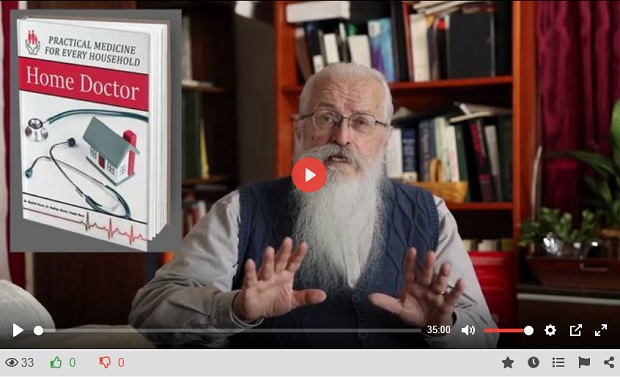
I highly recommend this book: The Home Doctor – Practical Medicine for Every Household – is a 304 page doctor written and approved guide on how to manage most health situations when help is not on the way.

If you want to see what happens when things go south, all you have to do is look at Venezuela: no electricity, no running water, no law, no antibiotics, no painkillers, no anesthetics, no insulin or other important things.

But if you want to find out how you can still manage in a situation like this, you must also look to Venezuela and learn the ingenious ways they developed to cope.

What To Do When Gun Control Gets Really Bad- We Need to Prepare For The Worst And Always Ready to Resist

Gun Control is a favorite tactic for many politicians on the left. It allows them to shift the blame from the person, whose worldviews and political party often aligns with theirs, to a simple tool they can ban. With an all Republican everything, you’d think we wouldn’t have to worry, but that’s far from true. These people seemingly always find a way to infiltrate politics and attempt to strip us of our God-given rights. So what do we do? How do we fight back if gun control legislation is proposed or passed?

#1. Learn How To Make Your Own

California is the beacon of cruddy gun control laws in the United States. They’ve gone above and beyond to reclassify your standard semi-automatic rifle into what they call an assault rifle. What we’ve seen is people and companies outsmarting the legislature at every turn. One of the most famous means was building your own gun. Specifically AR 15s. AR 15s are always on the chopping block, but even California couldn’t stop the signal.

With the advent of 80% lowers Californians were able to again build their own rifles within the law. The AR 15 is hardly the only weapon you can build. In fact, an enterprising patriot build can manufacture their own semi-auto Sten gun, Glocks, MAC 10/11s, AK rifles and more. The main issue is going to be acquiring the skills and tools needed to make these weapons. It takes a little mechanical skill and a lot of different tools.

It would be wise to start learning the insides and outsides of guns now. Learn to build them, acquire the tools, and fire up the Youtube machine. Here you’ll find as hard as they try they can’t stop the signal. You can build your own with a little practice, and it’s perfectly legal to do so. You aren’t just building guns, you are learning valuable skills regarding the construction and design of firearms that could be invaluable if things got really bad.

#2. Recognize the Gun Ban Matrix

One fact we’ve seen over and over again with anti-gunners is that they know absolutely nothing about guns. If the power these people had wasn’t so terrifying it would be hilarious. Every time they open their mouths about guns they say something incredibly stupid. They simply target guns that look scary and that’s it. That’s why the gun ban matrix exists. The gun ban matrix is a list of features and guns unlikely to be banned because anti-gunners are idiots and don’t understand firearms.

These are the guns you should consider investing in should sweeping legislation occur. In case the situations getting drastic and confiscation begins things may move too fast for people to react. In that event a neutered gun is better than no gun.

The first guns to go are going to be the traditional targets for anti-gunners, the AK 47s, the AR 15s, the Tavors, and the usual suspects. They may be banned by name, or by the features they share. A good alternative to these semi-auto rifles is the Ruger Mini 14 and Mini 30 series. They can be purchased in not so scary configurations.

Past the Mini 14 and Mini 30, there is the fixed magazine SKS rifle. It’s often left off ban lists, and it’s affordable and common. It’s limited to ten rounds, but with stripper clips, you can reload quite fast with practice.

Past this level we get into manually operated firearms, this includes pump-action shotguns, and lever and bolt action rifles. A good lever action rifle is a rapid firing gun and in the right caliber can hold up to 14 rounds. These guns are highly unlikely to be banned without a full constitutional amendment.

#3. Don’t Give A Single Inch

With the recent Las Vegas shooting there has been an increased interest in banning a firearm accessory known as a bump fire stock. These accessories are rather dumb and useless, and in no way did it make the shooter more lethal. Regardless of how dumb and useless they are there is no reason the firearms community should let them be banned without a fight. With the NRA even saying the ATF should reevaluate bump fire stocks.

This is how gun control starts, with tiny little cuts. We let them take one dumb accessory and next time they’ll push for something else, and they’ll keep pushing. Give them nothing, not a single inch. As gun rights advocates we have to defend what we have and go on the offensive. Fight back and take our God Given rights back.

#4. Push Back and Push Back Hard

If legislation gets passed regarding gun control, and I mean any legislation at all, we have to push back. The vast majority of gun owners are law abiding, tax paying, job having citizens who want nothing more than to live in peace. We all know actual gun control will do absolutely nothing to strip criminals of firearms, just good people who already obey the law.

If gun control happens as law abiding gun owners we have to flood the legislator’s offices with our demands. We have to protest, we have to write letters, we need to march on the capitals. In 2012 the gun community did an amazing job of coming together to resist any form of gun control. We need that same response to every law that passes, heck we need that reaction every gun control law that is even proposed.

We need to push at the local, state and federal level. Work every angle possible. We have to keep supporting companies that agree with our God-given rights, we have to join gun rights organizations of every kind. We literally have to put our money where our mouth is.

#5. Focus on the Small Politics as Much as the Large

It’s easy to forget the importance of local politics when it comes to federal gun control. Local and state politics can make all the difference. We saw Sheriff’s in states across the union step forward and say they would refuse to enforce federal gun control laws in their counties. We saw states and municipalities adopt laws that would act to nullify federal gun control laws.

If we can’t toss the anti-freedom and anti-gun bastards out of federal offices we can at least elect the right people at the local and state level to ensure the laws are useless.

Resist

As American citizens, we owe it to future generations to resist. Resist with every fiber we have. Resist gun control measures with everything we can. We need to prepare for the worst and always ready to resist.

End of the World Countdown: Using the Pages of History to Identify the End-Time Antichrist

In the prophetic countdown of end-of-the-world events, it is God’s intention that we warn the world of impending events in an accurate and credible way. The purpose of the prophetic word is to get people to believe the gospel and turn to God. That’s the reason why He wants us to be in a position to know what the future holds and proclaim it ahead of time so that our hearers will have no alternative but to believe. However, the Lord is well aware of the effects of foretelling an event that turns out not to be true. In view of this, He wants to make sure that those whom He commissions to preach the gospel are thoroughly informed in the scriptures in general and the prophecies in particular.

In His attempt to instruct His people in the interpretation of prophecy, the Lord has supplied us with all the necessary tools in His word so that we need not err in our prognoses on last-day events. One of the most effective tools that is given to us in the Bible is the principle of proleptic prophecy. Proleptic prophecies are predictions that have more than one application. You will find examples of prophecies with dual or multiple applications in Matthew 24 and Joel 2. In these predictions you will find that they were fulfilled in a limited way in a past dispensation with the promise of a wider fulfillment in the end-time.

There are a great amount of speculations and differences of opinion on the subject of the Antichrist of Bible prophecy. When I examine some of the different arguments I do not get the idea that the arguments are following any particular logic. Most of what I read in articles and watch on videos are just flippant conclusions that are arrived at by observing current events. This is not a good way to interpret prophecy. When you arrive at your conclusions in this way, you are no longer making the Bible your guide but events. When it comes to solving Bible prophecies, you must allow the scriptures alone to provide all the solutions.

The historical profile of the Antichrist in Daniel 7
When I think about fulfilled prophecies that can help us better understand end-of-the-world predictions, the countdown of end-time events in Daniel 7 immediately comes to mind. I am referring to the fourth kingdom in general and the little horn in particular. In Daniel 7, it is said that after the fourth kingdom is divided, the little horn king will emerge. This prophecy was fulfilled in the sixth century when the Roman kingdom has made a transition from pagan to papal rule. And it is believed by many Bible historians that as a direct result of the rise of the medieval Papacy a new religious culture was established and strange doctrines were introduced.

The specifications of this little horn power that are laid down in Daniel 7 are very interesting in terms of how they relate to the activities of the papal administration during the early centuries. Here you will see that they are confined to verses 24 and 25:

1. He subdues three kingdoms

2. He blasphemes the name of the Most High

3. He persecutes the saints of the Most High

4. He is to oppress the saints for time, times and dividing of time

As we closely observe the countdown of end-of-the-world events in this chapter you will be fascinated by the resemblance of these specifications to what obtains during the Dark Ages.

Three kingdoms were overthrown
History has recorded that in 476AD the Roman Empire was divided in to ten independent territories. These territories were captured by barbarian nations as a result of the Gothic invasion. But some time after the Papacy came to prominence, three of the ten barbarian nations were not prepared to assent to her dogmas. As a result they were attacked and overthrown, and thus the Bishop of Rome gains full ascendancy in all religious matters and world affairs.

The name of God was blasphemed
The most glaring evidence of blasphemous activities during the Dark Ages is the act of mortal man taking upon himself titles which belongs only to God. For instance, the popes were once addressed as Lord God the Pope, and proclaimed as the God of heaven, earth, and of lower regions. In addition, the people were taught to purchase indulgence certificates and confess their sins to the priests in order to have their sins forgiven instead of going to God in prayer.

The persecution of the saints
During this period of papal supremacy, there were many Christians who were not prepared to conform to the doctrines of the Roman Church. It was their view that the Church has compromise her faith by forming alliances with secular powers. As a result of remaining true to the apostolic tradition, they were considered heretics and, hence, a crusade was waged against them. Some of these brethren who were persecuted are the Waldenses, the Albigenses, the Heugenots, and the Hussites. Among the manifold methods of inflicting cruelty on heretics, the true saints of God were burnt at the stakes, thrown to hungry lions, tied to horses, and abandoned in dungeons to die of starvation.

The saints were oppressed for more than a thousand years
Time times and dividing of time is another way of saying three and a half years (time=1yr, times=2yrs, half a time=1/2yr). By Jewish reckoning, it’s 1260 days. Many theologians believe that this 1260-day period must be reckoned on the basis of the day-for-a-year principle in Numbers 14:34 and Ezekiel 4:6. This is precisely in agreement with the notion that the Papacy was officially in ascendancy in 538AD and lost her sovereign power in 1798 when the pope was deposed as head of state in the aftermath of the French Revolution.

While we can acknowledge the above scenario as a fulfillment of Daniel’s countdown of events in relation to the little horn, we cannot fail to see the clear connection to the end of the world. Therefore, we can expect to see a more fulsome fulfillment of the Antichrist prophecy of Daniel 7 in the last days. Because the Bible does not make any difference between the medieval and the end-time fulfillment of this prophecy, we can hardly remove the city of Rome from within its cross hairs. After all, Rome is supposed to be the fourth and final world kingdom just prior to the Second Coming. Therefore, there is no doubt as to where the Antichrist will come from.

The Final Backup Plan For A Lot Of Us In The Case Of A Disaster- How Much Cash Should You Have If the Grid Goes Down?

It is the final backup plan for a lot of us in the case of a disaster. A generous supply of cold hard cash to buy our way out of trouble, pick up as many last-minute supplies as possible or to acquire resources that are unavailable to anyone with a credit card in a world where the electricity is out and the internet is down. We frequently talk about having cash for emergencies, but how much cash should you have if the grid goes down? What will you be able to purchase with your doomsday supply and how long would it last in the first place?

One of our readers made a recommendation the other day to have between $500 and $1000 in cash for your bug out bag and at the time it prompted me to consider again if this amount makes sense. In my personal preparedness plans I have a supply of cash but I am always trying to figure out if what I have is enough or too much. Will it even matter when TEOTWAWKI comes and how can I best use the cash I have to survive?

Why do you need to have cash on hand?

You want to know the time when you will need cash the most? It will be when you can’t get to it. How many of you right now have no cash at all in your wallets or purses? I used to be the same way. I never had cash and relied on the ready availability of cash machines or most often the ability to pay for virtually everything with a debit card. How convenient is it to never have to make change or worry if you have enough cash when with the swipe of a card your bank account funds are at your disposal. This is a great technological advance, but the problem is that this requires two things to be functioning. First, the card readers and ATM machines require electricity. If the electricity is out, neither of these two machines works. The second thing is a network connection. If the network is down, even with electricity the transaction won’t work and you can’t pay for goods or get cash from your bank.

In a disaster, one of the first casualties is electricity. This doesn’t have to be due to some cosmic solar flare that has rendered the grid useless, it could be as destructive and common as a fire, flood, earthquake, tornado or winter storm. It could also be from simple vandalism or perhaps terrorism. A major fiber optic cable was cut in Arizona back in February leaving businesses without the ability to accept payments. When the electricity is out, you aren’t going to be able to access your cash via the normal means so having a supply on hand is going to be a huge advantage for you in the right circumstances.

Even if there is no natural disaster, you are still at the mercy of your bank. What if your bank closes or there is a bank holiday declared because of some economic crisis. In any of these situations, if you are dependent on access to money that is controlled by either technology or physical limitations like a bank office it is wise to have a backup plan should either of those two conditions prevent you from getting cash.

Important below:

I highly recommend this book: The Home Doctor – Practical Medicine for Every Household – is a 304 page doctor written and approved guide on how to manage most health situations when help is not on the way.

If you want to see what happens when things go south, all you have to do is look at Venezuela: no electricity, no running water, no law, no antibiotics, no painkillers, no anesthetics, no insulin or other important things.

But if you want to find out how you can still manage in a situation like this, you must also look to Venezuela and learn the ingenious ways they developed to cope.

What is cash good for in a crisis?

I think there are two levels to consider when it comes to keeping cash on hand. There is the bug out scenario mentioned above where you would have some “walking around money” to take care of relatively minor needs like food, a hotel or gas. The second is for a longer or more widespread unavailability of funds. Let’s say the economy tanks and the price of everything skyrockets but stores are still open for business. Your bank is one of the casualties, but you had a few thousand dollars of cash stored away that you could use to purchase food, gas and necessary preparedness items for your family. In this scenario, the government is still backing the fiat currency and vendors are still accepting it as a form of payment. For this scenario having a few thousand dollars makes sense.

But what if we have an extreme event where the currency is devalued and is essentially worthless? Your thousands of dollars might only buy you a loaf of bread. Don’t believe it can happen? It did to the Weimar Republic after WWI so it can happen again. That isn’t to say it will, but you should balance how much money you have squirreled away under your mattress with supplies you can purchase now that will last and keep you alive during that same event. My goal is to make sure I have the basics I need to survive at home for several months to a year without needing to spend any cash. This way, if the money is worthless, I still have what my family needs to survive.

If we have a regional disaster where you can bug out to a safer location, your cash should serve you well. Of course if you are in a safer location, assuming electricity was working your access to bank funds should still be working. If this is truly the end of the world as we know it, how long will that cash you have be worth anything?

It is surprisingly simple to disrupt all credit and debit transactions. Do you have cash instead?

How much cash do you need?

So the million dollar question is how much cash should you have if the grid goes down? I always try to plan for the worst case scenario. My rationale is that if I am prepared for the end of the world as we know it, I should be just as prepared for any lesser disaster or crisis I may be faced with. The way I see it is if we do have a disaster, you aren’t going to be using that cash most likely to pay your mortgage, student loans, rent, or your credit card bills. Cash will go to life saving supplies and this will need to be used in the earliest hours of any crisis before all of the goods are gone or the cash is worthless. Once people realize for example that the government has been temporarily destroyed, they aren’t going to want to take your $500 for a tank of gas. They are going to want guns, food or bullets.

I also don’t see you using your cash to buy passage to another country, but that’s just me. I know there is a historical precedent for that, but I am not planning on that being something I realistically attempt with my family. I am also not planning on bribing any officials with cash either. My cash is for last-minute necessities and then it is back into the hopefully safe confines of my home to plan the next steps. For that I have only a couple of thousand dollars in cash stored away. I figure if I need more than that I didn’t plan well. Also, I would rather spend my money on supplies like long-term storable food and equipment than having a large horde of cash. With that amount, I figure I can make one last run if needed or be able to weather any short-term emergency when I can’t access cash.

What is the best place to hide cash in your home?

I wrote a post awhile back titled, How to hide your money where the bankers won’t find it that had lots of good ideas for reasonably safe places you could store cash. As I said in that article, you do have risks involved with keeping cash in your house, but I think you have just the same, if not worse risks relying on banks to keep your money safe and give it back when you want it. There are a million places to hide cash, but you can get tricky and buy a fake shaving cream safe to store several hundred dollars in there. Just be careful you don’t throw that away. There are other options like wall clocks with a hidden compartment inside that might be less prone to getting tossed in the trash. Your imagination is really all that is needed for a good hiding place, but I would caution you that you don’t store cash in too many places or you could forget where you hid it. This happened to me when I had hidden some cash behind an item that I ended up giving to my daughter because I thought I didn’t need it anymore. Imagine my surprise when she came into the living room and said, “Dad, I found an envelope with a lot of money in it”. I gave her a twenty for a reward…

What about you? How much cash do you think you need to have on hand and what do you plan on spending it on if the grid goes down?

Slow Motion Genocide in Gaza (Slow-motion genocide of unwanted Palestinians — especially Gazans — is indisputable proof that Zionism is tyranny by another name.)

Slow-motion genocide of unwanted Palestinians — especially Gazans — is indisputable proof that Zionism is tyranny by another name.

Its pure evil is extremist, morally and legally indefensible, undemocratic, hateful, ruthless, racist, destructive, and hostile to what people yearning to breathe free most cherish.

Contemptuous of legal, moral and ethical principles, its scourge threatens everyone and everything it touches. 

In 2017, updated weeks earlier, B’Tselem minced no words about reality in Gaza, saying:

The Strip “is the scene of a humanitarian disaster that has nothing to do with natural causes.” 

It’s “entirely man-made, a direct result of official Israeli policy.”

Its ruling regimes “can choose to change this policy and considerably improve the lives of Gaza’s residents.”

“It can also choose to continue this cruel, unjustifiable policy, which sentences…two million…Gaza(ns) to a life of abject poverty…inhuman conditions” and utter misery.

The Strip is unlivable for its long-suffering people.

Its economy in free-fall, youth unemployment is around 70%.

Its healthcare system virtually collapsed.

About 96% of its drinking water is too contaminated for safe human consumption.

Electricity is available for only a few hours daily.

Israeli regimes use deadly force on Strip residents at their discretion — while the world community of nations yawns and pretends not to notice — especially the debauched West.

Hegemon USA finances, supports, encourages and partners with Israeli human rights abuses and other grievous rule of law breaches.

A small handful of nations stand tall by condemning Israeli state terror.

They’re exceptions to the rule.

Without nowhere in sight international community support with teeth, they’ll be no end to Israeli slow-motion genocide of long-suffering Palestinians, especially not in Gaza.

Along with terrorizing its people, Israel controls its border crossings, airspace and offshore waters.

A virtual blockade exists — an act of war under international law.

Based on FOIA-obtained documents by the Gisha Legal Center for Freedom of Movement, Israeli regimes employ a “deliberate reductive policy” in Gaza.

Slow-motion genocide by another name, Israel restricts the caloric intake of Strip residents to a bare minimum amount needed to survive.

Since Friday, Israel has been terror-bombing Gazan residential areas, killing civilians in cold blood. 

Through Saturday, at least 24 Strip residents were killed — including 6 children — over 200 others wounded, many seriously, according to Gaza’s Health Ministry.

PM Yair Lapid turned truth on its head, falsely claiming that IDF terror-bombing is based on “concrete threats (sic)” — what don’t exist.

According to IDF spokesman, Ran Kochav, terror-bombing of Gaza will continue for at least a week, ceasefire ruled out.

After Israel’s cold-blooded murder of senior Islamic Jihad (IJ) freedom fighter, Tayseer al-Jabari, on Friday, the IDF killed Khalid Mansour on Saturday, IJ’s southern Gaza military commander.

Like always before when Israeli regimes preemptively attack Palestinians, the Lapid regime invented a nonexistent threat to justify what’s indisputably unjustifiable, saying:

IDF strikes on Gaza aim to “remove a concrete threat against Israeli civilians” —  bald-faced Big Lie.

Israeli terror-bombing threatens to escalate into full-scale war for the 5th time since the Jewish state’s 2008-09 Cast Lead aggression.

By open letter to the UN Security Council on Friday, the Al Haq human rights organization said the following:

The Lapid regime preemptively attacked Gaza with “excessive force including missiles and artillery shells.”

“Al-Haq warns that Israel’s aggressive attacks on the Gaza Strip disproportionally (affect) the civilian population.”

By any standard, the Lapid regime is guilty of war crimes.

Its war minister, Gantz, “approved a draft order of up to 25,000 soldiers for operations in and around Gaza and (began) calling upon its reservists in preparation for the escalation of violence (against) Strip” residential areas.

“Al-Haq strongly condemns Israel’s aggressi(on) in occupied Gaza, as well as its continued illegal blockade and use of collective punishment against” its two million people. 

Days before preemptively attacking Gaza, the Lapid regime “closed all crossings into (the Strip), restricting movement of Palestinians, as well as inhibiting the flow of fuel to Gaza’s sole power plant, impacting the delivery of vital electricity resources.”

Al Haq’s call on Security Council members “to halt Israel’s indiscriminate and excessive attacks on Gaza, ensure the provision of vital humanitarian supplies and prevent further killings of the protected Palestinian population” fell on deaf ears.

US, UK and French veto power assures no end to Western support for Israeli crimes of war, against humanity and other grievous human rights abuses.

Separately on Saturday, the Gaza-based Palestinian Center for Human Rights (PCHR) said the following:

IDF terror-bombing of Strip residential areas continues.

“PCHR fears that there will be more civilian casualties in an area considered among one of most densely populated areas in the world and where there is not any form of protection, including public and private shelters or even safe corridors.”

“PCHR brings to mind that in recent offensives on the Strip, civilians and civilian objects were always under IOF’s attacks as a way of exerting pressure on (freedom fighting) Palestinian armed groups.”

“PCHR emphasizes that these airstrikes violate the principles of necessity and proportionality while conducting directed attacks against densely populated areas and use of weapons based on collective punishment is a grave breach of the four Geneva Conventions of 1949 and amount to war crimes.”

“PCHR calls upon the international community to take immediate action  to stop Israeli crimes and avoid any further deterioration of the humanitarian situation.”

In the run-up to and after establishment of the Jewish state on stolen Palestinian land in May 1948, its ruling regimes operated with impunity.

What began Friday against Gazans is the latest chapter of how the scourge of Zionist tyranny operates.

Once again, two million Strip residents have no way to protect themselves from IDF terror-bombing.

What the Lapid regime scheduled for a week — for political, not security, reasons — could go on much longer.

How many nonthreatening Palestinian men, women, children and infants will die from Israel’s latest aggression?

How many more will be seriously injured or maimed?

How many Strip residents will lose all their possessions — destroyed by IDF missiles?

How many Gazan families will be homeless, their residences turned to rubble?

Once again, the scourge of Zionist tyranny is on display.

The late Palestinian American scholar, intellectual, activist, Edward Said, once called “serious public discussion” about Israeli crimes of war, against humanity and genocide against Palestinians the last taboo, adding:

“Abortion, homosexuality, the death penalty, even the sacrosanct military budget can be discussed with some freedom.” 

“The extermination of native Americans can be admitted, the morality of Hiroshima attacked, the national flag publicly committed to the flames.” 

“But (decades-long Israeli) oppression and maltreatment of the Palestinians is virtually unmentionable, a narrative that has no permission to appear.”

While cracks in the wall of silence appeared after Said’s remarks, one-sided US/Western support for Israel remains rock-solid.

It’s because of Zionist lobby power in the US.

Operating as unregistered foreign agents, AIPAC and dozens of other Zionist groups exert enormous influence on all things Israel in the US.

With rare dissenting voices, almost the entire Congress and US regimes — since Harry Truman became the first world leader to recognize Israel straightaway after its establishment — support all things Israel, including its wars of aggression. 

Their backing gives Israeli regimes virtual carte blanche to operate with impunity.

It’s been this way for the past 74 years with nothing in prospect for changing things.

In the U.S we need to defend our Second Amendment rights- What Happens When the Government Becomes Your Worst Enemy!

Chile has struggled to become a thriving democracy. Once a dictatorship under Augusto Pinochet, the country has gone through considerable turmoil since his death. Capitalism has not treated everyone fairly in this country, even though Pinochet was once lauded for the dynamic free-market economy he created, once cited as the “model for the developing world.”

By no means has Chile been the only country which has struggled to become a free-market democracy. Russia is still struggling, decades after the collapse of the Soviet Union. Iraq really hasn’t accepted democracy as a political model, even after enormous amounts of investment by the US government. Other countries have struggled as well, but not with the same results.

Much of the problem that Chile has been experiencing has been due to the vast income inequality that exists in that country. While there are portions of the population which are thriving, many others are still suffering, especially those who are dependent on retirements that were established under the Pinochet regime. Many schoolteachers are still working into their 80’s, because they can’t survive on their $300 a month pension.

For those working in non-skilled jobs, public transit to take them to and from their work costs as much as 21% of their weekly wages. Thus, when the government announced a 30 peso rise in the cost of the metro, it was met with anger. A student-led protest, called evasión swarmed the metro, jumping the turnstiles to avoid paying the increased fare. Workers took advantage of the opportunity to save a little money and joined the protest.

While protests are nothing new in Chile, these seem to have gained traction. A demonstration which started in the capital has now spread to many of the major cities, with continued evasión of fares and widespread protests in the streets.

It appears that socialist organizers and anarchists have joined in the protests, working to turn it to their political ends. As in many such cases, word coming out of Chile is a bit confused, with each side accusing the other of what they themselves are doing. Much of the reporting is tainted by the political leanings of the reporters who are on the scene. But one thing is certain, the government’s response doesn’t stand up under scrutiny.

The Government’s Response

President Sebastián Piñera has declared that his country is “at war.” But if it is, it’s a war between the government and the citizens. While some government response is required to the violent acts of the protesters, that should be a police response, arresting the worst of the offenders and those who are inciting others to commit illegal acts. Protests, as our own government has learned, are not the reason to call out military forces armed and equipped to use deadly force.

What Happens When the Government Becomes Your Worst Enemy

We’ve seen that before in this country; at Kent State University in 1970. National Guard troops were called out in response to a protest. Although the National Guard does receive some training in how to respond to a riot, they are first and foremost soldiers, equipped and trained to kill, not to arrest people. In this case, the results were four dead college students and another nine who were injured.

The soldiers on the streets of Chile reminded many of the older citizens of the years of Chilean dictatorship, when such sights were common; a parallel that was lost on the students who started the protest. For the older citizens, that sight struck fear in their hearts.

The government has admitted to eight people being killed in the protests, but information leaking out of the country claims over 20 killed. There are also widespread reports of police and military brutality against the population, including against people who were not protesting, but merely in the wrong place at the wrong time.

Martial law was declared by the President, early on in the protests, allowing for the use of military forces and imposing ever more restrictive curfews on the people. Interestingly enough, whenever the protesters have gotten the upper hand, troops have retreated to wealthy areas of the cities, focusing on protecting the wealth centers. It seems clear from that action alone, that the leadership of the country is only interested in protecting their financial standing, not protecting the people.

Under martial law, police and military forces have beaten hundreds or perhaps even thousands of innocent people, often plucking them off the streets in civilian clothes, in an attempt to hide their identity. Civil rights are being trampled daily, as the government attempts to regain control.

Could that Happen Here?

Regardless of where you stand politically, Americans have grown afraid of politicians on the other side, especially as the political divide has grown. Each side assumes that the other is likely to declare martial law, on the thinnest of pretexts, imprisoning those who have declared themselves aligned with the other side. Yet that sort of thing has never happened in this country. For that matter, we haven’t seen people rounded up and put in any sort of detention camps since World War II.

Those on the left decry the “oligarchy” regularly, declaring that this country is actually run by them. But I’d like to propose a different viewpoint on that. That is, every government that has ever existed has been an oligarchy of one sort or another. Even monarchies are oligarchies, as the wealth is concentrated in the hands of the royalty.

Successful merchants could buy themselves titles under such a regime, gaining political respectability. But that’s not all they bought; they bought access to the throne, the seat of power. That’s what their titles and their money did for them, just like the oligarchy we have today.

Why is this important? Because in reality it has always been the oligarchy, the elite, who have been in control. I don’t care if you’re talking about the Rothchilds, the Bilderberg group, George Soros or our own political parties, they have kept the power to themselves. Much of the reason why they hate President Trump, is that he has defied their rule and has been working to do whatever he can to overthrow it.

What Happens When the Government Becomes Your Worst Enemy

As we’ve seen in the last few years, these power-brokers will do whatever they have to, in order to keep their power. Rumors have existed for years about how the Clintons have done away with anyone who could be a whistleblower on their nefarious actions. The same sort of rumors existed about Obama when he was in office. I’m sure if we searched around the world, we would find many more examples.

The accumulation of power and money is the central focus of these people’s lives. As such, they will do whatever it takes to retain that money and power. They don’t mind if we “little people” accumulate wealth or even some local power; but they aren’t sharing theirs with us. They will use whatever they have to, in order to keep control. Whatever they have to includes military forces.

These power brokers have control of large portions of our government, just like they do in other countries. As long as things go their way, they will allow us the illusion of our freedom. But if things don’t go their way, you can be sure they will take the necessary action to retain power.

What that Means for Us

One big difference between the United States and Chile is the Second Amendment. Even though there are those who are constantly chipping away, trying to take that right, the Second Amendment guarantees our right to keep and bear arms. There is no such equivalent in Chile.

That’s not to say that the Chilean people can’t own firearms. They can; but there are huge hurdles to overcome in order to get a permit to own one. Even bigger hurdles exist to having a permit to carry that gun outside your home. On top of that, private ownership of semi-automatic arms is prohibited.

Should martial law ever be declared in the United States, you can almost guarantee that it will be accompanied by widespread gun confiscation. This happened in New Orleans, in the wake of Hurricane Katrina. Probably the only thing that kept that from turning ugly and kept armed citizens from defending their right to keep and bear arms, was that there were so few of them still in the city; government forces had them outnumbered.

Many have declared that widespread gun confiscations would result in civil war. I tend to agree with that. While there are many gun owners who would give up their guns, albeit reluctantly, rather than fight government troops, there are enough of us who would stand up for our rights. How that war would end is anyone’s guess.

Recently, the new Democrat majority in Virginia’s state legislature passed a number of very restrictive gun control laws, without taking into account public opinion. They ended up being forced to retract those laws, when citizens got up in arms about it and law enforcement officers declared that they would not enforce those laws.

The same thing has happened in other parts of the country, as Democrat controlled state legislatures have tried over and over again to tamper with our Second Amendment rights. But in each and every case, while there have been some who have complied like good little sheeple, the majority refused.

This means that any protests against government overreach here in the United States have the potential of becoming much more violent than they do in other countries. While those of us on the right, who own most of the guns, are not the kind to take violent action, there are always a few who don’t see it that way. All it takes is one or two of them to start the ball rolling, and things could turn ugly, real quickly.

A second American Civil War would be even bloodier than the first. Not only are there more privately owned guns in the hands of citizens, than there are citizens, but the level of military technology has increased by several orders of magnitude. Hunters alone have our military grossly outnumbered. On the other side, the military has all the tanks, planes and artillery. As I said, it would be bloody.

This is probably why there are those in government service who are so bent on disarming the population. It also explains why the AR-15 is the main target of these people. You can’t win a war with pistols and even trying to win it without semi-automatic rifles would be difficult. Those who want to control us don’t want us to be able to fight back.

Throughout the last century, there have been numerous examples of what happens when the government disarms the civilian population. What we’re seeing in Chile today is nothing new; it has been done time and time again. Those who want to be despotic dictators (regardless of what political name they hide behind) know they must disarm the people first. It’s much easier to get sheep to submit, than it is to get sheep dogs too. The sheep dogs have teeth.

If anything, Chile serves as one more reminder as to why we need to defend our Second Amendment rights. Otherwise, it’s much too easy for those who would take away what remains of our liberty, the freedom to do so.

Inside A Secret Government Warehouse Prepping For Societal Collapse- While the mainstream media propagandists continue to push the lie of a robust recovering economy, the fact is, we are in some serious fiscal trouble. (The depression had far-reaching negative consequences, some of which ultimately led to World War II.)

While the mainstream media propagandists continue to push the lie of a robust recovering economy, the fact is, we are in some serious fiscal trouble. Economies around the world are crashing, countries are drowning in record amounts of debt, and governments continue to pile on new debt like there’s no tomorrow.

What is an Economic Collapse?

Economic collapse, in its simplest definition, means a sudden and severe drop in currency value, leading to a financial crisis. It usually happens when the country’s economic activities are mismanaged or when an unexpected event throws the country into chaos. Some examples of such events are terrorist attacks, natural disasters, political upheaval, severe social unrest, financial bubbles , a collapse in government, and pandemics.

A look at Prior Economic Disasters, Depressions and Market Collapses

Throughout the history of the world, there have been many instances where countries have experienced an economic collapse, leading to severe consequences such as hyperinflation, high unemployment rates, and poverty. In extreme cases, economic collapse can even lead to a societal breakdown, with people experiencing shortages, social unrest, and struggling to survive.

The earliest recorded economic collapse occurred in 176 BC when the Roman Republic experienced a severe financial crisis that eventually led to massive inflation and debasement of the currency. The government’s response to this crisis was to issue more coins with decreased silver content, resulting in worsening hyperinflation and a sharp decline in the purchasing power of its citizens. This eventually led to social unrest and political instability, eroding the strength of the Roman Empire over time.

Another significant economic collapse occurred during the Great Depression of the 1930s, triggered by the stock market crash of 1929. During this period, businesses failed, banks collapsed, and unemployment soared to unprecedented levels worldwide. The depression had far-reaching negative consequences, some of which ultimately led to World War II.

In 1997, the Asian Financial Crisis rocked Southeast Asia, causing widespread economic instability and social unrest. The crisis began with the devaluation of the Thai baht, leading to investors withdrawing their capital from other Southeast Asian countries. This, in turn, led to a sharp decline in the value of their currencies and an economic recession. As a result, millions lost their jobs, and poverty rates rose steeply. Some nations recovered relatively quickly, while others, such as Indonesia, suffered profound economic and political upheaval for several years.

The most recent collapse occurred in 2008 when the subprime mortgage crisis shook the global financial markets. The crisis began with predatory lending practices by mortgage lenders, high-risk borrowing by homeowners, and the buying and selling of risky loans between financial institutions. When homeowners began to default on their mortgages, banks and insurance companies suffered huge losses, and trust in the financial system evaporated almost overnight. As a result, governments worldwide were forced to intervene to avoid a total collapse of the financial system.

As history shows, it’s not if but when! Therefore, preparing for an economic collapse is vital to your survival, especially in today’s world, where the global economy is interdependent. Any event, even those in other parts of the world, can have a ripple effect on other countries. This article will provide tips on how to prepare for economic collapse.

Are we heading towards an Economic Collapse?

At some point this debt train is going to come to a screeching halt; when that happens we are going to see panic and chaos like nothing we’ve ever seen before.

As we’ve been covering for some time now, a look at the numbers and data shows we are heading for a potential disaster. From a series of high profile banks going bust to record inflation combined with major supply chain shortages, our economy seems to be heading right off the cliff.

The world, especially the United States, is drowning in debt.

The United States, once the world’s shining example of fiscal security and responsibility, has become shackled by a record amount of debt. We are literally drowning in debt.

Over the next ten years, experts think that debt could balloon to over $50 trillion. While that might seem like an insurmountable amount of debt to recover from, the fact is, we have already surpassed that number many times over.

When factoring in unfunded liabilities like Social Security, Medicare, government pension plans and Obamacare, the true debt number is actually much higher. Estimates put the real number somewhere between $222 trillion to $250 trillion.

But it’s not just the government, people are borrowing at record levels as well.

  • Household debt increased at the fastest pace in 15 years, partially due to huge increases in credit card usage and mortgage balances.
  • Credit card balances rose more than 15% from 2021, the largest annual jump in more than 20 years.
  • Total Consumer Debt is now over $2.36 Trillion, an increase of 7.3 per cent in Q3 2023 compared to last year.

The overall Economic numbers are downright Scary!

  • Silicon Valley Bank Collapse causing fears of market contagion and Bank Runs
  • Stock & crypto markets crash, U.S. debt to soar past $50 trillion within 10 years as Biden to Raise Taxes
  • Commercial Real Estate Collapse Latest Warning Sign to Prepare for Major Economic Troubles
  • Food Shortages: American Food Supply in Real Danger, expected to get worse in 2023
  • US inflation surges as economy becomes top preparedness threat
  • U.S. money supply, which measures safe assets households and businesses can use to make payments, has fallen abruptly since March and is negative on a yearly basis for the first time since 2006.
  • Mortgage payments as a share of income have doubled from 13% to 26%, and the savings rate has plummeted to almost zero.
  • Total household debt increased by 8.5% in 2022 and now stands at a record $16.9 trillion. That’s $2.75 trillion higher than it was pre-pandemic.
  • Sales of commercial mortgage bonds have taken a nose dive, plummeting about 85% year-over-year as commercial real estate investors are bracing for what looks like a wave of defaults throughout the commercial real estate industry.

What can you expect during a major Economic Collapse?

  • A Run on the Banks: One of the first things you will see is a run on the banks. People are going to be panicking, and they will be doing everything they can to get their hands on cash to buy extra supplies.
  • Chaos in the Streets: Once the banks run dry, you will see people turn desperate. The moment they realize the money is gone is the moment you will see widespread chaos sweep throughout the country. Riots, looting, and widespread violence will break out, making self-defense one of your primary concerns.
  • Martial Law: When things start to go bad, I believe you will see the government declare a state of emergency or Martial Law. When this happens you will see things like travel restrictions, mandatory curfews, and the suspension of Constitutional rights.

So what should you do to prepare for an economic collapse?

  • Are you prepared to survive a total economic collapse?
  • If you haven’t already, it’s time to put together a plan of action. The fact is, the writing has been on the wall for some time now, and we probably don’t have much time left.
  • If and when things go bad, and money starts to become scarce, do you have a plan? What if we suffer a complete meltdown and collapse of the economy?

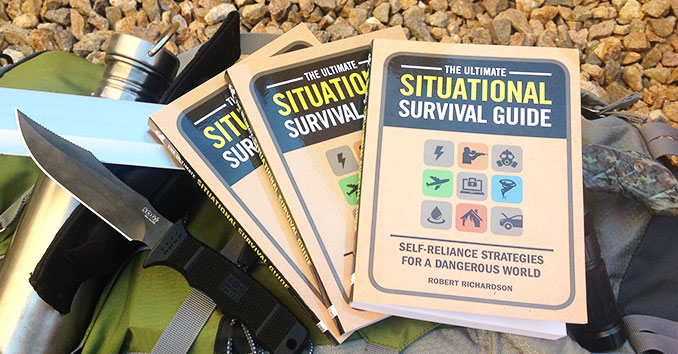
I devoted an entire section to financial preparedness and the coming collapse of the economy in my book, The Ultimate Situational Survival Guide; because I firmly believe it’s one of the most serious threats we face.

The first thing you need to do is Develop a Plan of Action.

The Ultimate Situational Survival Guide: Self-Reliance Strategies for a Dangerous World

The first step in preparing for an economic collapse is to have a plan. You should have a clear idea of what to do in case of a financial crisis. This plan should include steps you would take to protect yourself and your family.

A good starting point would be to have some emergency savings. These savings should be enough to cover your living expenses for at least six months. This could be in cash, precious metals, or other assets that can hold value during a financial crisis.

Another important aspect of your plan should be to have a source of income not affected by the collapse. This could be through investing in assets that will not lose value during a crisis, such as gold or silver (or good ol beans and bullets!). Alternatively, you could start a side business that provides a steady income stream.

If things go bad, having a plan of action will help increase your chances of surviving the chaos. Check out my list of Essential Preparedness Tips, Skills, and Resources to Prepare for Disasters & Threats.

Start being Smart with your Money

Money

During the 2008 financial collapse, millions of Americans lost their homes, cars and personal possessions because they saddled with debt. Since the so-called COVID pandemic, that trend has begun again with millions of people who now owe more on their property than they are worth, a vehicle repo market that is exploding, and consumer dent that is at record highs.

  • If you can get out of debt, do it now. Start cutting all non-essential expenses, and use that money to pay down your debt. During an economic collapse, the likelihood of losing your home to debt collectors is a very real prospect.
  • Start an Emergency Fund: Just like all areas of preparedness, there are steps you can take to insulate yourself from problems. Having an emergency fund is one way to prepare for financial troubles. It will give you a bit of a cushion during hard times, and can provide you with a fund to buy last minute supplies once things start to go bad.
  • Always have Cash on Hand: Once things start to go bad, there is a very real possibility that the banks may freeze or seize your accounts. Should there be a run on the banks; people are going to be desperate to get their hands on some cash. Even during a total economic collapse, paper currency will still play a major role in how people buy and sell during the initial phases of the crisis – especially if a bank holiday is declared.

Start Prepping for Problems NOW.

Now is the time to really start taking a serious look at your overall level of preparedness. The economy has been teetering on the edge of collapse for quite some time, throw in inflation that has almost doubled the price of staple goods and the growing social unrest that’s sweeping the country and you have yourself a real recipe for disaster.

  • Put together an emergency kit that includes extra food & water, clothing, a portable shelter (tents, tarps, sleeping bags.), and a way to defend yourself.
  • Think about what things are unique to your situation; items like medications, or supplies that you would be hard pressed to live without, should be stockpiled in preparation for economic troubles.
  • For more information on prepping, check out our article on the top ten prepping tips for every SHTF situation. Every one of those tips can help prepare you to deal with an economic crisis.

Start stocking up on Survival Supplies.

Urban Survival Gear

During an economic collapse, supply chain disruptions and shortages of essential supplies are possible. Therefore, it is essential to stockpile some essential supplies to tide you over during the crisis. Now is the time to buy the things you need! I’m not talking about T.Vs or IPads; but instead, long-term supplies that you will need in order to survive in the future.

  • Start stockpiling food and long-term consumables. During any type of crisis, food, water and long-term consumables are going to be worth their weight in gold. During an economic collapse, you will likely see major supply chain shortages and problems, making these types of supplies one of your most important pre-collapse considerations.
  • Put together a Bug Out Bag: Should this country face an economic collapse, chances are pretty good it will be followed by riots, violence and something much uglier than the initial collapse of the economy. You should have a Bugout bag filled with everything you need to survive a prolonged emergency situation.
  • Keep a good supply of First-Aid & Medical Supplies on Hand. Medical and personal hygiene supplies are going to be hard to come by when things go bad. Make sure you have everything you need to deal with medical emergencies.
  • Some of the critical supplies you should consider stockpiling include food, water, medicine, and toiletries. You should also have a backup power source, such as a generator or solar panels, in case of power outages and infrastructure breakdowns.

Grocery Options that ship right to your Home

  • Amazon Fresh
  • Bulk Emergency Foods
  • Amazon Grocery

Pay Off Debt

One of the biggest challenges during an economic collapse is debt. High levels of debt can be a significant burden during a financial crisis, especially if you lose your source of income.

Therefore, paying off any high-interest debt before a financial crisis hits is essential. This will help reduce your monthly expenses and free up money you can use for other essential things.

If you have a mortgage, it may be wise to consider refinancing to a fixed-rate mortgage, which can provide some stability during the crisis.

Start Stocking up on Survival Knowledge.

Even more important than supplies, is survival knowledge. Knowledge is the key to your survival, and now is the time to get some. During any kind of disaster, including an economic collapse, knowledge is going to be your most powerful ally.

During a crisis, the skills that are in demand may change, and having a wide range of skills can increase your chances of finding employment or starting a new business. Some valuable skills to learn are gardening, carpentry, welding, and plumbing. These skills can help you make repairs or grow your food, saving you money and keeping you self-sufficient during a crisis.

Additionally, learning new skills can also increase your current earning potential, which can help you build your emergency savings or invest in assets that will hold value during a crisis.

  • Start reading books on survival and start collecting information on how to live a more self-reliant lifestyle.
  • Subscribe to our RSS feed to stay up-to-date on all the latest economic threats and preparedness information.
  • Start doing your own Research. I don’t rely on government spun stories, or skillfully crafted press releases; I do my own research and you should too!

Take a serious look at your Self-Defense.

Safe Gun Use

One of the biggest threats you’re going to face during an economic crisis is the threat posed by people. The social unrest and riots we’ve witnessed over the last couple of years are going to pale in comparison to what we’ll see during a full-scale economic collapse.

  • Take a serious look at gun ownership, and learn everything you can about self-defense. When things go bad, you are going to need a way to protect yourself and those you love.
  • Watch for signs of social unrest, and stay alert to what’s going on in your neighborhood and throughout the world.
  • During an economic collapse, problems like home invasions and burglaries are going to become a real problem. Start looking into ways to strengthen your home’s security.

Preparing for an economic collapse can be challenging, but it is essential in today’s uncertain world. By having a plan, diversifying your investments, stockpiling essential supplies, learning new skills, and paying off debt, you can increase your chances of surviving and thriving during a financial crisis.

An economic collapse is a very real threat, one that has far-reaching consequences that you must take seriously. If you haven’t put together a game plan, what are you waiting for?

While nobody here is making any specific predictions, and I certainly can’t tell you that it’s going to happen on this date, in this year; I can tell you that the possibility is very real, and the reality of the situation is our politicians and leaders continue to put policies in place that ensure some very real future problems.