When discussing matters of national security, the economy is hardly ever a topic which is raised, except to say that the cost of defending our country is too high. With billions of dollars a year spent on branches of the government which are responsible for the safety of every American, defense and national security are definitely huge portions of the country’s yearly budget. However, it appears as if that money is indeed being spent wisely. Of course there are areas of the Department of Defense and other agencies which have some superfluous spending, but when one examines the overall spending on homeland security, we’re still coming out on top. A study conducted by Steven Weber and John Zysman out of the University of California, Berkeley, examined the economic impact of security treaties in Europe. What they found is that proactively protecting the United States is actually less expensive than dealing with prolonged security concerns. In other words, it’s cheaper to fix a problem before it becomes a problem, rather than trying to fix a leak in a dam.
With this piece of revealing information in hand, it is clear that the United States must ensure that it continues to be ahead of the game when it comes to defending the homeland. A pivotal piece of this puzzle is the training of new individuals who can become part of this solution. There must be an open stream of funds available for those who wish to peruse national security courses and/or counter terrorism training. Those students, the next generation of America’s defenders, will herald the way, not only for continual safety of the homeland, but economic stability as well. To this point, the United States military has done a very good job at protecting the continental United States from attack. With the number of enemies worldwide, the number of attempts and the amount of animosity towards the U.S. in the world, having the events of September 11th as the only major glaring failure is remarkable to say the least.
A continued and sustained monetary effort to support national security courses and counter terrorism training is one of the main keys to success of national security going forward into the future. America has always had a strong educational lineage and so it is no surprise that when it comes to teaching national security courses and counter terrorism training, there are numerous institutions which excel at this task. In addition to the merely the financial support offered by the government, more of the reputable academic institutions need to branch out into this specific area of study, bolstering their faculty with time-tested and experienced individuals whose expertise can be passed to the newest generation. Doing so, even though it will take an initial financial investment, will prove to make the nation safer and save money in the long-term. Very few things in life are truly considered a, “win-win” situation, but when it comes to the investment in our national security, there are only benefits to be found.
After an economic collapse, the aging infrastructure of the electrical power grid is likely to get less and less maintenance, repair and upgrades. This means that an already stressed power grid is going to become less reliable and we will be more prone to having power outages and even rolling blackouts during times of peak demand.
Even if there is no actual economic collapse, we know that the economic situation has put a strain on all utilities and infrastructure, as there is less money to do the maintenance and repairs that are necessary.
So if we know that we have an aging electrical power grid that is increasingly susceptible to failure, and an economic collapse is on the horizon that could make the situation even worse, what can we do about it?
Instead of waiting for something to happen and then complaining that we are helpless victims, we can be proactive and take action to be prepared for what is coming. Let’s look at some alternatives to being a victim.
First of all, you can educate yourself about the alternative methods of providing power to your home during an outage. While purchasing an emergency backup portable generator is what most people think of doing, many people either don’t have the $500 to $800 to lay out for that purchase. In addition, storing gasoline may not be an option, especially if you live in the city and have a small lot, or worse yet, if you live in an apartment.
For a fraction of the cost of a generator, you can get a small solar power system from a store like Harbor Freight that will at least supply you with light when the power goes out. Unlike flashlights, this system will last you indefinitely, as you don’t have to worry about replacing batteries.
Another thing you can do is purchase a small, indoor-safe propane heater in case the power goes out in the winter and you are without heat. You must be careful, as most heaters that rely on combustion are not safe for use in a closed environment, as they give off deadly carbon monoxide. However, there are a few units, and Coleman makes one, that are safe for use in the home.
Forward thinkers are always ostracized. It has been that way throughout history. Preppers are no different. We just ought to be thankful we are not living in the time of Socrates, or else we would be lining up for the hemlock.
From large scale civil unrest to the one of an EMP generated by the sun, it’s clear that preppers have been way ahead of their time. These topics were once deemed “paranoid”, or “delusional” but all of the sudden names in pop culture and even world governments are paying attention to these types of threats.
One such threat seems to be leading the pack and has shown up in many recent government reports. FEMA in particular seems to be concerned about the threat of a geomagnetic storm that would emanate from the sun and cause massive power outages across the planet.
A once classified FEMA report has surfaced and goes in depth on the level of preparations and concern that they have for a storm of this magnitude.
Understanding Reports and Unpublished Documents
The government buys ammo, writes and drafts lots of reports and documents that never really see the light of day. Now, we must be smart about that bit of information.
It’s important to take a look at these for what they are. There is a lot of research and science that goes into creating these drafts and reports. They are not a bunch of made up steps and stats.
However, some of these reports are also never going to be acted upon. That means, though the report may contain some very effective information, it’s not going to affect law or protocol in any way.
To be completely clear, what we have here is an unpublished document that was written by FEMA. It contains some very important information that confirms the government’s understanding of the EMP threat posed by our own sun.
The title of this unpublished report is very telling.
Mitigation Strategies for FEMA Command, Control and Communications During and After a Solar Superstorm
FEMA and NOAA’s Geomagnetic Storm Timeline
There are many takeaways from this classified FEMA report, but the geomagnetic storm timeline is the core of this document. This timeline shows that this report was put together with a tremendous amount of research and a focus on following the solar superstorm, from its start as a sunspot all the way crashing into the earth’s atmosphere.
G Minus 5 Days
This is the first spotting of the large sunspot on the surface of the sun. The focus is on large, complex magnetic fields on the surface of the sun. From this point we would have a 5 day window to prepare, but it would be very hard to determine the threat at this point.
G Minus 17 Hours
At the launching of a massive CME we are left with just 17 hours to prepare. Radio, radiation storms and geomagnetic storm warnings and watches are also issued at this point.
G Minus 16 hours 40 minutes
The solar radiation storm arrives at this time and we lose 15% of our satellite fleet due to solar panel damage. There could be greater loss and efficacy issues with GPS.
We would have about 20 minutes notice before this happened. “We” doesn’t necessarily mean you and I would hear anything.
G Minus 15 minutes
CME arrives at the NASA ACE Satellite.
There is no going back from this point. This is basically the point when we have an EMP on our planetary doorstep.
0 HourServices Interrupted
At the heart of the EMP fear is the loss of services. We all know that once shipping stops things get ugly fast. When the food and medicine are no longer being shuttled around the nation, people get hungry and desperate.
Water systems will also be affected by an EMP. Much of the process that cleans your water is governed by computers and machine systems. Those go away, too!
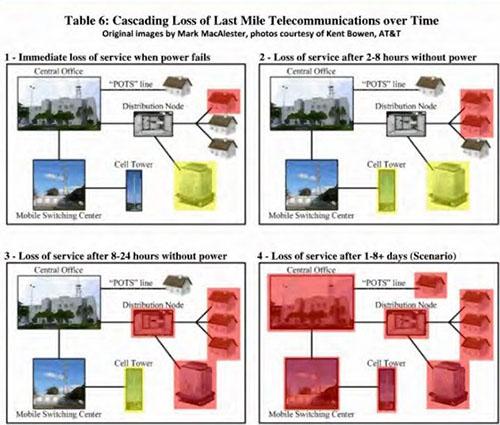
In this report they discussed something that was very interesting in terms of communications and infrastructure. It is called the “Cascading Loss of Last Mile Telecommunications over Time”. It’s a terrifying look at how over the span of 8 days all communications will fall, starting with communications from home telecom lines.
The diagram below offers up a telling scenario where this cascading loss takes its grip starting at the residential level and working its way through to the Central Office.EMP Recovery
The infrastructure needed to tackle EMP recovery is expensive and hard to make. That’s the deal. We are talking about things like oil cooled transformers that are 60,000 a piece and require special equipment to move around.
Special equipment that will likely not be EMP proof!
Recovery from an EMP is something of a pipe dream if we are honest and if the whole nation is affected. Maybe the military could bring up sections of the grid at a time, or maybe not. However, it really is more of a countdown on human life.
The survival of our society will depend on how many people die in the time it takes to recover from that EMP.
What to Make of all This Reporting?
There are two big takeaways from all these documents coming to light, research being done and even Donald Trump bringing the threat of an EMP to the forefront.
#1. People are Paying Attention
While we can all agree that our bloated government is full of people looking for a way to bide their time and get another day closer to pension, this keeps coming up. Grid down situations are a concern in the halls of government. I don’t think we can deny that.
Even the most cynical of us must agree that without electricity it gets much harder to collect taxes.
How far they will go to take action against an EMP threat is another thing entirely. However, we also have to be honest about our responsibility in this.
We the people cannot bray about small government all day and then complain that they aren’t 100% prepared to assist the public following a total grid down situation.
#2. A Prepper’s Responsibility
The second and more important takeaway from this report is that we have a responsibility to prepare and get as many others prepared as possible.
A widespread grid down situation is going to kill anyone who is not prepared for it. It’s even going to kill tons of people who are prepared for it. Now is the time to take action and make your action known. I really believe that us, preppers, can influence the world positively.
People might seem put off by the message but, trust me, they go home, and they think about putting up their own food and being ready for when disaster strikes.
If an EMP attack happened and you were on the other side of the country, what would you do? From time to time, my work required me to have to go out of town on business just like millions of other people each year. The distance and locations all vary with the need, but in a lot of cases, I am unable to be as equipped as I would normally be around my home town. In some cases, I travel internationally, but that is rare.
Sometimes I only travel an hour or two by car so I opt to drive. In this type of situation, I can take my Get Home Bag and usually a firearm (or two) with me. Most often it is several hundred miles away from home and to cities where firearms are not allowed. On business trips, it is harder to pack your survival supplies in sufficient quantities to last if some disaster happened and you needed to get home.
I started to consider what a person would need to think about and could possibly face if they were in a situation where an EMP attack, delivered by a warhead exploded over the US, total chaos ensued and you were forced to make it back home over a considerable difference.
In my scenario, the distance would be about 700 miles and the assumption with an EMP attack would be that there were not many electrical devices working. All cellular communications would be down as well as landlines were out of commission. TV and Radio networks had been taken offline even if some of the TV sets and radios themselves still worked. I don’t imagine every single electronic device in the world would go out forever, but it would be enough to create massive confusion, fear, and panic.
In addition to communication and access to news all access to money was cut off. Banks would slam shut and a bank holiday would be declared. Hospitals would quickly fill with the sick and injured and you would be on your own. How would you get back home and what would you need to consider if your home was 700 miles away and you had no survival supplies and no way to procure them.
Plan for an EMP attack before you travel
The average, healthy person on level terrain can comfortably walk about 20 miles in a day. In our scenario above, with no issues whatsoever, it would take you about 35 days to walk back home if you didn’t stop anywhere to take pictures. That is a very long time to be walking. There are a myriad of issues to consider in even starting a challenge like that.
Most backcountry hikers, who have plenty of gear and some expectation they are going to be roughing it, rarely set out on trips that long. Even backpackers, who hike the Appalachian Trail stop into towns, eat hot meals and pick up packages of goods they have stored along the way. How will you with minimal supplies even begin to hope to make it home alive? There are some items that I think you would need to have squared away in your mind first.
Should you stay in place or set out on foot?
What gear will you need?
How will you eat?
What route will you take?
An EMP attack could leave major metropolitan regions without power for weeks or years.
Should you stay or should you go after an EMP attack?
This will be the first mental challenge that you will be faced with and could determine if you will live or die. In all seriousness, the plans you make and more importantly your actions affect the situations down-line that you find yourself in.
We have all probably heard stories about travelers who had a “gut-feeling” that they shouldn’t get on a plane and the plane ended up crashing. Similarly, your “gut” is going to be screaming at you in a disaster. It is the well-known fight or flight response and you will need to figure out for yourself what you will be capable of doing mentally and physically before you set out on an expedition.
Hiking for over a month is a very monumental task that not a lot of people (including me) have any experience with. In days long past, a travel plan like this wasn’t so far out of the norm. We haven’t always had cars, trains and wagons to get us around and people walked. This is certainly doable, but for a lot of very good reasons, people didn’t live as long back then. Journeys of this scale take time, planning and skills.
Deciding whether or not you would even consider a trek like this is something you can do now. I know that I personally would try to make it back home to my family. I don’t know if I would make it, but I would be on the road somewhere. In my situation above, I would stick around a couple of days most likely to procure supplies, get any information I could, plan and prepare.
I think that a couple of days after an EMP attack everyone will be in shock, but that won’t last long. Eventually, people will panic and that is when you don’t want to be around. My wife already knows that if something like this happens, I am headed home but it might take me a while.
What are the chances of an EMP attack?
An EMP attack would be devastating to our entire way of life. If you stop for a second and think of just how many systems rely on electricity. From fuel pumps, to vehicles, to shipping and unloading machinery to refrigeration. Loss of electricity for a prolonged time could kill millions.
EMP is one of a small number of threats that can hold our society at risk of catastrophic consequences. EMP will cover the wide geographic region within line of sight to the nuclear weapon. It has the capability to produce significant damage to critical infrastructures and thus to the very fabric of US society, as well as to the ability of the United States and Western nations to project influence and military power. – The EMP Commission
What gear will you need?
As I said in the introduction, if I am driving anywhere, I pack a lot of supplies that would help me get back home in a disaster scenario like this. If you weren’t able to pack your Get Home Bag or any firearms, what would you do?
It helps to consider the journey back home and the different factors that you will encounter. Is this winter or summer? Will you have extreme temperature that needs to be planned for. What will you use for shelter? Security?
A good exercise if you find yourself in a scenario like this is to take stock of what you have. Empty your pockets of everything and conduct a simple inventory. When I travel, regardless of where I go I always have a bandanna, flashlight, multi-tool, and small hank of paracord. This is part of my everyday carry.
These items can really come in handy, but they wouldn’t be the only things I would count on to get me back home over 700 miles away. Depending on the season, I would try to acquire additional clothing if I needed it, but usually, I pack appropriate clothes for wherever I am going. What I don’t normally pack are clothes designed for living out in the woods for a month. Some modifications might have to happen.
A simple tarp and rope/bungie cords will provide shelter for you and will keep the elements off your head while you sleep. A big sheet of plastic would do the same. Is it the same as a nice backpacking tent? No, but it works and is lighter and speaking of lighter… You need an easy way to start a fire also.
Try to fit everything I needed into a standard size backpack that most everyone has. This way you will look just like everyone else headed home.
Great walking shoes that are already broken in would be a huge advantage. Actually, I think sturdy leather boots would be the perfect choice, but some people might have to hike back in dress shoes. If possible, I would look for boots as quickly as you can after deciding you are walking.
For security, you have to take what you can get if the grid crashes like this. At a minimum I would find a large stick or pole. Baseball bat would be my second choice but may be harder to find than a good old wooden stick. This needs to be sturdy enough to use as a walking stick or club to crack someone’s head open with if necessary. Additionally, it can be used to support your tent.
Money could either be worthless or crucial to you getting supplies in an EMP event. If you have your head screwed on tightly and have cash on hand, you may be able to run down to the sporting goods store and buy some needed supplies before you make your trip. When I travel I always try to have cash in my wallet. It isn’t enough to buy out the store, but could get me some crucial supplies.
I would caution you though to try and maintain a low profile. If you are all set up for a big backpacking expedition with the latest bag, gear and clothes you may be a target. Someone might want what you have (because they can’t get it) and try to take it from you. It’s better to keep a low profile and low weight will help the trip too.
I would try to fit everything I needed into a standard size backpack that most everyone has. This way you will look just like everyone else headed home.
How will you eat?
This will probably be the toughest part about a journey like this in my opinion. I think most people can walk long distances. Most people will be able to carry or find some relatively decent source of water, but most people won’t be able to find food. What do you do?
There is no way you could ever pack enough food to last you your entire journey. You more than likely won’t be able to set up traps like Bear Grylls and catch rabbits or fish from a stream with your pocket survival kit, but I could be wrong. I think a lot of people are going to be going several days at a time without food. Could you hole up somewhere and catch wild game? Of course you could and I am not knocking those skills. What I am going to try to do though is to get home as quickly as possible.
This may be where timing comes into play. Food from grocery stores will be wiped out in days. You could be one of the early birds and grab enough food to last you a week or so and set out. After that week, you will need to find food along the way. Will people have any to sell you or will there be some form of bartering set up already? I don’t know, but I think the sooner you can get home the better. As the realization that the power isn’t coming back on hits, people will be stingier with their food I imagine. The old rule is you can go 3 weeks without food but I don’t want to try and put that to the test.
What route will you take?
The final item to consider is how will you get back home. What route are you going to take to get there and this is where having maps will be invaluable for a couple of reasons. First, you want to plan your route and make sure you know which way you are going. I have on more than one occasion gone the wrong way and had to turn around and backtrack. Its easy to do this for twenty miles in a car, but if you are walking and realize you took a wrong turn, that could waste a day.
The second reason is I would use secondary roads as much as possible and not highways. I would also try to steer clear of major cities in my path. A highway is faster if you are traveling 70 miles an hour, but it might not be the most direct route you can take. Maps that show the secondary roads to your home will be good to have. Some may even be able to help you determine good places to stay. I would personally camp outside of cities and avoid people as much as possible, but I would want the flexibility to change that plan if needed. Everyone’s circumstances will be unique.
Hopefully, this was useful and gave you something to think about as you plan for your next trip. Please let me know if you have other suggestions in the comments below.
We don’t all get to choose where we live; at least, not the state we live in. For most of us, that’s determined by our work; we live where our jobs are. But what about when our jobs no longer determine where we live? Can that happen? It usually does when we reach retirement.
Granted, most people don’t move once they retire, but you’d be surprised how many people actually do. The area where I live has tens of thousands of retired winter residents who come down here to escape the cold weather “up north.” Some of those people come for the winter and just end up staying on, becoming permanent residents in the area. So if they can, you and I can too.
That raises the question of where we would go to retire, if we could go anywhere we want. As preppers, there’s more to that question for us, than there is for our friends and neighbors (unless they are preppers too). We obviously would want to go somewhere where we can live comfortably, even should a TEOTWAWKI scale disaster strike.
This is actually a fairly complex question, with a lot of factors involved. So let me see if I can thin it out a bit for you. I’m not going to tell you where you should go; but let me offer you a glimpse of states that you should avoid going to. I’m basing my decisions on the following criteria:
Population Density – The higher the population density of an area, the more of a fight for resources. This fight will probably hurt the poor, the aging and single mothers more than anyone, as they will not have the ability to fight. Survival of the fittest will take over, as people literally fight for the available resources. That’s enough to make many areas unattractive.
Average Annual Rainfall – We all know that water is going to be a problem in a post-disaster world. Areas with little rainfall and few rivers will be hard to live in. For most of us, the best way of harvesting water is probably going to be rainfall capture, so we’re going to need a lot of rainfall.
Political Leaning – While we all assume that government services and interference in our lives is going to be severely curtailed during a post-disaster situation, we have to think about the here and now as well. Many of the bluest states in the country are also the ones which are working the hardest to take away our Second Amendment rights. That alone is enough to say that those states aren’t a good place to move to.
Federally Owned Land – A lot of people talk about bugging out to the wild. That’s great; I have my own plans for that as well. But in most cases, the only practical place to bug out into the wild is federally owned land; national parks, national forests and other land under the control of the federal government. So states with little federal land ownership aren’t all that attractive for preppers to retire to.
Forestation – The most practical means of heating a home in a post-disaster world, especially one in which there is no electricity, is with wood. That means having a lot of forests available, where you can cut that wood. This leaves out huge swaths of the nation, such as the entire breadbasket, which is farmland, nor forests.
There may be other criteria which are important to consider; but I limited myself to those five. To me, those seem like the major ones which will affect a prepper’s ability to survive, both in a pre-disaster and a post-disaster world.
The Worst States
Based on that, here are my picks for the worst states to retire in, if you’re a prepper:
New York – I lived in upstate New York for a number of years and it is absolutely beautiful. There are miles and miles of hardwood forests, lakes and rivers. But even so, the state is one of the most heavily populated in the country. It is also one of the most left-leaning states, politically speaking, with some of the harshest anti-gun laws around. It would be a very difficult state to survive in.
California – In many ways, California and New York are copies of each other. Both have a high population and both are strongly blue. While California has a lot going for it, in the area of natural resources, it has the highest population of any state in the Union. We can expect many people to expand outwards from the major population centers, gobbling up everything in their path. I sure wouldn’t want to be in their path.
Florida – At first glance, Florida looks like a great place to go and a lot of people retire there. But much of the state is covered up by the Everglades. Unless you are going to learn how to survive in that harsh environment, it might not be a great place to be. The lack of forestation really isn’t much of an issue, as you aren’t really going to have to heat your home. But you are going to have to worry about hurricanes, which seem to have an affinity for the state.
Arizona – Another popular retirement state that’s going to be a mess in a post-disaster world. Arizona is extremely hot, even hotter than South Texas and the Florida peninsula. But there is very little water to be found. That alone is enough to put this state on our worst list. I seriously doubt there will be many people surviving in the heat of Arizona, without access to water.
Minnesota – Minnesota is known as “the land of 1,000 lakes” so there’s no shortage of water there. They’re pretty good in the forestation department too. So there’s actually a lot going for this state. But it and its neighbor Wisconsin have very high populations. Unless you could get way out in the boonies, it might be hard to avoid the crowds. Of course, way out in the boonies means the coldest parts of the state, so you have the problem of cold to contend with. That not only affects how much wood you need for your fire, but the very short growing season will make it hard to grow enough food to eat.
Granted, there are a lot of other states which we can rule out, based upon the same criteria. Pretty much all of both the eastern and western seaboards would be bad places to go, for the same reasons I’ve already mentioned. The trick is finding someplace that is good to move to.
My Picks for Best States
Everyone has their own opinion, but here are my top picks for the best states or regions for retiring in as a prepper. These choices were made based on the same criteria that I used for picking the worst states.
Eastern Texas – While Texas isn’t a perfect survival location, there are a lot of good areas in the Hill Country and eastern Texas where there is good forestation and water.
Idaho, Western Montana and Western Wyoming – This whole area is excellent; providing a lot of forestation, water, federally owned land, rainfall and good hunting. Although far enough north that cold would be a bit of a problem, I would call this the best area of the country to have a retirement home and/or survival retreat.
The Appalachian Mountains – This mountain range, passing through several states and changing names a number of times, is a great place to live. While there are some high population areas to avoid, there’s still a lot of back country, which would be ideal for our purposes. I’d avoid the Virginias though, for their political leaning.
The Gulf Coast – There’s a lot of good land in the gulf states, along with people who like to hunt and fish. While there really isn’t much government land to bug out to, there are lots of forests, lots of water and lots of game to hunt.
When I discuss the increased possibility of food shortages and food riots happening right here in the United States, people look at me like I have lost my mind. How could that ever happen in the richest country in the world where we have so much food we export it to other countries? The answer comes as a shock to many people.
Food Riots Are Not Always About Food Shortages
Food riots are about panic, not always reality. The best example is the insanity that happens every year with Christmas shoppers on Black Friday. The video clips of people getting trampled for an Xbox or a Barbie Doll are all over YouTube.
The fact is that there are plenty of gifts for everyone to buy, but the fear is that you won’t be able to get the exact item you want, when you want and at the price you want. This is what turns normal people into crazed Black Friday shoppers.
Food riots are all too frequently the same. The fact is that most Americans have a 3-day supply or more of food in their homes, and even if they missed a meal or two, they would be fine. However, when the news reports come out that stores are running low and panic sets in, we learn firsthand that stores have only a three day supply of food at best on the shelves, and they can get emptied in a matter of hours during a panic.
Food Riots Can Cause Food Shortages
So the fact is that very often, it is not a food shortage that causes a food riot. However, as crazy as it sounds, the opposite can happen. A food riot empties out store shelves and then suppliers become reluctant to ship food the next day, causing a real food shortage. Why don’t they ship the food?
There are two reasons that suppliers get gun-shy about shipping their food to the stores in such a scenario. The first is the obvious concern for safety for the drivers. Everyone remembers how during the Rodney King riots in Los Angeles the truck driver Reginald Denny was dragged from his truck and beaten half to death.
The second reason is that if the panic is due to fears of an impending economic collapse, then suppliers are concerned that they may not get paid for their shipments if their customers go under during the turbulent economic events that are just unfolding.
Or, even if the customer is rock-solid financially, the fact is that prices can easily skyrocket in this type of situation, and shipping the goods next week instead of this week could mean a huge price difference.
So now that we have looked at the mechanics of how food riots and food shortages can happen suddenly, the question we all have to ask ourselves is how stable and secure is our country’s financial situation.
If we are confident that our leaders have everything under control and the national debt and the budget deficit are no big deal, and nothing happening with the Euro will impact us here in America, then we have nothing to worry about and there is no need to take simple precautions to protect ourselves.
However, for most Americans familiar with our economic state of affairs and the way our leaders in Washington are dealing (or not dealing) with things, that is a big “if.”
If you have any dissatisfaction with my content, you can tell me here and I will fix the problem, because I care about every reader and even more so about your opinion!
According to Wikipedia: “An electromagnetic pulse (EMP), also a transient electromagnetic disturbance (TED), is a brief burst of electromagnetic energy. The origin of an EMP can be natural or artificial, and can occur as an electromagnetic field, as an electric field, as a magnetic field, or as a conducted electric current. The electromagnetic interference caused by an EMP can disrupt communications and damage electronic equipment. An EMP such as a lightning strike can physically damage objects such as buildings and aircraft. The management of EMP effects is a branch of electromagnetic compatibility (EMC) engineering.”
Whether you are a prepper or survivalist, preparing for an economic collapse, or merely a fan of the TV show “Doomsday Preppers” you have probably thought about a major power outage. An EMP attack, where a rogue nation or terrorist entity takes out the electrical power grid, is really one of the ‘worst case scenarios’ for our country, as we would be plunged into darkness, worse than the 19th century.
The reason it would be worse than the 19th century is because people back then were accustomed to a life without electricity; we are not. Not having electricity in your home is one thing, but if all of society lacked lighting, it would be utter chaos.
The first thing you would want to do is to stay home, as the streets would not be safe for a variety of reasons. If it was merely the power grid that failed, then streetlights and traffic signals would be out. If the EMP fried all electrical circuitry, then your vehicle wouldn’t even start.
Either way, the safety of your home would be the best place to be. Hopefully you have had the foresight to put together a family emergency communications plan and anyone who was caught away from home knows exactly what to do.
The first thing you would want to do is immediately fill the bathtub and all available containers with water, since the tap will be dry as soon as the water towers are emptied.
The second thing you’d want to do is to ready your emergency lighting, and prepare blackout curtains for your windows so that all of the neighbors don’t see how much light you have. The problem with being prepared is that it attracts the attention, and jealousy, of those who have chosen not to prepare.
Since the neighborhood will be very dark, any homes that have any lighting will be very obvious, and without blackout curtains someone could easily be spying in your window to see if they want to come and help themselves to your supplies.
The third thing to do after the power grid goes down is to make a plan for using up your perishable goods from your refrigerator and freezer. Cooking on a barbecue grill, either yours or a neighbors, may be your only option.
Rehearsing what to do if an EMP takes out the electrical power grid can be a fun way to spend a weekend, if you are committed to shutting off the electricity and really sticking with it. You don’t have to be a prepper or a survivalist to appreciate the confidence that comes from having taken steps toward emergency preparedness.
If you have any dissatisfaction with my content, you can tell me here and I will fix the problem, because I care about every reader and even more so about your opinion!
The crisis that France is going through today is not just another episode in an eternally agitated country. It is about a deep crisis of mode which will be solved only with the beginning of a new society. The country will go through several years of blockage, before embarking on a complete transformation, a revolution that will last at least a generation.
President Emmanuel Macron has just deliberately destroyed his constitutional authority
For several weeks, monster demonstrations have followed one another in France. There is no more fuel in the service stations of many departments and hundreds of tons of garbage are piling up in the centers of large cities.
President Emmanuel Macron has managed to impose a pension reform. His text solves no problem and creates many injustices. For example, people who started working at age 16 will only be able to access retirement with a number of working years greater than those granted to people who started at age 18. In a country that loves equality in law, this text should not have passed.
President Macron has deliberately created a deadlock situation in which no one has a possible exit. His government received all the unions for a year and a half to refuse all of their proposals. He attended mass demonstrations, all over the country, and particularly in medium-sized cities, without reacting. Then, he and the NUPES (left) (ER: note the collaboration of political forces) played on the calendar so that the deputies could not decide on this text at first reading; finally, he misused an exceptional provision of the Constitution to impose it at second reading.
To do this, he asked his Prime Minister, Elisabeth Borne, to hold his government accountable to the National Assembly under Article 49-3 of the Constitution. This one was imagined by its editors for specific emergency situations, unrelated to this one. Undoubtedly Charles De Gaulle and Michel Debré would never have done so under such circumstances.
At the end of the vote, only 9 votes out of 577 deputies were missing for the government’s motion of censure to cause his resignation. Automatically, the text, which was never put to the vote of the Assembly, was deemed to be “adopted”.
This coup is part of a long line of diktats ranging from measures for the repression of the “Yellow Vests” movement to the confinement of the healthy population during the Covid-19 epidemic, through a succession of orders and misuse of 49-3 (11 times in a year and a half). Even the French who convinced themselves of the justifications for the temporary limitation of their freedoms (ER: indeed they did!) now find that too much is too much. (Success, therefore?)
Now the country is cut in two. On the one hand, a small third of the population does not encounter any problem and wants Emmanuel Macron to allow the system to work longer to their advantage. On the other, more than two other thirds who are no longer hostile but find themselves in the same hatred. This evolution of collective emotions and the unity it engenders are new.
From his point of view, the president has won since his law is deemed “passed”. However, in practice, he lost since he brought together all the unions and what counts as popular political parties against him. Only parliamentary members of his party, Renaissance (ex-La République en Marche – ER: Macron started this ‘En Marche’ party, only to have to rebrand it, such being his popularity), supported him, as well as a few others claiming to be from the former Gaullist party, Les Républicains. 8 to 9 out of 10 French people are opposed to this text and are now convinced that the Executive has nothing to do with them.
The Republic, in the authentic sense of the term, is a regime that puts the general interest above all else. By dividing the country to such an extent, the president has betrayed it. Democracy is a form of institution that gives voice to the people. He also betrayed that. The situation is now blocked and the country has become ungovernable. No more important decisions can be made in the months or even years to come.
Only recourse to the people can unblock democratic institutions. The Constitution of the Fifth Republic provides for several solutions. The President could dissolve the Assembly and call a general election. But, for sure, his party would be pulverized. He could also call a referendum, but he would undoubtedly lose it. He will therefore do nothing and lock himself up to party at the Élysée Palace.
The pension reform marks the failure of the Macron method: the president promised to be above the right/left divide, he simply showed that he did not satisfy either one or the other.
Commentators wonder why Emmanuel Macron voluntarily placed himself in this trap. What was he pursuing? There is no political answer to these questions. Perhaps an economic response: he wants to advance funded retirement by sabotaging pay-as-you-go pensions. Perhaps a psychological answer: he is indifferent to the fate of others and likes to shock them (during his first election, I noted his behavior as a sociopath). If we follow this hypothesis, he will only find respite when he has completely discredited the 1958 Constitution and has acquired the certainty of being the last president of the Fifth Republic.
The political suicide of Emmanuel Macron and his desire to see the country collapse with him mask a very deep crisis. It is not by chance that the French successively elected an American agent at the head of the country, Nicolas Sarkozy, who destroyed the independence of France and violated the result of the referendum on the European Constitution by adopting the same text through parliamentary channels; then a petty bourgeois, François Hollande, who transformed the presidency of the Republic into vaudeville; and finally an investment banker who has made the Elysée Palace a reception hall for cocktail parties for American multi-billionaires. Four times (they re-elected Emmanuel Macron), the French took responsibility for this descent into hell. (ER: And we’re making the evidence-free claim that the ‘descent’, started by the US deep state, was taken to a much cleverer place than the original authors and architects ever imagined.)
Today, they have to deal with food and energy inflation of 20 to 25%. There is no longer a doctor in more than half of the territory and the hospitals are closing their emergency services. Above all, everyone notices that nothing is going right: the level of education has very dangerously collapsed, the police can no longer maintain order, the justice system does not have the means to do anything before two years (except when Macron weaponized the judiciary to go after the Yellow Vests in simply record time), the army is unable to respond to high intensity warfare. The problems are so numerous that one does not know where to start.
The French are beginning to realize that public services should not be patched up, but redesigned according to new realities: the computerization of the means of production and the globalization of trade. According to some, the crisis began in 2007, with the vote by Parliament of a text that had been rejected by referendum; or again, according to others, in 2005, with the riots in the Parisian suburbs; unless it was, in 1990, with the French participation in the United States war in the Gulf. Still, the country does not find itself in what its political class has become, and even less in the policy it leads.
Emmanuel Macron, who was elected with the promise of modernizing the country, appears today as the one who is blocking its transformation, who is preventing the emergence of a new society.
The French, who in 1789 took the initiative to overthrow the Old Regime and create modern society, hope to take another initiative to create a new world. They know indiscriminately that at the same time Africa is freeing itself from the domination of French governments and that Russia and China are reorganizing international relations, but they are very little informed on these subjects.
It is very surprising to observe their thirst for a new paradigm and their fear of plunging into a violent revolution. To resolve this crisis, it would be enough for their political class to listen to them, as King XVI did at the very beginning of the Revolution. But we are witnessing a dialogue of the deaf. During all the negotiations on the pension reform, the government conceded nothing at all to the unions. On the other hand, it multiplied the amendments with the parliamentarians, transforming the dialogue with the people into an internal debate of the political class. This attitude has closed all doors to peaceful exits.
The French have already noted the emptiness of the “great debates” and other “citizen conventions”. President Macron has already called for it. They participated, but their suggestions got lost in a bureaucratic maze. It will therefore not be possible to replay this charming staging for them.
In the months and years to come, nothing can change. The government will no longer be able to have a text adopted by Parliament and, in any case, its officials will no longer obey it. They will put troublesome files at the bottom of piles and drag them around. The French will no longer be able to protest without a savage repression falling on them, as has already been the case with the Yellow Vests.
The European elections, in 2024, and municipal elections, in 2026, will be an opportunity to isolate the host of the Élysée a little more before his departure, in 2027. Unless of course he admits that the only way to unblock the country is for him to resign.
Nobody has said it yet, but the Coronavirus has turned into a TEOTWAWKI event. Not the kind of “end of the world we knew” event that we all expected, but still one nevertheless. No matter how many people end up getting sick and how many die, the current changes in the ways we do things are so severe, that many of these are likely to end up becoming a permanent part of our society.
Some of them will not necessarily be for the best. Our government, at all levels, has taken a huge amount of authority upon itself, much of which is of questionable legality. While I don’t think that there are many people who would argue the government’s right to quarantine, shutting down churches and other places of worship as “non-essential” comes directly against our First Amendment rights.
But the real question is whether or not the government is going to be willing to give up all that control that they’ve taken. Historically, governments which gain control over something are not quick to give that control up. What’s to make any of us think that they will do so in this case?
Nevertheless, for the moment, many of us are obeying various government mandates to stay home, with companies telling as many of their employees that can, to do so as well. So, as we all sit in our homes, trying to telecommute with noisy kids in the background and our spouses on the other side of the table, working on their computer, we need to start thinking ahead. There will be an end to all this and we will have to emerge from our caves to see the light of the sun once again.
But what sort of world will we emerge into? Experts are forecasting that anywhere from 20 to 34 percent of our workforce will be laid off during the course of this pandemic. If we come anywhere near the top end of those predictions, it will be huge; much worse than the Great Depression. Unfortunately, from the viewpoint of where we are today, a worldwide economic depression seems to be in all of our futures, starting even before the pandemic burns out.
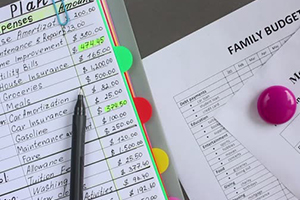
So how can you and I prepare ourselves for that coming depression? There are actually many things that we can do, but the first of them is to restructure our finances. Specifically, get rid of, or at least cut down on unnecessary expenses, so that we are ready when the depression hits.
Car Payments
Many families are paying more for their two car payments, than they are for their mortgage payment. If you think about that for a minute, it really doesn’t make much sense.
But cars and light trucks have gone up incredibly in price, at least partially due to all the bells and whistles they put on a car these days.
In a financial collapse, the people who are hit the hardest are those which are in debt. Those car payments are some of the biggest debt you have. So, it only makes sense to attack it first.
Trading your cars in for something used, but still in good condition, can save you a lot of money from your monthly payments. If you’re fortunate to find a good deal, you might even be able to get rid of one of those payments, really saving yourself some money.
Entertainment Expenses
The home computer has evolved into an entertainment center, or maybe the home entertainment center has evolved into a computer. Either way, many of us are spending a fair amount on cable service, plus an assortment of different movie websites. Netflix is no longer enough, producers have decided to divide and conquer, requiring us all to have multiple subscriptions in order to see all the movies we want to.
The obvious problem with this is that it can get rather expensive. Not only that, but it’s obviously an unnecessary expense. Now, I realize you might not agree with that, especially with your kids home from school. But at least find out how to cancel your subscriptions and have the information handy, so that if you have to, you can pull the plug on them.
Service Expenses
From mowing our lawns, through curbside pickup of our groceries, to having a mechanic repair our cars, we all pay others to do things for us. That’s fine, when you can afford it, helping others to have jobs.
But when the economy goes belly up, you’re going to need to save that money.
One of my favorite money saving techniques is that I’m a consummate do-it-yourselfer. I do everything from making gifts for my wife to making my own furniture, with car repairs somewhere in-between. The more you can do for yourself, the less you have to pay others to do. And in the midst of the next depression, you probably won’t be able to afford paying someone else to do it.
How much do you spend on coffee every month? Do you even know? How about every day? You should be able to figure that out.
That can add up to quite a bit over a month, especially if you’re buying the high-dollar made to order lattes and cappuccinos.
You can get just as good a cup of coffee, including all the assorted flavoring syrups, in your own kitchen. It might take a little experimentation to get it right, but you can probably even get a better cup of coffee than what you’re buying right now. And you can do it without paying seven bucks a cup.
Eating Out
Speaking of coffee, let’s expand on that idea. How much do you spend a month on eating out? If you happen to be the average American family, then that figure is somewhere between $250 and $300 per month. If you eat lunch out or from the cafeteria at work, that figure might be even higher.
There’s nothing wrong with eating out, just as long as it’s not in excess. How much is excess? That depends on how much you make. So for most of us, that figure is likely to be changing, sometime in the next few months. With that being the case, wouldn’t it be a good idea to start working on it now?
Don’t go overboard on take-out, just because you’re part of the lockdown going on. Take this time to experiment with some new recipes, so that you can keep your family happy, without having to eat out all the time.
Vices
Speaking of coffee again, there are those people who would call coffee an addiction.
This includes people who are at least emotionally addicted to having their two cups in the morning, before they are human enough to talk to anyone without biting their hand off.
Another word we can use for that is “vice”, a word normally associated with smoking, drinking, gambling, prostitution and drugs.
I’m not trying to accuse you of anything, but if you smoke or drink, this might be a good time to think of quitting. The cost of a few beers a day or a couple of packs of smokes may not seem like much, but it does add up. I’m sure you could find something better to do with the extra $150 to $350 a month than a two-pack-a-day habit can cost.
Unnecessary Monthly Payments
Creditors, especially the big credit card companies, have worked overtime to convince us all that the way to buy anything is on credit. That’s led us to having an average credit card debt of $6,028. While some of those purchases may have been necessities, I’d venture to guess that many are things we could have waited to buy, if we had a little more patience.
Either way, they are a problem or, more likely, they will be a problem when the economy collapses and we’re stuck holding that debt. As with any other debt, it will be one more (or several more) creditors calling and asking us when we’re going to pay our bills. If you’ve secured that debt with some sort of collateral, you might end up losing whatever you’ve put up to cover the debt.
Excessive Shopping
This one might cause some battles in your home, but how about cutting out unnecessary shopping? The trick here is to determine what really qualifies as unnecessary.
Women will say that all the “toys” that men buy are unnecessary and men will say that all the clothes their wives buy are. Either way, between the toys and the clothes, it can get really expensive.
Here’s something you can try, if you want to get a real handle on your shopping expenses. Make a deal with each other, that before you can buy something, you have to get the other to agree that it is necessary. If she wants a new pair of shoes, she’s got to convince her husband that she actually needs them. Likewise, if he wants to buy a tool, he’s got to convince her that he can’t do the pending repair or other project without it.
Quit Replacing Things
Long ago our society transitioned to being a disposable society. Other than some pretty major things, like cars and houses, we no longer repair anything.
We throw it away and replace it. In many cases, there’s no other option.
But we’ve gone far beyond that now, in that we don’t just replace things that are broken, we replace things that are just fine, for no other reason than because they are “old”.
Of course, our definition of old in many cases is highly subject to questioning, as last year’s cell phone model really isn’t old, just because the company has come out with a new one. Yet many of us will replace that phone, just to have the new one, “complaining” that our old one “Just doesn’t work right anymore”.
Smartphones aren’t the only thing we do this with. We also do it with eyeglasses, frying pans and even dishes. Once people had a mixed batch of dishes, because they kept using the remainder of a set, when some of them got broken. Today, we’ll throw away the rest of the set or donate it to charity, just so we can buy a new one.
There’s nothing wrong with using something that’s “old”, as long as it works. Why not try to see how long you can keep that cell phone or those glasses, rather than seeing how quickly you can replace them?
Avoid Gimmick Products
Our homes are filled with gimmicks and gadgets. Some are obvious, while others manage to slip under the radar. One of those is cleaning supplies. There’s really not much you can’t clean with Clorox in a spray bottle, but many of us have special cleaners for the bathtub, the kitchen, our appliances and even the toilet. Not so surprisingly, most of those “special” products are basically the same thing, in different packaging.
Figure out what you really need and stick with it. Don’t let Madison Avenue convince you that you need their latest product, just because it’s “New” and “Different”. It’s probably neither. All that’s new is the packaging and the advertising campaign.
Gun Control is a favorite tactic for many politicians on the left. It allows them to shift the blame from the person, whose worldviews and political party often aligns with theirs, to a simple tool they can ban. With an all Republican everything, you’d think we wouldn’t have to worry, but that’s far from true. These people seemingly always find a way to infiltrate politics and attempt to strip us of our God-given rights. So what do we do? How do we fight back if gun control legislation is proposed or passed?
#1. Learn How To Make Your Own
California is the beacon of cruddy gun control laws in the United States. They’ve gone above and beyond to reclassify your standard semi-automatic rifle into what they call an assault rifle. What we’ve seen is people and companies outsmarting the legislature at every turn. One of the most famous means was building your own gun. Specifically AR 15s. AR 15s are always on the chopping block, but even California couldn’t stop the signal.
With the advent of 80% lowers Californians were able to again build their own rifles within the law. The AR 15 is hardly the only weapon you can build. In fact, an enterprising patriot build can manufacture their own semi-auto Sten gun, Glocks, MAC 10/11s, AK rifles and more. The main issue is going to be acquiring the skills and tools needed to make these weapons. It takes a little mechanical skill and a lot of different tools.
It would be wise to start learning the insides and outsides of guns now. Learn to build them, acquire the tools, and fire up the Youtube machine. Here you’ll find as hard as they try they can’t stop the signal. You can build your own with a little practice, and it’s perfectly legal to do so. You aren’t just building guns, you are learning valuable skills regarding the construction and design of firearms that could be invaluable if things got really bad.
#2. Recognize the Gun Ban Matrix
One fact we’ve seen over and over again with anti-gunners is that they know absolutely nothing about guns. If the power these people had wasn’t so terrifying it would be hilarious. Every time they open their mouths about guns they say something incredibly stupid. They simply target guns that look scary and that’s it. That’s why the gun ban matrix exists. The gun ban matrix is a list of features and guns unlikely to be banned because anti-gunners are idiots and don’t understand firearms.
These are the guns you should consider investing in should sweeping legislation occur. In case the situations getting drastic and confiscation begins things may move too fast for people to react. In that event a neutered gun is better than no gun.
The first guns to go are going to be the traditional targets for anti-gunners, the AK 47s, the AR 15s, the Tavors, and the usual suspects. They may be banned by name, or by the features they share. A good alternative to these semi-auto rifles is the Ruger Mini 14 and Mini 30 series. They can be purchased in not so scary configurations.
Past the Mini 14 and Mini 30, there is the fixed magazine SKS rifle. It’s often left off ban lists, and it’s affordable and common. It’s limited to ten rounds, but with stripper clips, you can reload quite fast with practice.
Past this level we get into manually operated firearms, this includes pump-action shotguns, and lever and bolt action rifles. A good lever action rifle is a rapid firing gun and in the right caliber can hold up to 14 rounds. These guns are highly unlikely to be banned without a full constitutional amendment.
#3. Don’t Give A Single Inch
With the recent Las Vegas shooting there has been an increased interest in banning a firearm accessory known as a bump fire stock. These accessories are rather dumb and useless, and in no way did it make the shooter more lethal. Regardless of how dumb and useless they are there is no reason the firearms community should let them be banned without a fight. With the NRA even saying the ATF should reevaluate bump fire stocks.
This is how gun control starts, with tiny little cuts. We let them take one dumb accessory and next time they’ll push for something else, and they’ll keep pushing. Give them nothing, not a single inch. As gun rights advocates we have to defend what we have and go on the offensive. Fight back and take our God Given rights back.
#4. Push Back and Push Back Hard
If legislation gets passed regarding gun control, and I mean any legislation at all, we have to push back. The vast majority of gun owners are law abiding, tax paying, job having citizens who want nothing more than to live in peace. We all know actual gun control will do absolutely nothing to strip criminals of firearms, just good people who already obey the law.
If gun control happens as law abiding gun owners we have to flood the legislator’s offices with our demands. We have to protest, we have to write letters, we need to march on the capitals. In 2012 the gun community did an amazing job of coming together to resist any form of gun control. We need that same response to every law that passes, heck we need that reaction every gun control law that is even proposed.
We need to push at the local, state and federal level. Work every angle possible. We have to keep supporting companies that agree with our God-given rights, we have to join gun rights organizations of every kind. We literally have to put our money where our mouth is.
#5. Focus on the Small Politics as Much as the Large
It’s easy to forget the importance of local politics when it comes to federal gun control. Local and state politics can make all the difference. We saw Sheriff’s in states across the union step forward and say they would refuse to enforce federal gun control laws in their counties. We saw states and municipalities adopt laws that would act to nullify federal gun control laws.
If we can’t toss the anti-freedom and anti-gun bastards out of federal offices we can at least elect the right people at the local and state level to ensure the laws are useless.
Resist
As American citizens, we owe it to future generations to resist. Resist with every fiber we have. Resist gun control measures with everything we can. We need to prepare for the worst and always ready to resist.












 Preppgroup