How to Survive A Famine. Economic collapse can lead to a breakdown of society and mass food shortages

How to Survive A Famine

Economic collapse can lead to a breakdown of society and mass food shortages. Severe drought or weather, natural disasters, or a man-made catastrophe like an EMP can also bring on food shortages, and famine, followed by starvation. Millions go hungry. Countless people to die.Most Americans have only experienced the consequences of massive famine on their television screens. In 1981, in the movie The Road Warrior (played by Mel Gibson), this survivor in the apocalyptic wasteland of Australia experienced the results of widespread famine first hand. His way to survive: Dog food. Canned dog food.

I can’t remember the brand name. Alpo maybe. But does it even matter? The point is this: In a time of mass famine following nuclear war or some catastrophic disaster that takes place, people who survive may find themselves eating things they would never imagine themselves ever capable of eating. Or you simply starve to death.

Famine – A social and economic crisis that is often accompanied by widespread malnutrition and starvation which leads to epidemic and significantly increased mortality.

Here are a few good tips for preparing for a famine of Biblical proportions, a famine that experts believe could be a direct consequence of a widespread disaster, economic collapse, or even a nuclear terrorist attack, which is a growing risk today to the U.S.

Famine from EMP

The much talked about and feared EMP (electro-magnetic pulse) could also lead to famine, at least in the nation affected by the EMP. It’s not that an EMP will cause food to stop growing: Instead, a famine will take place when transportation comes to a halt and food out in counties and states where farming is plenty suddenly have no way to transport seasonal harvest to several million people out in distant cities.

Mass starvation on a widespread scale is a very real threat and can threaten your very survival. That includes your family and friends.

It also include your neighbors, yes that couple that seems so well put together. When pets start disappearing from around your neighborhood, it might be your neighbors behind the disappearances. After about 1 day without food your neighbors may resort to asking other neighbors for food, and then begging if no one is willing to hand over much.

Hungry People Group Up

What happens if you have a few neighbors that are unprepared? Those without may band together, and go after those who have. Guess what? If your neighbors don’t see you out looking for food, begging for food, and instead simply locking yourself inside your home, in their minds they’re going to suspect you’re sitting on a bunch of food.

If enough hungry people band together, they may decide to take it from you by force.

Finally, after about three days of your neighbors going hungry it’s possible that someone will mention “pets”; when day five rolls around, and still no food, there’s a good chance that it’s going to be open season on pets, I’m talking cats and dogs.

Have Stocks of Food, Water to Combat Famine

Do you understand now why it’s important to have at least a few weeks of extra food and water on hand? A famine resulting from any number of disasters has the potential to wreck havoc fast on Western nations. Having not experienced true hunger before, it is likely to affect Westerners more than it does say people in third world countries.

It may not happen right away, in the first few days of food shortages. But after several weeks food may start becoming sparse around the neighborhood; local church pantries may start running dry (outside of a miraculous provision from God, which is always a possibility, looking at the Bible). And then the day is going to come when there is simply no more food around the neighborhood.

Knowing how a few of your neighbors may act, you might want to buy yourself a ton of cheap bulk food like rice and beans, in addition to your typical emergency food stocks. That way you can at least have something to give to your neighbors, and hopefully keep them from turning on you, should they suspect that indeed you actually have quite a bit of food.

The End of the Old Kingdom- In the mid 22nd century B.C., Egypt was a hot bed of activity with a large population of people, which translated into a lot of mouths to feed; farming in the region provided food and the Nile River was a chief provider of water. Out of nowhere a brief change took place in the local climate that impacted Egypt’s food supply during the time of Unas (2381-2345). No one really understands what caused the weather problems; however, the results of this climate change seem clear.

Lake Moeris dried out, the Nile lowered, and bad harvests followed. Unfortunately for ancient Egypt, that spurred on a great famine throughout their lands. All of these factors also led to civil unrest and that meant crime and revolts.

The Old Kingdom never fully recovered.

Famine, Modern Day

The Causes of Famine and Mass Starvation

Famine can be caused by any number of factors. One of the most common reasons behind famine is climate change (as previously noted). When that happens drought, crop issues, and pestilence are often culprits.

Famine can also be brought on by war and political problems.

Politically, at different times in history, choices have been made by governments that have resulted in famines. Many times those in power have literally deprived the middle income and poor. In fact, many believe that the North Korean famine of the 1990s was a direct result of government actions forced on the people.

There are many who believe that almost all famine is — in essence — truly compelled more by politics than nature (in other words, problems that cause issues in the food supply can be handled by a pro-active government; one that is adequately prepared for a disaster and any food shortages that may arise).

Regardless, with the natural changes occurring all around us — some say climate change or global warming, others say the hand of God and the Bible “end times” of the modern world — the possibility of widespread famine due to climate change or widespread disaster is becoming more and more plausible, even in the United States of America.

What Does It Take To Survive A Famine?

Historically, the United States — unlike countries such as North Korea, for example — tries to make decisions that are in the best interests of its people.That’s the hope anyway; hope coming from the American people.

However, you shouldn’t assume that the United States will be able to come through for you. After all, if it wasn’t completely clear to you after Hurricane Katrina in New Orleans, we are not in charge of nature.

Still, political policies will play a huge role in determining whether or not we survive a famine. However, since that is in essence outside of our control (with the exception, of course, of the voting process) let’s talk about three other things that could help during a famine. Namely, these are growing food, storing food, and hunting, trapping and fishing.

Growing Food During A Famine

This one is tough to talk about simply because the task of growing food may be why the famine you’re dealing with is even happening. That said, consider that there may still be ways to grow food, at least on a small scale.

The Green Revolution — Okay, the Green Revolution basically refers to the spread of technologies for subsistence agriculture to countries that needed them: Things like pesticides, irrigation projects, and nitrogen fertilizer. These concepts and materials first spread to Mexico in 1943.

Now you’re probably asking what this has to do with surviving a famine on your own. Well, simply follow suit. In other words, you’ll need some know how, strong seeds (when shopping for seeds, ask for seeds that have the best chances to grow in sub-prime conditions), land, and pesticides / fertilizers.

If you’re worried about a famine in your neck of the woods, call a garden center and ask them what crops, pesticides, and fertilizers would work best in your area.

Regardless, during a famine growing food will almost certainly be a tough prospect. After all, if it were easy, then the famine wouldn’t be occurring, right?

Famine

Becoming A Survivor: Hunting, Trapping, And Fishing

In the CBS television show, Jericho, the story unfolds around a small Kansas town and its challenges trying to survive following a nuclear attack that has decimated the United States of America. As a result, the town of Jericho, Kansas begins to starve as a result of food shortages; at the same time, there isn’t an abundance of wildlife in the area, to provide food.

In other words, there’s not much to hunt. Even if there was, several towns and cities have too many people; there would just be too much competition between hunters in the early days and weeks of a disaster and famine; hunting in an area would be short lived and for most people unsuccessful. Those who went after big game (deer, elk, etc.) first would likely face the most challenges as a sudden increase in hunting would drive many of these animals out of the area.

Small Mammals, Birds, Snakes, And Insects On The Menu

Those willing to forgo big game instead for small animals like rabbit, duck, turkey, squirrels, cats and dogs (in a worst case scenario), stand to have the best chances of bringing home a meal in a time like this. In most communities, there are a number of small mammals and even reptiles like snakes that make a tasty meal in a time of need. You just have to be willing to look outside the traditional Western diet and you’ll find a number of foods, even things like insects and earthworms, to get you by on days when there’s simply nothing to eat.

If you learn to think like a survivor, you’ll find that these things are actually a lot easier to eat than you might believe today.

With small mammals, birds, snakes and insects on the menu, that doesn’t mean there won’t be any big game out there; as covered in a previous article on hunting big game, you’re going to need to go to remote areas — the more remote the better.

That’s because experienced hunters will target prime areas (which will be semi-remote) first; because they know how to hunt, and they understand the dynamic of “hunting pressure” and how it drives big game quickly out of an area. As a rule of thumb, if you want to hunt in a time like this, seek out wilderness areas that are deep in the wilderness and beyond those semi-remote areas. Now you’ll have the best chances of finding big game that hasn’t been spooked by a drastic increase in “hunting pressure”.

Finally, when it comes to hunting, those with experience and knowledge of the land stand to do best. Those without experience or basic knowledge, stand to fail miserably.

For all of you non-hunters, there’s one thing you need to know right now.

You’re going to need hunting gear and weapons.

Tools Of The Trade

If you believe there is a chance in the coming months and years that a famine might occur in your neck of the woods, then seriously consider purchasing a gun. As back-up, get yourself a crossbow with a good scope. After all, both a rifle and crossbow are proven tools when it comes to hunting. A crossbow is relatively easy to shoot and you can do quite a bit of urban hunting without alarming local town folk with sounds of gun fire.

Of course, you may need a gun to defend yourself. Count on a firearm first, before a crossbow, in purposes of self defense.

Squeamish about guns? The good thing is that there are alternatives (like crossbows, long bows, and compound bows, for example). Though, to be frank, nothing works better for hunting than a firearm.

What else should you have on hand for surviving a time of mass famine? Here’s a list:

1. Fishing pole and nets, or just strong line and plenty of hooks (know the water sources you’re likely to fish and then have the proper gear on hand to give yourself the best chances of success).
2. Traps and snare wire
3. Bait for whatever small mammals are most common in your area and most palatable
4. Crabbing gear (if you live in an area where crabbing is possible)
5. Camouflaged clothing (choose colors that best blend with the wilderness areas you’re likely to hunt).
6. Hunting knife

And there are a host of other things that might come in handy depending on what you’re hunting for and the area of the world you live in. Talk to experienced hunting guides in your region or the region you plan to relocate to in a time of disaster. Discuss everything from big game and small mammals to wild birds and even predators.

Then talk to some fishing guides. Discuss everything from lakes and rivers, to even streams (crawdads, crayfish), and finally the coast, if you live near the ocean.

Storing Food

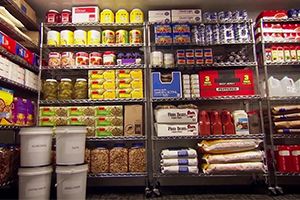
Preparation is the key to everything from coaching a football team to rallying your friends and family to survive during a famine or mass starvation. Thus, if you’re worried — and if you look around, you’ll probably realize that you should be — you might want to start buying non-perishable food items with a shelf-life of several years. At the same time, keep a revolving supply of non-perishable food items with a shelf life of just a few months. You can eat that food first, and then turn to foods like freeze-dried food after you’ve gone through the good stuff.

After all, growing food and hunting when the demand is high will probably not always go your way. Most people are going to be unprepared and just unable to make growing and hunting food a tool to count on in a time of disaster.

Along with this, it would be prudent to get your hands on foods like white and brown rice, wheat, and beans. When appropriately packaged and stored, these foods can sometimes last for decades. Speaking of storing dry foods appropriately, here are some things to consider:

1. Have #10 cans on hand (so you can do your own canning).

2. Have foil pouches (made multi layer laminated plastic and aluminum).

3. Buy a number of bottles made of polyethylene terephthalate (PETE bottles). These are used for long term dry food storage.

Further, dry foods should be stored at a temperature of 75 degrees F/ 24 degrees C or lower (recommended). If this prerequisite cannot be met, the foods should be rotated. Beyond that, moisture should be kept to a minimum (one way to help this along is to keep containers off the floor).

Also, keep things like cooking oil and long term storage items (oftentimes in PETE bottles) out of the light. And, of course, keep all foods protected in pouches or bottles (as this will serve many functions, one of which is to protect from insects / rodents).

Finally, to help reduce the threat of moisture, include oxygen absorbing packets in food storage containers.

There are several ways you can use these, so read the directions carefully. In fact, teach yourself the proper ways of using oxygen absorbing packets. Serious problems can occur when directions aren’t followed correctly (this is true for food storage in general, not just oxygen absorbing packets).

When in doubt, check with professionals in the field.

Last, but certainly not least, there’s the perishable items. Obviously, meats will need to be stored frozen. Further, it would be prudent to consume these first. The same can be said for fresh vegetables and fruit. Don’t go into your dry food stash until it’s needed.

Famine is a broad topic that can come about for a host of reasons. The way to combat famine can change depending on the situation.

Famine Caused By Natural Disaster Or Nuclear Attack

If your area is hit by a devastating natural disaster, such as an earthquake or tsunami — or worse even an asteroid or massive volcano eruption in the region — or if multiple cities are destroyed in a nuclear attack, access to food can shut down across the country overnight.

In a situation like this, you can find yourself quickly without food (and without drinking water, depending on the severity of the disaster). Seriously consider a back-up supply of food and water to support you and your family for up to 90 days or longer.

Just in case things get really chaotic in the world, you may want to have a back-up supply of food and water that can last you and your family six months or more, and then plans for resupplying your food and water as it runs low.

With disaster and probable famine looming on the horizon, due to the number of threats all seemingly lining up with the times we’re living in, stocking up on non-perishable foods , large jugs of water, and cash — if your bank is closed indefinitely or there is no power for an extended period, credit and debit cards will be useless — as well as things to barter with like ammunition, water filtration devices, and bulk coffee may be a smart move.

Imagine The Following Scenario: Your Vehicle Is Broken Down and You Have to Leave It For A Period Of Time As You Need to Find, Tools, Parts, Or Fuel- How to Conceal Weapons in Your Vehicle

First, let me give you a little background.

I am a retired Army Senior NCO, Retired Master Peace Officer, drug interdiction officer and for the last 4 years, a military-contracted counter explosive canine handler in Afghanistan and Iraq.

My job depended on finding things people did not what found. I have literally searched, and taken apart thousands of vehicles in my career.

This article is about where to hide your stuff in the vehicle. Since carrying a weapon in your vehicle is legal in most of the USA, this article is geared more to hiding your weapons from those uninvited looters and scavengers who are inevitably going to come around in a social/government breakdown situation. Yes, I’m talking about the proverbial SHTF times.

So, let us set some ground rules. We are going to talk about two types of vehicles, handguns and long guns, as well as ammo. These are no concealment techniques that let you get to your firearms at a moment’s notice. This is about hidden storage that others, unless very skilled, will not find. This is for storage.

Imagine the following scenario: your vehicle is broken down and you have to leave it for a period of time as you need to find, tools, parts, or fuel. You can’t reasonably carry everything, so you are counting on your hidden cache of weapons to still be there upon your return. Or, your vehicle is parked outside, the looters and scavengers come through the area and ransack every vehicle on the block taking what they can easily steal. You don’t want them to find your stuff that was hidden. This is what this article is about. That being said, let’s get to it.

Sedan

The modern sedan has plenty of places to hide weapons. I will start with the accessible places inside the vehicle.

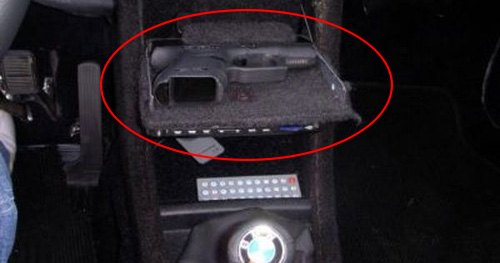
center console concealed weapon

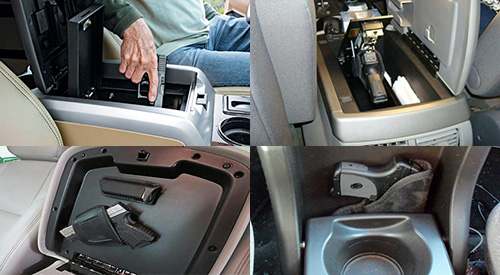
Under the center console. The center console is held to the floor in most sedans by a series of plastic clips or a few Phillip’s screws. Remove those and the console lifts up exposing a compartment that will house a rather large pistol and a couple boxes of ammo.

back seat bucket

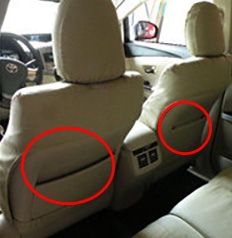
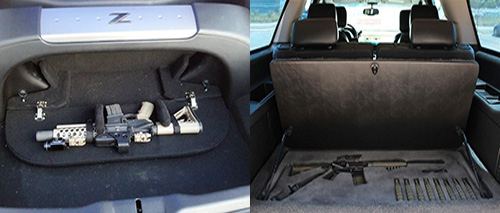
Seat Backs. The modern car has bucket seats. The back of the seats has a cover that simply snaps onto the seat and covers the springs. This area will conceal a pistol, ammo, and a short barrel long gun like an MP5 or Uzi.  Snap the seat back in place and no one will know it is there. This is also very fast to access if needed.  No tools required.

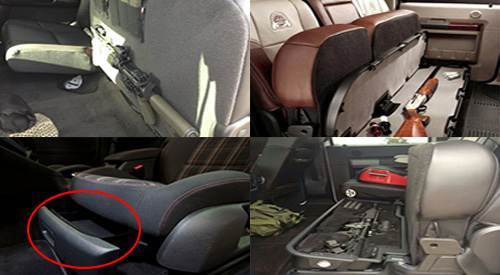
Under seatsI’m not talking about just on the floor under the seat. What we are talking about here is attached to the underside of the seat by tape, zip ties or something else. This keeps it out of sight if someone looks under the seat but it is still there if you just know where to look.

Other examples:

Inside door panels. You can hide a shotgun with a folding stock or a short rifle here. Clips and a couple of screws hold the door panels in place. You could remove the screws and leave them out but a sharp eye will notice something is amiss. My advice is to always put everything back the way it was so there will be no “giveaways” that there could be something behind the panel that is worth hiding.

behind radio weapon

Behind the radio. The radio will have four holes in the corners. Look at yours and you will see them. Most folks don’t realize all you have to do is insert metal rods, about the size of a wire coat hanger in these holes and the entire stereo slides out, leaving a very large cavity to hide weapons and ammo behind.

Now for the outside of the vehicle

Outside. The bumpers, front and rear have cavities under them that will hold a shotgun or rifle. Duct tape is a wonderful thing and you will be using it.

Open the hood. Inside the fender wells, you will see several places to hide your firearms. Inside the air cleaner box is a good place for a pistol.

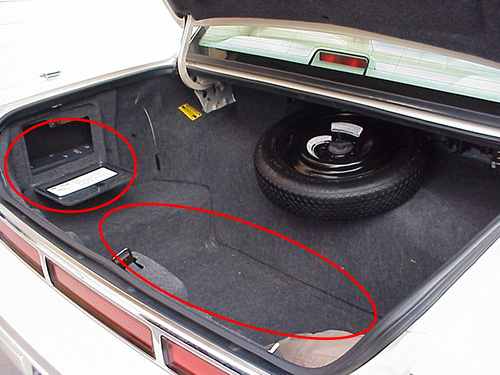
In the trunk. I don’t really suggest this area as it is very easy to detect but in a pinch, it may do. Pull the carpet away from the sides of the trunk. It will be attached to a cardboard backing. Place your weapons behind this, in the cavity that is in the lower part of the rear fender, and replace the trunk lining. If you have done this carefully, it will be undetectable to the untrained eye. I also suggest throwing some old rags or a little dirt in the area to make it look as if it has not been disturbed.

Other examples:

trunk concealed weapons

SUV or Truck

You have many more places to work with here. Count all of the same places mentioned for the inside of the sedan above. Those hiding places are common to just about all vehicles.

Starting at the front

The Front Bumper. Under the front bumper is a very large area to store weapons.  Tape them in a secure place. You can hide a lot of stuff here.

Front Fenders. From under the hood you have access to a very large area to place a rifle bag full of goodies.  It will fit in behind the fender well and be very hard to see without knowing it is there.

Air Box System. This is a common place for pistols and ammo. Placing a weapon here will not affect the operation of the vehicle.

Under the vehicle. The modern SUV/Truck frame is an I Beam type structure. This is a natural shelf for all sorts of things.  A few large black Zip Ties will hold a rifle, shotgun, and a lot more. These will not be visible from just bending down and looking under the vehicle. A person would have to get under the vehicle and really look for them to find your hidden arsenal.

Roof. The roof of all modern SUVs and Trucks is actually hollow. Remove the third stop light that is at the top and rear of the cab. Pull that out and you will see a vast area to hide magazines, ammo, and other items. The way to do this is to tape a string to each item with duct tape and string them together.  Replace the stop light after you have hidden your items in the roof section. Make sure you tape the end of the string to the back of the light or to an area that is concealed but you can reach again. Then to retrieve, all you do is take out the light, pull the string and the items come out one after another.

Tailgate. This is hollow. The inside can be accessed through the latch assembly OR by splitting the tailgate by removing the screws and bolts that hold it together. I have seen tailgates that were split and then resealed with silicone. To open you just cut the silicone with a razor-blade and pull the two halves apart. Not all tailgates are the same, so you may have to adapt to your situation.

Rear Bumper. Like the front of the truck, there is a vast amount of storage space.

spare tire weapons

Spare Tires. Placing something inside a tire is a real pain in the rear, but hiding an item on top of the tire is easy. Lower the spare tire; most are cranked down to the ground with the jack handle. Once on the ground you can place your items inside the rim and crank the tire back into place. This is a simple and readily available storage area.

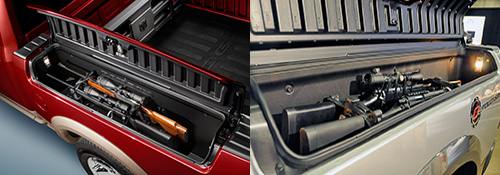
concealed weapons truck rears

Depending on your ingenuity, time you want to spend, if you want to modify the vehicle or not, it is not hard to make your vehicle a rolling arsenal and no one would ever suspect was holding weapons and ammo in every corner.

End thoughts

If you really feel this may be something that you have to deal with, I suggest throwing your roving horde of scavengers off the trail. If you have to abandon your vehicle and you are pretty sure it will get at least looked at, give them something to go after. Leave a useless (as in not functioning) pistol or something in plain sight. Let them take that and stop searching. Basically, throw them a bone. The whole point about concealing your weapons so that the looters won’t find them is just that: concealment. Make sure you leave no signs, no pointers that say “Hey, Look Here!”. Do this and when you return to your vehicle from something as simple as a walk into the woods to take care of bodily functions, you can rest assure when you get back your stuff with be safe and secure.

Exploiting the Pandemic to Target Indigenous Communities in Latin America

As coronavirus spreads in Latin America, indigenous peoples find themselves at imminent risk of annihilation should the pandemic break out in their communities. The Coordinator of Indigenous Organisations of the Amazon Basin (COICA) has written to the governments of countries which share the Amazon rainforest to enforce control on movement in and out of the indigenous territories, to help prevent a possible contagion.

However, the virus spread is not the only danger for indigenous communities. In Colombia, unknown assailants killed two indigenous people and wounded two others. All victims were in their home observing quarantine. Far-right paramilitaries are suspected to have carried out the attack, with full impunity from the Colombian government due to its reluctance to investigate criminal activity and the targeting of the indigenous populations on their lands.

Indigenous representatives have asked the government to implement a ceasefire to regulate the precarious political situation. Failure to regulate hostilities would exacerbate the already violent conditions under which indigenous communities live, especially with the virus threat looming.

In Ecuador, the Confederation of Indigenous Nationalities of the Ecuadorean Amazon (CONFENAIE) closed access to the rainforest for non-indigenous people and companies, demanding a complete halt to industrial activity as a means to prevent the coronavirus from reaching their communities. Two cases of coronavirus – both tourists who visited the forest – have been confirmed, thus raising the alarm and a possible threat of extinction for indigenous people in the area.

Across Latin America, indigenous populations are emulating Ecuador’s approach, with communities taking the initiative to protect themselves by blocking access to their lands and staying on their territory. The action taken by indigenous communities is a form of resistance which governments have criminalised in the past within the context of multinational companies’ exploitation of land and natural resources. For indigenous communities, the current protection for their own well-being to prevent a coronavirus outbreak is also the means through which a statement can be made about land ownership which, in Brazil and Chile for example, will be in direct confrontation with the governments’ plans for industrialisation of the Amazon and the Araucania, respectively.

Brazil’s President Jair Bolsonaro has taken the coronavirus spread lightly, prioritising profit over health and refusing to set strict quarantine rules. The poor are suffering the most, rationalised the president who has squandered Brazil to neoliberal profits. Bolsonaro has also threatened to fire Health Minister Luis Henrique Mendetta after the latter emphasised the importance of quarantine and refused the president’s rhetoric that coronavirus could be treated with medication used for malaria.

Refuting pandemic evidence constitutes additional dangers to indigenous communities in Brazil’s Amazon. An indigenous woman from the Kokama tribe in Brazil’s Amazon has contracted the coronavirus, raising fears of the spread among the communities. If industries – notably mining and agribusiness companies – disregard quarantine which the president himself is not taking seriously, both the risk of contamination and the risk of violence against indigenous people will be heightened. Undoubtedly, the communities will be on alert for any disruption that could jeopardise their communities’ health. However, with the government offering no protection, it is possible that there will be an escalation of violence committed with complete impunity from the government.

The danger for indigenous communities and environmental activists is unlikely to drop in the coming months. Colombia is one example of exploiting the coronavirus pandemic to target indigenous people. For right-wing governments in the region, the pandemic presents an opportunity to combine two deadly weapons – a virus and state impunity – to criminalise and target indigenous communities and their activism. Always elusive, governments’ accountability in this period is likely to become even more inaccessible through state and multinational violence cooperation, if there is no complete cessation of incursions into indigenous terrain.

This Is How Much Food You’ll Need for the Next 6 Months

How long will the pandemic last?

This question has caused more panic than any other, since the beginning of the outbreak. We have heard everything from 3 months to 2 years.

Our president spat out ’18 months’ at a press conference. Of course, we have no idea what any of that means.

The question people really want to be answered is, ‘how long will it be till things go back to normal.’

No one knows. So, we must prepare and plan to have food for months whether the supermarket has some food or no food. We are preppers.

This is what we do. However, when you start making big plans like adding 6 months of food storage to your plan there are some things to consider.

Preference

I am going to tell you about caloric intake equations, nutritional balance, and foods that store well. Remember, your food storage plan is YOURS and it should be built around preference. One of the things I lean on heavily in my own preparedness plan is oatmeal.

It’s a multipurpose food and a highly nutritious complex carbohydrate breakfast that is great for feeding the body. It can be made delicious with a sprinkle of sugar and cinnamon. If you hate oatmeal than don’t store it!

You and your family should be storing the food you like to eat above all else. This is food storage lesson #1.

When I first started prepping, in 2011, I found tons of blogs telling me about the importance of hard red wheat. Everyone needed buckets of hard red wheat! If you didn’t have it, you were unprepared for the coming collapse.

I had never used hard red wheat before, nor did I have a grinder at the time. I bought a Super pail anyway because I was influenced by fear and by others who proclaimed its necessity.

Mind your preference when it comes to food storage.

My Top Food Storage Picks

These food storage items are my preference and I chose most of them because they are multipurpose and provide my family with a variety of nutrients. These are also supplemented by gardening though we calculate for needed calories without the garden.

The garden is caloric and nutritional bonus.

  • Rice
  • Beans
  • Eggs
  • Oatmeal
  • Cornmeal
  • Flour
  • Sugar
  • Salt
  • Oil

Calculating 6 Months of Food Storage

Let’s start with the basics. We should first calculate how many calories we are going to need, in total, to feed our families for 6 months. That is the most important step in this process. If we are unsure about the total calories needed, we will vastly underprepare because 6 months of food is A LOT!

The RDA is 2000 calories per person per day. Preppers could argue for 2500 to 3000 because of a greater workload in SHTF. Then again, you might want to take a rationing mindset and prepare for 1500 calories per person per day.

Preference

We are going to look at these equations based on a 2000 calorie diet just to keep it easy.

2000 calories per day X the number of people in your home. This will give you your daily caloric needs.

8000 calories per day for a family of 4 X 31 days in a month gives you 248,000 calories per month

For 6 months you are looking at 1,488,000 calories for 6 months if you are feeding a family of four with 2000 calories per day.

Nutritional Balance

Of course, things are a little more complicated than just stacking up calories to the roof. Have you ever heard of rabbit starvation? It can happen to people who don’t get enough fat in their diet from eating very lean rabbits only.

Rabbits are a great protein source, but you need other things to eat alongside them.

Your food storage will need to include things like fats and proteins in the right amounts to assure you have the proper nutritional balance. So, what does that look like? I am going to give you some figures for this nutritional balance. These numbers are for an active person. A sedentary lifestyle will require less.

Protein – A good average for protein intake is going to be around 80 grams. You will need less if you are a small person and as much as 100 grams or more if you are a big active person.

Carbs – The best balance for healthy carb intake is right around 100-150 grams per day. However, in a survival situation you might up that to deal with the rigors or simply to cope with the serious stress of it all. You might also be eating more carbs because that is what you have stored up.

Fats – I often wonder how many people put their bodies through utter hell by cutting all the fat out of their diet in the 90s. Fat is incredibly beneficial to your diet. You want about 400 calories per day from fat. Based on a 2000 calorie per day diet you are going to want around 55 to 80 grams of fat.

A great ration to remember is 30:30:40 and that is 30% fat/30% protein/ 40% carbs. Of course, this will be adjusted if you are dealing with some sort of carb excluding diet. However, for planning and prepping purposes keep this in your back pocket.

Learning to Cook

One of the core skills that all preppers should practice is cooking from scratch. When you look at the list of ingredients above you should be looking at a world of possibilities. You can make all sorts of bread, pastries, tortillas, tostadas and full meals with just those ingredients above.

I see that list as unlimited potential because I spent years making foods with those ingredients. Now is the time for you to become proficient with the mixing bowl and in front of the oven.

We all have at least one complaint about isolation. If you are feeling bored spend some time baking something new. Cook a big pot of beans and see how they turn out. We store a lot of rice and beans but most of America eats beans out of a can.

Tactical training is cool, bushcraft skills get respect but food production and cooking have been the driving force behind all-conquering armies and civilizations throughout all of history.

6 months of long-term food storage is a pretty decent goal for any prepper. It’s very rare that we face a catastrophe that cuts us off the food supply for more than 3 months let alone 6 months. Of course, there is always the threat of that one event that changes the world forever.

Still, in a situation like that, you are eating off food storage while you set up your own inputs for food production. If the whole world goes offline you won’t be sitting around waiting for Walmart to open back up. You will either be hunting, farming, homesteading or some amalgamation.

Since I started prepping there are a handful of preps that truly help me rest at night. Food storage is one of those preps. Having extra food on hand for hard times is one of those things that I would have done even earlier if I knew how good it would feel to have that prong of my preparedness plan sharpened up.

The 5 Places In America You DON’T Want To Be When Society Collapses (Every region in the US certainly has its pros and cons, but these are the areas where the cons outweigh the positives the most)

What would you say is the number one threat to lead to an end-of-the-world-like scenario? A terrorist attack? An EMP strike? A natural disaster? An economic collapse?

All of these are possibilities, but in each one, a thick population density will make it far worse. There’s no denying that people panic when a crisis occurs, and that panic is only multiplied when more people are living closely to one another.

More people will be killed in a shorter period of time in the major cities, the roads will be clogged as people and families try to escape, and furthermore, just look at the other threats that we listed first. Many of them are directly connected to population density.

If an economic collapse were to occur, then urbanized cities would be simply unable to rebuild their economies as fast as more rural areas (with coal mining, logging, farmer’s markets, etc.) could.

This guide below can help you in a survival situation

If society collapses, you can bet that the foods the pioneers ate will become dietary staples

The Lost Ways prepares you to deal with worst-case scenarios with the minimum amount of resources just like our forefathers lived their lives, totally independent from electricity, cars, or modern technology.

So pay chose attention because this video will change your life forever for the good!

There are other factors that make certain areas in America unsafe and unsuitable for outlasting an apocalypse:

  • Strong natural disaster risks
  • A weak economy
  • High crime rates
  • Strict gun laws
  • A high cost of living
  • High taxes
  • Heavy traffic
  • Unfertile land for growing crops
  • Close proximity to nuclear/chemical power plants
  • Low populations of wild game and edible plants
  • Limited fresh water

In this story, we’re going to list out the five very worst retreat areas in the United States. These are the areas where you will definitely not want to be when disaster strikes, and if you live in or near any of these areas now, you may want to consider moving or have an alternate plan:

1. East Coast

Many survival and disaster experts agree that the East and West Coasts together are among the worst locations to survive a long-term disaster in the United States. This is because both meet the “unsafe factors” we just outlined. High population density? Check. High cost of living? Check.  Strict Gun Laws? For the Northeastern states, check. High crime rate? In many cities, yes. High taxes and regulations? In the Northeastern states yes. Heavy traffic? Check. Threat of natural disaster, namely hurricanes? Check. Low populations of wild game and edible plants? Check. Potential enemy nuclear targets? For the major cities, definitely.

As a general rule of thumb, avoid anywhere along the East Coast if you can. It’s simply not a safe place if you want to survive a disaster. If you do live on or near the East Coast, fall back to retreat areas in the Appalachian Mountains or northern New England, like New Hampshire or Maine, when worst comes to worst.

2. West Coast

The 5 Places In America You DON’T Want To Be When Society Collapses

Many of our concerns expressed with the East Coast apply to the West Coast as well. The largest state along the West Coast, California, is already an economic disaster and thus not somewhere you would want to be in an economic collapse. Washington and Oregon are both, by far, better off economic-wise, but they still have their problems with high taxes, tough regulations and large government spending. The major cities of San Diego, Los Angeles, San Francisco and Seattle have extremely high population densities and are potential terrorist/nuclear targets.

In addition, the West Coast lies along the Ring of Fire, which adds earthquakes to the list of natural disaster risks to worry about. If you don’t think earthquakes are that big of a deal, well, just look at what happened to Japan in 2011. Plus, in Washington, you have volcanoes. All in all, both the East and West Coasts are dangerous hotspots in an apocalyptic-type scenario and are not recommended.

3. Florida

Florida, in general, is not somewhere you will want to be during a disaster. Not to mention the ever looming threat of hurricanes in the state, Florida also endures a high crime rate, a collapsed housing market and high costs of living, a very dense population, and the fact that much of the state is actually below sea level (the parts of the state that are higher aren’t above it by much).

There’s no denying that Florida has nice weather, which is why many people move there in the first place, but its negatives far outweigh its positives to the point that it’s one of the worst retreat locations you could be in for outlasting a long-term disaster.

4. Alaska

Woah, woah, wait, Alaska? The so-called “last frontier” in America is one of the worst places to survive an apocalypse? First of all, Alaska does have a few positives (not to mention the beauty of its geography) that would make it an initially attractive place to live for someone who wants to be in a safe region from a major disaster. It is true that Alaska has the lowest population density of all 50 states, along with low tax rates. It also has a great abundance of rivers, lakes, wildlife and edible plants.

But when we come to economics, Alaska is practically cut off from the rest of the United States. A lot of the supplies that Alaskans rely on are either flown or shipped into the state. In a disaster scenario, these planes and ships will likely no longer be making shipments, greatly limiting available resources. Furthermore, those who live more inland in Alaska will be extremely limited in what they can do with commerce.

The 5 Places In America You DON’T Want To Be When Society Collapses

Remember when we noted that the West Coast of the USA is prone to earthquakes due to being situated along the Ring of Fire? Well, so is Alaska. There’s also very limited transportation to get oil from the North Slope to where it needs to go, and much of the fuel that Alaskans use is already brought in from the Lower 48 states. The winters in Alaska can also be quite cold and brutal.

Alaska may seem like the prepper’s haven, but on closer inspection it becomes apparent that you’re going to have a much tougher time surviving there than you would think. This is one place you may want to avoid, unless you know how to live 100 percent off the grid.

5. Hawaii

Like Florida, Hawaii may be a great place to vacation, but it’s an utterly terrible location to be in during an apocalyptic scenario. Most of Hawaii’s resources, as with Alaska, are shipped in.  This includes food and fuel. That’s on top of a very high cost of living in the state coupled with generally poor farming soil.

Gun laws are very strict in the state, and there are many military bases on the islands that could be the targets of enemy attacks. Let’s also not forget one more thing: Should a big enough natural disaster ever happen to Hawaii, how will you escape? After all, it’s a series of islands in the middle of the Pacific Ocean. Unless you have access to a plane or a ship, you may be toast.

Every region in the US certainly has its pros and cons, but these are the areas where the cons outweigh the positives the most.

Here’s just a small glimpse of what you’ll find in The Lost SuperFoods:

The US Army’s Forgotten Food Miracle And 126 Superfoods That You Can Store Without Refrigeration for Years

Watch the video below!

The First 19 Foods You Should Stockpile For Disaster- A good stockpile of food will go a long way toward helping you survive the aftermath of any disaster or life crisis, especially when grocery stores are emptied

A good stockpile of food will go a long way toward helping you survive the aftermath of any disaster or life crisis, especially when grocery stores are emptied.

In fact, I’d go so far as to say that there are people who are not preppers who nevertheless instinctively know to stockpile food. This really isn’t surprising when you consider that through most of mankind’s history, stockpiling food was essential to survival — specifically surviving the winter months. During those months, wildlife is bedded down trying to stay warm and plants are dormant. If one didn’t have a good stockpile of food, their chances of survival were pretty darn slim.

But knowing to stockpile food and knowing what to stockpile are two different things. The vast majority of what the average American family eats is unsuitable for stockpiling, because it falls into one of three categories:

  • Junk food – Lots of carbs, lots of sugar, lots of salt and lots of chemicals, but not much nutrition.
  • Fresh food – Foods that won’t keep without refrigeration.
  • Frozen food – It will begin to spoil within two days of losing electrical power.

So we need to come up with other foods — foods that will give us a lot of nutrition and also have the ability to be stored for a prolonged period of time. Here are what we consider the 19 most important ones:

1. Beans – This is one of the more common survival foods. Not only are beans plentiful and cheap, but they provide a lot of protein — something that’s hard to find without meat.

2. White rice – The perfect companion to beans. An excellent source of carbohydrates, and it stores well. [Note: Don’t store brown rice, which contains oils and will spoil.]

3. Canned vegetables – A good way of adding micro-nutrients to your survival diet. Canned goods keep well, long past the expiration date on the label.

4. Canned fruit – For something sweet, adding canned fruit allows you a nice change of diet. Being canned, they keep as well as the vegetables do.

5. Canned meats – Of all the ways of preserving meat, canning is the most secure in protecting the meat from decomposition. While it doesn’t typically have as good a flavor as fresh meat, it still provides animal protein at the most reasonable price you’ll find.

6. Honey – As long as you can keep the ants out of it, honey keeps forever. Plus, it is beneficial during cold season.

7. Salt – Nature’s preservative. Most means of preserving foods require the use of salt. In addition, our bodies need to consume salt for survival.

8. Pasta products – Pasta is a great source of carbohydrates, allowing you a lot of variety in your cooing. Besides that, it’s a great comfort food for kids. Who doesn’t like spaghetti?

9. Spaghetti sauce – Obviously, you need this to go with the pasta. But it is also great for hiding the flavor of things your family doesn’t like to eat. Pretty much anything, with spaghetti sauce on it, tastes like Italian food — whether you’re talking about some sort of unusual vegetable or a raccoon that you caught pilfering from your garden.

10. Jerky – While expensive to buy, jerky is pure meat, with only the addition of spices. Its high salt content allows it to store well, making it a great survival food. It can be reconstituted by adding it to soups and allowing it to cook.

11. Peanut butter – Another great source of protein and another great comfort food, especially for the kiddies. It might be a good idea to stockpile some jelly to go with it.

12. Wheat flour – For baking, especially baking bread. Bread is an important source of carbohydrates for most Americans. Flour also allows you to shake up the diet with the occasional batch of cookies or a cake.

13. Baking powder & baking soda – Also for making the bread, cookies or cakes.

14. Bouillon – Otherwise known as “soup starter,” this allows you to make the broth without having to boil bones on the stove for hours. Soups will probably be an important part of anyone’s diet in a survival situation, as they allow you to eat almost anything. Just throw it together in a pot and you’ve got soup.

15. Water – We don’t want to forget to stockpile a good supply of water. You’ll go through much more than you expect. Experts recommend a minimum of one gallon per person per day, but remember: That’s just for drinking.

16. Whole-wheat –Crackers are a good replacement for bread and make a fine substitute when making sandwiches. Due to their higher fat content, whole-wheat or whole-grain crackers have a shorter shelf life than their plain counterparts (check the box for expiration dates), but the extra fiber pays off when you’re particularly hungry. Consider vacuum-packing your crackers to prolong their freshness.

17. Nuts and trail mixes – Stock up on these high-energy foods—they’re healthful and convenient for snacking. Look for vacuum-packed containers, which prevent the nuts from oxidizing and losing their freshness.

18. Powdered milk –Almost all dairy products require refrigeration, so stock this substitute for an excellent source of calcium and vitamin D when fresh milk isn’t an option.

19.Multivitamins –Supplements will help replace the nutrients you would have consumed on a normal diet.

While this doesn’t constitute a complete list of every type of food that you should stockpile, it’s a good starting point. You’ll want more variety than this, but in reality, your family can survive for quite a while with just the 15 things on this list.

As your stockpile grows, add variety to it. One way of doing that is to create a three-week menu, with the idea of repeating that menu over and over. If you have everything you need to cook everything on that menu, you’ll have a fair assortment of food, and enough so that your family shouldn’t grow tired of it.

The Long-Lasting, 3-Ingredient Survival Food The Pioneers Ate

While working cattle at my in-laws’ ranch recently I caught myself dreaming about the past, running through a checklist of things I take for granted that George – the ranch’s founder who grew up in the 1930s — never had the chance to enjoy as a kid in his small house.

The one thing I kept circling back to was food. I thought about my refrigerator at home, packed with juices, meat, cheese, fruit and everything else the average fridge contains. I imagined how my diet would change if one day somebody disconnected the fridge for good. Not only would it cause some storage problems, but it would drastically alter what foods I actually ate.

The Lost Ways – Pemmican Tutorial Guide

The Lost Ways website has an awesome step-by-step how to make Pemmican video. While having a written guide is important and helpful to a lot of people, watching a video guide is even better.

They cover a few things I did not and demonstrate how to make your own pemmican.

This video is an excellent pemmican making resource.

These dilemmas were an everyday reality for people of George’s day. Folks today often cite canning as the way our ancestors preserved food. It is true the generations of the late 19th and entire 20th century put excess food away by canning. But canning has only been around for a little over 200 years. How did people preserve food prior to that?

The answer is through a variety of methods. Many foods were dehydrated or salted to extend their shelf life. One food that people, especially explorers, found especially useful was hardtack. It seemingly lasted forever.

The Long-Lasting, 3-Ingredient Survival Food The Pioneers Ate

Hardtack refers to a type of biscuit or cracker that can last an extraordinary length of time. This bread is made with very little water, no yeast, and will keep in storage for years if kept dry. Hardtack’s ability to stay in storage for years without spoiling or molding was probably its greatest attribute. It is also lightweight, nearly indestructible, and contains an abundance of carbohydrates which makes it ideal for a person on the move. (Here are 23 survival uses for honey that you didn’t know about.)

Hardtack is one of the oldest known foods we have. If you sit down and enjoy a piece, you’ll be sharing the same cuisine feasted on by Roman legionaries, Egyptian sailors and crusaders — just to name a few. Known around the world by different names, the title of “hardtack” became well-used by the early 1800s. Patriot fighters during the Revolutionary War, pioneers and frontiersmen such as Daniel Boone, and mountain men like Jim Bridger and Jedediah Smith would have known the unyielding strength of a hardtack biscuit. In fact, the food was so common to the mountain men they simply referred to it as a “biscuit” rather than differentiating between it and the softer textured bread we know today. In the past, hardtack was generally enjoyed after dipping it in coffee or soup to moisten and soften the bread. In many circumstances I’m sure they were happy to have something to eat.

Making hardtack is extremely easy and only takes a few minutes. If you’ve ever thought about making hardtack, want to get a better feel for what table fare in the past would have been like, or are intrigued by foods that can last indefinitely, give this recipe a try.

Recipe

This recipe is one I got my hands on after browsing the book Wildwood Wisdom by Ellsworth Jaeger. Jaeger was a very experienced woodsman who put the book together after a life spent learning skills we would dub today as bushcraft. His four ingredients are as follows:

  • 5 cups flour
  • 1 teaspoon salt
  • 1 teaspoon sugar
  • Water
The Long-Lasting, 3-Ingredient Survival Food The Pioneers Ate

In the book the entire recipe reads as such:

Mix the dry ingredients, and then add just enough water to make a stiff dough. Roll out the dough to about ¼-inch thickness and cut it into sections. Bake them in a greased pan until the hardtack is bone-dry.

That is the entire recipe for making hardtack. Jaeger doesn’t divulge cooking time in his recipe, but I can attest it will take around 1 hour and 10 minutes to cook at 375 degrees Fahrenheit. If you have your oven preheated, it will help. Simply put the rolled and cut dough into the oven for 35 minutes. After 35 minutes, you can flip the pieces for another 35 minutes. When you pull it out of the oven, you’ll likely be surprised how incredibly hard this stuff is. If you choose to use this recipe, there is one thing to note. The sugar in the recipe should be considered an optional ingredient. By adding sugar to the mix, you decrease the shelf life of the product, since sugar does not store as well. If you leave out the sugar, then you are left with three ingredients:

  • 5 cups flour
  • 1 teaspoon salt
  • Water

I’m not entirely sure why Jaeger included sugar in this recipe, other than it was probably a recipe he had personally used before. Anyone looking to preserve their hardtack for an extremely long time should avoid using sugar.

Hardtack is a food everyone interested in history, camping or survival should know how to make. It is extremely simple and only takes a few minutes of preparation. Once you have made a batch, it can keep for years at a time and provide you with the energy you need to keep moving forward. It also can offer a glimpse into the lives of those shadowy figures who came before us and struggled to build the world we know today. I’d encourage you to take a few minutes to prepare yourself some of the indestructible camp bread known as hardtack.

Preparedness Hacks: Once a nuke is heading your way, you might think that there isn’t much left to do, but you would be wrong!

Because we will show you America’s natural nuclear bunkers that are also EMP proof. When the sirens start wailing, all you need to do is pick the closest one to your home, where you can take cover before it hits.

Hidden bunkers discovered stocked with survival supplies

ST. GEORGE, Utah — A large amount of explosives and illegally built survivalist cabins were found by crews working to suppress a wildfire in southern Utah in June.

According to a release issued by the Iron County Sheriff’s Office, boxes of modified novelty hand grenades, explosive powder, fuses, ammunition and firearms were found in multiple survivalist-style shelters illegally built on U.S. Forest Service and state-managed land near the ski resort town of Brian Head.

Firefighters battling the 71,000-acre Brian Head fire heard a series of “popping” sounds while working to control the blaze near Henderson Hill on June 27 (2017)— 10 days after the fire was allegedly started by a man using a weed torch to clear his property in dry conditions, the release stated.

Preparedness Hacks: Once a nuke is heading your way, you might think that there isn’t much left to do, but you would be wrong!

Because we will show you America’s natural nuclear bunkers that are also EMP proof. When the sirens start wailing, all you need to do is pick the closest one to your home, where you can take cover before it hits.

“The firefighters first thought the ‘popping’ sounds were rocks exploding due to heat, but as the sound continued for approximately five minutes, firefighters realized the ‘popping’ sound was actually ammunition exploding in the fire,” Iron County sheriff’s Lt. Del Schlosser wrote in the release.

The remains of a cabin burned down by the Brian Head fire. Officials said the cabin and bunkers were filled with explosives. (Photo: Iron County Sheriff’s Office

Firefighters discovered a burned-down cabin and a bunker that had been dug into the ground. The bunker contained a box of grenades that had been altered by drilling out the bottoms and plugging the drilled holes with threaded, galvanized pipe plugs. Explosive powder, fuses, ammunition and containers of food storage were also found in the bunker. (Here are 23 survival uses for honey that you didn’t know about.)

On June 30, officers contacted a man in Parowan, about 20 minutes away, who admitted to owning the cabin, bunker and explosives. He also told investigators there were an additional seven or eight structures hidden throughout the area that he had built over a “number of years.”

“He said it was a place to go when the end of the world came,” Schlosser said.

Dozens of grenades in inert condition were found in the original bunker. Bomb technicians destroyed several hand grenades at the site and “a significant quantity” of black powder.

Investigators located each of the bunker and cabins the next day. All the structures had been built on public land. County and federal officials had to remove the items from the bunkers before dismantling them.

Two of the cabins had been destroyed in the fire. They had been constructed with concrete footings at each of the four corners as anchors for the structure. It was also outfitted with a corrugated metal roof and a metal stove and chimney.

Another cabin was located on a steep mountainside outside of the fire area on state-managed land. This cabin, which was not effected by the fire, was made of plywood and two-by-four beams secured to concrete footing, measuring approximately 4 feet wide by 8 feet long and 10 feet tall in size. Two bunk-beds, food and water storage, reading materials and a small amount of ammunition were found inside.

The name of the Parowan man has not been released.

Schlosser said a criminal investigation has been completed and has been forwarded to the Iron County Attorney’s Office and the U.S. Attorney’s Office to determine whether charges should be filed.

In this video, i will unearth a long-forgotten secret that helped our ancestors survive famines, wars, economic crisis, diseases, droughts and anything else life trew at them.
So pay chose attention because this video will change your life forever for the good!

There’s no way of telling quite how different life after a major disaster or serious collapse of society could be, but humans are remarkably resilient, so life would certainly go on: 25 skills you can trade after SHTF

When people talk about trading after the apocalypse, usually they start discussing whether you’re better off stockpiling extra ammunition or some surplus food. These are both great trade assets – for a while. Eventually they’ll run out, though, and then what? The guy who’s been bringing you fresh eggs every day isn’t going to keep doing it when you’ve run out of shells for his 12-gauge. Trading surplus supplies might be essential from time to time, but it’s never going to be a long-term solution because, in the end, your supplies will be gone.

How about gold and silver? Some preppers have a touching belief that they’ll be highly prized after society falls apart. I’m not so sure. I don’t know about you, but I wouldn’t be too keen to trade a handful of rifle bullets or a sack of flour for something that’s basically just going to sit around looking shiny.

No, if you want a real trade asset, you can’t beat skills. Once you’ve learned a skill you have an inexhaustible supply of it. If you fixed someone’s generator today in exchange for a bag of apples from his tree, you can get more apples by fixing it again tomorrow. Years from now you can still be fixing his generator every time it goes wrong, and trading your time for his surplus fruit (unless he decides you’re either not so good at fixing generators or a bit too fond of his apples). Skills won’t run out, and in a prolonged emergency that makes them far more valuable for trade than anything else.

Here are 25 skills that are going to be in demand if we’re all thrown back on our own resources. Some of them will be valuable right away; others will kick in when hoarded goods start running out. Learning all 25 of them is probably beyond most of us, but if you get pretty good at three or four you should be able to barter your work for anything you need after the apocalypse.

1.Vehicle maintenance

Being able to keep cars on the road is going to be a vital skill. With society in disarray, most regular workshops will be closed. If you have a reputation as someone who can keep engines running that’s going to be a valuable skill – and you’ll be able to fix generators and pumps, too.

2. Electrics

If the power grid stays down for a while people are going to start looking for alternative sources of electricity. It might be a solar array, generator or wind turbine – in any case, it’s going to need wired up. That can be difficult and even dangerous. If you know how to adapt and extend house wiring, people will pay for that skill.

3. Electronics

If people have electricity they’re going to want gadgets that use it – but eventually they’re going to go wrong. You probably aren’t going to be able to make a new microprocessor, but some basic soldering skills can fix a surprising number of faulty appliances. Their owners will be pleased.

4. Plumbing

When plumbing goes wrong things can get pretty unpleasant in a hurry. That’s why everyone’s immediate reaction is to call a plumber. But what if the world as we know it has ended, and the plumber isn’t answering the phone? If you can help people out with that, they’ll be glad to help you out in some other way.

5. Medicine

Life is dangerous when society collapses; disease and injury will be more common, and the consequences of not treating them are more severe. Any medical assistance you can give, from basic first aid to advanced surgical skills, will make you a valuable asset to the community.

6. Amateur radio

Most of the communications we rely on aren’t going to survive a major social collapse. Without people to run its infrastructure, cell phones and the internet will go down in minutes. Landline phones – the ones that haven’t switched to VOIP – might last hours or even a couple of days. If you have the skills to use radios, especially CB or ham radio, that’s going to be a skill lots of people will want access to.

7. Mending clothes

Nowadays, if our clothes get damaged we just throw them away and buy new ones. Our ancestors, even a couple of generations ago, fixed them instead. If you can repair rips, replace broken zippers and even make alterations for size, you’re not likely to run out of customers willing to trade.

8. Foraging

There’s a lot of food out there if you know what to look for, in the form of edible fruits, berries, leaves, fungi and other plants. The problem is, if you don’t know what to look for you can get in a lot of trouble. Mistaking a death cap for a mushroom is a mistake you’ll only make once. If you have the right skills you can either teach them to others, or trade part of what you collect.

9. Hunting

Not everyone has the skills or equipment to harvest their own meat. If you do, you have a valuable source of food that you can trade for other things you need.

10. Fishing

If you’re elderly or infirm, and can’t do more physical jobs, you can still build up a tradeable food surplus with a fishing pole and some bait.

11. Crop growing

Not too long ago most families had their own vegetable garden. That’s a skill most of us have lost. If you still have it, it’s a valuable asset. Grow more than you need and trade the surplus, or look after people’s plots for them in exchange for a share of the crop.

12. Animal husbandry

Some livestock is a valuable asset, but it takes skill to keep it alive and productive. If you’re good at looking animals you can help out people who don’t have your experience. The most efficient way to do this is to keep their animals with your own and give them their share of the milk, meat or other products.

13. Butchery

Yes, this is the part of keeping livestock many people hate. It’s easy to buy Percy the pig as an investment in your future self-sufficiency, but a lot harder to whack him on the head with a hammer and chop him up. If you can do that for them, they’ll be happy to reward you with a few choice cuts.

14. Canning

A lot of people will manage to find or grow food, with or without your help, but won’t have the skills they need to store it safely. If you’re a canning expert you can make yourself useful by processing their surplus so they can build up stockpiles for the winter – maybe by trading your skills for a share of their crop.

15. Carpentry

It’s amazing what you can make with some timber, a few basic tools – and a bit of talent at woodworking. A good carpenter can put together anything from a storage box to a serviceable timber frame home. In other words, lots of things people will need and be happy to trade for.

16. Blacksmithing

This is a really rare skill nowadays, but it’s going to be in huge demand if the economy implodes. There are still a lot of horses round, and they need shoes – but a good smith can make a lot more than horseshoes.

17. Gunsmithing

Weapons are going to be essential when the SHTF – but they’re complex things, and sometimes they go wrong. Any good shooter can clear a stoppage, but what about repairing a broken trigger mechanism or re-crowning a barrel? Gunsmithing skills are pretty rare – and very valuable.

18. Reloading

There’s a lot of ammunition in the USA, but it won’t last forever. When stocks start to run low a lot of people will be willing to trade for more. If they can bring you their spent brass, and have it remanufactured into ammunition, that’s a very valuable skill to have.

19. Fletching

In a sustained collapse, stocks of modern weapons and ammunition will eventually be gone. To help them last as long as possible, and replace them when they’re exhausted, bows make a viable hunting – and even defensive – weapon. If you can make arrows you’ll find plenty of people willing to trade for them.

20. Soap making

Did you remember to stockpile a large supply of soap? Probably not, but that doesn’t matter – you know how to make it, using lye and any handy fats. Do you think everyone else in the neighborhood remembered to stockpile soap? Unlikely, but never mind. They can trade with you for the surplus you made.

21. Candle making

A year or two into a major collapse electric light will be a lot less common than it is now. Help your neighbors keep the darkness at bay by trading home-made candles. They’re a lot brighter – and safer – than a crude oil lamp.

22. Leatherworking

If you know how to make things from leather, you’ll never be short of work. Everything from shoe repairs to making new tack for horses will be in demand.

23. Teaching

Civilization might have collapsed, but you can help rebuild it by passing on the knowledge the next generation will need. You don’t have to be a qualified teacher, but if you have knowledge and the enthusiasm to pass it on you can turn that to your advantage.

24. Playing an instrument

No matter how bad things get, people need entertainment. In fact, when it’s really bad entertainment is more valuable than ever. If you can play a musical instrument you can do a lot to boost morale, and human nature means people will want to show their gratitude.

25. Spiritual comfort

If you’re good at choosing an uplifting piece of scripture, or making an inspirational speech, that can be a valuable skill. It might not be essential to life, but it can make people feel a lot happier about their situation. In a major emergency death is a real possibility, for example, and if you can give someone a proper send-off their loved ones will cope better.

Living In A Post-Disaster World It Is Not Going to be Easy (The Fight Over Scarce Resources Will Drive The Chaos)

Urban survival scares the hell out of me.

Too many people, living too close together.

But that’s why I’ve prepared for it.

Don’t run away from what scares you; stare it down, and get prepared.

So let’s start by agreeing “What Urban Survival Is” and “What It’s Not”.

The definition of Urban Survival differs slightly depending on who you ask.

Many take it to mean your “day-to-day city survival and safety measures” – a.k.a. “street smarts.”

But for us, I define it as follows:

The skills, tactics and ability to survive a widespread prolonged disaster while remaining in a densly populated urban environment (even if it’s just for a few days).

Urban survival is having the ability to tough it out in the belly of the beast.

Surviving a world-shattering catastrophe event from within the heart of a dangerous city takes an entirely different mindset. It also takes a particular set of survival skills, tools, and plans to stay alive.

Now, even if you don’t live or work in one of these 146 high population counties, maybe, you have a family member that does. Or maybe you occasionally visit your kids, friends or relatives in a nearby high-density city.

If society collapses, you can bet that the foods the pioneers ate will become dietary staples

The Lost Ways prepares you to deal with worst-case scenarios with the minimum amount of resources just like our forefathers lived their lives, totally independent from electricity, cars, or modern technology.

So pay chose attention because this video will change your life forever for the good!

The bottom line is this:

If SHTF happens and you live in a city or are just there for a short visit, do you have the urban survival skills and knowledge to hunker down and survive? Maybe you’re forced to stay for a couple of days or weeks, do you know how to successfully transverse such an environment?

Urban survival skills differ significantly from wilderness survival skills. You should learn both…

So today we are going to cover the following urban survival topics:

  • Getting Home
  • Back Up Rendezvous Location
  • Bunkering Down or Bugging Out
  • Urban Survival Planning and Preparation
  • Avoiding Others – Staying Put
  • Avoiding Others – Urban Transportation
  • Get To Know Your Area Well
  • Scavenging Key Resources
  • Situational Awareness
  • Trusting Others
  • Staying Fit, Stay Trained
  • Living In A Post-Disaster World

Getting Home

When a disaster strikes, the first thing you’ll want to do is to get home (unless your home was destroyed). Why? Because if you’ve prepared to any degree, that’s where you’ll be keeping the bulk of our survival gear and resources. But they don’t do you much good unless you can’t get home first.

You should assume you won’t be home when disaster strikes. You might be…but you shouldn’t assume that. This assumption helps you get prepared for that scenario.

And that’s why you need a fully stocked Get Home Bag.

Before you skip this section, hear this first: a GET HOME BAG is very different than a “Bug Out Bag” (BOB).

A BOB tends to be a large backpack, stored at home, and chalked full of almost every necessary piece of survival gear imaginable. It’s used for surviving (mostly in the wild) post-disaster.

A “Get Home Bag” by comparison, is small, lightweight and straightforward. You should have at least one of these but for many, it makes sense to have several dispersed in strategic areas. One for the car, one for the office, one for the boat, one of the RV, etc.

A get home bag should contain a number of specific survival resources to help you get back to home base. Here are the most common items found in a get home bag:

  • Spare Cash
  • Everyday Carry Knife
  • Maps (of city and surrounding areas)
  • Military Compass
  • Everyday Carry Flashlight
  • Small First Aid Kit
  • Hand Crank Radio
  • Protein Bars
  • Water and Portable Water Filter

The point of a Get Home Bag is to help you Get Home, duh! It’s the basic survival gear that will give you a bit of an edge should the world surrounding you fall into chaos when you’re away from your home base.

Rendezvous Location Specification

Great now that you’ve got your Get Home Bag, what happens if home base is destroyed or not safe? Do you have a backup rendezvous location? Have you shared this location with your loved ones?

When you are trying to survive an urban emergency, you might not have the opportunity to call your family and friends to arrange a meeting place. The kids might be at school. Your significant other may be at work across town; you might be at the dentist.

It’s better to plan ahead and specify a rendezvous point. But it has to be somewhere memorable – this does not work if everyone forgets where the meeting place is. Landmarks, schools or someone else’s house (you trust) are all possible options.

Bug In vs Bug Out

Make sure everyone is on the same page and even practice a few rendezvous drills to this location.

Deciding to Bunker Down or Bug Out

OK, this is the next big decision you need to make.

The desire to get as far away from the city in a prolonged disaster is natural, but not an urge you should follow in every circumstance. When you get home, check the news and talk to your neighbors to dig up more information on the situation. There are some considerations to take into account:

What is your emergency food stock looking like? Depending on how much food and water you have stocked up, you may be able to survive at home longer. The better your stockpile, the higher your chances of survival.

How serious is the disaster or emergency? If it’s dangerous and forecasted to continue that way, maybe your best option is to grab your stocked bug out bag and go. OR, it could be a severe (but temporary) emergency in which case bugging out might be a rash decision.

Are government institutions still functioning? Without police officers, firefights, and paramedics, EMT’s things are going to get nasty fast.

Of course, unanticipated things happen all the time – and they tend to occur more frequently during emergencies and disasters. Some unforeseen event may sway your decision. It may force you out of the city, or trap you within your own home; expect the unexpected.

You need to plan and then decide if it makes more sense to stay or go.

Urban Survival Planning and Preparation

For the sake of the rest of this article, let’s assume you decide it’s best to hunker down.

The real survival threat in an urban setting is the sheer number of people fighting over the same resources. So to survive such an environment we will primarily focus on the following two skills:

1 – Avoiding Others

2 – Scavenging Resources

If you can limit your exposure to others and scavenge essential resources, your chances of urban survival go up significantly.

Avoiding Others – Staying Put

Avoiding others will be a real challenge in a dense city, but the easiest way to avoid other people is to stay hidden in your home or apartment. And the only way you’re going to be able to do that for an extended period of time is to stockpile.

I won’t go into extreme detail here about stockpiling, but basically, you need to stock food, water, medical supplies, etc.

A note of caution: Don’t tell your neighbors or even friends about your stockpile. Unless you’re OK with sharing your stock resources when SHTF.

So limiting the amount of exposure to others by hunkering down is a good first step. But if you’re dealing with a prolonged disaster, at some point you’ll be forced to venture out for replenishment.

Avoiding Others – Urban Transportation

Naturally, if you jump in your car, start her up and put the pedal to the metal you’ll be noticed by others. But more often than not, in serious emergencies roads will be jammed up anyways. This can be a serious obstacle for someone determined to get back to home base or trying to move about the city.

Cars and trucks are the hardest to get around in the midst of chaos. Motorcycles and scooters more nimble and can dart/weave through thick traffic and tight roadways.

Bicycles are another quick way of getting around in an emergency – they are particularly handy in the case of an EMP because they do not require any electrical input to get you from point A to point B. However, with all of these options you are highly exposed. Exposed to gangs, thieves, or a looter who all may have gunfire.

So evasion is paramount when exposure becomes risky.

Going by foot is preferred once cars, scooters, and bikes become a liability because you can move quietly, and efficiently without the need for roads. Unfortunately, many large cities sprawl which means that you could have a very long distance to cover. Miles could take days if remaining hidden is required.

Darting through small buildings, basement or rooms to provide hidden paths can work, however, if you don’t know the city well you may be evading right into a bad guy’s lair.

Cities simply have too many people in them to remain undetected for the long haul. So you also need to have a self-defense plan and be ready to take immediate proactive action.

Firearms are loud but effective so equip yours with a suppressor. Melee weapons are quieter but less efficient.

I plan to have both options with me at all times and use the one that seems most appropriate for any given situation.

Get To Know Your Area Well and Practice

People who live and work in urban environments should know their area intimately. Take multiple different routes to and from work each day to explore new areas and find back alleys and shortcuts.

Buy some detailed maps of the city and surrounding areas (keep these in your Get Home Bag). Study these maps. Learn them now so you’re not fumbling with them later when the lights go out, and anarchy breaks loose in the city.

Urban survival includes learning how to move about a city undetected; like a ninja. Traveling over rooftops or sewer systems becomes a major advantage. These are routes you should start practicing today to move secretly throughout a city.

On December 6th President Trump’s words shook the world.

For the first time in over 2000 years, Jerusalem was recognized as the capital of Israel.

Whether he knows it or not, President Trump fulfilled his part in a frightening biblical prophecy exactly as the scriptures predicted.

Only the top church leaders and Bible scholars know the real meaning behind this great and terrible moment, yet no one is saying a thing about it…

So pay chose attention because this video will change your life forever for the good!

Here’s a video that provides several excellent ideas on how to travel and scavenge in an urban survival situation.

Scavenging For Resources

As we just discussed, moving about undetected is key to avoiding conflict. But where are you going and why? You’re scavenging.

Finding useful resources in an urban environment may seem like a simple process. Just dart off to the nearest Walmart or Target, right? The problem with these public locations is that they are obvious.

Everyone already knows about these locations and they will be looted early in a disaster. So you need some new ideas. Some good locations where the masses won’t be looking (at least initially).

You want to focus on places that the masses have never thought about. Places such as distribution centers, manufacturing sites, schools, or building construction sites.

Your odds of scoring a few precious resources go up significantly if the masses haven’t been there yet. The main resources you’re going to want are:

  • Water
  • Food
  • Medical Supplies
  • Tools and Gear

Also, if you’re a skilled survivalist, you’ll know how to turn what looks like junk into a useful survival item. So keep that in mind when scavenging.

The following two videos provide several examples of less well known urban survival locations that you’ll want to focus your scavenging efforts.

Situational Awareness

The urban survival skill you really need to focus on and develop is situational awareness. The choices you make when traveling and scavenging will be determined by how well you’ve honed your situational awareness.

Using your instincts and constantly scanning your environment for evidence of trouble will help you to make wise survival decisions. Often it’s not the strongest or most aggressive who wins, but the one who makes better choices based on what a situation calls for.

The bottom line is: A lot of violence could be prevented if more people had better situational awareness.

To learn more, watch this video that focuses in detail on urban situational awareness techniques.

To Trust Others or Not

Helping your neighbors can be incredibly rewarding. Sharing your emergency food stockpileor ammo, or even a useful survival tip can earn you an ally during a tumultuous period.

You watch their back, and they will watch yours. It is a symbiotic relationship that benefits both parties.

Besides, having survival friends is nice for the company.

However, don’t be too trusting or you might end up dead. Even if it is someone you have known for years and consider a close friend, it is never a good idea to show someone where you keep your survival stash.

Use diversion safes to keep your most valuable items hidden.

Revealing valuable food, water, weapons or your ammo supplies to someone might present unnecessary temptation. It would suck to wake up one morning and find out your “buddy” Scott skipped town with all your ramen noodles and shotgun shells.

Be conservative with your trust; do not just give it to anyone. If there is a big bad cue ball meth-head living down the hall, you can go ahead and assume you are better off without him. Have some common sense.

There is also the option not to trust anyone at all. You do not necessarily need other people to survive (although, it does make it easier). Sticking just to yourself makes life a little simpler, you just need to be sure you have the ability to do so. The lone wolf lifestyle certainly has its advantages.

Personally, I take the middle ground. I trust with extreme caution. The two criteria for me to trust someone is:

1) They are nearly as prepared as me BEFORE the world goes to shit.

2) They pull their own weight.

If they have these two qualities, I will consider building a relationship with them in preparation for SHTF. But building a new relationship mid-diaster is like playing Russian roulette. Not recommended unless it’s truly your only option.

Stay Fit, Stay Trained

If you are trying to make your way back home or to your apartment from within a city you will have to travel through dangerous territories (probably by foot).

Roadways will likely be jammed up by police barricades, gridlocked traffic, or debris from destruction.

And along the way, you may have to fight. So it is pertinent to stay in shape, and even train yourself physically for such an event.

Long walks, hikes or runs are great ways of keeping fit. But it’s also great practice for traveling by foot. Having travel endurance is key to urban survival.

For urban survival, you should practice moving quickly and with urban evasion techniques. Thrill sports such as rock climbing, bouldering, and free running are great for toning your core and upper body muscles. This will prepare you to climb building ladders, scramble between rooftops.

Mostly you need to be able to move throughout a city with minimal visual exposure.

Martial arts are particularly useful because, on top of being great exercise, they are tried and tested methods of self-defense.

If you ever find yourself in a violent riot or a looting frenzy, there may arise the necessity to fight as opposed to flight – if you are a trained martial artist, you are going to be ready for that.

Living In A Post-Disaster World

It is not going to be easy.

When the dust finally settles, and the hectic mayhem subsides, there will be a severely damaged society to cope with.

Depending on how severe the destruction is, there may be an extended period of “toughing it out”. It could be weeks, months, or years before life starts returning to normal – you may have to go without running water, electricity, and essential services like garbage removal.

The fight over scarce resources will drive the chaos. If resources continue to be scarce escalation will ensue. People will go from fighting over resources to killing for them.  

The most important step is survival, and if you keep your wits about you, and prepare yourself with these steps, you will be ready to cope with just about any urban survival scenario you find yourself in.

You might be living in one of America’s deathzones and not have a clue about it
What if that were you? What would YOU do?

In the next few minutes, I’m going to show you the U.S. Nuclear Target map, where you’ll find out if you’re living in one of America’s Deathzones.

This image has an empty alt attribute; its file name is untitled-1.png