Root Cellars 101- Root Cellar Design, Use and Mistakes to Avoid

In this article we’ll talk about 5 things you must include in a root cellar design, plus 10 tips for fruit and vegetable storage. There’s also a printable storage guide for over 30 fruits and veggies, and jump links to additional information at the bottom of the post.

A root cellar is a great low-cost way to store food – not just root vegetables, but other fresh produce, too. They require no energy to use and very little maintenance. You can build in a root cellar when your home is under construction, but it’s also possible to add a root cellar to your basement, or build one outside your home.

(21 wild edibles you can find in urban areas)

What is a root cellar?

Dig a deep enough hole, and you’ll find that the ground is cool (and often moist). Root cellars tap into those cool, moist soil conditions and use them to store produce – like your refrigerator produce bin.

Preparedness Hacks: Once a nuke is heading your way, you might think that there isn’t much left to do, but you would be wrong!

Because we will show you America’s natural nuclear bunkers that are also EMP proof. When the sirens start wailing, all you need to do is pick the closest one to your home, where you can take cover before it hits.

Building a Root Cellar

There are five major elements that a root cellar requires:

  1. Ventilation:  Some produce gives off ethylene gas, which can cause other produce to spoil. Also, a tightly sealed cellar will increase the risk of mold. Make sure fresh air can get in, stale air can get out, and air can circulate around the produce.
  2. Earth-shelter:  The soil insulates and maintains a cool temperature. A packed earth floor or gravel floor is better than concrete for keeping moisture levels high.
  3. Darkness:  Light can trigger sprouting, so if you have a window in your root cellar, keep it covered, and don’t leave the lights on.
  4. Humidity:  A high humidity level of 85-95% keeps produce from drying out. Note: Humidity that is high enough for produce may cause canning jar lids to rust, so be sure to check lids and rotate stock if you store canned goods in the root cellar.
  5. Shelving/Storage bins: Wood shelving and bins are naturally antibacterial. Wood also conducts heat more slowly than metal, and doesn’t rust. Avoid treated wood, and stick to those that are naturally rot resistant.

Types of Root Cellars and Natural Cold Storage Options

Natural cold storage options include (click on any item in the list to jump to more information below):

  • Basement or Under Porch Root Cellar (accessible from inside the home)
  • Traditional Root Cellar (buried below ground, accessible from outside)
  • Earth Berm (at ground level or partially above ground)
  • Barrel in the ground

These earth sheltered fruit and vegetable options work best for those in cooler climates, where the ground temp is naturally cooler. For those in warmer areas, check out the posts Above Ground Root Cellars and Build Your Own Walk In Cooler with a CoolBot Controller and A/C Unit.

(Here are 23 survival uses for honey that you didn’t know about.)

You may not be able to store things like we northerners can, but the Above Ground Root Cellar post will give you some ideas of what you can store, plus tips for year round food production so you always have fresh, local food to enjoy. The Coolbot makes it very affordable to use a standard AC unit for refrigerated fruit and vegetable storage.

10 Tips for Fruit and Vegetable Storage in a Root Cellar

Key storage tips to remember:

  1. Late-maturing crops store better than early maturing crops. Specific varieties also store better than others. Watch for varieties that are noted for good storage quality.
  2. Check fruit and vegetable condition at storage time. If you note any damage on produce, use those items first. One bad apple or onion can spoil the whole bin, so it’s good to regularly inspect produce during storage, too.
  3. Cure the vegetables that need it before storage. Vegetables that require curing include onions, garlic, winter squash (pumpkins) and potatoes.
  4. Most root vegetables store best in the root cellar if they are wiped off rather than washed. Wipe excess dirt off of carrots, beets, rutabagas and turnips and store them in lightly dampened leaves or straw. Use fresh leaves each year to prevent potential pathogen buildup. Sand and sawdust will also work, but are messier.
  5. If you have a muddy garden at harvest time, it’s okay to wash, but make sure dry up excess moisture (and cure if needed) before storage to avoid rot.
  6. Less-than-ideal conditions shorten storage life – try to get as close as possible to target temps and moisture levels. Use different areas of your storage for crops that are a best fit, such as storing carrots and beets lower (colder) and tomatoes and winter squash higher (warmer). (See chart below.)
  7. Store fruits that give off ethylene gas away from produce that can be spoiled easily by ethylene gas. You can also wrap fruit that produces excess ethylene in newspaper to contain the gas. See Ethylene Gas below for more information.
  8. The odor of strong smelling vegetables, like turnips and cabbage, can be absorbed by fruits and other vegetables. Store them away from other food and where the odor cannot waft into the house.
  9. Do not allow fruits and vegetables to freeze. They will get mushy and rot. 
  10. Track temperature and humidity to measure your root cellar performance. The SensePushunit can track up to 20 days and sync with your smartphone.

Fruit and Vegetable Storage Chart

The chart below gives preferred temperature and moisture ranges for root cellar storage of a variety of fruits and vegetables. Adapted from the University of Missouri Extension Office. 
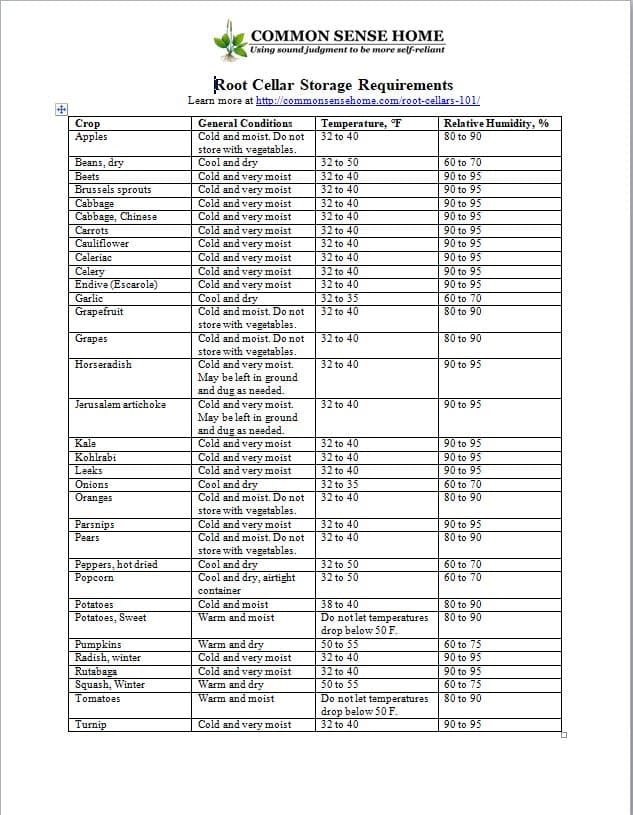
root cellar storage chart

Root Cellar Location – In the Basement or Buried Outside?

By default, the word “cellar” means “underground”. A big part of why root cellars work as well as they do is that the earth remains at a relatively constant (cool) temperature. This temperature will vary, depending on your location. Closer to the equator, and it may be cooler than air temp, but still isn’t likely to act well as a root cellar. At the opposite extreme, you have arctic permafrost, which the native folks use to store whole animals.

Retrofitting a Root Cellar in an Existing Home

The easiest option for building a root cellar is to section off a part of the basement (or maybe even the whole basement, if you live in an old farmhouse) for produce storage. Old dirt floor basements without heat are great for maintaining proper temperature and humidity levels.

Select an area with an existing window if possible, and use the window for ventilation. Fill the window with exterior grade plywood, and cut the necessary vent holes through the plywood. (The plywood also helps block light.)

North facing corners work well, because you can leave the two exterior walls uninsulated, and only insulate the interior walls. A north facing wall won’t gain heat from the sun. Use materials that tolerate moisture exposure.

Your basement root cellar should have no standard heating or cooling. Take note of ductwork or piping that runs through the ceiling above your root cellar (if any), and make sure vents or hot water pipes are well insulated so they don’t bleed heat into your root cellar.

For additional food storage space, build shelving on the outside of your basement root cellar for canned goods or other items.

During a SHTF situation, pain could become an annoyance for some, but unbearable for others.
If doctors are scarce and medicine becomes even scarcer, this one little weed, found all over North America and similar to morphine, could be a saving grace.

Adding a Root Cellar in a New Home

Many new homes have small concrete exterior porch. Typically this area has 4ft footings and is filled under the porch with dirt. You need to put a foundation wall under it anyway, so why not put this area to good use?

To turn this under porch area into a root cellar, have the builder put in full footings, an insulated exterior grade access door from the basement and two 4 inch vent holes. Add concrete slab on top as normal. This area could also be a wine cellar or safe room.

Our under porch root cellar measures about 6’x8′, which provides plenty of room for our stash of root veggies, plus gives a nice sized porch above. Locating the root cellar outside the footprint of the home allows the root cellar to maintain cooler temperatures more easily than a cellar located within the house.
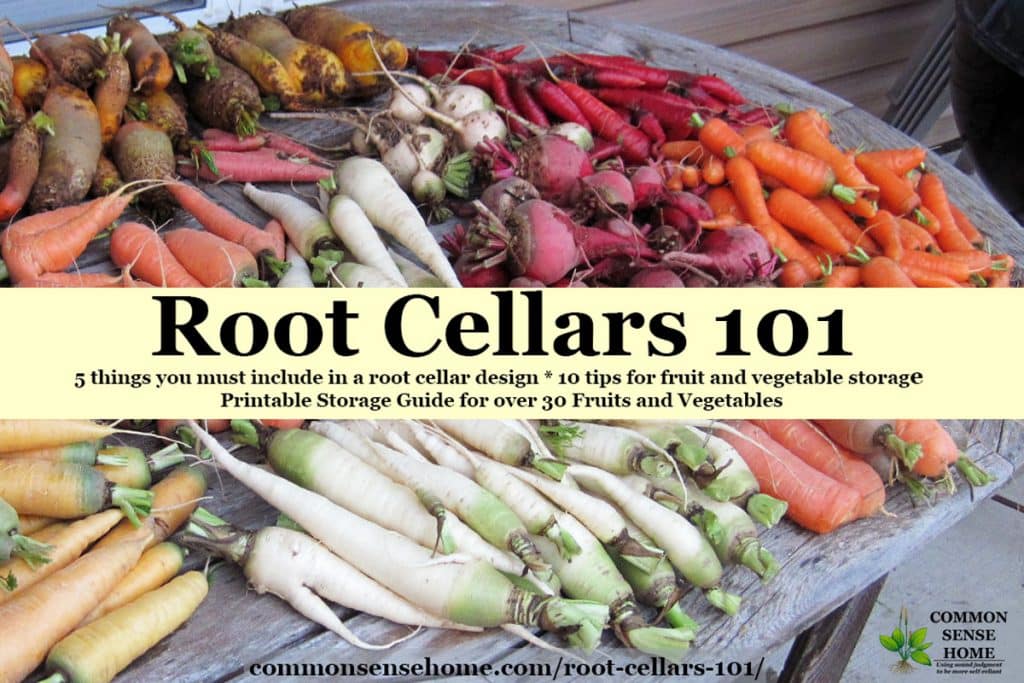
"root cellars 101" test over table piled carrots and beets

Building a Root Cellar Outside the Home

For an exterior root cellar, similar rules apply – have good ventilation, keep it earth sheltered and dark. A north facing door is preferred, to avoid sun beating in and heating your cellar up. Aim for at least one to two feet of soil covering the root cellar, and make sure you choose a premade option (some people have used new septic tanks) or materials that are rot resistant and can stand the weight of wet soil.

Traditional Root Cellar

This is what most of us think of when we hear the phrase “root cellar”. There are insulated doors that lead down into the earth. It’s dug down or into the side of a hill. Walls are concrete, cinder block, or more creative materials like old tires. You need to make sure the roof and walls are well supported to avoid collapse. Engage an engineer to help ensure safety.

Earth Berm Root Cellar

Above ground root cellars are usually partly sunken with earth mounded on 3 sides and the door avoiding the direct sun. See the  Above Ground Root Cellars post for more information.

For a great resource on building a homestead root cellar, check out the book below by my friend, Teri, of Homestead Honey.

Barrel in the ground A (approximately Zones 6-9)

The size and depth depends on the zone you live in. A simple bucket, with holes drilled in the bottom and top, buried level with the soil with a bale of hay as an insulating cover will work into zone 7 and possibly into zone 6 depending on cover and conditions. The colder and hotter zones require the bucket or barrel to be deeper, and more insulation on the top to avoid the freezing surface temps.

Barrel in the ground B (approximately Zones 3-6)

Buy one large heavy duty garbage can, and a smaller garbage can that fits inside the larger one (with an inch or two gap). Both the larger garbage can and the smaller one need holes in the bottom. The inside one needs a cover with vents / screen. Cover exterior holes with screens to keep rodents out. It also needs significant insulation above it.

Prepare a hole that is deeper than the large garbage can, with rocks and gravel in the bottom to create a simple French drain. If water drains well, you will need a small amount of rocks and gravel. If soil doesn’t drain well, you need to go deeper and wider so your underground storage barrel doesn’t turn into a water hole. Another trick is to dig a very deep, large hole next to the garbage can hole and fill that hole with rocks. The deeper hole acts as a drain for your shallower garbage can root cellar.

Once you have the large garbage can in the ground and secure, lower the smaller one into the larger barrel. Store food in the small barrel. When you need access, grab from the top or pull out the smaller barrel. This makes it easier to reach food the bottom. There are many variations on this. Search “garbage can root cellar” for examples.

stored potatoes

Root Cellar Ventilation

Improper ventilation is one of most common mistakes that people make when designing/installing a root cellar. They build their underground food storage airtight to keep things nice and cold, and everything spoils. Why? Because some foods give off ethylene gas, which speeds ripening (and rotting). A root cellar that is too airtight may also build up excess humidity, leading to mold and mildew.

How should you ventilate your root cellar? Use two vents, about 3-4 inches in diameter. Place the vents so that one is near the top of the root cellar to exhaust stale air and ethylene gas. The other vent should be run down to near the floor, to drop in fresh air. 4 inch vents should be adequate for to up to around an 8’x10’ room. If your cellar is larger than this, consider additional ventilation. Make sure to put screen on the outside to keep mice and other small animals out!

Ethylene Gas

As fruits such as apples and pears ripen, they give off ethylene gas, which decreases the storage life of some produce. Ethylene gas can cause sprouting, decay, mold, yellowing, shrinking, toughness, softness, bitterness and other damage.

To combat spoilage from ethylene gas, segregate fruits and veggies that produce excess ethylene gas from those that are easily damaged from ethylene gas. (This is a good idea for your refrigerator produce bins, too.)

Fruits and Vegetables that may create excess ethylene gas include:

Apples, apricots, avocados, ripening bananas, blueberries, cantaloupe, citrus fruit (not grapefruit), cranberries, figs, guavas, grapes, green onions, honeydew, ripe kiwi fruit, mangoes, melons, mushrooms, nectarines, okra, papayas, passion fruit, peaches, pears, peppers, persimmons, pineapple, plantains, plums, prunes, quinces, tomatoes and watermelon.

Fruits and vegetables that may be damaged by excess ethylene gas include:

Asparagus, broccoli, Brussels sprouts, cabbage, carrots, cauliflower, chard, cucumbers, cut flowers, eggplant, endive, escarole, florist greens, green beans, kale, kiwi fruit, leafy greens, lettuce, parsley, peas, peppers, potatoes, potted plants, romaine lettuce spinach, squash, sweet potatoes, watercress and yams.

Root Cellar Lighting

Light exposure is the enemy of food storage. Every time I see people lining up their canning jars or spices on open shelves, I cringe. It looks beautiful, but light bleaches out the color and the nutrient value of foods.

In the root cellar, light exposure may lead to sprouting and green potatoes. If you’re venting through a window, cover the rest of the window. If you have a light in your root cellar so you can see your food storage better, don’t leave the light on when you’re not using it. A hunk of burlap drawn over bins of potatoes or fruit will allow ventilation while still blocking the light. A single incandescent light (switched on exterior) should provide adequate lighting (unless your room is really huge) and, if for some reason your storage gets too cold, you can always use it to introduce a little heat.

Solar energy is a renewable source of energy with has many benefits.

The best thing is that you’ll save money on you electric bill.

To build your own solar panel almost for free, you’ll need to watch this video

Root Cellar Humidity – Keep Things Moist But Not Wet

Checking the fruit and vegetable storage chart, you’ll see that most store best with fairly high humidity. If you have a dirt or gravel floor in your root cellar, you’re in luck, because the natural ground moisture will help keep your produce damp.

Produce will give off some moisture on its own, but if you note that your produce is shriveling, your root cellar is probably too dry. Take a tip from the grocery stores, and try a little misting action with a spray bottle. Avoid getting any area too wet, as that can lead to standing water and potential mold growth. Some people leave trays of water in the root cellar to increase humidity. Be careful with this option, as it can also result in bacteria or mold growth.
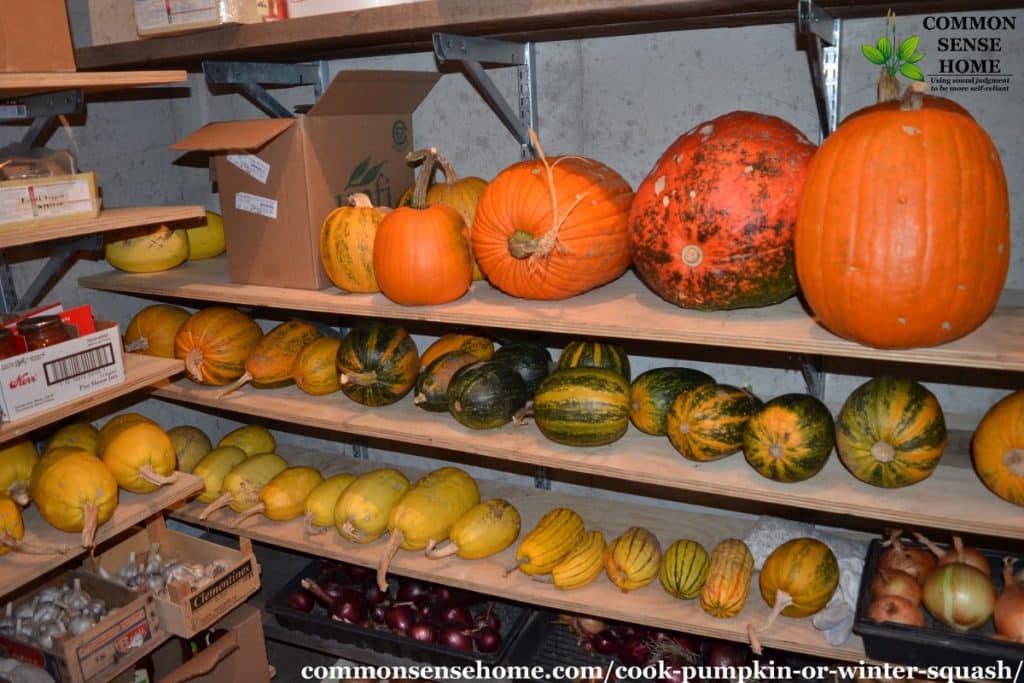
pumpkins and squash

Root Cellar Shelving

Shelving should allow airflow and add storage. Keep a gap between the shelving or storage bins and wall to encourage air flow. Remember to check the chart and keep produce that likes cooler temps lower and food that like warmer temps higher.

12 Dangers That Await You When Bugging Out- Bugging In Is Almost Always A Safer Route to Take Because You Are At Least Somewhat Aware Of The Hazards That Exist In Your Local Area

If you’re preparing for an event where you believe you may be forced to leave your home, you need to be prepared to combat the dangers of bugging out. Bugging in is almost always a safer route to take because you are at least somewhat aware of the hazards that exist in your local area.

If the area around you has become unstable enough that you need to bug out, it means there are new and increasing hazards around you that you aren’t familiar with or even aware of. It is these unknown hazards after any SHTF event that can thwart even the best laid bug out plans if you aren’t prepared to deal with them and adapt your bug out plans quickly in response.

#1. Lack of Clean Drinking Water

You know that you need to include water in your bug in stockpile and have several options for getting fresh water to drink when that runs out. Following a SHTF event, public utilities, like the water and wastewater treatment facilities, could quickly become overwhelmed. Running water provided by the city or public utility may become contaminated or even stop altogether. It’s even possible that groundwater will become contaminated and end up contaminating local wells.

If you’re bugging out, it will be essential that your bug out route and alternative routes put you within reach of multiple places to check for clean water. You’ll also need to know with certainty that you can filter and purify any water you drink. It’s entirely possible that your bug out will take longer because you have to detour in order to get to water.

#2. Dehydration

If you’ve been prepping for any amount of time at all, you’ve heard the warnings about dehydration. The human body must have water on a regular basis in order to continue to function normally. During a bug out, you will be on the move, expending energy to try and get to your bug out and to accomplish many of the physically demanding tasks that are required for survival when bugging out. You’ll be losing more fluids due to perspiration that occurs during physical activity. Depending on the climate, you may also be exposing your body to unrelenting heat. You’ll need more water than normal to keep functioning, not less.

If you’ve ever watched Naked and Afraid on TV, you’ve seen how quickly a lack of water can start to impact motivation, drive, energy, and strength. If your body is weakened from dehydration, you put yourself at increased risk for illness, injury, and being unable to successfully defend yourself against looters or others who want to take your remaining supplies.

#3. Impassable Roadways

Most preppers have planned at least one and maybe more than one bug out route they will use to get from work or school to home and from home to their bug out location. But another one of the dangers of bugging out after a widespread disaster or SHTF event is the likelihood that many roadways in the area will be completely impassable.

Even if you do have a vehicle, there will be many, many other vehicles that simply ran out of gas or were abandoned wherever they were when the event happened. Highways, bridges, overpasses, freeway entry and exit ramps, and intersections may very well be completely impassable due to broken down or abandoned vehicles. Even if your car is operating, you may not be able to get through or turn around, forcing you to abandon your vehicle.

You need to prepare to change routes and even change transportation methods or set off on foot to get where you’re going. Keep in mind that what took several hours by car can easily take several days on foot. So, you will need more supplies but will have less capacity to carry them without your car. Therefore many preppers considering using a cache system.

#4. Hypothermia

Make sure your gear and supplies are adequate to keep everyone as dry and as warm as possible if you anticipate any kind of inclement weather. Hypothermia can set in even in weather that is 50 or 60 degrees Fahrenheit if you are wet and can’t get dry. If your bug out route requires you to cross creeks, streams, or other bodies of water or will mean travel through an area that is flooded or may be plagued with rain storms, plan to use waterproof clothing and other ways to stay dry when bugging out.

#5. Looters/Zombies

One of the greatest dangers to you and your family when bugging out will be other people. Looters and “zombies” who are desperate to feed themselves and their families and who didn’t prepare will not hesitate to take your gear and supplies. Some of these people will resort to violence in order to get what you have. Do what you can to avoid other people when possible, but also make sure you are knowledgeable in self-defense and are prepared to defend your family and your supplies during a bug out.

#6. Disappearing Rule of Law

One of the huge dangers of bugging out will be the disappearing rule of law. There are huge numbers of people in our world today whose tendency to violence and criminal activities are reined in by the rule of law. When a widespread disaster strikes, emergency services personnel, especially law enforcement, will be quickly overwhelmed by demand for assistance. The last thing police and other enforcement personnel will be worrying about is that someone stole your car or that you can’t find your teenage daughter.

Law enforcement will have bigger fish to fry and you will essentially be on your own. People normally reigned in due to laws and fear of punishment will quickly realize that they now have reduced risk of being caught for minor offenses such as burglary, assault, theft, even rape or kidnapping. It will be you against them with very little if any chance of anyone coming to your assistance. You must be prepared to take steps to avoid these people at all costs and to defend yourself and your family if confronted.

#7. Separation from Your Group

Being separated from your group during a bug out can be really dangerous. A widespread disaster or event can impact your communication systems and devices, especially if phone systems and other circuits are overwhelmed with demand. This means if you are separated from your group, you may not be able to get in touch with them to rendezvous or let them know if a pre-planned meeting place is now unsafe. To plan for this, make sure you have a visual system in place to get word to your group about your movements or changes in plans.

#8. Injury

Another one of the most dangerous threats during a bug out is an injury. If you aren’t used to using portable or hand tools you will be more susceptible to injury from misuse. In addition, allowing yourself to become exhausted or weak from malnutrition will increase the likelihood of an injury. An injury during a bug out can limit your mobility and if you don’t have an alternative way to get around and can’t get to safety, an injury can even be fatal. Learn as much as you can about how to prevent and treat injuries that can occur during a bug out to help combat this threat.

#9. Illness/Disease

Sanitation and hygiene after a disaster will be poor due simply because systems will get flooded with demand and some won’t be working because of the disaster or event. In addition, the number of deaths will greatly increase, and emergency services won’t be able to keep up with proper removal and burial of the dead. Animals and rodents will quickly overrun the streets and buildings. All of these things mean the risk of illness will increase.

Many of the diseases we thought were eradicated could once again rear their ugly heads. If you aren’t aware of these diseases and properly prepared to deal with a variety of illnesses using stockpiled medications or natural remedies, your bug out will fail. Talk to your physician about writing an extra script or two so you can stockpile prescription medication or look into animal antibiotics or natural alternatives.

#10. Exhaustion

Even if you choose to bug out by vehicle, it’s possible to become exhausted during a bug out or any extended travel. The stress of being constantly on the move and being continually on high alert for hidden dangers will take its toll. Make sure you plan for adequate sleep. If you choose to bug out on foot, by bicycle, or another method that requires you to physically expend energy in order to travel, adequate breaks to rest will be critical to success.

#11. Malnutrition/Starvation

The human body needs adequate fuel in order to be able to continue to expend the energy required for many of the tasks needed during a bug out. Without the right fuel going into your body, you will start to feel the effects pretty quickly. Ensure that you plan to carry enough food and supplies so that each person in your group can consume the needed number of calories, including protein, to keep moving. If the human body doesn’t get adequate fuel to keep it moving, your ability to stay moving will be negatively impacted.

#12. Lack of Accurate Information

As you read through all of these hazards and dangers of bugging out, it should have become clear that another threat to your safety is going to be the lack of information or misinformation. Finding out what’s really happening around your home, neighborhood, and town will be difficult if not impossible.

You will have to get information from multiple sources and piece information together and then make assumptions based on what you do know. Even if you are lucky enough to have some way to communicate with others, information you get could be delayed, inaccurate, or even deliberately misleading. And if you take action and bug out based on misinformation or incorrect assumptions, your bug out could go wrong quickly.

Wrap-up

If you’ve read through all of these dangers of bugging out, it becomes clear the odds are stacked against you. The only way to begin to even out those odds is to gather as much knowledge and experience as you can about each of the bug out obstacles so that you can deal with whatever comes up along the way. Consider these dangers one at a time and make sure you’ve learned all you can and that you incorporate procedures into your bug out plan to combat them as best you can. There will be incidents where you simply can’t stay where you are. But whatever you do, don’t ignore the dangers of bugging out.

Did miss something that you think is an obvious danger of bugging out? Let us know in the comments below.

Imagine The Following Scenario: Your Vehicle Is Broken Down and You Have to Leave It For A Period Of Time As You Need to Find, Tools, Parts, Or Fuel- How to Conceal Weapons in Your Vehicle

First, let me give you a little background.

I am a retired Army Senior NCO, Retired Master Peace Officer, drug interdiction officer and for the last 4 years, a military-contracted counter explosive canine handler in Afghanistan and Iraq.

My job depended on finding things people did not what found. I have literally searched, and taken apart thousands of vehicles in my career.

This article is about where to hide your stuff in the vehicle. Since carrying a weapon in your vehicle is legal in most of the USA, this article is geared more to hiding your weapons from those uninvited looters and scavengers who are inevitably going to come around in a social/government breakdown situation. Yes, I’m talking about the proverbial SHTF times.

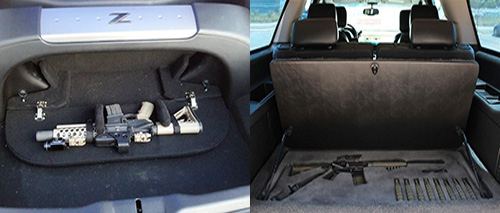
So, let us set some ground rules. We are going to talk about two types of vehicles, handguns and long guns, as well as ammo. These are no concealment techniques that let you get to your firearms at a moment’s notice. This is about hidden storage that others, unless very skilled, will not find. This is for storage.

Imagine the following scenario: your vehicle is broken down and you have to leave it for a period of time as you need to find, tools, parts, or fuel. You can’t reasonably carry everything, so you are counting on your hidden cache of weapons to still be there upon your return. Or, your vehicle is parked outside, the looters and scavengers come through the area and ransack every vehicle on the block taking what they can easily steal. You don’t want them to find your stuff that was hidden. This is what this article is about. That being said, let’s get to it.

Sedan

The modern sedan has plenty of places to hide weapons. I will start with the accessible places inside the vehicle.

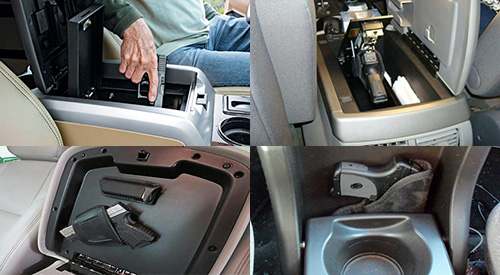
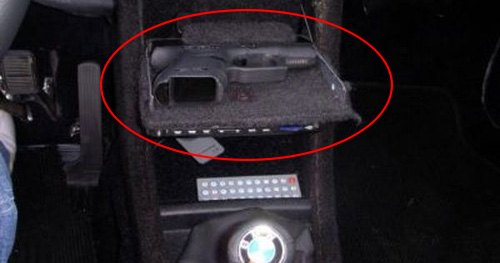
center console concealed weapon

Under the center console. The center console is held to the floor in most sedans by a series of plastic clips or a few Phillip’s screws. Remove those and the console lifts up exposing a compartment that will house a rather large pistol and a couple boxes of ammo.

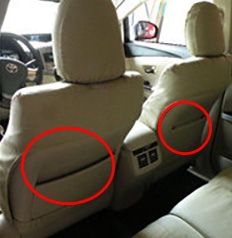
back seat bucket

Seat Backs. The modern car has bucket seats. The back of the seats has a cover that simply snaps onto the seat and covers the springs. This area will conceal a pistol, ammo, and a short barrel long gun like an MP5 or Uzi.  Snap the seat back in place and no one will know it is there. This is also very fast to access if needed.  No tools required.

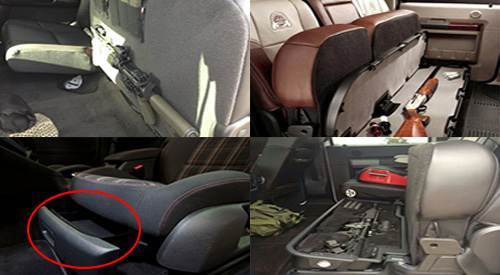
Under seatsI’m not talking about just on the floor under the seat. What we are talking about here is attached to the underside of the seat by tape, zip ties or something else. This keeps it out of sight if someone looks under the seat but it is still there if you just know where to look.

Other examples:

Inside door panels. You can hide a shotgun with a folding stock or a short rifle here. Clips and a couple of screws hold the door panels in place. You could remove the screws and leave them out but a sharp eye will notice something is amiss. My advice is to always put everything back the way it was so there will be no “giveaways” that there could be something behind the panel that is worth hiding.

behind radio weapon

Behind the radio. The radio will have four holes in the corners. Look at yours and you will see them. Most folks don’t realize all you have to do is insert metal rods, about the size of a wire coat hanger in these holes and the entire stereo slides out, leaving a very large cavity to hide weapons and ammo behind.

Now for the outside of the vehicle

Outside. The bumpers, front and rear have cavities under them that will hold a shotgun or rifle. Duct tape is a wonderful thing and you will be using it.

Open the hood. Inside the fender wells, you will see several places to hide your firearms. Inside the air cleaner box is a good place for a pistol.

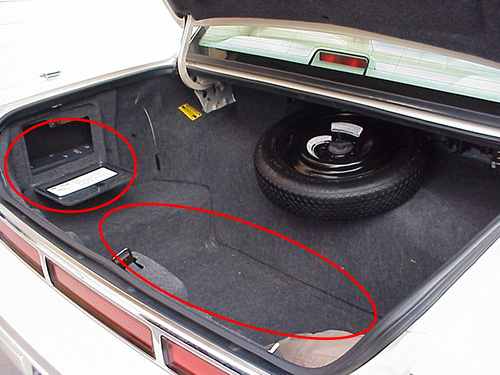
In the trunk. I don’t really suggest this area as it is very easy to detect but in a pinch, it may do. Pull the carpet away from the sides of the trunk. It will be attached to a cardboard backing. Place your weapons behind this, in the cavity that is in the lower part of the rear fender, and replace the trunk lining. If you have done this carefully, it will be undetectable to the untrained eye. I also suggest throwing some old rags or a little dirt in the area to make it look as if it has not been disturbed.

Other examples:

trunk concealed weapons

SUV or Truck

You have many more places to work with here. Count all of the same places mentioned for the inside of the sedan above. Those hiding places are common to just about all vehicles.

Starting at the front

The Front Bumper. Under the front bumper is a very large area to store weapons.  Tape them in a secure place. You can hide a lot of stuff here.

Front Fenders. From under the hood you have access to a very large area to place a rifle bag full of goodies.  It will fit in behind the fender well and be very hard to see without knowing it is there.

Air Box System. This is a common place for pistols and ammo. Placing a weapon here will not affect the operation of the vehicle.

Under the vehicle. The modern SUV/Truck frame is an I Beam type structure. This is a natural shelf for all sorts of things.  A few large black Zip Ties will hold a rifle, shotgun, and a lot more. These will not be visible from just bending down and looking under the vehicle. A person would have to get under the vehicle and really look for them to find your hidden arsenal.

Roof. The roof of all modern SUVs and Trucks is actually hollow. Remove the third stop light that is at the top and rear of the cab. Pull that out and you will see a vast area to hide magazines, ammo, and other items. The way to do this is to tape a string to each item with duct tape and string them together.  Replace the stop light after you have hidden your items in the roof section. Make sure you tape the end of the string to the back of the light or to an area that is concealed but you can reach again. Then to retrieve, all you do is take out the light, pull the string and the items come out one after another.

Tailgate. This is hollow. The inside can be accessed through the latch assembly OR by splitting the tailgate by removing the screws and bolts that hold it together. I have seen tailgates that were split and then resealed with silicone. To open you just cut the silicone with a razor-blade and pull the two halves apart. Not all tailgates are the same, so you may have to adapt to your situation.

Rear Bumper. Like the front of the truck, there is a vast amount of storage space.

spare tire weapons

Spare Tires. Placing something inside a tire is a real pain in the rear, but hiding an item on top of the tire is easy. Lower the spare tire; most are cranked down to the ground with the jack handle. Once on the ground you can place your items inside the rim and crank the tire back into place. This is a simple and readily available storage area.

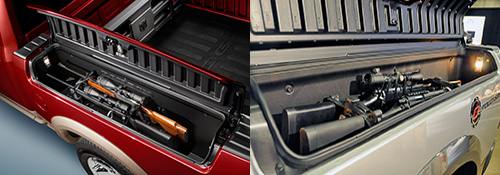
concealed weapons truck rears

Depending on your ingenuity, time you want to spend, if you want to modify the vehicle or not, it is not hard to make your vehicle a rolling arsenal and no one would ever suspect was holding weapons and ammo in every corner.

End thoughts

If you really feel this may be something that you have to deal with, I suggest throwing your roving horde of scavengers off the trail. If you have to abandon your vehicle and you are pretty sure it will get at least looked at, give them something to go after. Leave a useless (as in not functioning) pistol or something in plain sight. Let them take that and stop searching. Basically, throw them a bone. The whole point about concealing your weapons so that the looters won’t find them is just that: concealment. Make sure you leave no signs, no pointers that say “Hey, Look Here!”. Do this and when you return to your vehicle from something as simple as a walk into the woods to take care of bodily functions, you can rest assure when you get back your stuff with be safe and secure.

There’s no way of telling quite how different life after a major disaster or serious collapse of society could be, but humans are remarkably resilient, so life would certainly go on: 25 skills you can trade after SHTF

When people talk about trading after the apocalypse, usually they start discussing whether you’re better off stockpiling extra ammunition or some surplus food. These are both great trade assets – for a while. Eventually they’ll run out, though, and then what? The guy who’s been bringing you fresh eggs every day isn’t going to keep doing it when you’ve run out of shells for his 12-gauge. Trading surplus supplies might be essential from time to time, but it’s never going to be a long-term solution because, in the end, your supplies will be gone.

How about gold and silver? Some preppers have a touching belief that they’ll be highly prized after society falls apart. I’m not so sure. I don’t know about you, but I wouldn’t be too keen to trade a handful of rifle bullets or a sack of flour for something that’s basically just going to sit around looking shiny.

No, if you want a real trade asset, you can’t beat skills. Once you’ve learned a skill you have an inexhaustible supply of it. If you fixed someone’s generator today in exchange for a bag of apples from his tree, you can get more apples by fixing it again tomorrow. Years from now you can still be fixing his generator every time it goes wrong, and trading your time for his surplus fruit (unless he decides you’re either not so good at fixing generators or a bit too fond of his apples). Skills won’t run out, and in a prolonged emergency that makes them far more valuable for trade than anything else.

Here are 25 skills that are going to be in demand if we’re all thrown back on our own resources. Some of them will be valuable right away; others will kick in when hoarded goods start running out. Learning all 25 of them is probably beyond most of us, but if you get pretty good at three or four you should be able to barter your work for anything you need after the apocalypse.

1.Vehicle maintenance

Being able to keep cars on the road is going to be a vital skill. With society in disarray, most regular workshops will be closed. If you have a reputation as someone who can keep engines running that’s going to be a valuable skill – and you’ll be able to fix generators and pumps, too.

2. Electrics

If the power grid stays down for a while people are going to start looking for alternative sources of electricity. It might be a solar array, generator or wind turbine – in any case, it’s going to need wired up. That can be difficult and even dangerous. If you know how to adapt and extend house wiring, people will pay for that skill.

3. Electronics

If people have electricity they’re going to want gadgets that use it – but eventually they’re going to go wrong. You probably aren’t going to be able to make a new microprocessor, but some basic soldering skills can fix a surprising number of faulty appliances. Their owners will be pleased.

4. Plumbing

When plumbing goes wrong things can get pretty unpleasant in a hurry. That’s why everyone’s immediate reaction is to call a plumber. But what if the world as we know it has ended, and the plumber isn’t answering the phone? If you can help people out with that, they’ll be glad to help you out in some other way.

5. Medicine

Life is dangerous when society collapses; disease and injury will be more common, and the consequences of not treating them are more severe. Any medical assistance you can give, from basic first aid to advanced surgical skills, will make you a valuable asset to the community.

6. Amateur radio

Most of the communications we rely on aren’t going to survive a major social collapse. Without people to run its infrastructure, cell phones and the internet will go down in minutes. Landline phones – the ones that haven’t switched to VOIP – might last hours or even a couple of days. If you have the skills to use radios, especially CB or ham radio, that’s going to be a skill lots of people will want access to.

7. Mending clothes

Nowadays, if our clothes get damaged we just throw them away and buy new ones. Our ancestors, even a couple of generations ago, fixed them instead. If you can repair rips, replace broken zippers and even make alterations for size, you’re not likely to run out of customers willing to trade.

8. Foraging

There’s a lot of food out there if you know what to look for, in the form of edible fruits, berries, leaves, fungi and other plants. The problem is, if you don’t know what to look for you can get in a lot of trouble. Mistaking a death cap for a mushroom is a mistake you’ll only make once. If you have the right skills you can either teach them to others, or trade part of what you collect.

9. Hunting

Not everyone has the skills or equipment to harvest their own meat. If you do, you have a valuable source of food that you can trade for other things you need.

10. Fishing

If you’re elderly or infirm, and can’t do more physical jobs, you can still build up a tradeable food surplus with a fishing pole and some bait.

11. Crop growing

Not too long ago most families had their own vegetable garden. That’s a skill most of us have lost. If you still have it, it’s a valuable asset. Grow more than you need and trade the surplus, or look after people’s plots for them in exchange for a share of the crop.

12. Animal husbandry

Some livestock is a valuable asset, but it takes skill to keep it alive and productive. If you’re good at looking animals you can help out people who don’t have your experience. The most efficient way to do this is to keep their animals with your own and give them their share of the milk, meat or other products.

13. Butchery

Yes, this is the part of keeping livestock many people hate. It’s easy to buy Percy the pig as an investment in your future self-sufficiency, but a lot harder to whack him on the head with a hammer and chop him up. If you can do that for them, they’ll be happy to reward you with a few choice cuts.

14. Canning

A lot of people will manage to find or grow food, with or without your help, but won’t have the skills they need to store it safely. If you’re a canning expert you can make yourself useful by processing their surplus so they can build up stockpiles for the winter – maybe by trading your skills for a share of their crop.

15. Carpentry

It’s amazing what you can make with some timber, a few basic tools – and a bit of talent at woodworking. A good carpenter can put together anything from a storage box to a serviceable timber frame home. In other words, lots of things people will need and be happy to trade for.

16. Blacksmithing

This is a really rare skill nowadays, but it’s going to be in huge demand if the economy implodes. There are still a lot of horses round, and they need shoes – but a good smith can make a lot more than horseshoes.

17. Gunsmithing

Weapons are going to be essential when the SHTF – but they’re complex things, and sometimes they go wrong. Any good shooter can clear a stoppage, but what about repairing a broken trigger mechanism or re-crowning a barrel? Gunsmithing skills are pretty rare – and very valuable.

18. Reloading

There’s a lot of ammunition in the USA, but it won’t last forever. When stocks start to run low a lot of people will be willing to trade for more. If they can bring you their spent brass, and have it remanufactured into ammunition, that’s a very valuable skill to have.

19. Fletching

In a sustained collapse, stocks of modern weapons and ammunition will eventually be gone. To help them last as long as possible, and replace them when they’re exhausted, bows make a viable hunting – and even defensive – weapon. If you can make arrows you’ll find plenty of people willing to trade for them.

20. Soap making

Did you remember to stockpile a large supply of soap? Probably not, but that doesn’t matter – you know how to make it, using lye and any handy fats. Do you think everyone else in the neighborhood remembered to stockpile soap? Unlikely, but never mind. They can trade with you for the surplus you made.

21. Candle making

A year or two into a major collapse electric light will be a lot less common than it is now. Help your neighbors keep the darkness at bay by trading home-made candles. They’re a lot brighter – and safer – than a crude oil lamp.

22. Leatherworking

If you know how to make things from leather, you’ll never be short of work. Everything from shoe repairs to making new tack for horses will be in demand.

23. Teaching

Civilization might have collapsed, but you can help rebuild it by passing on the knowledge the next generation will need. You don’t have to be a qualified teacher, but if you have knowledge and the enthusiasm to pass it on you can turn that to your advantage.

24. Playing an instrument

No matter how bad things get, people need entertainment. In fact, when it’s really bad entertainment is more valuable than ever. If you can play a musical instrument you can do a lot to boost morale, and human nature means people will want to show their gratitude.

25. Spiritual comfort

If you’re good at choosing an uplifting piece of scripture, or making an inspirational speech, that can be a valuable skill. It might not be essential to life, but it can make people feel a lot happier about their situation. In a major emergency death is a real possibility, for example, and if you can give someone a proper send-off their loved ones will cope better.

Living In A Post-Disaster World It Is Not Going to be Easy (The Fight Over Scarce Resources Will Drive The Chaos)

Urban survival scares the hell out of me.

Too many people, living too close together.

But that’s why I’ve prepared for it.

Don’t run away from what scares you; stare it down, and get prepared.

So let’s start by agreeing “What Urban Survival Is” and “What It’s Not”.

The definition of Urban Survival differs slightly depending on who you ask.

Many take it to mean your “day-to-day city survival and safety measures” – a.k.a. “street smarts.”

But for us, I define it as follows:

The skills, tactics and ability to survive a widespread prolonged disaster while remaining in a densly populated urban environment (even if it’s just for a few days).

Urban survival is having the ability to tough it out in the belly of the beast.

Surviving a world-shattering catastrophe event from within the heart of a dangerous city takes an entirely different mindset. It also takes a particular set of survival skills, tools, and plans to stay alive.

Now, even if you don’t live or work in one of these 146 high population counties, maybe, you have a family member that does. Or maybe you occasionally visit your kids, friends or relatives in a nearby high-density city.

If society collapses, you can bet that the foods the pioneers ate will become dietary staples

The Lost Ways prepares you to deal with worst-case scenarios with the minimum amount of resources just like our forefathers lived their lives, totally independent from electricity, cars, or modern technology.

So pay chose attention because this video will change your life forever for the good!

The bottom line is this:

If SHTF happens and you live in a city or are just there for a short visit, do you have the urban survival skills and knowledge to hunker down and survive? Maybe you’re forced to stay for a couple of days or weeks, do you know how to successfully transverse such an environment?

Urban survival skills differ significantly from wilderness survival skills. You should learn both…

So today we are going to cover the following urban survival topics:

  • Getting Home
  • Back Up Rendezvous Location
  • Bunkering Down or Bugging Out
  • Urban Survival Planning and Preparation
  • Avoiding Others – Staying Put
  • Avoiding Others – Urban Transportation
  • Get To Know Your Area Well
  • Scavenging Key Resources
  • Situational Awareness
  • Trusting Others
  • Staying Fit, Stay Trained
  • Living In A Post-Disaster World

Getting Home

When a disaster strikes, the first thing you’ll want to do is to get home (unless your home was destroyed). Why? Because if you’ve prepared to any degree, that’s where you’ll be keeping the bulk of our survival gear and resources. But they don’t do you much good unless you can’t get home first.

You should assume you won’t be home when disaster strikes. You might be…but you shouldn’t assume that. This assumption helps you get prepared for that scenario.

And that’s why you need a fully stocked Get Home Bag.

Before you skip this section, hear this first: a GET HOME BAG is very different than a “Bug Out Bag” (BOB).

A BOB tends to be a large backpack, stored at home, and chalked full of almost every necessary piece of survival gear imaginable. It’s used for surviving (mostly in the wild) post-disaster.

A “Get Home Bag” by comparison, is small, lightweight and straightforward. You should have at least one of these but for many, it makes sense to have several dispersed in strategic areas. One for the car, one for the office, one for the boat, one of the RV, etc.

A get home bag should contain a number of specific survival resources to help you get back to home base. Here are the most common items found in a get home bag:

  • Spare Cash
  • Everyday Carry Knife
  • Maps (of city and surrounding areas)
  • Military Compass
  • Everyday Carry Flashlight
  • Small First Aid Kit
  • Hand Crank Radio
  • Protein Bars
  • Water and Portable Water Filter

The point of a Get Home Bag is to help you Get Home, duh! It’s the basic survival gear that will give you a bit of an edge should the world surrounding you fall into chaos when you’re away from your home base.

Rendezvous Location Specification

Great now that you’ve got your Get Home Bag, what happens if home base is destroyed or not safe? Do you have a backup rendezvous location? Have you shared this location with your loved ones?

When you are trying to survive an urban emergency, you might not have the opportunity to call your family and friends to arrange a meeting place. The kids might be at school. Your significant other may be at work across town; you might be at the dentist.

It’s better to plan ahead and specify a rendezvous point. But it has to be somewhere memorable – this does not work if everyone forgets where the meeting place is. Landmarks, schools or someone else’s house (you trust) are all possible options.

Bug In vs Bug Out

Make sure everyone is on the same page and even practice a few rendezvous drills to this location.

Deciding to Bunker Down or Bug Out

OK, this is the next big decision you need to make.

The desire to get as far away from the city in a prolonged disaster is natural, but not an urge you should follow in every circumstance. When you get home, check the news and talk to your neighbors to dig up more information on the situation. There are some considerations to take into account:

What is your emergency food stock looking like? Depending on how much food and water you have stocked up, you may be able to survive at home longer. The better your stockpile, the higher your chances of survival.

How serious is the disaster or emergency? If it’s dangerous and forecasted to continue that way, maybe your best option is to grab your stocked bug out bag and go. OR, it could be a severe (but temporary) emergency in which case bugging out might be a rash decision.

Are government institutions still functioning? Without police officers, firefights, and paramedics, EMT’s things are going to get nasty fast.

Of course, unanticipated things happen all the time – and they tend to occur more frequently during emergencies and disasters. Some unforeseen event may sway your decision. It may force you out of the city, or trap you within your own home; expect the unexpected.

You need to plan and then decide if it makes more sense to stay or go.

Urban Survival Planning and Preparation

For the sake of the rest of this article, let’s assume you decide it’s best to hunker down.

The real survival threat in an urban setting is the sheer number of people fighting over the same resources. So to survive such an environment we will primarily focus on the following two skills:

1 – Avoiding Others

2 – Scavenging Resources

If you can limit your exposure to others and scavenge essential resources, your chances of urban survival go up significantly.

Avoiding Others – Staying Put

Avoiding others will be a real challenge in a dense city, but the easiest way to avoid other people is to stay hidden in your home or apartment. And the only way you’re going to be able to do that for an extended period of time is to stockpile.

I won’t go into extreme detail here about stockpiling, but basically, you need to stock food, water, medical supplies, etc.

A note of caution: Don’t tell your neighbors or even friends about your stockpile. Unless you’re OK with sharing your stock resources when SHTF.

So limiting the amount of exposure to others by hunkering down is a good first step. But if you’re dealing with a prolonged disaster, at some point you’ll be forced to venture out for replenishment.

Avoiding Others – Urban Transportation

Naturally, if you jump in your car, start her up and put the pedal to the metal you’ll be noticed by others. But more often than not, in serious emergencies roads will be jammed up anyways. This can be a serious obstacle for someone determined to get back to home base or trying to move about the city.

Cars and trucks are the hardest to get around in the midst of chaos. Motorcycles and scooters more nimble and can dart/weave through thick traffic and tight roadways.

Bicycles are another quick way of getting around in an emergency – they are particularly handy in the case of an EMP because they do not require any electrical input to get you from point A to point B. However, with all of these options you are highly exposed. Exposed to gangs, thieves, or a looter who all may have gunfire.

So evasion is paramount when exposure becomes risky.

Going by foot is preferred once cars, scooters, and bikes become a liability because you can move quietly, and efficiently without the need for roads. Unfortunately, many large cities sprawl which means that you could have a very long distance to cover. Miles could take days if remaining hidden is required.

Darting through small buildings, basement or rooms to provide hidden paths can work, however, if you don’t know the city well you may be evading right into a bad guy’s lair.

Cities simply have too many people in them to remain undetected for the long haul. So you also need to have a self-defense plan and be ready to take immediate proactive action.

Firearms are loud but effective so equip yours with a suppressor. Melee weapons are quieter but less efficient.

I plan to have both options with me at all times and use the one that seems most appropriate for any given situation.

Get To Know Your Area Well and Practice

People who live and work in urban environments should know their area intimately. Take multiple different routes to and from work each day to explore new areas and find back alleys and shortcuts.

Buy some detailed maps of the city and surrounding areas (keep these in your Get Home Bag). Study these maps. Learn them now so you’re not fumbling with them later when the lights go out, and anarchy breaks loose in the city.

Urban survival includes learning how to move about a city undetected; like a ninja. Traveling over rooftops or sewer systems becomes a major advantage. These are routes you should start practicing today to move secretly throughout a city.

On December 6th President Trump’s words shook the world.

For the first time in over 2000 years, Jerusalem was recognized as the capital of Israel.

Whether he knows it or not, President Trump fulfilled his part in a frightening biblical prophecy exactly as the scriptures predicted.

Only the top church leaders and Bible scholars know the real meaning behind this great and terrible moment, yet no one is saying a thing about it…

So pay chose attention because this video will change your life forever for the good!

Here’s a video that provides several excellent ideas on how to travel and scavenge in an urban survival situation.

Scavenging For Resources

As we just discussed, moving about undetected is key to avoiding conflict. But where are you going and why? You’re scavenging.

Finding useful resources in an urban environment may seem like a simple process. Just dart off to the nearest Walmart or Target, right? The problem with these public locations is that they are obvious.

Everyone already knows about these locations and they will be looted early in a disaster. So you need some new ideas. Some good locations where the masses won’t be looking (at least initially).

You want to focus on places that the masses have never thought about. Places such as distribution centers, manufacturing sites, schools, or building construction sites.

Your odds of scoring a few precious resources go up significantly if the masses haven’t been there yet. The main resources you’re going to want are:

  • Water
  • Food
  • Medical Supplies
  • Tools and Gear

Also, if you’re a skilled survivalist, you’ll know how to turn what looks like junk into a useful survival item. So keep that in mind when scavenging.

The following two videos provide several examples of less well known urban survival locations that you’ll want to focus your scavenging efforts.

Situational Awareness

The urban survival skill you really need to focus on and develop is situational awareness. The choices you make when traveling and scavenging will be determined by how well you’ve honed your situational awareness.

Using your instincts and constantly scanning your environment for evidence of trouble will help you to make wise survival decisions. Often it’s not the strongest or most aggressive who wins, but the one who makes better choices based on what a situation calls for.

The bottom line is: A lot of violence could be prevented if more people had better situational awareness.

To learn more, watch this video that focuses in detail on urban situational awareness techniques.

To Trust Others or Not

Helping your neighbors can be incredibly rewarding. Sharing your emergency food stockpileor ammo, or even a useful survival tip can earn you an ally during a tumultuous period.

You watch their back, and they will watch yours. It is a symbiotic relationship that benefits both parties.

Besides, having survival friends is nice for the company.

However, don’t be too trusting or you might end up dead. Even if it is someone you have known for years and consider a close friend, it is never a good idea to show someone where you keep your survival stash.

Use diversion safes to keep your most valuable items hidden.

Revealing valuable food, water, weapons or your ammo supplies to someone might present unnecessary temptation. It would suck to wake up one morning and find out your “buddy” Scott skipped town with all your ramen noodles and shotgun shells.

Be conservative with your trust; do not just give it to anyone. If there is a big bad cue ball meth-head living down the hall, you can go ahead and assume you are better off without him. Have some common sense.

There is also the option not to trust anyone at all. You do not necessarily need other people to survive (although, it does make it easier). Sticking just to yourself makes life a little simpler, you just need to be sure you have the ability to do so. The lone wolf lifestyle certainly has its advantages.

Personally, I take the middle ground. I trust with extreme caution. The two criteria for me to trust someone is:

1) They are nearly as prepared as me BEFORE the world goes to shit.

2) They pull their own weight.

If they have these two qualities, I will consider building a relationship with them in preparation for SHTF. But building a new relationship mid-diaster is like playing Russian roulette. Not recommended unless it’s truly your only option.

Stay Fit, Stay Trained

If you are trying to make your way back home or to your apartment from within a city you will have to travel through dangerous territories (probably by foot).

Roadways will likely be jammed up by police barricades, gridlocked traffic, or debris from destruction.

And along the way, you may have to fight. So it is pertinent to stay in shape, and even train yourself physically for such an event.

Long walks, hikes or runs are great ways of keeping fit. But it’s also great practice for traveling by foot. Having travel endurance is key to urban survival.

For urban survival, you should practice moving quickly and with urban evasion techniques. Thrill sports such as rock climbing, bouldering, and free running are great for toning your core and upper body muscles. This will prepare you to climb building ladders, scramble between rooftops.

Mostly you need to be able to move throughout a city with minimal visual exposure.

Martial arts are particularly useful because, on top of being great exercise, they are tried and tested methods of self-defense.

If you ever find yourself in a violent riot or a looting frenzy, there may arise the necessity to fight as opposed to flight – if you are a trained martial artist, you are going to be ready for that.

Living In A Post-Disaster World

It is not going to be easy.

When the dust finally settles, and the hectic mayhem subsides, there will be a severely damaged society to cope with.

Depending on how severe the destruction is, there may be an extended period of “toughing it out”. It could be weeks, months, or years before life starts returning to normal – you may have to go without running water, electricity, and essential services like garbage removal.

The fight over scarce resources will drive the chaos. If resources continue to be scarce escalation will ensue. People will go from fighting over resources to killing for them.  

The most important step is survival, and if you keep your wits about you, and prepare yourself with these steps, you will be ready to cope with just about any urban survival scenario you find yourself in.

You might be living in one of America’s deathzones and not have a clue about it
What if that were you? What would YOU do?

In the next few minutes, I’m going to show you the U.S. Nuclear Target map, where you’ll find out if you’re living in one of America’s Deathzones.

This image has an empty alt attribute; its file name is untitled-1.png

8 Industry Experts Pick Their Must-Have SHTF Gun: Our panel of experts answers the age-old question ‘If you could only grab one gun when SHTF, what would it be?’

Our panel of experts answers the age-old question ‘If you could only grab one gun when SHTF, what would it be?’

The question is pretty commonly heard at gun shops, barbecues and shooting ranges. Every shooter knows it, and every shooter thinks about it. What gun would you choose if you could only have one gun? It seems simple, but experts and enthusiasts alike know how difficult it can be.

The question gets a little trickier when we add a caveat: What if it’s during the apocalypse? Now you have to consider ammunition; if you run out of ammo, will you be able to scrounge some up? What about hunting and self-defense?

Answering this question can be difficult, but that’s why we’ve assembled an assortment of industry experts to offer their opinions. On top of learning more about each of these gurus, these answers can also help you formulate your own.

Nick Collier

  • Affiliation: DoubleStar Corp.
  • Position: Senior Executive, DoubleStar, Training Academy Instructor
  • SHTF Gun: AR-15

I’d choose an AR-15 for a SHTF situation. That’s an easy choice. I have had this conversation many times with industry associates as well as family members and friends. With the thousands of variations available, the AR-15 is the best choice. My decision is based on the following: training, reliability, ease of use, size and ammunition.

I have spent ample time training on this firearm. I feel like I would be able to handle the weapon in a variety of situations. Whether I am in a rural setting taking distant shots or a densely populated area, the AR-15 is capable of kill shots in excess of 300 yards, and it’s short enough to maneuver in urban terrain.

The reliability of the AR-15 is only as good as the sum of its parts. When built with quality components, the AR-15 will perform in most any condition, as proven by our military and law enforcement over the years. I adhere to the “buy once, cry once” principal when buying gear. Go ahead and pay for the good stuff and you won’t have to buy it again.

Ease of use is another big factor. Not everyone is a trained firearms enthusiast, so you may encounter situations where you are unable to fire and need to teach someone in your group to return fire or hunt for food. The AR is very basic and easy to use. My 9-year-old son has been shooting one since he was big enough to hold it up, and in my training experience, it doesn’t take much to get the average person up to speed safely.

The size of the AR-15 makes it easy to carry. If you have ever covered a long distance on foot, you know every ounce you are carrying counts. Moving through obstacles also requires a small, compact firearm. Any hunter can tell you that climbing over fallen trees and rough terrain is easier with a smaller, shorter rifle, and the AR-15 can be made short to carry and adjusted for the correct length of pull with collapsible stocks.

The last and maybe biggest factor is ammunition. The AR-15’s standard 5.56mm cartridge is big enough to put down small- to medium-sized targets with well-placed shots. Whether it’s a zombie horde or a whitetail dinner that comes into the scope, the 5.56mm cartridge can handle it. Carrying six to ten 30-round magazines on your plate carrier or in your backpack still leaves room for things like water, food and medical supplies on your trek without adding too much bulk or weight. Other factors include caliber conversions for larger ammunition and parts availability. The AR-15 is the most popular rifle in America, and it should be easy to find ammunition and parts while scavenging. For these reasons, the AR-15 is the ideal SHTF firearm.

Mike Detty

  • Affiliation: Mad Dawg Global Marketing, Inc.
  • Position:President
  • SHTF Gun: AR-15 carbine

Guns are tools, and each of them has been designed to perform a certain job. Unfortunately, an event of apocalyptic proportions can limit our choices, so the selection of just one gun is extremely critical. To me, this means choosing a gun that has a great degree of versatility. My pick would be an AR-15 carbine.

For many years I competed in USPSA competition and considered myself an above- average shooter, and I own many nice, custom 1911 pistols. But I have enough experience behind a carbine to know that no matter how much I practice with my pistol, I will never be able to shoot one as accurately as one of my AR-15 carbines. AR-15s are accurate while the 5.56mm cartridge is light on recoil, making this combination especially effective and easy to shoot for all family members.

Besides the precision of a carbine, there is also the capacity factor. Thirty-round AR magazines are abundantly available at bargain prices. My own home-defense guns all use 40-round Magpul 5.56mm magazines.

Flattop carbines are especially versatile and offer the shooter the ability to use folding backup sights, reflex sights or a scope depending on the task at hand. Free-floating handguards make it easy to attach lights, lasers and other accessories to aid the shooter.

The AR’s modular design also makes it easy to switch uppers—i.e., convert the gun from a short M4-style carbine to a long-range precision rifle with ease. Guns can even be converted to hard-hitting calibers like the .458 SOCOM or inexpensive .22 LR.

The ubiquitous of the AR-15 makes its choice a logical one in a doomsday scenario. Parts, magazines and ammunition should be easier to find with such a popular gun. Unwanted parts or accessories should also make for good trading fodder.

My own choice for home defense is an AR-15 SBR with a 7-inch barrel, a flash suppressor and a red dot reflex sight. In the event of an unimaginable catastrophe where I can only grab one gun before I leave my home, I would feel very well protected with my AR-15!

Mykel Hawke

  • Affiliation: U.S. Army Special Forces veteran, survival instructor, author, star of the Travel Channel’s “Lost Survivors”
  • Position: Founder and Director of SpecOps Adventures and Training
  • SHTF Gun: Scavenger 6 by Ralston Arms

Like any skilled person, I prefer to use the right tool for the task. However, sometimes you have to make do and improvise. As a survival guy, I live with a long machete, large, medium and small knives and a backup. The same principles apply for my weapons; I have sniper rifles, shotguns, AR-15s, pistols. But if I must choose just one weapon, I want the one that will give me the biggest bang for the buck, which means it has the most utility and versatility.

So, for me, the best all-around weapon to carry in a bug-out situation would be the Scavenger 6 by Ralston Arms. Designed by one of the most creative survival inventor/designer guys I’ve ever met, Tim Ralston, it’s a weapon that can shoot 21 different calibers. In a survival situation, you never know what kind of ammo will be available. It’s very likely you’ll sooner or later expend whatever ammo you have stored and you can’t always carry all the ammo with you, but if your weapon will shoot whatever is around, you’re well ahead of the power curve, and in a crisis, that could be the difference between surviving and pushing up daisies.

Jared Hinton

  • Affiliation: Vista Outdoor
  • Position: Communications Coordinator for Firearms & Ammunition
  • SHTF Gun: Savage 11 Hog Hunter

I’m a bolt-action fanatic, and a gunsmith first. Somewhere deep down inside me, I still believe that the autoloading firearm is a passing fad; lever actions, bolts and revolvers are simple mechanical mechanisms that still rise to the top of my list if SHTF. Don’t get me wrong—I play with the AR platform, and I’ve assembled more ARs than I can count. The AR-15 is a great option if you expect a firefight. My primary concern is a simple rifle that anyone can operate and maintain should I become immobilized. Backup iron sights are mandatory. If anything happens to the optic, I can’t be stuck guessing where I am shooting. I need to be able to harvest game while having the ability to stop two-legged varmints. No excess hanging off the gun, waiting to get caught on brush while moving. Simplicity.

I value the ability to make one shot matter, and believe the Savage 11 Hog Hunter rifle in .223 Remington would be tough to beat if things got bad in a hurry. The Model 11 Hog Hunter comes in at 7.25 pounds, so it’s no flyweight, but I’ll take the extra weight of the medium-contour barrel for better off-hand control on target. Pre-threaded for a suppressor, the medium-contour barrel won’t submit to point-of-impact shifts that a sporter-weight barrel will with a suppressor out front. I’d top the rifle with a Weaver Classic 1-3x24mm optic in Weaver rings. Light, simple, reliable and the adjustable LPA sights ensure I can hit what I’m aiming at no matter the situation. With an optic, I can keep the entire package under 10 pounds, which is a reasonable threshold for days on the move.

Moving parts and reciprocating mass are more likely to wear, raising concerns over long-term maintenance. Autoloaders have a tendency to make a person waste ammo with extra trigger pulls. The Hog Hunter is compact, made to be hauled through the stuff no one wants to move through, precisely where I’ll be lurking. The Savage action is extremely strong, and should I come across ammo that is questionable, I know that the chances of the action failing are all but nonexistent. The zero-headspace system of the Savage barrel nut and floating bolt head give me a 100-percent reliable lockup that guarantees maximum accuracy and safety.

By choosing the .223 Remington as my caliber, I can carry a high volume of ammo. I need to pack as much ammo on my person as possible. While we’re at it, make it 69-grain Federal Gold Medal rounds; I need to know I’m hitting exactly where I’m aiming. Federal’s Gold Medal Match ammunition is sufficient to engage targets out to 600 yards while I make evasive maneuvers. It also doesn’t hurt that I have a large stockpile of it cached at the farm. It’s not designed for expansion, so it doesn’t excessively damage rabbits, pheasants and vermin that I may need to eat. I also have a decent supply of Fusion ammo stashed around; the 62-grain bonded bullet is more than sufficient for the biggest Minnesota deer I’ll encounter.

If SHTF, my goal is to avoid a close-range confrontation. I don’t need to eliminate most threats—I just need to slow them down long enough for me to get out of the area. Being discreet is my go-to plan, and getting to and holding our farm ground would be my top priority. The Model 11 Hog Hunter is versatile enough that I could trust my life with it when the going gets tough.

Jason Morton

  • Affiliation: CZ-USA
  • Position: Vice President of Marketing
  • SHTF Gun: CZ Scorpion EVO

If SHTF, I can assume that I’m not expecting a typical self-defense scenario, which our daily-carry pocket dump anticipates in these pre-apocalypse times. Instead I have to assume that we can expect multiple encounters with multiple targets. Since my first choice, air support, isn’t an option, I’m reduced to choosing only one gun.

Whatever I choose has to accomplish three goals: have adequate stopping power against multiple targets, be easy to carry with lots of ammo and, given the likelihood of a target rich environment, be common enough in caliber to have a reasonable expectation of finding more ammo when necessary. The multiple-target expectation means that for me, I need semi-auto capability. It also needs to be maneuverable both indoors and out. I think an SBR is just the ticket here. Assuming there is no government at this point, an SBR won’t require a tax stamp—just a hacksaw.

Caliber-wise, I like the .22 LR because I can carry lots of ammunition with me. Unfortunately, I have to find that ammo first and haven’t had very good luck doing that for several years. I know bunches of people are hoarding it in their basements, but if I try to scavenge it from there, I’m very likely to become one of their targets. Let’s say that the .22 LR won’t work due to ammo availability, and we don’t even need to consider stopping power for this one. The 5.56mm and 9mm calibers are going to be the most commonly encountered rounds. They are close enough to the same overall bullet weight that we can call choosing one over the other a draw. For stopping power though, the 5.56mm  NATO has to get the nod, assuming I can come up with something other than FMJs, but that’s not a guarantee.

The 5.56mm gives me more range over the 9mm, but I’m more concerned with multiple close targets, so a 9mm carbine or submachine gun is probably going to be my go-to gun in this scenario. It’s got plenty of magazine capacity, good stopping power with the defensive loads most commonly found in the caliber, and it generates low recoil. The 9mm is lighter in weight than a 5.56mm carbine and with a folding stock, and it’s easily concealed. Some might accuse me of being a little biased here, but my top pick has to be the CZ Scorpion EVO for my SHTF gear bag. The Scorpion is fast and reliable. Add a red dot and a suppressor and it’s even better.

Sean Murphy

  • Affiliation: Nightforce Optics
  • Position: Marketing Communications Manager
  • SHTF Gun: DEVGRU “RECCE” carbine

In the event of a true SHTF situation, we must accept that our “normal” day isn’t so normal. If I am limited to taking just one firearm to help me solve problems in a SHTF environment, it’s going to be a rifle.

In my eyes, it is hard to beat the all-around qualities of a good AR-15 carbine. My personal favorite for “the one” is a modern interpretation of the DEVGRU “RECCE” carbine. This upgraded AR-15 has a medium-contour, 16-inch, stainless steel, match barrel; a slim, 15-inch handguard; a muzzle device to accept a suppressor; a collapsible buttstock; and a match trigger. When paired with a good optic/ammo combination, you now have a very effective platform to deliver rounds accurately on target at any practical distance.

Topping off the carbine would be a Nightforce 2.5-10X riflescope, attached in a Nightforce Ultralite Unimount. This piece of glass is a perfect all-around optic that enables close/fast firing at low power, and up to 10X power for target indentification and shooting at longer-range targets. Quality ammo with heavy 69- to 77-grain projectiles or a premium- bonded bullet would be fed through the rifle for the best balance of accuracy and maximum terminal effect downrange.

The moderate weight and overall handiness of this package makes it easy for such a combination to accompany me on many trips hunting for deer, ridding fields of prairie dogs, competing in field/action rifle matches and countless trips to the range. The carbine is not too heavy to carry in hand or on a sling and is a good size to stash in a vehicle. I can deliver precision fire out to 600 yards with reliability (and a little farther on good days), but also engage targets at CQB ranges with ease. Other qualities to like about this setup are the plethora of magazines available, light recoil, ease of operation and perhaps most importantly, reliable operation. As higher-level maintenance or repairs became necessary; the parts availability and limited tools required make it an easy task for a competent person to handle.

Additionally, lights, lasers, bipods, night-vision devices and a whole range of other accessories can be added or removed to suit a particular use or environment. Chambered in 5.56mm NATO, this setup can also accommodate nearly any .223/5.56mm ammo one had stashed or had to scrounge.

If things go seriously wrong in my part of the world, my anticipated threat levels are going to go up, and my armament levels will go up to match. While a handgun provides an easy solution to carry all day, the energy on target, effective range, ammunition capacity and modularity of an AR-15 rifle cannot be ignored. My preference for an “accurized” carbine provides a balanced set of features for nearly any use, from hunting to defense or even limited offense if needed. I like having options to deal with problems, and my “RECCE” gun would be the one to grab.

Robin Sharpless

  • Affiliation: Redding Reloading
  • Position: Executive Vice President
  • SHTF Gun: Marlin 1894C

This is a very fun question to answer. It gives insight into both professional and personal preferences. Many will look at personal interest and or a favorite cartridge. Others will think about the sexiest gun to have during this time. For me, I’ll be driven by practicality.

As an avid handloader, my decision will be driven by something that is effective on wild game for food and predators, be they two- or four-legged. But it also must conducive to being handloaded and offer real versatility. Therefore, my choice is a .357 Magnum lever-action rifle, the Marlin 1894C. With its 18-inch barrel, it can generate enough energy to kill a deer, disable an attacker and handle coyotes but is also compact and convenient enough for easy carrying. Mine would sport a peep sight that works very well for my eyes, and the rifle’s overall handling characteristics make it a good choice for instinctive or point shooting when necessary.

From the reloading front, the choice of the .357 Magnum allows for the use of a variety of powders and, most importantly, the ability to simply and easily cast bullets for future use. Hopefully I’ll have a large stock of good projectiles on hand, but if that’s not the case, this caliber is a simple one to cast bullets for, regardless of what that dark future may hold.

Since the .357 Magnum has a straight-walled case, I won’t need to have lube for sizing. It is extremely easy to load for, and long case life is a positive. Additionally, in a future where we may have to scrounge for components. With that in mind, .357 Magnum and .38 Special brass is going to be relatively easy to find. Through creative loading we can create a range of offerings from quiet, low-velocity, low-flash defense loads to heavy-bullet loads capable of taking deer-sized North American game for food. While I would not tackle a grizzly bear, I would have confidence with this rifle on a black bear, which, by the way, could produce lube for my cast bullets if needed, with a heavy bullet and slower powder.

Bill Wilson

  • Affiliation: Wilson Combat
  • Position: President and Founder
  • SHTF Gun: Wilson Combat Tactical Lightweight .308 (rural), Wilson Combat AR9B(urban)

I think there are two different answers to this question based on where I am geographically. If I’m living on my ranch in rural Texas when SHTF and I can only have one firearm for the foreseeable future, my pick would be a lightweight .308 Winchester AR with a 14.7-inch barrel. I’d hopefully also have two additional upper receivers—in 6.5 Creedmoor and .338 Federal—with 18-inch, crowned-muzzle barrels for longer-range defense and more killing power for hunting. I’d really feel pretty naked without a handgun on my side since I carry one 24/7, but the question was one gun, and a .308 Winchester AR would handle most any defensive situation I would likely encounter in rural Texas and still put meat on the table as needed. Also .308 ammunition is pretty common in this neck of the woods—not that I don’t always have plenty on hand!

My setup would be as follows: I’d choose a Wilson Combat Tactical Lightweight .308 with a 14.7-inch barrel and a permanently attached Q-Comp flash suppressor. I’d add a top-quality optic like a Leupold 2-12x42mm VX-6 riflescope as well as a Streamlight TLR-1 HL weapon light and a sturdy Blue Force Gear Vickers two-point sling.

If allowed, my extra 6.5 Creedmoor upper would have a mid-weight, 18-inch, crowned-muzzle barrel and a Leupold 2-12x42mm VX-6 scope. The .338 Federal upper would have a light “Hunter” 18-inch, crowned-muzzle barrel and the same scope.

If I am in a large city on business (I would never live in a city!) when SHTF and I can only have one firearm for the foreseeable future, my answer changes. For this one I’m assuming total society breakdown and chaos in the city. For that, the need for concealed carry is a thing of the past. That being said, I’d go with one of our new AR9B 9mm carbines that uses Beretta 92/M9 magazines, which I normally take with me when I travel. In a true SHTF situation in an urban area, I want to be prepared for multiple assailants at relatively short ranges.

A light and short carbine that is easy to carry and deploy in tight places would be very handy. A 9mm carbine would also allow me to carry a lot of ammunition, and using subsonic loads, it would be almost as quiet as a suppressed 5.56mm. An additional plus would be the very likely chance that eventually I would be able to acquire a 9mm pistol, and ammunition compatibility would be a good thing.

For this setup I’d choose a Wilson Combat AR9B with a fluted, 14.7-inch barrel and a permanently attached Q-Comp flash suppressor. I’d use a Leupold 1-6x24mm VX-6 scope and an Aimpoint CompM4s, both in QD mounts, as well as a Streamlight TLR-1 HL weapon light and a Blue Force Gear Vickers two-point sling.