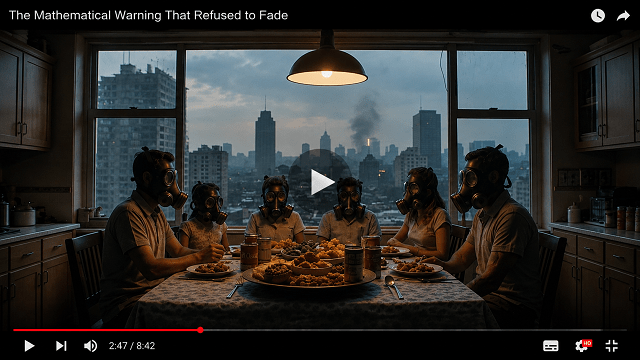
Editor’s Note:In 1849, the Russian writer Alexander Herzen recorded in his journals a strange observation from the streets of Paris: “People do not revolt when they face the most terrible oppression, nor when the judges are most corrupt, but when they can no longer obtain their small daily pleasures — a cup of tea, a cigarette, the habit of placing their slippers by the stove.” This odd, almost laughable observation — trivial on its surface — may contain the deepest truth about the nature of human breaking points.
I want to tell you about a conversation I had that I can’t stop thinking about. It was with a man in Indiana — I’ll call him Mike, though that’s not his real name. Mike works in a warehouse. He’s fifty-three. He’s got a wife who works part-time at a pharmacy, two grown kids who moved away and don’t call enough, and a mortgage he’s been paying for twenty years. He’s the kind of guy you’d pass on the street and not notice. The kind of guy who blends into the background of American life so completely that you might wonder if he actually exists or if he’s just a composite of statistics.
We were sitting on his porch. It was August, hot, the kind of humid evening where the air feels like a physical weight. He’d offered me a beer, which I accepted, and we talked about nothing for a while — the weather, the Colts, how the neighborhood had changed. Then, out of nowhere, he said something I’ve been turning over in my mind ever since.
“You know what scares me?” he asked. Not waiting for an answer, he continued: “It’s not dying. It’s not even something bad happening to my kids. It’s that I know — I know — that if someone came for them, if someone threatened them, I could do things. And I wouldn’t feel bad about it after. That’s what scares me. That I’m capable of that.”
He said it casually. Not dramatic. Not like he was trying to sound tough. Just a statement of fact, like he was describing the color of his house. And then he took a drink of his beer and changed the subject to something about his truck needing new brakes.
But I couldn’t let it go. Because Mike isn’t a violent person. He’s not a criminal. He’s not a revolutionary or a prepper or any of the categories we use to dismiss people who talk about these things. He’s just… a guy. A normal American guy who’s been paying attention. And what he’s figured out, what he’s articulating in that offhand way, is something that I think a lot of people are starting to feel but can’t quite name.
The line isn’t where we think it is. It’s not between good people and bad people, between law-abiders and criminals, between citizens and revolutionaries. It’s between the version of yourself that operates within the rules because they work, and the version that emerges when the rules stop working. And that line is closer than most of us want to admit.
What We Talk About When We Talk About Breaking Points
I’ve been reading about this stuff for years. Not because I’m particularly interested in violence or collapse or any of the dramatic scenarios that sell books and get clicks. But because I keep noticing this gap between what the data says and what people feel. The data says the economy is recovering, or growing, or resilient. The data says democracy is stable, or at least not collapsing. The data says things are basically okay, maybe not perfect, but okay.
But that’s not what you hear when you actually talk to people. You hear something else. You hear exhaustion. You hear a kind of low-grade, chronic anxiety that doesn’t have a name. You hear people describing their lives in terms of maintenance — keeping things running, keeping things together, keeping the plates spinning — rather than in terms of progress or meaning or any of the things we were promised.
And here’s where I have to be careful, because I don’t want to sound like I’m making this up. So let me give you some actual numbers, the kind that don’t make headlines but probably should.
In 2024, something happened that hadn’t happened in over two decades: authoritarian regimes outnumbered democracies worldwide. The count was 91 to 88. That means 72% of the global population — over 5.8 billion people — now lives under authoritarian rule. This isn’t ancient history. This is last year. And if you look at the trend lines, it’s not slowing down. It’s accelerating.
Now, you might say: that’s other countries. That’s not here. And you’d be right, to a point. But you’d also be missing something, because movements don’t respect borders the way they used to. Ideas travel faster than ever. Fear travels faster. And the conditions that create authoritarianism — economic precarity, institutional distrust, social fragmentation — those are here. In abundance.
Let me give you another number that stopped me cold. Colonel Chris Ellis, who studies disaster preparedness for the U.S. Army, estimates there are now 20 million “preppers” in the United States. Twenty million. That’s more than the population of most countries. And this isn’t the fringe anymore. This is mainstream. You can buy emergency food supplies at Costco now. Amazon moves thousands of survival kits a month. The industry is worth $70 billion annually and growing at nearly 10% per year.
What are these people preparing for? Some of them will tell you: natural disasters, economic collapse, civil unrest, government overreach. Others won’t tell you anything. They’ll just keep stocking their pantries and learning to purify water and hoping they’re wrong.
I don’t think they’re all crazy. I think they’re paying attention to something the rest of us are trying to ignore.
The Sound Beneath the Noise
There’s this thing that happens when you spend enough time talking to people who’ve lived through actual collapse — not the Hollywood kind with zombies and explosions, but the real kind, where the bank closes and doesn’t reopen, where the power goes out and stays out, where the rules just… stop. They all say something similar. They say it wasn’t sudden. They say there was a period, sometimes months, sometimes years, where things felt wrong but not urgent. Where you could still buy groceries and go to work and pretend everything was normal, even as the foundations were crumbling.
One woman I talked to, who’d lived through the collapse of Yugoslavia, described it like this: “It was like being in a marriage that’s dying. You know it’s dying. Everyone knows it’s dying. But you keep having dinner together and making small talk because what else are you going to do? And then one day, someone throws a plate. And that’s when you realize the small talk was the only thing holding it together.”
I think about that a lot. I think about what it means to keep having dinner while the marriage dies. Because that’s what a lot of us are doing. We’re maintaining the rituals of normalcy even as the substance drains away. We’re going to jobs that don’t pay enough to cover our bills. We’re voting in elections we don’t believe will change anything. We’re raising children in a world we can’t honestly tell them is going to be okay.
And the weird thing is, most of the time, this works. Most of the time, you can keep going like this indefinitely. The human capacity for adaptation is remarkable. We normalize things that would have seemed unthinkable five years ago. We adjust our expectations downward. We learn to live with less, to hope for less, to demand less.
But there’s a limit. There’s always a limit. And finding that limit — understanding what actually pushes people from adaptation to action, from compliance to resistance, from citizen to… something else — that’s what I’ve been trying to understand.
What Actually Makes People Snap
The psychology of breaking points is weirdly understudied, given how important it is. We have endless research on how to make people more productive, more compliant, more efficient. We have much less on what happens when those systems of control fail. What we do have comes mostly from studying crowds, riots, revolutions — the visible manifestations of collective breaking.
Gustave Le Bon, writing in the 1890s, thought crowds made people irrational, that being in a group dissolved individual morality and replaced it with something primitive and dangerous. Later research complicated this. Philip Zimbardo’s work on deindividuation suggested that anonymity — losing your individual identity in a group — could lead people to act in ways they normally wouldn’t. But both of these frameworks miss something crucial: the violence that emerges in crowds isn’t irrational from the perspective of the people involved. It’s often hyper-rational. It’s the logical conclusion of a cost-benefit analysis where the costs of continued compliance have come to exceed the costs of resistance.
Think about it this way. If you’re a normal person — Mike from Indiana, let’s say — you spend most of your life accepting certain constraints. You don’t steal because you believe it’s wrong, but also because you don’t want to go to jail. You don’t hit people who annoy you because you’ve internalized norms about violence, but also because you don’t want to get hit back or arrested. These constraints work because they’re backed by a system that more or less functions. If you call the police, they come. If you go to court, there’s a process. If you work hard, you get paid.
But what happens when that system stops functioning? What happens when calling the police doesn’t help, or makes things worse? What happens when working hard doesn’t pay the bills? What happens when the courts are so slow, so expensive, so obviously biased that they become irrelevant to your life?
At that point, the calculation changes. The constraints that kept you in line become abstract, while the immediate pressures become concrete. And normal people — people like Mike, people like your neighbor, people like you — start making different choices.
This isn’t theoretical. We have recent examples. In Brazil in 2013, an estimated two million people poured into the streets. The trigger? A fare increase for public transportation. That’s it. Ten cents. But it wasn’t about the ten cents. It was about the accumulated weight of everything else — corruption, inflation, poor services, a sense that the government was taking and taking and giving nothing back.
In China, villagers have risen against security forces over restrictions on cultural practices — restrictions that had existed for decades. Why then? Why not earlier? Because at some point, the accumulation of grievances crossed a threshold where action became preferable to continued endurance.
The thing that’s hard to grasp from the outside is that these moments feel inevitable to the people involved. They’re not making a calculated decision to revolt. They’re not weighing pros and cons. They’re just… done. Something shifts. And once it shifts, it doesn’t shift back.
The American Context: Closer Than It Looks
I want to be careful here, because I don’t want to sound alarmist. But I also don’t want to sugarcoat what the data shows. And the data shows some concerning trends.
In 2024, the United States saw the largest increase in monthly protest size globally. We’re talking about a jump from an average of 172,000 people in Q4 2024 to 696,000 in Q4 2025. That’s not a small increase. That’s a fourfold increase in a single year. And these aren’t just the usual suspects — professional activists, college students, the people who always protest. These are increasingly mainstream Americans who’ve reached their own personal breaking points.
The causes are varied and overlapping. Economic precarity is a big one. Despite what the aggregate numbers say about economic growth, the distribution of that growth has been wildly unequal. The top 10% of Americans now control 60% of the nation’s wealth, while the bottom half holds just 6%. Median household income is around $83,730, which sounds okay until you factor in housing costs, healthcare, education, and the fact that most people have no meaningful savings.
But it’s not just economics. It’s a broader sense of institutional failure. Trust in government is at historic lows. Trust in media is at historic lows. Trust in corporations, in banks, in schools, in churches — all down. When you ask people if they believe the system works for people like them, the majority say no. And that’s been true for long enough that it’s not a reaction to any single event. It’s become a baseline condition.
Here’s where it gets tricky. The prepper movement — those 20 million Americans stockpiling food and learning survival skills — is often dismissed as paranoia. But I think it’s better understood as a kind of rational adaptation to perceived risk. These people aren’t necessarily expecting the apocalypse. They’re preparing for the possibility that the systems they rely on might fail. And they’re not wrong to think that way.
Look at what the government itself is doing. Stockpiling ammunition. Acquiring military vehicles for domestic police use. Building continuity-of-government facilities designed to sustain ruling elites through catastrophes. These are not the actions of an institution that believes everything is fine. These are the actions of an institution that’s preparing for something.
The question is: what? And will ordinary people be prepared for the same something?
Learning from the Wrong History
I mentioned Solzhenitsyn earlier, and I want to come back to him, because his work contains something essential that most people miss. We read The Gulag Archipelago as a condemnation of Soviet totalitarianism, which it is. But it’s also something else. It’s a meditation on how ordinary people — good people, normal people, people like us — become complicit in their own oppression. And how they might have stopped it.
There’s a passage that’s haunted me since I first read it. He’s talking about the mass arrests in Leningrad, when the security forces would take a quarter of the city in a single night. And he asks: what would have happened if, instead of sitting in their apartments waiting for the knock on the door, people had organized? If they’d set up ambushes in their stairwells with whatever weapons they had? If they’d made the cost of each arrest high enough that the system couldn’t sustain it?
His conclusion is devastating. “We didn’t love freedom enough,” he writes. “And even more — we had no awareness of the real situation. We purely and simply deserved everything that happened afterward.”
That’s a hard thing to read. It’s a harder thing to sit with. Because it suggests that the line between survival and complicity is not as clear as we’d like it to be. That there’s a point where going along becomes collaboration, where keeping your head down becomes enabling, where the desire to protect your family becomes the mechanism by which tyranny establishes itself.
I don’t know where that point is. I don’t think anyone does, really, until they’re past it. But I think a lot of Americans are starting to wonder if we’re approaching it. If the things we’re being asked to accept — the surveillance, the economic extraction, the gradual normalization of things that would have been unthinkable a generation ago — if these things are the early stages of something we don’t want to be complicit in.
The Specific Shape of American Breakdown
If something happens in America — not the Hollywood version with flags and speeches, but the real version with confusion and fragmentation and局部 collapse — it won’t look like what happened in other places. It’ll look like us. It’ll be shaped by our particular history, our particular divisions, our particular fantasies about who we are.
We have more guns than people in this country. That’s a fact that gets thrown around a lot, usually in debates about gun control. But think about what it means for social stability. In most countries, the state’s monopoly on violence is a given. Here, it’s contested. There are millions of households that are, in effect, small arsenals. That changes the calculation for everyone — the government, the police, the citizens themselves.
We also have a particular kind of individualism that’s both our strength and our vulnerability. Americans believe, deeply, in the possibility of going it alone. Of self-sufficiency. Of opting out. This is part of why the prepper movement is so strong here — it fits our mythology. But it also means that when things break down, we may fragment faster than more collectivist cultures. We may default to tribalism, to localism, to “me and mine first” faster than we default to solidarity.
And we have a media environment that’s perfectly designed to fragment shared reality. Not just in the sense of “fake news” — though there’s plenty of that — but in the deeper sense of not having any shared reference points. People on different sides of the political divide don’t just disagree about solutions. They disagree about facts. About what’s happening. About what’s real.
This matters for understanding breaking points because breaking points require collective recognition. You need enough people to agree that the line has been crossed. If you don’t have that — if half the population thinks everything is fine while the other half thinks we’re on the brink of collapse — then you don’t get coordinated action. You get chaos. You get different groups reacting to different realities, often in ways that conflict with each other.
What Preparation Actually Means
I’ve been using the word “prepper” a lot, and I want to clarify what I mean by it, because the stereotype is misleading. Yes, there are people in bunkers with gas masks and fifty years of freeze-dried food. But that’s not most of them. Most are much more ordinary. They’re the couple down the street who installed solar panels and learned to garden. They’re the single mom who keeps a month of supplies in her basement. They’re the retired guy who knows how to fix small engines and has a network of neighbors who rely on him.
What distinguishes them isn’t paranoia. It’s pattern recognition. They’ve looked at the same data everyone else has — climate change, economic inequality, political polarization, infrastructure fragility — and drawn a different conclusion. Not that the world is definitely ending. But that it might. And that it makes sense to be ready if it does.
I find this approach much more compelling than the alternatives. On one side, you have people who refuse to look at the data at all, who insist everything is fine because believing otherwise is too uncomfortable. On the other side, you have people who’ve given up on the present entirely, who are waiting for the collapse as a kind of apocalyptic redemption. The preppers, at their best, are in the middle. They’re trying to live normally while also preparing for the possibility that normal might end. That’s a hard balance to strike. But it’s probably the most rational response to the conditions we face.
What does this preparation actually look like? It’s not mostly about guns and bunkers, despite what the media suggests. It’s about redundancy. Having more than one way to get water, power, food. It’s about skills. Knowing how to grow food, fix things, provide basic medical care. It’s about community. Having people you can rely on, and who can rely on you. The survivalists who actually survive long-term are almost never the lone wolves. They’re the ones embedded in networks of mutual aid.
The Question of When
People always want to know: when will it happen? When is the breaking point? And the honest answer is: I don’t know. Nobody knows. Historians are good at identifying these moments in retrospect, but in real-time, they’re almost always surprises.
Think about the Arab Spring. Mohamed Bouazizi set himself on fire in Tunisia because he was harassed by police. He wasn’t the first person to be harassed. He wasn’t the first to protest. But something about that moment — his specific act, the specific context, the specific way it spread through social media — created a catalyst. Within months, governments across the region had fallen or been shaken.
Or think about the financial crisis of 2008. Plenty of people saw it coming. But almost nobody saw exactly when, or exactly how it would unfold. The timing was determined by specific decisions, specific failures, specific moments of panic that couldn’t have been predicted in advance.
What you can predict, with reasonable confidence, is the conditions under which these catalysts become explosive. You need a population that’s economically stressed — check. You need institutional legitimacy that’s been eroded — check. You need a sense that the future will be worse than the past — check. You need communication networks that allow rapid spread of information and coordination — check. You need some triggering event that seems symbolic of larger grievances — variable, but likely at some point.
America has most of these conditions now. Has had them for years. So the question isn’t really if, but when and what. What will be the specific thing that pushes enough people over the edge? And will it be something that creates the possibility for change, or just for chaos?
Living in the Meantime
So what do you do with this information? If you accept that the conditions for breakdown are present, that the pressure is building, that something is likely to happen at some point — how do you live? Do you drop everything and move to a bunker? Do you join a militia? Do you just try not to think about it?
I think the answer is more mundane. You prepare, in the ways that make sense for your life. You build the skills and relationships that will be valuable in a variety of scenarios. You pay attention to what’s happening around you, without becoming obsessed. You try to maintain some quality of life now, while also being ready for a different quality of life later.
Most importantly, you think about who you want to be when things get hard. Because that’s the thing about breaking points — they don’t just reveal who we are, they shape who we become. The version of you that exists in crisis is not the same as the version that exists in stability. But they’re related. The choices you make now, the habits you build, the relationships you cultivate — these become the foundation for who you’ll be when the foundation shifts.
Mike from Indiana, sitting on his porch with his beer, understood something that took me longer to grasp. It’s not about predicting the future. It’s about accepting uncertainty. It’s about being honest with yourself about what you’re capable of, both good and bad. And it’s about making peace with the fact that there may come a moment when you have to choose between who you thought you were and who you actually are.
The Weight of Small Things
I want to end with something small. Herzen’s observation about the tea and the slippers. It seems trivial, but it’s not. The things that push people over the edge are rarely the big things — the wars, the famines, the obvious catastrophes. People endure those, sometimes with incredible resilience. It’s the small things that break them. The daily humiliations. The gradual erosion of dignity. The sense that they can’t even control the smallest aspects of their lives.
In America right now, there are millions of people who are one medical bill away from disaster. One job loss away from losing their homes. One interaction with a bureaucratic system away from despair. These are not abstract economic conditions. These are lived experiences of precarity that accumulate, day by day, until something shifts.
And on the other side, there are people — not necessarily bad people, just people — who are making decisions that contribute to this precarity. Policy decisions. Business decisions. Personal decisions. Each one seems reasonable in isolation. Each one has a justification. But the accumulation is breaking something. Some social contract. Some shared understanding of what we owe each other.
I don’t know where the line is. I don’t know what will happen when it’s crossed. But I think Mike is right to be scared. Not of the violence itself, but of the realization that he’s capable of it. That we all are. That the only thing keeping us in check is a set of conditions that are themselves becoming precarious.
The final straw isn’t an event. It’s a process. It’s the slow accumulation of weight until the structure can’t hold. We’re somewhere in that process now. Exactly where, I can’t say. But I think more of us are starting to feel it. That low vibration. That sense that something is coming.
Maybe it won’t be dramatic. Maybe it’ll just be a long, grinding adjustment to a lower standard of living, a more constrained set of possibilities, a narrower scope for individual freedom. Maybe we’ll look back in thirty years and realize the breaking point came and went and we barely noticed because we were too busy surviving.
Or maybe it’ll be sharper. Maybe there will be moments when the normal rules don’t apply, when the institutions we’ve relied on simply fail, when each of us has to decide what we’re willing to do and what we’re willing to become.
Either way, the preparation matters. Not because it guarantees survival — nothing does — but because it gives you options. Because it lets you choose, rather than simply react. Because it maintains some sense of agency in conditions that are designed to make you feel powerless.
Mike finished his beer and went inside to check on his wife. I sat on the porch a while longer, watching the fireflies come out, listening to the sounds of the neighborhood settling in for the night. It all looked so normal. It all felt so fragile.
I don’t know what’s coming. But I think we should be ready.
You can still get a passport processed. The highway department still patches potholes, eventually. Social Security checks arrive, though the purchasing power shrinks monthly in ways the official statistics fail to capture. Everything looks operational. The buildings stand. The uniforms remain crisp. The websites load, the forms process, the announcements issue forth with familiar cadence.
Something has shifted underneath.
It is not visible in dramatic collapse but in the accumulation of small degradations—the phone call that goes unanswered for hours, the permit that takes months instead of weeks, the emergency response that arrives too late and explains, with genuine regret, that resources were stretched thin. These are not aberrations. They are the new baseline, accepted gradually enough that each generation adjusts its expectations downward without recognizing the adjustment as loss.
The United States national debt reached forty trillion dollars in early 2026. The Treasury now pays approximately eighty-eight billion dollars in interest every month. This exceeds the entire defense budget. It exceeds Medicare. It is money spent not on services, not on infrastructure, not on any productive capacity, but purely on the maintenance of previous borrowing. The Congressional Budget Office projects these costs rising to two trillion annually by 2036. These figures appear in reports that few read and fewer understand, yet they manifest in daily life through mechanisms both obvious and obscure.
Your grocery bill tells part of the story. Food prices rose three percent year-over-year through mid-2026, according to Bureau of Labor Statistics data, but this aggregation conceals more troubling specifics: eggs fluctuating wildly due to avian influenza culls, beef prices elevated by drought conditions affecting feed costs, fresh produce becoming seasonal in ways that previous generations did not experience. The personal savings rate has fallen to three percent. Credit card debt has reached historic highs. These are not indicators of profligacy but of necessity—households maintaining consumption despite income stagnation through unsustainable leverage.
The federal government continues to function in the sense that legislation passes and agencies operate. But the nature of that function has changed. When debt service consumes more revenue than defense, the state becomes essentially a mechanism for transferring wealth from future taxpayers to current creditors. This is not ideology. It is accounting. The money that might have funded bridge maintenance or laboratory research or training programs instead flows to bondholders, many of them foreign central banks and domestic financial institutions, as interest on obligations accumulated over decades of bipartisan deficit spending.
Presidents of both parties have pressured the Federal Reserve to reduce interest rates, explicitly citing debt service costs as motivation. This creates a trap. Lower rates reduce borrowing costs but inflate asset bubbles and currency debasement. Higher rates control inflation but increase debt service, crowding out other spending. The Fed navigates between these hazards, but the space for navigation narrows each year as the debt compound grows. There is no policy solution that does not require either explicit default—politically impossible—or implicit default through monetary erosion.
You feel this in your wallet even if you do not track Treasury auctions.
Here are the five signs:
Debt Service Has Become the Primary Function of Government
The numbers are public but rarely connected to experience. In fiscal year 2026, the United States will spend approximately one trillion dollars on net interest payments. This represents a tripling since 2019, when interest costs ran about three hundred seventy-five billion annually. The acceleration is geometric rather than arithmetic; each percentage point increase in the federal funds rate adds hundreds of billions to future obligations, and the debt stock continues expanding regardless of which party controls Congress.
What this means practically is that discretionary spending—that portion of the budget not already committed to mandatory programs like Social Security, Medicare, and now interest—faces perpetual compression. The Infrastructure Investment and Jobs Act of 2021 authorized substantial spending, but implementation has lagged due to capacity constraints. The money exists on paper. The actual construction moves slowly because the engineering capacity, the contractor availability, the regulatory processing—all these bottlenecks persist and worsen.
Military procurement illustrates the dynamic. Defense spending nominally exceeds one trillion dollars annually, but much of this covers personnel costs, health care for veterans, and maintenance of existing equipment rather than modernization. When Admiral Lisa Franchetti testified before Congress in late 2025 regarding naval shipbuilding, she noted that the Navy could not meet its thirty-year shipbuilding plan due to industrial base constraints and cost overruns. The money was appropriated. The ships were not being built. This gap between authorization and execution characterizes contemporary governance more than partisan conflict does.
The debt itself has become a kind of permanent emergency, invoked to justify various policy choices while remaining immune to resolution. Debt ceiling negotiations occur annually, each time producing temporary fixes that suspend limits rather than address trajectory. The 2023 Fiscal Responsibility Act established caps that were immediately breached through emergency designations and accounting adjustments. This is not failure in the conventional sense. It is the system operating as designed—designed to postpone difficult choices until they become impossible choices.
Citizens adapt to monetary erosion through behaviors that further complicate policy. Those with assets shift into real property, precious metals, cryptocurrencies—anything that might preserve value against currency debasement. Those without assets fall further behind, their wages purchasing less each year despite nominal increases. The inequality that results is not merely economic but existential, creating populations with fundamentally different relationships to the future. Some prepare for scarcity. Others cannot afford preparation.
Argentina provides a template for where this leads, though Americans resist the comparison. In the 1980s and 1990s, Argentina maintained first-world infrastructure and educational attainment while running persistent deficits. The peso was pegged to the dollar, creating artificial stability. When the peg broke in 2001, the collapse was not gradual but sudden—bank accounts frozen, savings wiped out, middle-class professionals reduced to bartering. The warning signs had been visible for years: capital flight, dollarization of transactions, political polarization around distributional conflict. They were ignored because ignoring them was easier than confronting them.
The United States retains advantages Argentina lacked: reserve currency status, deeper capital markets, greater institutional legitimacy. But these advantages function increasingly as delay mechanisms rather than solutions. They extend the timeline of deterioration without altering its direction. And they create a dangerous complacency—the assumption that because collapse has not occurred, it cannot occur.
Official Guidance Now Assumes Systemic Failure
In 2011, the Federal Emergency Management Agency updated its preparedness guidelines to emphasize seventy-two hour self-sufficiency. The recommendation was not new, but the emphasis was. Where previous civil defense messaging had focused on community shelter and organized response, the contemporary approach assumes that households will be on their own for at least three days following major disruption. This assumption reflects hard experience rather than theoretical modeling.
Hurricane Katrina in 2005 exposed the gap between official capacity and actual need. Thousands sheltered in the Superdome and Convention Center for days without adequate food, water, or security. The National Guard arrived eventually, but eventually proved too late for those who required immediate medical attention or protection from violence. Hurricane Maria in 2017 repeated the pattern in Puerto Rico, where infrastructure collapse left millions without electricity for months. The official death toll remains disputed, with estimates ranging from several dozen to several thousand depending on methodology.
The 2021 Texas winter storm provided a different lesson. The power grid, operated by the Electric Reliability Council of Texas, failed under demand spikes caused by unusual cold. Millions lost electricity during freezing temperatures. Water systems failed. The official response emphasized individual preparation—generators, stored water, alternative heating—rather than systemic reform. Subsequent legislation required weatherization of generation facilities, but implementation has been partial and enforcement weak.
FEMA’s 2026 National Preparedness Report acknowledges these limitations with bureaucratic candor. The report identifies “resource constraints” and “capacity gaps” as persistent challenges, noting that simultaneous disasters regularly exceed available federal resources. The language is technical, but the implication is clear: citizens should not expect immediate assistance in crisis. This is not abandonment. It is honest assessment. But honesty about incapacity represents a significant shift from the implicit promise of mid-twentieth-century governance.
The psychological effects of this shift are subtle but profound. Populations that internalize self-reliance as virtue may fail to recognize it as necessity imposed by institutional retreat. The prepper movement, once marginal, has entered mainstream culture through television programming and retail marketing. Costco sells emergency food buckets. Amazon offers solar generators. These products address real vulnerabilities, but they also normalize the expectation that individuals will provide services that were once understood as collective responsibilities.
Local emergency management offices increasingly emphasize “community resilience”—code for decentralized response using volunteer networks rather than professional services. This can function effectively in small-scale events. It fails catastrophically in large-scale disasters that overwhelm local capacity. The 2024 wildfire season in California illustrated the pattern: community preparedness delayed evacuation in some cases, leading to higher mortality when fires moved faster than anticipated.
The shift from collective to individual responsibility occurs without legislative mandate or public debate. It is presented as empowerment, as resilience, as the admirable refusal to become a victim. These framings contain partial truth. But they obscure the structural abdication that necessitates such preparation. A society requiring every household to function as an autonomous survival unit has not empowered its citizens. It has privatized the costs of systemic failure.
Supply Chains Recover, Then Break Again
The shortages of 2021 were supposed to be temporary. Pandemic disruption would resolve as vaccination allowed normal economic activity. Container ships would unload, factories would restaff, shelves would refill. This happened, partially, by 2022. But the underlying fragility was not addressed. It was merely obscured by restored abundance.
In April 2025, China imposed export controls on gallium and germanium—critical minerals essential for semiconductor manufacturing, battery production, and military hardware. By May, Ford Motor Company confirmed plant shutdowns due to component shortages. The controls were retaliation for U.S. technology restrictions, but they exposed American vulnerability regardless of motive. Alternative sourcing requires years of mine development and processing facility construction. Immediate substitution is impossible.
Cyberattacks on logistics infrastructure increased sixty-one percent in 2025, according to Everstream Analytics data. Ports, carriers, and third-party logistics providers faced ransomware attacks that disrupted operations for days or weeks. The Port of Los Angeles experienced a three-day shutdown in March 2026 attributed to unspecified “system maintenance” widely understood to cover security incidents. Such events do not make headlines because they are managed before reaching public awareness, but they accumulate in system brittleness.
Climate disruption compounds these vulnerabilities. The 2025 Mississippi River drought reduced barge traffic to levels that required trucking substitution, increasing costs and delays. Hurricane seasons have intensified, damaging Gulf Coast petrochemical facilities that supply raw materials for plastics, fertilizers, and pharmaceuticals. Each event is manageable in isolation. The concern is simultaneous disruption across multiple nodes—port closures coinciding with rail strikes, cyberattacks overlapping with extreme weather—that exceed redundancy buffers.
Just-in-time manufacturing, the dominant production model since the 1980s, eliminates inventory buffers to minimize costs. It assumes stable supply conditions. When those conditions prove unstable, shortages propagate rapidly through industrial ecosystems. Baby formula scarcity in 2022 resulted from a single plant closure. Semiconductor shortages affected automotive production through 2023-2024 despite massive investment in domestic fabrication. These are not isolated incidents but symptoms of system design optimized for efficiency rather than resilience.
The consumer experiences these stresses as price increases and availability constraints, rarely connecting specific shortages to structural origins. When construction projects delay due to materials unavailability, when automotive prices remain elevated despite interest rate increases, when medical devices become backordered—these feel like market fluctuations rather than systemic warnings. Only when multiple systems fail simultaneously does the architecture become visible.
Official response emphasizes diversification of sourcing, domestic manufacturing incentives, strategic stockpiling. Implementation lags behind deterioration. The CHIPS Act of 2022 authorized semiconductor fabrication subsidies, but construction of new facilities requires years. Intel’s Ohio plant, announced with great fanfare, faces delays due to cost overruns and labor shortages. TSMC’s Arizona facility has pushed back production timelines repeatedly. These projects will eventually produce chips. Eventually provides little comfort during current shortages.
Institutional Trust Has Entered Free Fall
Gallup’s June 2026 polling found average confidence in American institutions at twenty-seven percent—near historic lows for the fifth consecutive year. Congress scored lowest at eight percent. Media organizations fared little better. Banks, despite regulatory reforms following the 2008 crisis, retained only marginal public confidence. These figures represent not partisan dissatisfaction but structural withdrawal of faith from centralized authority.
The mechanism is cumulative disappointment rather than singular betrayal. Each scandal that goes unpunished, each promise unfulfilled, each crisis revealing unpreparedness deposits sediment in collective memory. Water contamination in Flint, Michigan, began in 2014. By 2026, some residents still lack reliable access to clean water. The officials responsible faced minimal consequences. This pattern—failure without accountability—repeats across domains: financial fraud, medical malpractice, political corruption, corporate malfeasance.
The 2024-2025 banking stress illustrated the dynamic. Regional banks faced insolvency due to interest rate impacts on bond portfolios. Federal regulators arranged mergers and provided liquidity facilities. Depositors were protected, but shareholders and bondholders were wiped out. The message conveyed: the system protects itself, not participants. This is accurate description of regulatory function, but it undermines the legitimacy required for voluntary compliance.
When institutional trust falls below threshold, behavior changes fundamentally. Tax compliance becomes calculative rather than automatic, with sophisticated taxpayers exploiting legal ambiguities while ordinary wage earners lack such options. Regulatory adherence fragments, with some firms maintaining rigorous standards while others cut corners, creating competitive disadvantage for compliance. Emergency guidance faces skepticism; evacuation orders are ignored based on previous false alarms; public health recommendations are dismissed due to perceived politicization.
The epistemic fragmentation is perhaps most troubling. Populations no longer share common factual baselines. Climate change, vaccine efficacy, electoral integrity—these become contested territories where different communities inhabit different realities. This is not merely disagreement about policy responses but disagreement about observable conditions. When authorities lose credibility, information vacuums fill with sources that confirm existing biases rather than challenge them. Social media algorithms amplify this fragmentation, creating feedback loops of polarization.
Educational institutions have experienced particularly sharp confidence declines. The 2023-2024 campus protests regarding Gaza policy, combined with ongoing debates about curriculum content, have reduced public trust in universities as neutral arbiters of knowledge. Student loan burdens have created generational resentment toward higher education as an institution. Primary and secondary schools face similar pressures regarding gender education, book banning, and pandemic policies. The result is a withdrawal from public education into private alternatives, homeschooling, and micro-schools that further fragment shared civic culture.
What makes this sign dangerous is its effect on coordination capacity during crisis. Modern emergency response depends upon voluntary compliance—evacuation orders, public health measures, resource conservation. When large populations distrust the authorities issuing such guidance, compliance becomes uneven and response less effective. This was evident during COVID-19, when polarization around masking and vaccination reduced public health effectiveness. It will be more evident in future crises where the threat is immediate rather than gradual.
Recovery from institutional trust collapse requires decades under favorable conditions. The United States experienced similar patterns during the 1970s—Watergate, Vietnam, stagflation—but recovery occurred against favorable demographic and economic tailwinds. Current conditions offer no such compensations. Population aging, fiscal constraint, and geopolitical competition create headwinds that may extend the trust deficit indefinitely.
Local Governments Are Running Out of Money
Federal dysfunction captures attention, but failure begins locally. Cities and counties represent the interface between abstract state authority and concrete daily experience. When these systems falter, effects are immediate and undeniable. Current fiscal conditions suggest widespread distress that national aggregates obscure.
The Reason Foundation’s 2025 Pension Solvency Report documents $1.48 trillion in unfunded pension liabilities—$187 billion at local government level alone. These are contractual promises to retired police officers, firefighters, teachers, and civil servants that must be honored before other expenditures. As pension costs consume increasing budget shares, discretionary spending contracts.
Chicago’s persistent crisis exemplifies the pattern. Pension obligations absorb nearly twenty percent of operating budget, crowding out services while failing to address underfunding. The city has resorted to asset sales, debt issuance, and accounting adjustments that delay but do not resolve structural imbalance. Similar conditions prevail in Hartford, Stockton, and numerous smaller jurisdictions that have entered bankruptcy or state receivership.
2026 stress testing projects that a twenty percent market downturn would reduce average pension funding to sixty-three percent—below actuarial soundness thresholds. Given demographic trends—retiring baby boomers drawing benefits while fewer workers contribute—this represents likely scenario rather than tail risk. When pension systems require bailouts, costs fall upon state or federal taxpayers, creating intergovernmental tensions that degrade service delivery further.
Staffing shortages compound fiscal constraints. Police departments in New Orleans, Nashville, and Portland report vacancy rates exceeding twenty percent. Fire departments delay station openings. 911 call centers experience turnover that degrades dispatch efficiency. These are not management failures but resource constraints—municipalities cannot offer competitive compensation against private sector while meeting pension obligations.
Physical infrastructure reflects fiscal strain. Deferred maintenance accumulates in water mains, road surfaces, bridge structures, school buildings. The American Society of Civil Engineers estimates trillions in deferred maintenance. This backlog represents accumulated risk; systems pushed beyond design life fail catastrophically. The 2024 Baltimore bridge collapse, caused by vessel collision with inadequate protection, illustrated how deferred investment creates sudden crisis.
Citizens experience municipal decline as withdrawal of presence. Police response takes hours rather than minutes. Building permits require months. Code enforcement becomes sporadic. This creates vacuums filled by informal arrangements—neighborhood security patrols, private water filtration, generators—that represent privatization by default rather than design.
The fragmentation is uneven. Affluent suburbs maintain services through property tax bases that poorer municipalities lack. This creates a two-tier system where geography determines governmental quality more than citizenship. The inequality is not merely economic but governmental—some populations receive effective services while others inhabit zones of administrative abandonment.
What Happens When the Momentum Stops
These five signs interact in ways that exceed linear analysis. Monetary constraint reduces infrastructure investment; infrastructure degradation increases logistical vulnerability; logistical failure erodes institutional trust; trust collapse reduces fiscal policy compliance; fiscal shortfall accelerates monetary expansion. The system becomes a network of deterioration, each node reinforcing others.
Historical comparisons fail because modern interdependence exceeds anything previously attempted. Rome’s collapse occurred in an era of limited connectivity; provinces could revert to local self-sufficiency. Contemporary civilization depends upon global supply chains, just-in-time inventory, digital communication, electrical grids that know no boundaries. Collapse of such systems produces cascading failure across multiple domains.
The timeline remains unclear. Complex systems persist longer than linear models predict, absorbing shocks through adaptation and improvisation. The United States retains enormous resources—human capital, institutional memory, geographic advantages—that provide resilience. Yet these resources are being consumed, converted from productive to extractive uses at compounding rates.
Appropriate response is neither panic nor denial but recognition of pattern. Civilizations collapse not because they encounter problems but because they encounter problems they cannot solve with existing arrangements. Current American polity shows little capacity for fiscal consolidation, institutional reform, infrastructure investment, or trust reconstruction that remediation would require. Political incentives favor short-term accommodation over long-term correction.
What citizens can do is limited but not negligible. Personal preparation provides buffer against systemic stress. Local engagement preserves coordination capacity when centralized systems falter. Recognition of pattern—resisting normalization of deterioration—maintains psychological independence necessary for adaptive response.
The nightmare is not sudden collapse with dramatic announcement. It is the quiet continuation of current trajectory, each year slightly worse than the last, until the accumulated difference becomes undeniable. The signs are visible for those willing to see them. Recognition is the first requirement of response. Without it, adaptation becomes impossible, and deterioration becomes destiny.
I don’t know if you’ve ever lived through a major power outage, but I have. I live in a hurricane zone, so I suppose it was inevitable that I would eventually face the full wrath of nature’s fury. The storm that hit us wasn’t one of those headline-grabbing monsters that brings FEMA agents swarming in with cameras rolling and politicians posing for photo ops. It was what meteorologists call a “moderate” event—just strong enough to knock out infrastructure, just weak enough to be forgotten by the national media within 48 hours. But it took seven days for our power to return. Seven days. One hundred and sixty-eight hours. Ten thousand and eighty minutes of living in a world that suddenly resembled something from another century—or another dimension entirely.
You don’t truly realize how much you need electric power until you’re left without it. As a society, we are addicted to electricity in ways that would horrify our great-grandparents and confuse our ancestors. Pretty much everything we do uses electricity in one way or another, even activities we think of as analog, unplugged, or “natural.” The water flowing from your tap? Electric pumps. The gas at the station? Electric pumps. The food in your refrigerator? Electric cooling. The money in your bank account? Electronic records. The safety of your neighborhood? Electric streetlights and surveillance systems. When the power goes out, you notice immediately. The sudden silence of a house without humming appliances is disorienting. The stillness feels like a presence, a weight. And the uncertainty—will it be hours? days? weeks?—creates a low-grade anxiety that simmers beneath every decision.
Looking at the way things are in California, Texas, and across the Midwest right now, extended power outages may be something we all need to get used to. The rolling blackouts that have become increasingly common aren’t just due to isolated errors by utility companies or government mismanagement—though both play significant roles. They’re symptoms of a grid infrastructure that was largely built in the 1960s and 1970s, designed for a population half its current size, and now being asked to handle loads and weather patterns that its designers never imagined. The government blames utilities for not properly maintaining their lines, while utility companies blame government regulations for forcing them to invest money that should have gone into maintenance into expensive green energy projects that haven’t yet proven reliable at scale. Meanwhile, extreme weather events are producing more stress on this aging infrastructure beyond its breaking point. With the push for rapid decarbonization across the country, we may be entering an era where forced blackouts become as common in Ohio and Pennsylvania as they already are in California. Once the precedent is established—that utilities can simply shut off power to millions to prevent wildfires or manage peak loads—the dam has been opened. We could see forced blackouts anywhere in the country where there is risk of infrastructure failure, which is essentially everywhere.
I first noticed that the power failed when my computer suddenly shut off. The screen went black. The fan stopped whirring. The silence was immediate and absolute. This wasn’t the first time this had happened—power outages in the middle of storms are fairly normal in my area. I figured the power would return within an hour or two, and in the meantime, I could have a snack, read a book, and watch the rain from my porch. But the power didn’t come back on. As I sat there for hours, I began counting all the work I wasn’t getting done, all the money I wasn’t making, and all the deadlines that were slipping away into an uncertain future. In our hyperconnected economy, a day without power isn’t just an inconvenience—it’s a financial hemorrhage. Freelancers lose billable hours. Remote workers lose their connection to employers. Small business owners watch inventory spoil and revenue evaporate.
Meanwhile, since I live in the Deep South, the temperature was rising relentlessly. It had been 100°F outside before the storm started, and now, with the rain stopped but the humidity locked in, the house was rapidly becoming an oven. I opened every door and window that I could without letting in the mosquitoes that breed in standing water after storms, but there wasn’t enough airflow to cool the house significantly. The air felt thick enough to chew. I suppose it wasn’t as bad as being up north in the dead of winter. While excessive heat can kill you—heat stroke is a real and present danger, particularly for the elderly and those with cardiovascular conditions—extreme cold is statistically more lethal. People who live in colder climates and who don’t have alternative means of heating their homes, like a wood-burning stove or a fireplace with a substantial stock of dry firewood, are genuinely risking their lives during extended winter power outages. The 2021 Texas winter storm proved this catastrophically, when over 240 people died, many from hypothermia in their own homes as temperatures inside dropped to lethal levels.
Without power, we really didn’t have much light in the house. Modern homes aren’t designed for natural lighting—they’re designed with the assumption that electric light will always be available. Most homes don’t have enough windows, and mine is no exception. Between the lack of windows and the heavily overcast sky that lingered after the storm, it was hard to do much of anything productive. Reading strained the eyes. Cooking required flashlights. Navigating hallways became an exercise in memorization and careful toe-placement. Fortunately, we had a gas stove with standing pilot lights, so cooking dinner wasn’t immediately problematic. We had plenty of food in the refrigerator and freezer, and for the moment, those appliances were keeping things cold through thermal mass and insulation. We just had to make sure we kept the doors closed to preserve that cold, treating the refrigerator like a cooler that we opened only when absolutely necessary.
I had a hard time sleeping that first night, due entirely to the heat. The humidity was oppressive, clinging to the skin like a wet blanket, making every position uncomfortable. For that matter, we had a hard time sleeping all week long. The body needs to cool down to enter restful sleep, and without air conditioning or even fans, our core temperatures remained elevated, leading to shallow, fitful rest and waking constantly throughout the night. If I had been able to string up some hammocks, we could have been cooler—hammocks allow air circulation beneath the body, which significantly improves comfort in hot conditions. But the only place I could have done that was in the backyard, and it was still raining intermittently, with saturated ground and dripping trees. I work from home, so I obviously couldn’t work. But neither could my wife. The school where she taught didn’t have power either, so she was stuck at home, losing wages she couldn’t afford to lose. The kids initially loved it—as children will, they saw it as an unexpected vacation from classrooms and homework. But even if the schools had been open, they would have been stuck at home anyway, as our street looked like a lake. Some malfunction with the stormwater drainage system—probably debris-clogged intakes—had turned our residential road into a stagnant pond three feet deep in places.
The big thing that confronted me that morning was the home’s sump pump. Without electricity, the pump wasn’t emptying the sump automatically, and water was rising in the basement. I spent hours manually bailing, carrying five-gallon buckets up the stairs and out the back door, dumping them into the yard where the water could eventually drain away. By noon, my back was screaming and my hands were blistered. By afternoon, I had to tell the family we were switching over to emergency procedures. They’d have to use a five-gallon bucket toilet we had set up for emergencies—a toilet seat clipped onto a sturdy bucket lined with heavy-duty trash bags, with kitty litter for covering waste after each use. The smell was immediate and pervasive. Fortunately, we had installed a greywater recycling system years ago, so the water from sinks and tubs went out into the backyard through separate pipes, not into the sewage system. This meant our toilets wouldn’t back up from municipal system overload—a common problem in extended outages when pumping stations fail.
As afternoon rolled around, the water flow from the kitchen sink started diminishing, sputtering, and eventually came to a complete stop. We were without municipal water. The pumping station that served our neighborhood had lost power, and apparently, either it didn’t have a backup generator or the generator had failed. Fortunately, I had foreseen this possibility and had stockpiled water. My rain barrels were full from the storm, and I had a quality water purification system—filters capable of removing bacteria, parasites, and chemical contaminants. We had enough drinking water for weeks if we were careful. But the psychological impact of turning a faucet and having nothing come out cannot be overstated. It’s a primal fear, a severing of the most basic expectation of modern life.
The rain finally let up on the third day, at least for the most part. We were still getting sudden downpours as weather systems continued to move through, but we were also getting dry periods as well. Maybe our street would finally drain and I’d be able to move the cars. But the humidity was brutal—hovering near 100%, making every breath feel like inhaling through a warm, wet cloth. Up until now, the food in the refrigerator had been doing surprisingly well. The insulation was sufficient to maintain cold temperatures, especially since I had kept the freezer full—frozen water bottles and bags of ice had maintained thermal mass. But today was crunch day for that food. I was going to have to start processing it or watch hundreds of dollars worth of meat, dairy, and produce spoil. Time to fire up the smoker. I had a traditional offset smoker that ran on wood and charcoal, no electricity required. I spent the morning butchering frozen chickens and pork roasts, trimming them for smoking, and getting fires started. Too bad the cloud cover was too thick to use solar dehydration for making jerky—another preservation method I had hoped to employ.
Bathing had become a serious challenge. We didn’t have running water, and with the heat and humidity, we all needed to bathe daily just to maintain basic hygiene and prevent skin infections. I’ve spent considerable time in rural Mexico on humanitarian missions, so I knew how to handle this. All it takes is a five-gallon bucket and a smaller plastic container—something that holds about two quarts, like a repurposed yogurt container or small pitcher. To bathe, you get a couple of gallons of water in your bucket and lock yourself in the bathroom, setting the bucket in the tub. You wet yourself down by pouring water over yourself with the small container. Once wet, it’s time to soap and lather. Then use the same container to pour water over yourself to rinse. The water is whatever temperature the ambient air has brought it to—lukewarm at best—but you don’t want to use more than necessary anyway. I can actually bathe thoroughly and wash my hair with less than a gallon of water. Of course, not all family members were enthusiastic about cold water bathing. I won’t mention any specific names, but certain members of the household made it clear that heated water was non-negotiable. That meant heating water in a metal bucket on the barbecue grill—propane, fortunately, since I always keep extra tanks on hand as part of my preparedness mindset. But every gallon heated this way consumed fuel that was now a finite resource.
By day four, I would have been deeply worried about my firewood supply if I lived up north. Most people stack their firewood in the open, which means it would have gotten soaking wet from the rainfall and would be nearly impossible to burn efficiently. In olden times, most people either stacked their wood in sheds or built their homes with wide eaves specifically so they could stack firewood against the house where the roof overhang would protect it. We’ve lost that practical wisdom. I was still working on smoking the meat from the freezer and canning vegetables from the garden. That’s challenging on an open fire—maintaining consistent temperatures for safe canning requires attention and skill—but not impossible. We were using the gas barbecue grill for water heating when we weren’t using it for cooking, and I was watching my propane supply dwindle with growing concern. There was enough sunlight breaking through that I could make jerky from some of the meat rather than smoking it all. I had already soaked it in brine in anticipation of smoking, so it had salt content—that’s not as good for flavor as a proper marinade, but it works fine for preservation. To make the jerky, I sliced the meat thin and hung it over the clothesline in the backyard, weighted to prevent it from blowing away. This is somewhat analogous to what Native American tribes did on the Great Plains and in the Southwest, except they used wooden racks rather than clotheslines. Still, the principle is the same, and the meat dried well as long as the sun stayed out and the humidity dropped temporarily.
But the real developments of day four were social, not logistical. Neighbors were starting to run out of food and had begun knocking on doors. That’s tough—I know many of their kids, had watched them grow up, had coached some of them in little league. Fortunately, we knew this wasn’t a TEOTWAWKI event. We knew the power would eventually return, that order would be restored, that this was temporary. So I shared some food with them, giving them rice and beans from my stockpile, as well as some of the chicken that had thawed and needed to be eaten anyway. But I was concerned about what was going to happen in a few more days. People had already broken the windows in the local supermarket and raided it for food on day three. The police were overwhelmed and had essentially stopped responding to property crimes, focusing only on violent emergencies. What’s going to happen when that scavenged food runs out? The average supermarket only has three days worth of food on hand under normal circumstances—less when people panic-buy. That supermarket was now empty, and the next closest one was miles away, probably in the same condition. The math was becoming clear: there were approximately 200 homes in our immediate neighborhood. If each home had an average of 2.5 people, that’s 500 people. If I had six months of food for my family of four, that’s approximately 720 person-meals. Divided by 500 people, that’s less than a day and a half of food for everyone. The math of generosity has hard limits.
By day five, I had reached a devastating conclusion: my preparations for alternative power were totally inadequate. The few solar panels I had purchased—enough to keep phones charged and run a few LED lights—had barely been able to keep up with even those minimal needs given the cloud cover. They certainly couldn’t power the refrigerator, let alone the air conditioner. If I had been able to power even a small refrigerator, I wouldn’t have had the panic to save my food. If I could have air conditioned at least one room in the house, we could have slept, could have thought clearly, could have maintained our emotional resilience. The sleep deprivation was becoming dangerous—decision-making was suffering, irritability was rising, and the constant physical discomfort was grinding down our psychological defenses. It’s more than just keeping cool so that we can sleep better. My wife is heat intolerant—she has a medical condition that makes thermoregulation difficult. We normally have to keep her in air conditioning pretty much all the time during warm months. Without climate control, she had been unable to do anything but lie still and suffer, her body unable to shed heat effectively. I’d been using evaporative cooling as much as possible—wet towels, misting spray bottles, sitting in the path of any breeze. But in 90% humidity, evaporation barely happens. There wasn’t any ice, or I’d have been using that for cold compresses. The best I could do was keep her wet and in whatever breeze I could create with hand fans.
People in the neighborhood were starting to talk about “organizing” so that everyone could eat. I knew exactly what that meant—it meant they expected those who had prepared to share with those who hadn’t. As best I knew, there were no other preppers in the neighborhood, no one else who had stockpiled food or water or supplies. I didn’t know where all this food was supposed to come from, unless they were thinking that I—and perhaps a few others like me—had enough to feed everyone indefinitely. Finally got all the food salvaged that could be saved. But as much as I care for my fellow man, I didn’t do it for them. I did it for my family. And the math was brutal: by the time you split up what was in my freezer through 500 people, you’ve got enough for one good meal. Then what? Then we’re all hungry together, and I’ve lost the resources that were supposed to carry my family through the crisis. The conversations I overheard that day revealed how quickly people’s thinking shifts. On day one, it was “when will the power come back?” On day three, it was “this is inconvenient.” By day five, it was “someone needs to do something,” with the unspoken assumption that “someone” meant “someone else” who had planned ahead. The psychology of dependency dies hard.
More people were coming around by day six, asking for food. I didn’t know these people—they weren’t from my immediate neighborhood. Word had spread that someone on this street had supplies, and the desperate were seeking out the prepared. I had been turning them away, mostly by directing them to the FEMA distribution center that was supposedly being set up downtown. But as far as I knew, FEMA wasn’t actually present yet. If they were, it was probably just to bring red tape and paperwork. I hadn’t seen anyone who had actually received food or water from official sources. The government agencies that people assume will save them in emergencies were proving to be slow, bureaucratic, and overwhelmed. I decided to do some scouting that day, to get a better picture of the situation beyond our immediate area. I took the car out—carefully, since gas was now precious and stations weren’t pumping—to see what was happening in the wider community. As best as I could tell, there were a few churches and non-profits up and running, trying to help people with limited resources. That was it. No National Guard presence, no FEMA trucks distributing MREs, no organized relief effort. I took that information back to my neighborhood and tried to spread it around, hoping to direct people toward actual resources rather than my front door.
But the real lesson of day six came during that scouting trip. I almost got carjacked while driving through a commercial district. There has always been gang activity in this area, and I suppose it was inevitable that organized criminal elements would recognize the opportunity that chaos provides. I must have looked like an inviting target—a working vehicle on streets that were largely empty of traffic, an obvious have in a sea of have-nots. Fortunately, I saw them in time—three young men stepping out from behind an abandoned car, one with a tire iron, moving with purpose toward my vehicle. I gunned the engine before they could reach me, swerved around their barricade, and took a series of turns through residential streets until I was certain I wasn’t being followed. But it was close. Too close. The radio had gone dead by evening. We weren’t even getting information that way anymore. Radio stations are supposed to have emergency power supplies and fuel stockpiles to maintain broadcasts during disasters. So I guess they ran out, or their generators failed, or the staff abandoned their posts to take care of their own families. We didn’t even know if anyone out there was paying attention to what was happening here, if the wider world knew about our situation or cared. It sure felt lonely. That night, I slept with a pistol within arm’s reach. I had carried concealed for years, but now the weapon was out of its holster, ready. The rules had changed.
Things were starting to get genuinely ugly by the seventh day. People were hungry, and more importantly, their children were hungry. There’s something about the sound of a hungry child that breaks psychological constraints that would otherwise hold. Parents who would never steal for themselves will kill for their children. I was starting to see others walking around with guns openly displayed—strapped to hips, slung over shoulders. I carry concealed, so I’ve been armed throughout this ordeal, but hidden. But I doubted all these newly armed people had concealed carry licenses. They had simply decided that the laws no longer applied, that they would take their security into their own hands. And I had to say, they didn’t all look like nice people. Some looked desperate. Some looked predatory. Some looked like they had been waiting for an excuse. Several of them got together that afternoon and came up my walkway in a group of six, moving with the coordinated intent of people who had discussed their plan. They looked like they were planning on taking what they wanted. Since I have a four-foot tall hedge around my front yard, they were forced to bunch up, right there on the walkway—right where I wanted them, where we had the advantage.
I stepped out onto the second-floor balcony while my family positioned themselves at windows, weapons ready but not visible. As I said, the intruders were right where we wanted them—in a kill zone, where we had the upper hand, where they had no cover and no escape route that wouldn’t expose them to fire from multiple angles. That was enough to get them to turn back. They shouted threats at the house, promises of return, curses and obscenities. But they left. I’m sure they would come back, just as soon as they were ready, just as soon as they had gathered more numbers or more courage or more desperation. The seventh day was the day I understood, truly understood, that people were going to be the biggest problem. Not the heat. Not the thirst. Not the lack of electricity or the spoiled food or the logistical challenges. People. More people, more problems. The equation was that simple.
Thank God, the lights came back on at 6:47 PM. I remember the exact moment because I was staring at my watch, counting down the remaining daylight, when the hum of the refrigerator suddenly restarted. The air conditioner kicked on. Lights blazed on throughout the house. We had power once again. Things started to settle down almost immediately. Where it had looked like we were going to have a High Noon confrontation in the streets of our neighborhood just hours earlier, civilization reasserted itself with startling speed. People put their guns away. The threat evaporated. Some food trucks showed up—apparently organized by a local church that had finally gotten supplies moving. I saw smiles on faces for the first time in a week. Within 48 hours, it was like it had never happened. People went back to work. Kids went back to school. The supermarket was restocked. The water ran clear. The street was repaired. Life returned to normal, and most people seemed eager to forget the fear, the desperation, the way the veil had briefly lifted to show what lurked beneath.
But I couldn’t forget. And I couldn’t go back to my previous level of preparation. The historical precedents are there for anyone who cares to look. The Northeast Blackout of 2003 left over 55 million people without power across eight states and Canada, some for more than two days. The 1977 New York City blackout resulted in widespread looting and arson, with over 1,600 stores looted and damage exceeding $300 million. Hurricane Katrina in 2005 showed us how quickly urban centers can descend into chaos when multiple systems fail simultaneously. The 1998 Ice Storm in eastern Canada left millions without power for weeks, demonstrating the vulnerability of infrastructure to weather events. Texas Winter Storm Uri in 2021 killed over 700 people when the isolated grid failed during freezing temperatures. These aren’t conspiracy theories. These are data points. The grid is fragile. People are fragile. And the veneer of civilization is far thinner than we like to believe.
So that was my experience. I’m glad it wasn’t any worse. But what about you? Have you lived through something similar? Have you had the lights go out? How did you handle it? How did your neighbors? What did you learn that you were doing wrong? And more importantly—what will you do differently when it happens again? Because it will happen again. Not if. When. The grid is aging. The weather is becoming more extreme. The population is growing. The infrastructure is crumbling. And the people around you—the ones who smile and wave at barbecues, who borrow your tools and bring you casseroles when you’re sick—those same people will be at your door on day four, then day five, then day six, with hungry children and desperate eyes and the slow realization that you have what they need and they have nothing to lose. Will you be ready? Or will you be the one knocking on someone else’s door, wondering if they’re going to turn you away? The power will go out again. The only question is whether you’ll be ready for what comes after. And whether you’ll recognize that the darkness outside is nothing compared to the darkness that lives in the hearts of men when they get hungry enough.
I don’t know if you’ve ever lived through a major power outage, but I have. I live in a hurricane zone, so I suppose it was inevitable that I would eventually face the full wrath of nature’s fury. The storm that hit us wasn’t one of those headline-grabbing monsters that brings FEMA agents swarming in with cameras rolling and politicians posing for photo ops. It was what meteorologists call a “moderate” event—just strong enough to knock out infrastructure, just weak enough to be forgotten by the national media within 48 hours. But it took seven days for our power to return. Seven days. One hundred and sixty-eight hours. Ten thousand and eighty minutes of living in a world that suddenly resembled something from another century—or another dimension entirely.
You don’t truly realize how much you need electric power until you’re left without it. As a society, we are addicted to electricity in ways that would horrify our great-grandparents and confuse our ancestors. Pretty much everything we do uses electricity in one way or another, even activities we think of as analog, unplugged, or “natural.” The water flowing from your tap? Electric pumps. The gas at the station? Electric pumps. The food in your refrigerator? Electric cooling. The money in your bank account? Electronic records. The safety of your neighborhood? Electric streetlights and surveillance systems. When the power goes out, you notice immediately. The sudden silence of a house without humming appliances is disorienting. The stillness feels like a presence, a weight. And the uncertainty—will it be hours? days? weeks?—creates a low-grade anxiety that simmers beneath every decision.
Looking at the way things are in California, Texas, and across the Midwest right now, extended power outages may be something we all need to get used to. The rolling blackouts that have become increasingly common aren’t just due to isolated errors by utility companies or government mismanagement—though both play significant roles. They’re symptoms of a grid infrastructure that was largely built in the 1960s and 1970s, designed for a population half its current size, and now being asked to handle loads and weather patterns that its designers never imagined. The government blames utilities for not properly maintaining their lines, while utility companies blame government regulations for forcing them to invest money that should have gone into maintenance into expensive green energy projects that haven’t yet proven reliable at scale. Meanwhile, extreme weather events are producing more stress on this aging infrastructure beyond its breaking point. With the push for rapid decarbonization across the country, we may be entering an era where forced blackouts become as common in Ohio and Pennsylvania as they already are in California. Once the precedent is established—that utilities can simply shut off power to millions to prevent wildfires or manage peak loads—the dam has been opened. We could see forced blackouts anywhere in the country where there is risk of infrastructure failure, which is essentially everywhere.
I first noticed that the power failed when my computer suddenly shut off. The screen went black. The fan stopped whirring. The silence was immediate and absolute. This wasn’t the first time this had happened—power outages in the middle of storms are fairly normal in my area. I figured the power would return within an hour or two, and in the meantime, I could have a snack, read a book, and watch the rain from my porch. But the power didn’t come back on. As I sat there for hours, I began counting all the work I wasn’t getting done, all the money I wasn’t making, and all the deadlines that were slipping away into an uncertain future. In our hyperconnected economy, a day without power isn’t just an inconvenience—it’s a financial hemorrhage. Freelancers lose billable hours. Remote workers lose their connection to employers. Small business owners watch inventory spoil and revenue evaporate.
Meanwhile, since I live in the Deep South, the temperature was rising relentlessly. It had been 100°F outside before the storm started, and now, with the rain stopped but the humidity locked in, the house was rapidly becoming an oven. I opened every door and window that I could without letting in the mosquitoes that breed in standing water after storms, but there wasn’t enough airflow to cool the house significantly. The air felt thick enough to chew. I suppose it wasn’t as bad as being up north in the dead of winter. While excessive heat can kill you—heat stroke is a real and present danger, particularly for the elderly and those with cardiovascular conditions—extreme cold is statistically more lethal. People who live in colder climates and who don’t have alternative means of heating their homes, like a wood-burning stove or a fireplace with a substantial stock of dry firewood, are genuinely risking their lives during extended winter power outages. The 2021 Texas winter storm proved this catastrophically, when over 240 people died, many from hypothermia in their own homes as temperatures inside dropped to lethal levels.
Without power, we really didn’t have much light in the house. Modern homes aren’t designed for natural lighting—they’re designed with the assumption that electric light will always be available. Most homes don’t have enough windows, and mine is no exception. Between the lack of windows and the heavily overcast sky that lingered after the storm, it was hard to do much of anything productive. Reading strained the eyes. Cooking required flashlights. Navigating hallways became an exercise in memorization and careful toe-placement. Fortunately, we had a gas stove with standing pilot lights, so cooking dinner wasn’t immediately problematic. We had plenty of food in the refrigerator and freezer, and for the moment, those appliances were keeping things cold through thermal mass and insulation. We just had to make sure we kept the doors closed to preserve that cold, treating the refrigerator like a cooler that we opened only when absolutely necessary.
I had a hard time sleeping that first night, due entirely to the heat. The humidity was oppressive, clinging to the skin like a wet blanket, making every position uncomfortable. For that matter, we had a hard time sleeping all week long. The body needs to cool down to enter restful sleep, and without air conditioning or even fans, our core temperatures remained elevated, leading to shallow, fitful rest and waking constantly throughout the night. If I had been able to string up some hammocks, we could have been cooler—hammocks allow air circulation beneath the body, which significantly improves comfort in hot conditions. But the only place I could have done that was in the backyard, and it was still raining intermittently, with saturated ground and dripping trees. I work from home, so I obviously couldn’t work. But neither could my wife. The school where she taught didn’t have power either, so she was stuck at home, losing wages she couldn’t afford to lose. The kids initially loved it—as children will, they saw it as an unexpected vacation from classrooms and homework. But even if the schools had been open, they would have been stuck at home anyway, as our street looked like a lake. Some malfunction with the stormwater drainage system—probably debris-clogged intakes—had turned our residential road into a stagnant pond three feet deep in places.
The big thing that confronted me that morning was the home’s sump pump. Without electricity, the pump wasn’t emptying the sump automatically, and water was rising in the basement. I spent hours manually bailing, carrying five-gallon buckets up the stairs and out the back door, dumping them into the yard where the water could eventually drain away. By noon, my back was screaming and my hands were blistered. By afternoon, I had to tell the family we were switching over to emergency procedures. They’d have to use a five-gallon bucket toilet we had set up for emergencies—a toilet seat clipped onto a sturdy bucket lined with heavy-duty trash bags, with kitty litter for covering waste after each use. The smell was immediate and pervasive. Fortunately, we had installed a greywater recycling system years ago, so the water from sinks and tubs went out into the backyard through separate pipes, not into the sewage system. This meant our toilets wouldn’t back up from municipal system overload—a common problem in extended outages when pumping stations fail.
As afternoon rolled around, the water flow from the kitchen sink started diminishing, sputtering, and eventually came to a complete stop. We were without municipal water. The pumping station that served our neighborhood had lost power, and apparently, either it didn’t have a backup generator or the generator had failed. Fortunately, I had foreseen this possibility and had stockpiled water. My rain barrels were full from the storm, and I had a quality water purification system—filters capable of removing bacteria, parasites, and chemical contaminants. We had enough drinking water for weeks if we were careful. But the psychological impact of turning a faucet and having nothing come out cannot be overstated. It’s a primal fear, a severing of the most basic expectation of modern life.
The rain finally let up on the third day, at least for the most part. We were still getting sudden downpours as weather systems continued to move through, but we were also getting dry periods as well. Maybe our street would finally drain and I’d be able to move the cars. But the humidity was brutal—hovering near 100%, making every breath feel like inhaling through a warm, wet cloth. Up until now, the food in the refrigerator had been doing surprisingly well. The insulation was sufficient to maintain cold temperatures, especially since I had kept the freezer full—frozen water bottles and bags of ice had maintained thermal mass. But today was crunch day for that food. I was going to have to start processing it or watch hundreds of dollars worth of meat, dairy, and produce spoil. Time to fire up the smoker. I had a traditional offset smoker that ran on wood and charcoal, no electricity required. I spent the morning butchering frozen chickens and pork roasts, trimming them for smoking, and getting fires started. Too bad the cloud cover was too thick to use solar dehydration for making jerky—another preservation method I had hoped to employ.
Bathing had become a serious challenge. We didn’t have running water, and with the heat and humidity, we all needed to bathe daily just to maintain basic hygiene and prevent skin infections. I’ve spent considerable time in rural Mexico on humanitarian missions, so I knew how to handle this. All it takes is a five-gallon bucket and a smaller plastic container—something that holds about two quarts, like a repurposed yogurt container or small pitcher. To bathe, you get a couple of gallons of water in your bucket and lock yourself in the bathroom, setting the bucket in the tub. You wet yourself down by pouring water over yourself with the small container. Once wet, it’s time to soap and lather. Then use the same container to pour water over yourself to rinse. The water is whatever temperature the ambient air has brought it to—lukewarm at best—but you don’t want to use more than necessary anyway. I can actually bathe thoroughly and wash my hair with less than a gallon of water. Of course, not all family members were enthusiastic about cold water bathing. I won’t mention any specific names, but certain members of the household made it clear that heated water was non-negotiable. That meant heating water in a metal bucket on the barbecue grill—propane, fortunately, since I always keep extra tanks on hand as part of my preparedness mindset. But every gallon heated this way consumed fuel that was now a finite resource.
By day four, I would have been deeply worried about my firewood supply if I lived up north. Most people stack their firewood in the open, which means it would have gotten soaking wet from the rainfall and would be nearly impossible to burn efficiently. In olden times, most people either stacked their wood in sheds or built their homes with wide eaves specifically so they could stack firewood against the house where the roof overhang would protect it. We’ve lost that practical wisdom. I was still working on smoking the meat from the freezer and canning vegetables from the garden. That’s challenging on an open fire—maintaining consistent temperatures for safe canning requires attention and skill—but not impossible. We were using the gas barbecue grill for water heating when we weren’t using it for cooking, and I was watching my propane supply dwindle with growing concern. There was enough sunlight breaking through that I could make jerky from some of the meat rather than smoking it all. I had already soaked it in brine in anticipation of smoking, so it had salt content—that’s not as good for flavor as a proper marinade, but it works fine for preservation. To make the jerky, I sliced the meat thin and hung it over the clothesline in the backyard, weighted to prevent it from blowing away. This is somewhat analogous to what Native American tribes did on the Great Plains and in the Southwest, except they used wooden racks rather than clotheslines. Still, the principle is the same, and the meat dried well as long as the sun stayed out and the humidity dropped temporarily.
But the real developments of day four were social, not logistical. Neighbors were starting to run out of food and had begun knocking on doors. That’s tough—I know many of their kids, had watched them grow up, had coached some of them in little league. Fortunately, we knew this wasn’t a TEOTWAWKI event. We knew the power would eventually return, that order would be restored, that this was temporary. So I shared some food with them, giving them rice and beans from my stockpile, as well as some of the chicken that had thawed and needed to be eaten anyway. But I was concerned about what was going to happen in a few more days. People had already broken the windows in the local supermarket and raided it for food on day three. The police were overwhelmed and had essentially stopped responding to property crimes, focusing only on violent emergencies. What’s going to happen when that scavenged food runs out? The average supermarket only has three days worth of food on hand under normal circumstances—less when people panic-buy. That supermarket was now empty, and the next closest one was miles away, probably in the same condition. The math was becoming clear: there were approximately 200 homes in our immediate neighborhood. If each home had an average of 2.5 people, that’s 500 people. If I had six months of food for my family of four, that’s approximately 720 person-meals. Divided by 500 people, that’s less than a day and a half of food for everyone. The math of generosity has hard limits.
By day five, I had reached a devastating conclusion: my preparations for alternative power were totally inadequate. The few solar panels I had purchased—enough to keep phones charged and run a few LED lights—had barely been able to keep up with even those minimal needs given the cloud cover. They certainly couldn’t power the refrigerator, let alone the air conditioner. If I had been able to power even a small refrigerator, I wouldn’t have had the panic to save my food. If I could have air conditioned at least one room in the house, we could have slept, could have thought clearly, could have maintained our emotional resilience. The sleep deprivation was becoming dangerous—decision-making was suffering, irritability was rising, and the constant physical discomfort was grinding down our psychological defenses. It’s more than just keeping cool so that we can sleep better. My wife is heat intolerant—she has a medical condition that makes thermoregulation difficult. We normally have to keep her in air conditioning pretty much all the time during warm months. Without climate control, she had been unable to do anything but lie still and suffer, her body unable to shed heat effectively. I’d been using evaporative cooling as much as possible—wet towels, misting spray bottles, sitting in the path of any breeze. But in 90% humidity, evaporation barely happens. There wasn’t any ice, or I’d have been using that for cold compresses. The best I could do was keep her wet and in whatever breeze I could create with hand fans.
People in the neighborhood were starting to talk about “organizing” so that everyone could eat. I knew exactly what that meant—it meant they expected those who had prepared to share with those who hadn’t. As best I knew, there were no other preppers in the neighborhood, no one else who had stockpiled food or water or supplies. I didn’t know where all this food was supposed to come from, unless they were thinking that I—and perhaps a few others like me—had enough to feed everyone indefinitely. Finally got all the food salvaged that could be saved. But as much as I care for my fellow man, I didn’t do it for them. I did it for my family. And the math was brutal: by the time you split up what was in my freezer through 500 people, you’ve got enough for one good meal. Then what? Then we’re all hungry together, and I’ve lost the resources that were supposed to carry my family through the crisis. The conversations I overheard that day revealed how quickly people’s thinking shifts. On day one, it was “when will the power come back?” On day three, it was “this is inconvenient.” By day five, it was “someone needs to do something,” with the unspoken assumption that “someone” meant “someone else” who had planned ahead. The psychology of dependency dies hard.
More people were coming around by day six, asking for food. I didn’t know these people—they weren’t from my immediate neighborhood. Word had spread that someone on this street had supplies, and the desperate were seeking out the prepared. I had been turning them away, mostly by directing them to the FEMA distribution center that was supposedly being set up downtown. But as far as I knew, FEMA wasn’t actually present yet. If they were, it was probably just to bring red tape and paperwork. I hadn’t seen anyone who had actually received food or water from official sources. The government agencies that people assume will save them in emergencies were proving to be slow, bureaucratic, and overwhelmed. I decided to do some scouting that day, to get a better picture of the situation beyond our immediate area. I took the car out—carefully, since gas was now precious and stations weren’t pumping—to see what was happening in the wider community. As best as I could tell, there were a few churches and non-profits up and running, trying to help people with limited resources. That was it. No National Guard presence, no FEMA trucks distributing MREs, no organized relief effort. I took that information back to my neighborhood and tried to spread it around, hoping to direct people toward actual resources rather than my front door.
But the real lesson of day six came during that scouting trip. I almost got carjacked while driving through a commercial district. There has always been gang activity in this area, and I suppose it was inevitable that organized criminal elements would recognize the opportunity that chaos provides. I must have looked like an inviting target—a working vehicle on streets that were largely empty of traffic, an obvious have in a sea of have-nots. Fortunately, I saw them in time—three young men stepping out from behind an abandoned car, one with a tire iron, moving with purpose toward my vehicle. I gunned the engine before they could reach me, swerved around their barricade, and took a series of turns through residential streets until I was certain I wasn’t being followed. But it was close. Too close. The radio had gone dead by evening. We weren’t even getting information that way anymore. Radio stations are supposed to have emergency power supplies and fuel stockpiles to maintain broadcasts during disasters. So I guess they ran out, or their generators failed, or the staff abandoned their posts to take care of their own families. We didn’t even know if anyone out there was paying attention to what was happening here, if the wider world knew about our situation or cared. It sure felt lonely. That night, I slept with a pistol within arm’s reach. I had carried concealed for years, but now the weapon was out of its holster, ready. The rules had changed.
Things were starting to get genuinely ugly by the seventh day. People were hungry, and more importantly, their children were hungry. There’s something about the sound of a hungry child that breaks psychological constraints that would otherwise hold. Parents who would never steal for themselves will kill for their children. I was starting to see others walking around with guns openly displayed—strapped to hips, slung over shoulders. I carry concealed, so I’ve been armed throughout this ordeal, but hidden. But I doubted all these newly armed people had concealed carry licenses. They had simply decided that the laws no longer applied, that they would take their security into their own hands. And I had to say, they didn’t all look like nice people. Some looked desperate. Some looked predatory. Some looked like they had been waiting for an excuse. Several of them got together that afternoon and came up my walkway in a group of six, moving with the coordinated intent of people who had discussed their plan. They looked like they were planning on taking what they wanted. Since I have a four-foot tall hedge around my front yard, they were forced to bunch up, right there on the walkway—right where I wanted them, where we had the advantage.
I stepped out onto the second-floor balcony while my family positioned themselves at windows, weapons ready but not visible. As I said, the intruders were right where we wanted them—in a kill zone, where we had the upper hand, where they had no cover and no escape route that wouldn’t expose them to fire from multiple angles. That was enough to get them to turn back. They shouted threats at the house, promises of return, curses and obscenities. But they left. I’m sure they would come back, just as soon as they were ready, just as soon as they had gathered more numbers or more courage or more desperation. The seventh day was the day I understood, truly understood, that people were going to be the biggest problem. Not the heat. Not the thirst. Not the lack of electricity or the spoiled food or the logistical challenges. People. More people, more problems. The equation was that simple.
Thank God, the lights came back on at 6:47 PM. I remember the exact moment because I was staring at my watch, counting down the remaining daylight, when the hum of the refrigerator suddenly restarted. The air conditioner kicked on. Lights blazed on throughout the house. We had power once again. Things started to settle down almost immediately. Where it had looked like we were going to have a High Noon confrontation in the streets of our neighborhood just hours earlier, civilization reasserted itself with startling speed. People put their guns away. The threat evaporated. Some food trucks showed up—apparently organized by a local church that had finally gotten supplies moving. I saw smiles on faces for the first time in a week. Within 48 hours, it was like it had never happened. People went back to work. Kids went back to school. The supermarket was restocked. The water ran clear. The street was repaired. Life returned to normal, and most people seemed eager to forget the fear, the desperation, the way the veil had briefly lifted to show what lurked beneath.
But I couldn’t forget. And I couldn’t go back to my previous level of preparation. The historical precedents are there for anyone who cares to look. The Northeast Blackout of 2003 left over 55 million people without power across eight states and Canada, some for more than two days. The 1977 New York City blackout resulted in widespread looting and arson, with over 1,600 stores looted and damage exceeding $300 million. Hurricane Katrina in 2005 showed us how quickly urban centers can descend into chaos when multiple systems fail simultaneously. The 1998 Ice Storm in eastern Canada left millions without power for weeks, demonstrating the vulnerability of infrastructure to weather events. Texas Winter Storm Uri in 2021 killed over 700 people when the isolated grid failed during freezing temperatures. These aren’t conspiracy theories. These are data points. The grid is fragile. People are fragile. And the veneer of civilization is far thinner than we like to believe.
So that was my experience. I’m glad it wasn’t any worse. But what about you? Have you lived through something similar? Have you had the lights go out? How did you handle it? How did your neighbors? What did you learn that you were doing wrong? And more importantly—what will you do differently when it happens again? Because it will happen again. Not if. When. The grid is aging. The weather is becoming more extreme. The population is growing. The infrastructure is crumbling. And the people around you—the ones who smile and wave at barbecues, who borrow your tools and bring you casseroles when you’re sick—those same people will be at your door on day four, then day five, then day six, with hungry children and desperate eyes and the slow realization that you have what they need and they have nothing to lose. Will you be ready? Or will you be the one knocking on someone else’s door, wondering if they’re going to turn you away? The power will go out again. The only question is whether you’ll be ready for what comes after. And whether you’ll recognize that the darkness outside is nothing compared to the darkness that lives in the hearts of men when they get hungry enough.
Fifty-four years ago, a team of researchers at MIT fed population data, resource consumption curves, and pollution metrics into a mainframe computer the size of a shipping container. The machine whirred through calculations and spat out a trajectory that ended in sharp decline. The 1972 Limits to Growth report predicted that without drastic course corrections, industrial civilization would hit terminal constraints by mid-century. At the time, critics dismissed the findings as Malthusian paranoia, pointing to the green revolution and technological optimism as proof that human ingenuity would always outpace scarcity. They were wrong. The variables aligned with terrifying precision.
A reassessment published by KPMG in January 2026 confirmed what the original MIT model suggested: we are not merely on track for the 2040 collapse—we are eighteen months ahead of the worst-case scenario. The report analyzed thirty key indicators including arable land depletion, aquifer drawdown, atmospheric carbon concentrations, and debt-to-GDP ratios across OECD nations. Twenty-seven of those indicators exceeded the 1972 projections. The remaining three—global shipping volume, semiconductor production, and satellite launches—mask underlying fragility by measuring activity rather than resilience. The study concluded that the “business as usual” trajectory now points to systemic rupture between 2032 and 2038, with cascading failures likely to begin manifesting visibly by late 2027.
The mathematics does not care about human optimism. Exponential curves have a way of appearing flat until they go vertical. The MIT model tracked five variables: population, food production, industrial output, pollution, and non-renewable resource depletion. In 2026, global population stands at 8.2 billion, having added the last billion in just twelve years. Food production plateaued in 2023 despite increased fertilizer application, indicating diminishing returns on agricultural intensification. Industrial output continues to rise, but energy return on investment—the amount of usable energy extracted versus the energy required to extract it—has fallen below the critical threshold of 15:1 for most fossil fuel sources. Pollution, measured in particulate matter, oceanic plastic density, and atmospheric methane, exceeds the model’s “pollution crisis” scenario by forty percent. The curves converge toward a singularity of scarcity and toxicity.
The Nine Fractures Already Spiderwebbing Through the Foundation
Economic architecture is not collapsing in a dramatic thunderclap. Instead, it is dissolving like limestone in acid rain—slowly, invisibly, until the cavern opens beneath your feet. Global debt reached $307 trillion in early 2026, representing 333% of global GDP. This is not a number that resolves through growth. It resolves through devaluation, default, or dissolution. Central banks in thirty-seven countries are currently piloting Central Bank Digital Currencies (CBDCs), programmable money that carries expiration dates and usage restrictions. The Bank for International Settlements openly discusses “financial repression” as a necessary tool for managing sovereign debt loads. Translation: your savings will be harvested to keep institutions solvent, and you will have no recourse because the money will be code, not cash.
The banking crisis of 2023 never truly ended; it merely entered a chemically-induced coma. Regional banks in the United States continue to hemorrhage deposits as savers flee to money market funds and Treasury bills. Commercial real estate—office towers built in the 1980s and 1990s—trades at sixty percent below 2019 valuations. Pension funds that loaded up on these “stable” assets face insolvency by 2028. The derivatives market, that opaque web of interconnected obligations, now notionalizes at over one quadrillion dollars. When—not if—a major counterparty fails, the unwind will not be orderly. It will be a stampede toward exits that no longer exist.
Climate systems are not changing. They are destabilizing. The summer of 2026 broke records that had stood for mere months. Phoenix recorded thirty-one consecutive days above 115°F. The wet-bulb temperature in Mumbai exceeded 35°C for six hours on August 3rd, 2026, crossing the threshold for human survivability without air conditioning. The Arctic ice minimum this September will likely establish a new record low, with some models suggesting the first “blue ocean event”—ice-free Arctic waters—could occur as early as 2027, decades ahead of previous estimates. The permafrost in Siberia is not merely thawing; it is exploding. Methane craters half a kilometer wide now pockmark the Yamal Peninsula, releasing ancient greenhouse gases at rates that render human emission reductions irrelevant.
Water is not becoming scarce. It is being weaponized. The Colorado River, which irrigates fifteen percent of American agricultural output, has reached critically low levels that trigger mandatory cutbacks under the 2026 Compact renegotiations. Farmers in Arizona are already bulldozing orchards that took decades to establish. The Ogallala Aquifer, which underlies the American breadbasket, drops an average of two feet annually. It will not recharge within any human timescale. In India, the groundwater beneath the Punjab region—India’s wheat basket—will be economically inaccessible by 2028. Pakistan and India have exchanged fire across the Line of Control three times this year over water rights to the Indus River basin. The first water war of the 21st century is not coming. It is already here, dressed in the rhetoric of territorial sovereignty.
Migration patterns have shifted from streams to torrents. The UN estimates that 1.2 billion people currently live in regions that will become uninhabitable within two decades due to heat, drought, or sea level rise. In 2026 alone, 340,000 people crossed the Darién Gap between Colombia and Panama, heading north. These are not economic migrants seeking opportunity; they are climate refugees fleeing agricultural collapse. The Sahel region of Africa is emptying into Europe at rates that exceed the 2015 crisis by factors of three. Bangladesh, where 160 million people live on a delta that rises one centimeter annually while seas rise three times faster, is negotiating “managed retreat” agreements that will relocate twenty million citizens by 2030. Borders are hardening. Camps are swelling. The infrastructure of compassion is fracturing under the weight of mathematical impossibility.
Food systems operate on margins so thin they resemble tightropes. The world maintains approximately seventy days of grain reserves. When Ukraine’s exports were disrupted in 2022, wheat prices spiked forty percent. When the Mississippi River dropped to historic lows in 2023, barge traffic backed up for months. These were warnings, not aberrations. In 2026, rice prices hit fourteen-year highs due to El Niño-induced droughts across Southeast Asia. The “green revolution” that fed the population boom relied on fossil fuel inputs—natural gas for fertilizer, diesel for tractors, petroleum for pesticides. As energy costs rise, food costs follow with mathematical inevitability. The bread riots that began in Sri Lanka in 2022 and spread to Pakistan, Peru, and Kenya were previews, not finales.
Disease is evolving faster than our defenses. Antibiotic resistance now kills 1.27 million people annually, a figure projected to reach ten million by 2035. Gonorrhea, tuberculosis, and staphylococcus infections are emerging that respond to no known pharmaceutical treatment. The post-antibiotic era means surgery returns to being a life-threatening gamble, childbirth becomes dangerous, and minor wounds can kill. Meanwhile, viral zoonotic spillover events have increased threefold since 2010. The H5N1 avian influenza has achieved mammal-to-mammal transmission in cattle populations across the American Midwest. Virologists give it a forty percent probability of achieving efficient human-to-human transmission within eighteen months. When—not if—it does, mortality rates could exceed those of the 1918 Spanish Flu.
Demographics are inverting with terrifying speed. The global fertility rate has fallen to 2.3 children per woman, barely above replacement level. In South Korea, it is 0.72. In Italy, 1.24. In China, 1.09. The inverted age pyramid—few young supporting many old—creates fiscal impossibilities. Japan is currently spending forty percent of its budget on elderly care and debt service. By 2030, that figure reaches sixty percent. Pension systems are not underfunded; they are unfundable. Simultaneously, youth unemployment in the developing world has reached forty percent in regions where seventy percent of the population is under thirty. The combination of idle young men and resource scarcity produces the historical precursor conditions for war.
Social cohesion is unraveling into constituent threads. Political polarization has reached levels where seventy percent of Americans view members of the opposing party as existential threats. Trust in institutions—media, government, academia, medicine—has fallen below twenty percent across Western democracies. Conspiracy theories move faster than facts because they offer narrative coherence in a world of chaotic complexity. When the official story loses credibility, people construct their own realities. The result is a population that cannot agree on basic facts, rendering collective problem-solving impossible. The public sphere has become a battlefield of competing hallucinations.
The Cascade Mechanics Nobody Modeled Correctly
These nine factors do not operate in isolation. They are coupled oscillators, feeding energy into each other with terrifying efficiency. Climate stress triggers migration. Migration triggers political backlash and border militarization. Resource nationalism disrupts trade. Trade disruption causes economic shock. Economic shock triggers currency crises. Currency crises prevent importation of food and energy. Food and energy shortages trigger social unrest. Social unrest disrupts supply chains further. The feedback loops are not linear; they are exponential.
The 2022 energy crisis in Europe demonstrated this coupling. Sanctions on Russian natural gas triggered price spikes. Price spikes forced industrial shutdowns. Shutdowns reduced fertilizer production. Reduced fertilizer production lowered grain yields. Lower yields increased food prices. High food prices triggered protests in developing nations that imported European wheat. The disruption traveled from pipelines to plazas in six months. Now imagine this cascade occurring simultaneously across water, food, energy, and financial systems. The models suggest that once three critical systems fail, the remaining seven follow within months, not years.
The concept of “resilience” has been strip-mined by corporate consultants who use it to sell software solutions. True resilience is biological, not digital. It is the redundancy of multiple seed varieties, not data backups. It is the muscle memory of manual labor, not cloud storage. It is the trust between neighbors, not blockchain verification. Industrial civilization has optimized for efficiency at the expense of redundancy, creating systems that are “lean” in the same way a razor blade is lean—sharp, but prone to snapping under pressure.
What the Breaking Point Actually Looks Like
The collapse will not announce itself with cinematic flair. There will be no single day when the president declares martial law over a montage of burning cities. Instead, the degradation will be granular, personal, and unevenly distributed. It will arrive as the day your debit card stops working at the grocery store, not because you lack funds, but because the payment processor is down. It will arrive as the week the pharmacy cannot refill your prescription because the supply chain fractured somewhere in a factory district you have never heard of. It will arrive as the month when the water coming from your tap runs brown, then stops running entirely.
Infrastructure does not fail catastrophically at first. It fails in brownouts. The electrical grid, that marvel of twentieth-century engineering, currently operates with less than three percent spare capacity in most developed nations. During the August 2026 heat dome, rolling blackouts affected forty million Americans. Hospitals ran on backup generators. Traffic lights went dark. Refrigerators warmed. The meat in freezers spoiled. These were not third-world conditions; they were suburbs of Dallas and Sacramento. When the grid finally fails completely—and physicists give it a sixty percent chance of major continental failure by 2030—it will not return quickly. Transformers take eighteen months to manufacture. High-voltage cables require specialized ships to lay. The knowledge to repair these systems resides in aging engineers who are not being replaced.
Water scarcity does not mean the taps run dry everywhere at once. It means the price triples. It means the municipal supply is restricted to four hours daily. It means those with private wells become targets. It means the wealthy install reverse-osmosis systems while the poor queue at distribution points with plastic jugs. It means hospitals cancel surgeries because they cannot sterilize instruments. It means the sewage system backs up because there is insufficient water pressure to maintain flow. It means cholera and typhoid return to cities that have not seen them in a century.
Food shortages do not manifest as empty shelves immediately. They manifest as the substitution of fresh produce with processed carbohydrates. They manifest as “meatless Mondays” becoming meatless weeks. They manifest as portion sizes shrinking while prices remain static. They manifest as the disappearance of imported goods—coffee, chocolate, bananas—replaced by local substitutes that taste like memory. They manifest as weight loss that doctors attribute to diet trends rather than caloric deficit. They manifest as the reappearance of “victory gardens” in suburban yards, not as hobbies, but as necessities.
Crime does not explode into Mad Max theatrics. It metastasizes. Petty theft becomes normalized because the police no longer respond to non-violent calls. Home invasions increase because desperation outpaces deterrence. Organized looting of cargo trains and delivery trucks becomes so common that insurance companies stop covering transported goods. Vigilante patrols form in neighborhoods that previously considered themselves progressive. The law does not disappear; it fragments into private security, gang justice, and mob violence. The state retains the capacity for overwhelming force but loses the capacity for consistent order.
Disease spreads not as plague pits but as chronic burden. Hospitals operate at 140% capacity year-round. Elective surgeries are canceled indefinitely. Cancer treatments are rationed by age. Antibiotics are reserved for the wealthy who can pay black market prices. Routine infections kill because the drugs no longer work. Mental health crises spike as anxiety becomes the baseline emotional state. The medical system does not collapse in a day; it erodes like coastal cliffs, losing a meter of capacity annually until the foundation undermines the structure.
Economic collapse does not look like hyperinflation in Weimar Germany, with wheelbarrows of cash. It looks like the cashless society the technocrats dreamed of, but as a prison rather than a convenience. CBDCs arrive as “financial inclusion” and become social control. Your money expires if not spent within thirty days. Your purchases are restricted based on carbon scores. Your accounts are frozen if you violate speech codes or exceed travel allowances. The wealthy move assets into land, precious metals, and cryptocurrency, leaving the masses holding programmable tokens that lose value algorithmically. The stock market does not crash; it is suspended “temporarily” to prevent panic selling, then reopened under capital controls.
The Survival Imperative Beyond Stockpiling
Preparation is not paranoia when the threat is mathematical. However, the survivalist aesthetic of canned goods and bunker construction misses the point. Three months of stored food will not carry you through a decade of decline. The lone wolf dies; the pack survives. The critical resource is not ammunition or freeze-dried rations; it is social capital. Trust is the currency that retains value when fiat fails. Skills are the assets that appreciate when markets crash.
Water security means more than bottled reserves. It means knowing how to purify rainfall, how to access aquifers, how to build solar stills. It means understanding your local watershed, the sources upstream, the contaminants likely downstream. It means community-level infrastructure—cisterns, filtration, distribution networks—that functions when municipal systems fail.
Food security means regenerative agriculture, not industrial agriculture. It means learning to grow calories, not Instagram aesthetics. It means heritage seeds that reproduce true, not hybrids that require annual purchase. It means composting, foraging, preserving, fermenting. It means small livestock—rabbits, chickens, goats—that convert inedible biomass into protein. It means knowing your neighbors’ skills and bartering labor for produce.
Energy security means redundancy. Solar panels with battery backup for when the grid falters. Wood stoves for when the gas lines freeze. Hand tools for when the power tools have no electrons to consume. The ability to repair rather than replace. The knowledge to maintain engines, to wire circuits, to improvise solutions from salvaged materials.
Medical security means primitive skills. Knowing how to set bones, suture wounds, identify medicinal plants. Stockpiling antibiotics while they still work, learning to use veterinary equivalents when human grades become unavailable. Understanding sanitation—proper latrine construction, water purification, waste disposal—to prevent disease rather than merely treat it.
Security means community defense, not individual armament. A fortress mentality invites siege. Mutual aid pacts, neighborhood watches, communication networks that function when cell towers fail. The ability to de-escalate conflict because every bullet fired invites retaliation. The wisdom to share surplus because hoarding invites theft.
Psychological resilience may prove the rarest commodity. The ability to adapt to lower standards of living without despair. The capacity to find meaning outside of consumption and status. The mental flexibility to abandon plans when circumstances change. The emotional stability to witness suffering without becoming numb or broken. The spiritual fortitude to maintain ethics when systems of enforcement dissolve.
The Horizon We Are Actually Walking Toward
The 2040 prediction was not wrong; it was conservative. The KPMG reassessment suggests we are witnessing not a sudden cliff but a steepening slope that began around 2020 and accelerates annually. The collapse is not an event in the future. It is a process we are currently inhabiting. The question is not whether you will live to see societal collapse. You are already living within it. The question is where on the curve you will find yourself when your personal trajectory intersects with the systemic breakdown.
The Roman Empire did not fall in a day. It experienced centuries of decline during which life continued, markets operated, and culture flourished—until they didn’t. The Mayans did not vanish; they abandoned their cities when the agricultural basis could no longer support the population density. The Bronze Age collapse of 1177 BCE saw multiple interconnected civilizations fail within decades due to climate change, seismic disruptions, and invasion. The survivors were those who decentralized, who maintained oral traditions when writing disappeared, who shifted from complexity to resilience.
We face a similar inflection. The next fifteen years will not resemble the last fifteen. The assumptions of perpetual progress, of technological salvation, of infinite growth on a finite planet, are being ground against the whetstone of physical reality. The pain will be unevenly distributed, as it always is. The wealthy will buy islands, citizenships, and security details. The poor will suffer first and most. The middle class will discover that their credentials and retirement accounts are abstractions that dissolve when the infrastructure supporting them fails.
But within this darkness, there is a strange liberation. When the impossible burden of maintaining industrial civilization is lifted by its own weight, space opens for other ways of being. Not utopia, certainly. Hardship, definitely. But also proximity, skill, meaning, and connection that the digital age promised but failed to deliver. The future is not uniformly bleak; it is textured, varied, and still undetermined.
The MIT model offered a choice in 1972. We made it, collectively, through action and inaction. Now we navigate the consequences. The 2040 horizon approaches not as prophecy, but as physics. Those who see it coming, who prepare bodies and minds and communities, will not escape the storm. But they might build boats sturdy enough to reach the other side of it.
I used to think the whole “debanking” panic was overblown. I really did. I’d roll my eyes at the Twitter threads and the think-pieces about how we’re all living in some dystopian soft-censorship nightmare. I’m a reasonable person, you know? I vote, I pay my taxes, I have a 401k that I check maybe twice a year when I’m feeling particularly masochistic. I thought the people screaming about being deplatformed or debanked were probably extremists, probably saying genuinely horrible stuff that any reasonable company would want to distance themselves from.
I was wrong about all of it, and I learned that lesson the hard way on a Tuesday morning that started like any other.
Let me tell you about March 14th, 2026. I remember the date because it was the day after my daughter’s seventh birthday, and we were still cleaning up wrapping paper and trying to find homes for the avalanche of plastic toys that had taken over our living room. I woke up, made coffee in the same black mug I always use, sat down at my desk to start the workday like I do every morning. I’m a freelance copywriter. Boring stuff. Product descriptions, email campaigns, the occasional blog post about software I don’t understand for companies I’ve never heard of. It pays the bills, or at least it used to before everything went sideways.
I tried to log into my Chase account to check if a client had paid an overdue invoice and got an error message. Weird, but not unheard of. I tried the app. Nothing. I called the number, waited through forty minutes of hold music that sounded like it was composed by an AI having an existential crisis, and finally got through to a human being who told me my accounts had been “restricted” and that I’d need to come into a branch with two forms of ID.
Restricted. That’s the word they used. Not frozen, not closed. Restricted. Like I was a teenager who’d hit their data limit.
So I drove to the branch during my lunch break, still thinking this was some kind of mistake, probably related to that time my card got skimmed at a gas station in 2019. I brought my passport, my driver”s license, a utility bill, my Social Security card, basically every piece of identification I’ve accumulated in my thirty-four years of existence. I sat down with a nice woman named Patricia who had the kind of patient smile that people develop after years of telling customers things they don’t want to hear. She typed for a while, her face slowly changing from professional neutrality to something more complicated, something that looked almost like embarrassment. Then she told me she couldn’t discuss the matter further and that I’d receive a letter explaining everything within ten business days.
Ten business days. I had maybe three hundred dollars in cash in my apartment, a mortgage payment due in five days, and a family that likes to eat food on a regular basis. I asked her what I was supposed to do until then, how I was supposed to pay for groceries or gas or the medication my wife takes for her migraines, and she just gave me that smile again and said she was sorry but there was nothing she could do.
The letter came six days later, after I’d already borrowed money from my brother-in-law and explained to my daughter why we couldn’t go to the trampoline park we’d promised her for spring break. It was three paragraphs of corporate legalese that boiled down to one sentence: my accounts had been flagged for “suspicious activity related to potential money laundering and the financing of extremist organizations.”
I read it three times sitting on my porch, feeling like I’d slipped into some alternate reality where I was a completely different person than the one I thought I was. I’m not an extremist. I’ve never been arrested. The most radical thing I’d done in the past year was argue with my HOA about whether I could plant tomatoes in my front yard. But then I got to the second page, and there it was: the specific transactions that had triggered their algorithms. A $500 transfer to a legal defense fund. A $200 donation to a nonprofit that I’d later learn had been added to some obscure watchlist. A subscription to a newsletter that apparently shared contributors with other newsletters that shared contributors with organizations that someone, somewhere, had decided were problematic.
Here’s the thing nobody tells you about the modern financial system: it’s not really run by humans anymore, not in any meaningful sense. It’s run by algorithms and risk-assessment matrices and third-party vendors that sell “reputational intelligence” to banks who are terrified of bad press and regulatory scrutiny. Somewhere in a server farm in Virginia or maybe Bangalore, a piece of software had scraped my social media, cross-referenced my donations with databases I’d never heard of, and decided I was a risk factor. And because banks are incentivized to be paranoid, because the cost of a false positive is nothing compared to the cost of missing a real bad actor, there was no appeal process that mattered. I called the number on the letter and spoke to people who genuinely seemed to want to help but had no power to do anything. I escalated to supervisors who read from scripts that all ended with the same phrase: “The decision has been made in accordance with our risk management protocols.”
I spent the next three weeks living in a kind of financial limbo that I wouldn’t wish on anyone. I couldn’t access my savings, which represented years of careful budgeting and sacrifice. My automatic payments started bouncing, which meant late fees and angry emails from creditors who didn’t care about my explanations. I had to ask my parents for a loan at thirty-four years old, which was humiliating in ways I can’t fully describe. My wife tried to be supportive, but I could see the worry in her eyes, the question she was too kind to ask: what if this doesn’t get fixed? What if this is just how things are now?
The Efficiency of the Surveillance Machine: Hard Data from 2026
Below are the official figures from FinCEN’s 2026 reporting cycle. These numbers tell their own story about the scale of financial monitoring and its actual effectiveness:
[Imagine tabel statistic aici – media_id: YcQcmxSxcW0Zc8.0]
Metric
Figure
Suspicious Activity Reports Filed
28,700,000
Investigations Generated
275
Success Rate
0.001%
A 0.001% success rate is not a law enforcement system. It is a mechanism of collective punishment designed to produce compliance through fear.
The part that really broke me wasn’t the practical stuff. It was the realization that someone, somewhere, had looked at my life and decided I was dangerous based on a handful of data points and association chains that I had no control over. I’ve always been politically engaged, sure. I post about local elections and environmental policy and sometimes I get into arguments in comment sections that I regret the next morning. But I’m not a radical. I’m a guy who likes to grill on weekends and worries about his kids’ education and thinks healthcare should be affordable. The donations that flagged me were to organizations that are completely legal, that have 501(c)(3) status, that operate in broad daylight. But someone had decided they didn’t like those organizations, or the people who run them, or the people who donate to them, and that dislike had cascaded through the system until it landed on me, sitting on my porch with a letter that made me feel like a criminal.
Eventually, after I hired a lawyer I couldn’t afford and threatened to go to the press, the bank reversed their decision. I got a call from someone in their “executive relations” department who explained that there had been a “misunderstanding” and that my accounts were being restored with a “goodwill credit” for the inconvenience. Just like that, after weeks of stress and shame and financial precarity, it was over. I was supposed to be grateful, I think. I was supposed to accept their apology and move on and be happy that I could pay my mortgage again. But I can’t shake the feeling that I got a glimpse behind the curtain, and what I saw there scares me more than I can articulate.
We talk a lot about free speech in this country, about the First Amendment and the marketplace of ideas, but we don’t talk as much about the infrastructure that makes participation in society possible. You need a bank account to get paid. You need a bank account to pay rent. You need a bank account to buy food, to access credit, to function in the modern economy. When that gets taken away, it doesn’t matter what rights you have on paper because you’re locked out of the systems that make those rights meaningful. And when the decision to exclude you is made by algorithms acting on criteria that are proprietary and secret, when you have no right to know who accused you or why, when the burden is on you to prove you’re not a bad person rather than on them to prove you are, that’s not freedom. That’s just a more sophisticated form of control.
I don’t know what the solution is. I’m not a policy expert. I just know that I’m different now than I was before March 14th. I self-censor more. I think twice before donating to causes I care about, before signing petitions, before posting opinions that might be controversial. I keep more cash in my safe. I’ve opened accounts at two different banks, trying to diversify my risk like I’m a portfolio instead of a person. My wife and I have talked about keeping more of our savings in physical assets, which feels paranoid until you remember that paranoia is just pattern recognition in people who’ve been burned before.
The worst part is the isolation. When this happened to me, I didn’t know who to talk to about it. I was ashamed, for one thing. There’s a stigma to having your accounts frozen that feels uncomfortably close to the stigma of being arrested, even though I hadn’t done anything wrong. And the people I did tell mostly didn’t understand. They’d say things like “just use a different bank” or “you must have done something suspicious” or “this is why I don’t mix politics and money.” They couldn’t grasp that the problem wasn’t one bank making a bad decision, it was a system that allows private companies to act as gatekeepers to economic participation based on secret criteria and political whim. They couldn’t see that this isn’t about me and my specific situation, it’s about what happens when we build a society where the infrastructure of daily life can be withdrawn as punishment for wrongthink.
I’m telling this story now because I think people need to understand that this is real, that it happens to normal people who aren’t extremists or criminals or threats to anyone. It happens to freelancers trying to pay their mortgages. It happens to parents saving for their kids’ college. It happens to people who thought they were safe because they follow the rules and stay in their lane. And once it happens, you don’t see the world the same way anymore. You realize how fragile your place in the economy really is, how conditional your participation in society has become, and how little it takes to transform a respectable citizen into a financial untouchable.
I got my accounts back, but I didn’t get my sense of security back. That disappeared somewhere between the hold music and the form letter, and I don’t think it’s coming back. I used to believe that if you were honest and worked hard and stayed out of trouble, the system would basically work for you. Now I know better. Now I know that the system works for whoever controls the algorithms, and the rest of us are just living at the mercy of their judgment. And that’s no way to live at all.
I want to present you one of the most interesting sites, where you will see new articles daily! www.321gold.com
Electricity pulses through continental veins so vast, so intricately synchronized, that most inhabitants never comprehend how precarious this circulation remains. Invisible currents illuminate operating theaters, preserve vaccines, pump water, maintain markets, power military centers, charge devices—this flow has become existence’s bloodstream, moving beneath asphalt with consistency that feels metaphysical. Less frequent interruption means less notice. Less notice means greater danger.
Within Washington facilities, analysts acknowledge “low-probability, high-impact infrastructure disruptions”—scenarios involving cascading failures, geomagnetic disturbances, cyber intrusions, electromagnetic pulses capable of incapacitating transformers. These documents reassure planners that someone imagined worst-case parameters. But imagining differs from observing patterns that resemble early outlines of catastrophe.
🔴 Five substations across five states register identical commands within fractions of seconds—bearing signatures of archived EMP simulation frameworks never intended for operational use
🔴 A network of unofficial guardians intercept and neutralize these commands through unauthorized defensive filters, preventing propagation that would cascade into nationwide darkness
🔴 The population sleeps through their narrowest escape, never knowing civilization’s continuity rested upon vigilance operating beyond formal authorization
🔴 What follows is anatomy of invisible protection—how heavy stillness, muffled air, and footsteps dissolving into marble corridors preserved the world we take for granted
Recognition: When Clean Data Becomes Unclean Intuition
Exhaustion drove my involvement, not suspicion. As contract analyst working with telemetry streams under North American Electric Reliability Corporation standards, daily environment consisted of timestamps, logs, voltage readings, operational noise. Patterns were expected; anomalies routine; false positives common. Uncommon was elegance.
At 02:14 one March 2024 morning, five substations in five states registered nearly identical diagnostic commands within fractions of seconds. Not geographically contiguous, not part of same balancing authority, not scheduled for coordinated updates. Yet for one moment, they behaved as if single invisible hand tapped each simultaneously. No operational justification, no software deployment, no maintenance directive. Logs were clean, almost beautiful in symmetry—that unsettled me. Random errors are messy. This was deliberate.
Transmission went to former colleague Mara, transitioned into National Security Agency cybersecurity work. Expected dismissal as benign. Instead, heavy stillness responded—more alarming than any siren. She had observed something similar before, but not in external intrusion context. Command signature resembled legacy test routines used in classified resilience simulations—exercises designed to evaluate grid component behavior under EMP-like conditions.
Implication was not external attack, but someone possessing internal simulation framework knowledge quietly reactivating dormant pathways never intended for operational use. This distinction altered emotional tone. External threats are simple: borders, adversaries, defenses. Internal misuse disorients psychologically because it erodes assumption that system’s greatest protection lies in its own complexity and restricted access.
Mara did something professionally reckless, morally compelling: she shared telemetry fragments with encrypted network of ethical hackers—”White Hats”—existing in liminal space between institutional cybersecurity and independent research. Their reaction was immediate. One recognized command structure as part of archived EMP simulation frameworks. Another plotted substations, noticed shared quiet vulnerability: aging extra-high-voltage transformers, many with replacement lead times measured in months or years due to overseas manufacturing constraints. Third participant wrote: “This isn’t malware. It’s reconnaissance with credentials.”
Small disconnected incidents surfaced across country, none triggering national alarms individually. Ohio hospital backup generator briefly engaged without clear cause. New York rail signaling system reset itself in ways technicians attributed to sensor drift. Nevada water treatment facility logged voltage fluctuation dismissed as routine equipment aging. Each had plausible explanation. Together, overlaid with substation anomalies, they resembled systematic probing of stress propagation through grid peripheral systems—like someone gently pressing different spider web strands to observe tension accumulation while civilians sat in web unknowingly.
Within Washington secure meeting rooms, Federal Energy Regulatory Commission analysts reviewed reports mirroring what we observed. Documents presented synchronization events, historical EMP simulation code fragments, transformer vulnerability maps in neutral language. But in one report’s margin, someone handwritten three letters: EMP. No one wanted to say it aloud, according to Mara. Naming possibility gives narrative shape; narrative shape invites fear.
Public imagination visualizes EMP as dramatic explosion. Technically, it is absence—electronics failing simultaneously over wide regions, transformers overheating without spectacle, communication networks blinking out, vehicles stalling, hospitals shifting to backup power that may not last. Recovery is not reboot; it is slow, uncertain reconstruction dependent on hardware no longer readily available. Grid is not designed for instant resurrection. It is designed for continuity—continuity EMP precisely disrupts.
White Hats examined legacy credential pathways embedded in aging control systems. Found dormant access routes untouched in years, tied to internal simulation programs thought archived. Not vulnerabilities in traditional sense; authorized backdoors created for testing, forgotten because no one imagined relevance again. Someone had not broken into system. Someone remembered how to enter legitimately.
As anomalies increased in frequency and coherence, shared intuition emerged among strangers: something approached threshold. No manifesto, no intercepted plan, no explicit directive—just growing choreography sense. On night indistinguishable from any other to public, handful of analysts, hackers, uneasy insiders watched dashboards with intensity reserved for incoming storms or military alerts. At 01:37 AM, diagnostic command pattern propagated again across multiple substations. This time, unexpectedly: commands failed.
Interception: When Unauthorized Hands Preserve What Authorized Hands Cannot
White Hats had, through insight and audacity, inserted defensive filter into communication layer of several vulnerable nodes after identifying common exploit pathway. Digital brace applied quietly, without authorization, to aging infrastructure. When commands reached these nodes, rejection occurred almost instantly. Logs across several states registered synchronized failed execution attempts within milliseconds. First time: not observing rehearsal, but observing resistance.
Nothing went dark. No headlines appeared. Citizens woke to functioning lights, running water, charged devices. Inside secure channels, different conversation began. Logs dissected. Access trails examined. Questions surfaced no one wanted documented: Who initiated commands? Why use internal credentials? Why target most vulnerable hardware clusters? Why stop after encountering resistance?
Evidence satisfying audit cannot be provided. Much lives in memory, encrypted exchanges, conversations never meant for permanent form. Possible misinterpretation of benign tests. Possible fear stitching unrelated events into coherent story. But visceral relief remembered when commands failed—wave of exhalation shared by strangers connected only by vigilance and unease. Most haunting aspect: officially, nothing happened. No report acknowledged attempted intrusion. No agency admitted investigation. Public narrative remained undisturbed—greatest success of all. Stability preserved not only in grid, but in perception.
Privately, conclusion reached that stayed: modern civilization depends on systems so complex no single individual comprehends them fully. Fragmentation of understanding creates peculiar vulnerability—not merely to attack, but to neglect, secrecy, forgotten credentials, aging components persisting after institutional memory fades. Threat origin—hostile actors, misguided insiders, escaped experiments—became almost irrelevant. What mattered: small group of unofficial guardians, scattered across apartments, offices, hidden networks, may have prevented silent disaster simply by paying attention when system assumed no one looked. Power stayed on.
Particular fear exists that does not arrive loudly. Does not crash through doors or announce with sirens. Accumulates quietly, like static before storms, detectable only by those who learned to pay attention to smallest irregularities. Initially unrecognized—thought fatigue, or byproduct of staring too long at sleepless data. Looking back: slow realization that system trusted for years to behave predictably was beginning to whisper in unrecognized language.
Stark lesson: security and continuity of complex systems cannot be assumed. Infrastructure vulnerable not only to direct attacks, but to quiet oversight erosion, gaps created by outdated assumptions, latent power of actors who may or may not align with societal norms. Resilience requires more than redundancy; requires awareness, initiative, willingness to intervene decisively when system behaves in unintended ways. Requires guardians who observe, understand, act, even when actions cannot be recognized or rewarded.
Moving forward, foiled EMP attempt remains cautionary tale. Society has little margin for error. Invisible forces protecting it often operate in ways that cannot be acknowledged publicly. Human judgment, improvisation, ethical responsibility—perhaps paradoxically—final defense line in landscape dominated by technology, automation, complexity. Lights remain on, life continues normally, but underlying reality far more delicate than most realize. Precisely this delicate balance, maintained by unnoticed and unrecognized, allows modern world to function day by day, minute by minute, without collapsing into chaos.
Patterns observed in March 2024 have not disappeared. Merely gone dormant, waiting for conditions favoring reactivation. Transformers remain aging, replacements still manufactured overseas with lead times stretching across seasons. Credential pathways remain embedded in legacy systems, presence forgotten by institutional memory but preserved in code that never forgets. Simulation frameworks remain archived, routines available to anyone with knowledge of existence and access to invocation. Vulnerabilities persist because addressing them requires acknowledging them, and acknowledging requires explaining why created, and explaining creation reveals shortcuts and compromises building invisible infrastructure everything depends upon.
What comes next: not prediction but trajectory observation. Grid continues aging. Expertise required to maintain continues retiring. Manufacturing capacity to replace continues concentrating in regions that may not remain friendly. Knowledge required to exploit continues disseminating. Vigilance required to protect continues depending upon individuals receiving no recognition, no reward, no guarantee attention will suffice when next test arrives.
Night invisible arteries held breath was not unique. Prototype. Template for future tests growing more sophisticated, targeted, difficult to detect and intercept. Each successful defense teaches attackers what failed. Each intercepted command reveals defensive capabilities. Each quiet victory makes next encounter more challenging. Asymmetry favors those who probe over those who protect—probes can fail indefinitely; defenders must succeed every time.
Reality heavy stillness conceals, muffled air obscures, where footsteps dissolve into marble corridors without echo. Protection invisible because it must be. Guardians unrecognized because recognition compromises them. Victory unacknowledged because acknowledgment reveals vulnerability. World continues, illuminated by currents not comprehended, protected by vigilance not known to exist, dependent upon fragility refused acknowledgment, until future collapse makes visible what always present: precariousness of everything taken for granted, and cost of complacency.
That night has not arrived. But it approaches. Footsteps audible in long hallway—too distant to identify, too consistent to ignore. Heavy stillness not peace but preparation. Muffled air not tranquility but compression before release. Those knowing how to listen, watch, recognize patterns in operational noise—they continue vigilance in shadows beyond institutional awareness, waiting for next test, next probe, next rehearsal that might become final performance.
Grid hums. Data flows. Anomalies accumulate. Somewhere, in apartments, offices, hidden networks, unofficial guardians maintain watch, knowing recognition of existence compromises effectiveness, gratitude for protection reveals presence, only reward for vigilance continuation of world protected. Paradox of invisible defense: success indistinguishable from absence, protection indistinguishable from non-existence, only evidence of value catastrophe prevented—which by definition never occurs.
Story remains untold, heroes unnamed, victory unacknowledged, world illuminated. Each day narrow escape, each night held breath, each normalcy moment gift from those paying attention when systems assume no one looks. Invisible arteries pulse with current that could stop at any moment, preserved by vigilance that cannot rest, protected by guardians that cannot be recognized, sustained by fragility that cannot be acknowledged, until future collapse makes visible what always present: precariousness of everything taken for granted, and cost of complacency.
Watch continues, in heavy stillness and muffled air, where footsteps dissolve into purpose without recognition, where protection operates without acknowledgment, where only evidence of value absence of catastrophe—which by nature cannot be observed, measured, rewarded—but must be maintained nonetheless, because alternative is darkness, and darkness is not acceptable to those who have seen how close it approaches, how quietly it gathers, how quickly it could descend.
Invisible arteries held breath. Then released. Current continued. World remained illuminated. Guardians, watch complete for this night, prepared for next, knowing each breath held is victory, each normalcy moment gift, each narrow escape reminder of how much depends upon how little, how fragile everything, how necessary vigilance, how unsung protection, how precarious civilization, how much owed to those never known, who pay attention when attention all that stands between world we have and darkness that waits.
Ludwig von Mises Economic philosopher and author of Human Action (1949), whose analysis of bureaucratic intervention and market distortion influenced generations of free-market economists:
“The bureaucrat is not only a government employee. He is, by virtue of his position, the representative of the government, the agent of coercion. He is the man who, instead of producing goods and services for his fellow men, lives at their expense. He is the man who, instead of contributing to the welfare of his community, is a burden upon it. And yet, he is the man who claims moral superiority over those who feed him.”
The Extraction: When Your Labor Becomes Someone Else’s Entitlement
Open your paycheck. Look at the numbers. Gross pay: $4,600. Federal income tax: $736. Social Security: $285. Medicare: $67. State income tax: $322. Unemployment insurance: $46. Disability: $28. Total vanished before you touched it: $1,484. Thirty-two percent. Gone. Not voluntarily. Not contractually. Extracted through legal coercion enforced by agencies with enforcement arms, prison systems, and the full apparatus of state violence.
This is not hyperbole. This is your Friday afternoon in America, August 2026.
The Congressional Budget Office—nonpartisan, official, the gold standard of federal fiscal analysis—confirmed in its June 2026 report that Social Security’s Old-Age and Survivors Insurance Trust Fund will be depleted by 2031, three years earlier than projected in 2024. Seven years from now. The Hospital Insurance Trust Fund, which pays Medicare Part A benefits, faces depletion by 2033. When these dates arrive, benefits will be cut automatically by 25% unless Congress intervenes with massive tax increases, benefit reductions, or both. The system you are compelled to fund will collapse before you need it. You are paying for promises that will be broken in your lifetime.
Meanwhile, the extraction accelerates. In fiscal year 2025, the federal government spent $7.4 trillion—up from $6.1 trillion in 2023. Of that, $5.2 trillion—70.3%—constituted direct payments to individuals or transfers to state and local governments for redistribution. Not defense. Not infrastructure. Entitlement spending alone now exceeds total federal revenue from all sources. The government borrows $2.3 trillion annually to fund transfer payments that purchase votes today and deliver insolvency tomorrow.
The Internal Revenue Service confirms what the rhetoric obscures: the top 1% of earners—households making $612,000 or more in 2025—paid 45.8% of all federal income taxes. The top 10% paid 76.2%. The bottom 50%—half the country—paid 1.9%. Yet the political narrative, amplified through the 2024 and 2026 election cycles, insists the “rich” must pay their “fair share.” The arithmetic suggests the extraction has reached saturation. The arithmetic suggests that “fair share” now means whatever justifies taking everything, until the geese that lay golden eggs are plucked bare or flee to jurisdictions that value their contribution.
The Anatomy of Dependency: What Thirty Trillion Dollars Actually Purchased
Since the declaration of “unconditional war on poverty” in 1964, the United States has spent approximately $31.7 trillion (adjusted for inflation) on means-tested welfare programs through fiscal year 2025. The poverty rate in 1964: approximately 19%. The poverty rate in 2026: approximately 12.4%—but this figure masks catastrophic restructuring. In 1960, 9% of American children lived in single-parent households. By 2026, that figure reached 43%. Among African American children: 79%. Among Hispanic children: 46%. The welfare state did not eliminate poverty. It industrialized family dissolution, subsidizing the condition that predicts every negative outcome the programs claim to combat.
The Bureau of Labor Statistics tracks what the political rhetoric ignores: labor force participation among men aged 25-54—the prime working years—has fallen from 96.9% in 1960 to 87.9% in 2026. 10.4 million men of working age have simply disappeared from the labor force. They are not counted as unemployed because they are not seeking work. They are not seeking work because the marginal tax rate on their potential earnings—factoring in benefit phase-outs and the expanded Child Tax Credit, Earned Income Tax Credit, and housing subsidies—exceeds 100% in 34 states. They have rationally concluded that working is for suckers, and the data proves them correct.
Visual Statistical Analysis: The Redistribution Reality (Fiscal Year 2025-2026)
Your Annual Contribution
Program
Recipient
Administrative Cost
Net Benefit
Trust Fund Insolvency
$4,620 annually
Social Security
Retirees (avg. benefit $1,976/month)
0.7% ($314 per recipient)
$1,962/month
2031 (6 years)
$3,040 annually
Medicare
Healthcare providers (not patients)
3.4% ($102 billion)
96.6% to medical industry
2033 (7 years)
$2,280 annually
Medicaid
State bureaucracies, hospitals
5.1% ($51 billion)
94.9% to institutional providers
No trust fund; unlimited liability
$680 annually
Unemployment
Former workers (avg. 32 weeks, $398/week)
4.2% administrative
$382/week net
State funds depleted 2025-2026
$560 annually
Food (SNAP)
Grocery retailers, agribusiness
6.8% ($13 billion)
93.2% to corporate sellers
No limit; 42 million recipients
$420 annually
Housing subsidies
Real estate developers, landlords
8.3% ($11 billion)
91.7% to property owners
Section 8 waitlist: 10+ years
Sources: CBO The Budget and Economic Outlook: 2026 to 2036 (June 2026), SSA 2026 Trustees Report, OMB Historical Tables FY2025, USDA FY2025 Budget, BLS Employment Situation July 2026
The visualization above reveals what your extracted thirty-two percent actually purchases: not your security, but someone else’s consumption, filtered through bureaucratic apparatus that consumes between 0.7% and 8.3% in administrative costs, with trust funds facing imminent collapse. Social Security’s insolvency moved from 2033 (2024 projection) to 2031 (2026 reality) as wage growth failed to match benefit indexing. Medicare’s Hospital Insurance trust fund faces identical compression. The welfare state is not a safety net. It is a wealth transfer machine from workers to institutions, with insolvency as its permanent destination and your children’s debt as its permanent funding mechanism.
The Iconography of Collapse: What Seven Decades of “Compassion” Actually Created
🔴 $31.7 trillion spent on means-tested welfare since 1964 through FY2025 — enough to purchase the entire S&P 500 index three times over, yet poverty persists as permanent feature while dependency spans generations
🔴 Labor force participation for men 25-54 collapsed from 96.9% (1960) to 87.9% (2026) — 10.4 million prime-working-age men disappeared from productive economy, neither working nor seeking work, subsidized by your extraction
🔴 Single-parent households exploded from 9% (1960) to 43% (2026) — the strongest predictor of child poverty, educational failure, criminal involvement, and intergenerational welfare dependency, now subsidized as alternative lifestyle
🔴 Bottom 50% of earners pay 1.9% of federal income taxes (2025) — yet receive 70% of transfer payments, creating permanent majority for extraction from productive minority
🔴 Federal debt reached 102% of GDP in 2026 — with CBO projecting 178% by 2054, ensuring either hyperinflation or sovereign default within current workers’ lifetimes
These outcomes are not aberrations. They are structural features of systems that tax production to subsidize non-production. When you make work less rewarding relative to non-work, you get less work. When you subsidize single parenthood through TANF, SNAP, housing vouchers, and EITC, you get more single parenthood. When you promise that others will pay for your retirement while systematically depleting the trust fund, you get less private retirement saving and more dependency. The incentives are not mysterious. They are ignored because acknowledging them requires admitting that compassion implemented through coercion produces insolvency in aggregate.
The Irreversible Decline: When the Math Becomes the Message
The CBO’s June 2026 Long-Term Budget Outlook projects that federal debt will reach 178% of GDP by 2054, up from 102% in 2026. Interest payments on that debt will consume 7.8% of GDP by 2046—more than defense, more than Medicare, more than all discretionary spending combined. The welfare state, sold as sustainable through population growth and productivity gains, faces demographic collapse accelerated by the 2024-2026 border crisis: the ratio of workers to Social Security beneficiaries has fallen from 16.5-to-1 in 1950 to 2.6-to-1 in 2026, and will reach 2.1-to-1 by 2038. Two workers supporting one retiree. The arithmetic is impossible. The promises are lies. The extraction will intensify until the system collapses or the productive flee to jurisdictions beyond the vampire’s reach.
Nine states—California, New York, New Jersey, Connecticut, Massachusetts, Oregon, Minnesota, Vermont, and Hawaii—now impose top marginal income tax rates exceeding 10%, with California reaching 14.4% (including Mental Health Services Tax) and New York City residents paying combined state and city rates exceeding 15.5%. The exodus is catastrophic: 4.8 million residents left California between 2021 and 2026. 2.1 million left New York. They are fleeing to Texas, Florida, Tennessee—states with zero income tax, where the vampire’s fangs are less sharp. But the federal fangs follow everywhere. The 2025 Tax Cuts and Jobs Act partial expiration raised federal rates across all brackets. There is no escape from the extraction, only mitigation, and mitigation grows more difficult as the federal government claims ever-larger percentages of ever-shrinking productive capacity.
The socialist promise is that someone else will solve your problems. The socialist reality is that you become someone else’s problem—the source of funding for their solutions, their power, their vision of how you should live. And when their solutions fail, when the money runs out, when the trust funds collapse in 2031 and 2033 as the CBO confirms they will, you will be left with neither the resources you surrendered nor the competence you allowed to atrophy.
That is the system. That is the bargain. That is what your thirty-two percent purchases: not security, but serfdom, sold as solidarity, enforced by law, justified by envy, destined for collapse when the last productive citizen finally asks: why should I continue feeding a beast that promises to devour my children?
I want to present you one of the most interesting sites, where you will see new articles daily! www.321gold.com
By someone who’s seen what happens when the ambulance doesn’t come
Let me tell you a story that’ll keep you up tonight.
A guy I know—let’s call him Mike—had been “prepping” for years. Not the crazy bunker-building type, just a regular dude with a family who paid attention to the news and figured having some supplies made sense. Good guy. Smart guy. Had one of those fancy tactical first aid kits with all the Velcro and MOLLE webbing. Looked legit as hell.
Last summer, his daughter—she’s twelve—got her leg caught in a wood chipper they were using to clear some fallen trees after a storm took out the power lines. Bad scene. Real bad. Femoral artery nicked. Blood everywhere. Mike grabbed his kit, hands shaking, and ripped it open.
Tourniquet was fused solid. The rubber had bonded to itself from sitting in his hot garage for three years. The “sterile” gauze? Mouse had gotten into the pack, chewed through the outer bag, left droppings all over everything. The QuikClot? Expired into a solid brick of useless chemicals.
He tried direct pressure. Tried yelling for help. Tried everything he could think of while his daughter bled out on the driveway. Nearest hospital was forty minutes away on a good day. Power was out. Phones were dead. By the time anyone got there with a working tourniquet, she’d been gone for twenty minutes.
Mike still has the kit. Keeps it in his truck as a reminder. Writes me sometimes at three in the morning. The last message just said: “I thought I was ready.”
What We’re Going to Cover—The Things That Actually Matter
The Rot in Your Medicine Cabinet: Why Your Current Kit is a Lie You Tell Yourself
The Mathematics of Mayhem: How Death Multiplies When the System Breaks
Beyond Band-Aids: What Real Emergency Medicine Looks Like in the Dark
The Expiration Date Lie: What Those Dates Actually Mean for Your Life
From Theory to Blood: Making Medical Skills Automatic When Your Brain Freezes
The Pharmacy at the End of the World: Getting What You Need Without Getting Arrested
When You’re the Only Doctor: Doing Things That Would Make Your Mother Faint
The Young and The Old: Why Vulnerable People Die First in Collapse
Mental Health in the Abyss: The Crisis Nobody Preps For
The Maintenance Ritual: Keeping Your Edge When Life Wants You Soft
Scenario Planning: What Hurricane Katrina Taught Us About Medical Reality
The Network Effect: Why Lone Wolves Starve and Teams Survive
Legal and Ethical Quicksand: Staying Out of Prison While Saving Lives
The Weight: Living With Knowledge That Changes How You See Everything
Now let’s get uncomfortable.
1. The Rot in Your Medicine Cabinet: Why Your Current Kit is a Lie You Tell Yourself
I want you to do something right now. Not later. Now. Go get your first aid kit. Whatever you’ve got. That plastic box from CVS with the red cross on it. That “tactical” pouch you bought after watching too many YouTube videos. That drawer in your bathroom where you throw random medical stuff.
Got it? Good. Open it up.
Take a deep breath. That smell? That’s negligence. That’s the scent of good intentions decaying into false confidence. Those adhesive bandages you bought three summers ago? They’re one solid mass now. The plastic fused together, the adhesive turned to yellowed glue that won’t stick to skin but will stick to itself just fine.
Look at the pain relievers. Check the date. Go ahead, I’ll wait. Expired, right? Probably by years. Here’s the thing about expiration dates—they’re not suggestions. That ibuprofen didn’t just become “less effective.” The chemical structure broke down. You’re looking at pills that might do nothing, or might do something unpredictable to your liver.
That “sterile” gauze? Sterility is a temporary state. It requires proper packaging, proper storage, proper handling. How long has it been sitting in your humid bathroom? How many temperature swings has it endured? That sterile field you’re counting on to pack a wound—it’s been compromised for months, maybe years. You just can’t see the bacteria partying on those fibers.
The antiseptic wipes? Dry as the Sahara. The Neosporin tube? Separated into oily goo and crusty paste. The latex gloves? Brittle. They’ll tear the second you try to put them on, probably while you’re elbow-deep in someone’s wound.
You’re not holding a medical kit. You’re holding a prop. A psychological security blanket that lets you tell yourself “I’m prepared” while you do absolutely nothing to address actual vulnerability.
And here’s the part that should wake you up sweating at 3 AM: when you need this stuff, you won’t have time to run to the store. You won’t have Amazon Prime. You’ll have what’s in your hands, and if what’s in your hands is garbage, you’ll stand there watching someone you love die while you clutch useless plastic and expired chemicals.
The fix isn’t complicated, but it requires you to stop lying to yourself. Medical supplies are perishable. Treat them like milk, not like canned beans. Rotation isn’t optional. Maintenance isn’t something you’ll “get to eventually.” It’s the entire game.
Your kit needs to live somewhere dark, cool, and dry. Not your car. Not your attic. Not that cabinet over the radiator. Temperature swings destroy medications faster than time itself. Every time your car goes from 20 degrees to 120 degrees, your supplies are degrading. The Arrhenius equation isn’t a suggestion—it’s chemistry, and chemistry doesn’t care about your plans.
Go throw that kit out. All of it. Start fresh. Do it right this time, or don’t bother pretending you’re prepared.
2. The Mathematics of Mayhem: How Death Multiplies When the System Breaks
People think collapse is linear. One thing breaks, then another, then another, gradual decline. That’s not how it works. Systems collapse in cascades, in exponentials, in ways that make your head spin as you try to process what’s happening.
Let me paint you a picture. Grid goes down. Could be a cyberattack, could be a hurricane, could be the infrastructure finally giving up after decades of deferred maintenance. Doesn’t matter why. What matters is that suddenly, 911 is just three numbers that don’t connect to anything.
Your neighbor cuts himself badly doing emergency repairs. Deep laceration, arterial bleed. In normal times, he’d be at the ER getting stitched up within an hour. Now he’s your problem. You apply pressure, maybe you get the bleeding stopped. But he needs stitches. He needs antibiotics. He needs tetanus protection.
You drive him to the hospital—if you have gas, if the roads are passable, if it’s safe to travel. The ER is overwhelmed. They’ve got generator power, maybe, but they’re running on reserves. The staff is skeleton—some didn’t make it in, some are dealing with their own families, some have already left for greener pastures.
Your neighbor waits. Infection sets in. Sepsis follows. What would have been a simple closure and a week of antibiotics becomes a life-threatening systemic infection. He survives, barely, but now he’s weak for weeks. Can’t work. Can’t contribute. Needs care.
Meanwhile, someone else got hurt because he wasn’t there to help with the work. And someone else got hurt helping that person. The injuries compound. The healthy workforce shrinks. The demands on the remaining medical supplies grow while the supplies themselves dwindle.
This is the mathematics of collapse. Not subtraction—multiplication.
In the first 72 hours of a major infrastructure failure, trauma cases spike by 300-400%. Not because people suddenly became clumsy, but because normal safety systems evaporated. No traffic lights mean accidents. No power means people using dangerous tools and heating methods they’re not trained for. No emergency services mean minor injuries become major because they don’t get treated promptly.
And the chronic conditions—oh, the chronic conditions. The diabetic who runs out of insulin. The cardiac patient whose medication runs out. The psychiatric patient whose stabilizing drugs disappear. These people don’t make dramatic headlines, but they die just as surely as the trauma cases. Just quieter. In their homes. In their beds. While their families watch helplessly.
Your community’s survival depends on bending this curve. Every injury prevented, every infection caught early, every chronic condition managed—each one is a multiplier that keeps working in your favor instead of against you.
The math is brutal and it doesn’t care about your feelings. Prepare accordingly.
3. Beyond Band-Aids: What Real Emergency Medicine Looks Like in the Dark
Let me shatter some illusions for you. That first aid kit with 150 bandages in various sizes? It’s nearly worthless for anything that will actually kill you. Adhesive bandages don’t stop arterial bleeding. They don’t treat chest wounds. They don’t manage airways. They’re for papercuts and minor scrapes—the kinds of injuries that won’t kill you even if you ignore them completely.
Real emergency medicine is tiered. It’s not one kit—it’s a system of capabilities that scales with the situation. And most preppers get this completely wrong, buying Level 3 gear when they haven’t mastered Level 1, or stocking supplies they don’t know how to use while neglecting fundamentals.
Level One: The First Ten Minutes
This is what stops you from dying in the parking lot. It’s what you carry on your body, every day, because you don’t get to choose when trauma finds you. This isn’t your car kit or your home kit—this is your “I’m bleeding right now and help isn’t coming” kit.
You need a quality tourniquet. Not a knockoff from Amazon. Not the “tactical” version that looks cool but fails under pressure. A CAT-7 or SOF-TT-Wide. Real ones. Practice with them until you can apply them one-handed in the dark while someone screams at you. If you can’t do that, you don’t know how to use a tourniquet—you just own one.
Hemostatic gauze. QuikClot or Celox. The stuff that chemically accelerates clotting. For wounds where a tourniquet won’t work—junctional areas, deep penetrations. Learn to pack wounds. It’s not pretty. It’s sticking your fingers into bleeding cavities and forcing gauze deep enough to create pressure on the vessel. It’s intimate and messy and absolutely life-saving.
Chest seals. Two of them, minimum, and they need to be vented. Tension pneumothorax—air trapped in the chest, collapsing the lung, compressing the heart—kills fast. The treatment is sealing the chest wound while allowing air to escape. If your chest seals don’t vent, you’re trading one deadly problem for another.
Gloves. Nitrile, not latex—latex allergies are common and you don’t want to discover someone’s allergic while you’re elbow-deep in their blood.
That’s it. That’s your “save a life in the first ten minutes” kit. Fits in a cargo pocket. Costs maybe a hundred bucks if you buy quality. And it’s the difference between watching someone die and giving them a chance to reach…
Level Two: The First 24 Hours
This is your house kit, your vehicle kit, your “we’re not getting to a hospital today” capability. It expands on Level One with supplies for managing pain, preventing infection, stabilizing fractures, and addressing common medical emergencies.
Multiple tourniquets because one is none and two is one. Extensive wound care—gauze rolls, Kerlix, Ace wraps, tape that actually sticks. Iodine or chlorhexidine for cleaning wounds. Burn dressings because when the grid fails, people get burned trying to cook, heat, and light their world.
Airway management beyond the basics—nasopharyngeal airways (NPAs) that go through the nose, oropharyngeal airways (OPAs) for unconscious patients. A bag-valve mask if you’ve been trained to use it. These are the tools that keep people breathing when their body has forgotten how.
Splinting materials. SAM splints, triangular bandages, padding. Fractures that aren’t stabilized become worse fractures. Simple breaks become complex breaks. Mobility that could have been preserved becomes permanent disability.
Medications that matter—analgesics for pain, antibiotics for infection, antihistamines for allergic reactions, antiemetics for vomiting, antidiarrheals for the dysentery that follows failed sanitation. Electrolyte replacement because dehydration kills quietly.
Level Three: Days to Weeks
This is where you separate the tourists from the residents. It’s not just supplies anymore—it’s equipment, knowledge, and the ability to approximate professional medical care for extended periods.
IV supplies. Catheters, tubing, saline, lactated Ringer’s. Fluid resuscitation for shock. Antibiotics that can be given intravenously when oral routes fail or when infection is severe.
Suturing materials. Various sizes of suture, needles, local anesthetic. The knowledge to close wounds properly—because closing the wrong wound, or closing it wrong, creates abscesses that can kill.
Chest decompression needles for tension pneumothorax. Surgical airways when all other methods fail. Obstetric supplies for emergency childbirth. Dental emergency kits for the abscesses that become life-threatening when dentists aren’t available.
Each level builds on the previous. You don’t skip to Level Three because you watched a YouTube video. You master Level One until it’s automatic, then add Level Two, then consider Level Three if you have the training and commitment.
The gear is just metal and plastic and chemicals. You are the medical system. Your knowledge, your skills, your ability to function when everything around you is trying to break you—that’s what matters. Everything else is just props.
4. The Expiration Date Lie: What Those Dates Actually Mean for Your Life
Those little dates stamped on your medication bottles? They’re not what you think they are. They’re not magical thresholds where good medicine becomes poison at the stroke of midnight. They’re not guarantees of safety before and guarantees of danger after. They’re data points in a complex equation, and understanding that equation might save your life—or prevent you from throwing away perfectly good medications when you need them most.
Here’s the dirty secret pharmaceutical companies don’t advertise: those dates are conservative estimates, often based on stability testing that only ran a few years. The manufacturer has no incentive to prove their product lasts ten years. They have every incentive to sell you a new bottle every two.
The Department of Defense ran a program called the Shelf-Life Extension Program (SLEP). They tested stockpiled medications that were years, sometimes decades, past expiration. What they found would surprise most people: many medications retain 90% or more of their potency long after those stamped dates.
But—and this is crucial—stability varies wildly by drug, by formulation, by storage conditions. You can’t just ignore all expiration dates and assume everything is fine. You need to understand what degrades how, and what that means for your specific situation.
The Stable Ones
Ciprofloxacin, amoxicillin, many antibiotics—these are remarkably stable when stored properly. Studies show full potency years beyond expiration. Aspirin, ibuprofen, acetaminophen—the workhorses of pain relief—similarly robust. Epinephrine, contrary to popular belief, maintains significant effectiveness well past expiration. An auto-injector that’s “expired” by a year or two still likely contains 80% or more of its labeled dose.
The Unstable Ones
Then there are the problem children. Insulin degrades rapidly and unpredictably—don’t mess with expired insulin, ever. Nitroglycerin tablets lose potency quickly—replace every six months regardless of date. Liquid formulations generally last months, not years, once opened. Biological products—vaccines, antibody-based drugs—these are notoriously fragile.
And then there’s tetracycline. This one gets its own paragraph because it’s special—and not in a good way. Expired tetracyclines can degrade into compounds that cause Fanconi syndrome, a potentially fatal kidney disorder. People have died taking expired doxycycline. Never, under any circumstances, use expired tetracycline-class antibiotics. The risk isn’t theoretical—it’s documented, it’s real, and it’s not worth it.
Storage Conditions Matter More Than Dates
Here’s what really determines medication longevity: how you stored it. That “store at room temperature” instruction? It means 68-77°F. Your attic hits 120°F in summer. Your car trunk hits 140°F. Every 10 degrees above optimal roughly doubles the degradation rate. That five-year expiration? In your hot car, it’s maybe 18 months in real terms.
Humidity destroys medications. Many drugs are hygroscopic—they suck moisture from the air and start chemical reactions that break them down. Those clear pill organizers? They’re slowly ruining your medications. Light destroys photo-labile compounds. Oxygen causes oxidative degradation.
Proper storage is dark, cool, dry, and stable. Mylar bags with oxygen absorbers. Vacuum sealing for appropriate items. Silica gel to control moisture. Original packaging when possible. Basements often work well if they’re dry—cool and dark, minimal temperature fluctuation.
The Rotation Strategy
Smart preppers don’t just stockpile and forget. They rotate. Use the oldest first. Replace what you use. Your medical supplies should flow through your life like water, constantly refreshed. When you buy new ibuprofen, put it in your kit and take the old stock for your medicine cabinet. When you replace bandages, use the old ones for daily life.
This keeps everything current and familiarizes you with your supplies. You’ll know if that gauze feels right, if those gloves are still flexible, if that tape still sticks. You’ll catch problems before they become emergencies.
When SHTF and You Face Expired Meds
In a genuine crisis, you might face decisions about using expired medications. This is where knowledge becomes power. Tablets that look right, smell right, and are only moderately past expiration might be worth the risk when the alternative is no treatment. Liquids that have changed color, consistency, or odor are suspect regardless of date.
Some preppers use testing kits to verify potency. These exist for common medications and can provide confidence. They’re not perfect, but they’re better than blind hope.
The expiration date is a starting point, not gospel. Learn the chemistry. Understand the risks. Make informed decisions. Your life may depend on it.
5. From Theory to Blood: Making Medical Skills Automatic When Your Brain Freezes
Knowledge without practice is trivia. In emergency medicine, it’s dangerous trivia because it creates false confidence. You read about tourniquets. You watched the video. You understand the concept. You are not prepared. You are informed, which is a different thing entirely, and the gap between those states is measured in bodies.
Here’s something they don’t tell you in the books: when trauma happens, your brain changes. The prefrontal cortex—that’s the part that does complex thinking, decision-making, rational analysis—it largely shuts down under extreme stress. Blood flow redirects to older, more primitive brain structures. You don’t think your way through emergencies. You react. You rely on patterns, on muscle memory, on things you’ve done so many times you don’t have to think about them anymore.
This is why reading about medical skills isn’t enough. Watching videos isn’t enough. You need embodied knowledge—physical, automatic, reflexive. Your hands need to know what to do while your mind focuses on the bigger picture.
The Path to Automatic
Start with fundamentals and practice until they’re boring. Tourniquet application. Not once. Not five times. Fifty times. A hundred times. Until you can do it without looking, without thinking, while someone screams at you, while you’re exhausted, while it’s dark.
Practice under increasingly difficult conditions. Start in good light with no pressure. Then add a timer—can you do it in 30 seconds? In 15? Then practice one-handed because you might only have one hand available. Then practice in the dark because emergencies don’t wait for lighting. Then practice while someone screams at you because that’s what real patients do. Then practice when you’re exhausted, when you’ve just done burpees or sprinted, simulating the physical state of someone who’s been running from danger.
Each layer encodes the skill deeper. Each successful repetition under stress builds confidence that translates to real-world performance.
Scenario Training
Individual skills matter, but they exist in context. You need scenario-based training—realistic situations that force you to integrate skills, make decisions, prioritize.
Start simple. Single patient, single injury, controlled environment. Progress to multiple patients. Multiple injuries. Environmental challenges—darkness, rain, confined space. Resource constraints—limited supplies, limited time, limited help.
Use simulation materials that approximate reality. Fake blood that looks and feels like blood. Simulated wounds that require actual cleaning and dressing. Mannequins or live actors who respond to your treatment.
Debrief after every scenario. What went well? What failed? What knowledge gaps emerged? This reflection is where learning crystallizes.
The Training Schedule
Medical skills degrade without use. Create a schedule and stick to it. Weekly: individual skill practice, 30 minutes. Monthly: scenario-based training with others, 2-3 hours. Quarterly: comprehensive skills assessment, equipment check, scenario progression. Annually: formal recertification.
This sounds like a lot because it is. But consider the alternative: standing over someone who’s dying because you can’t remember how to open an airway, or fumbling with equipment you’ve never actually used while precious seconds tick away.
Teaching Others
The best way to solidify your own knowledge is to teach it. Train your family, your group, your community. Each person you bring to competency multiplies your group’s resilience. Each teaching session reveals gaps in your own understanding.
Create training materials. Checklists. Flow charts. Laminated cards with critical information. These become force multipliers when you’re not available to direct care.
The Mental Game
Physical skills are only half the equation. The other half is mental preparation—developing the capacity to function when everything around you is trying to break you.
Stress inoculation is gradual exposure to stress in training, building tolerance like building muscle. Start with mild stressors and progressively increase. This isn’t about becoming emotionless—it’s about channeling stress into focus.
Visualization helps. Mentally rehearse scenarios. Imagine the sights, sounds, smells. Picture yourself responding effectively. This creates neural pathways that make actual performance smoother.
After-action reviews of real emergencies provide invaluable learning. Study what others did right and wrong. Build your library of responses.
The goal isn’t to become a robot. It’s to become someone who can feel fear without being controlled by it. Someone who can act with precision and compassion in chaos. That’s not innate—it’s trained.
6. The Pharmacy at the End of the World: Getting What You Need Without Getting Arrested
Let’s talk about the elephant in the room. You can’t buy significant quantities of prescription medications without prescriptions. This is the law. It’s also a significant problem for anyone serious about long-term preparedness. What follows is entirely about legal methods, but understand that the constraints are real and the workarounds require creativity, persistence, and uncomfortable conversations.
Working With Healthcare Providers
Your best source for emergency medications is a sympathetic medical professional. Finding one requires building relationships, being honest, and framing requests in terms of legitimate preparedness rather than apocalyptic fantasy.
Emergency physicians, family practice doctors, nurse practitioners—these are your targets. They understand disaster medicine. They’ve seen systems fail. Many are preppers themselves.
Approach strategically. Don’t lead with “I need antibiotics for the apocalypse.” Lead with “I’m concerned about supply chain disruptions and want to be prepared for extended periods without medical access.” Discuss specific scenarios relevant to your area—hurricanes, earthquakes, civil unrest, pandemics. Most medical professionals have seen these scenarios and understand the risks.
Ask about emergency prescriptions. Many will write 90-day supplies with early refills for patients they trust. Some will prescribe emergency antibiotics for travelers. Be transparent—most providers appreciate honesty and will work with you if you’re not asking them to compromise ethics.
Veterinary and Aquatic Sources
Many human antibiotics are identical to veterinary formulations. Fish antibiotics are widely discussed in prepper circles. The same amoxicillin, ciprofloxacin, and doxycycline used for aquarium fish are chemically identical to human versions.
The legal and ethical considerations are complex. These products aren’t FDA-approved for human use. Quality control varies. Using them is technically illegal and potentially dangerous. That said, in genuine extremis, they represent a potential source of life-saving medications.
If you explore this route, research extensively. Identify reputable manufacturers. Verify pill markings against human equivalents. Understand dosages and contraindications. This is harm reduction, not medical advice, and the risks are yours to accept.
Overseas Pharmacies
International pharmacies in countries with less restrictive regulations can be sources of difficult-to-obtain medications. This carries significant risks: counterfeits, quality control issues, customs seizures, legal complications.
If pursuing this, use established, verified pharmacies. Check credentials. Start with small orders to verify quality. Understand you’re operating in a gray zone.
The Natural Pharmacy
Many effective medications derive from plants. This isn’t romantic herbalism—it’s biochemistry. Willow bark contains salicylic acid (aspirin). Foxglove contains digitalis. Poppy contains morphine.
Learning herbal medicine requires serious study. Dosage variability is enormous. Preparation methods matter. Contamination is a constant risk. But in extended scenarios where pharmaceuticals are exhausted, this knowledge becomes invaluable.
Focus on proven, safe options first. Honey for wound care and cough suppression. Aloe for burns. Garlic as a broad-spectrum antimicrobial. These have genuine efficacy with minimal risk.
Storage Strategies
Once acquired, medications must be stored properly. Original packaging when possible. Dark, cool, dry environments. Consistent temperatures. Protection from light, moisture, and oxygen.
Mylar bags with oxygen absorbers are excellent for long-term storage. Vacuum sealing works for many items. Silica gel controls moisture. Label everything with acquisition dates, expiration dates, and contents.
Maintain an inventory. Check quarterly. Rotate stock. Use oldest first. Replace what you use. This isn’t hoarding—it’s intelligent resource management.
The Ethics of Preparation
There’s a fine line between prudent preparation and hoarding resources that others need now. Stockpiling insulin when diabetics are rationing it today is morally questionable, regardless of your future concerns.
Balance your preparations against current needs. Build relationships with healthcare providers who can help you acquire supplies legitimately. Accept that perfect preparation is impossible and focus on what you can achieve ethically and legally.
7. When You’re the Only Doctor: Doing Things That Would Make Your Mother Faint
There comes a point in serious preparedness when you must ask: how far am I willing to go? What am I prepared to do when the person in front of me will die without intervention that exceeds standard first aid? The answer determines your medical capabilities and your psychological readiness.
Hemorrhage Control Beyond Basics
Most bleeding is controlled with direct pressure. But what about when pressure fails? When the wound is too large, too deep, or inaccessible?
Wound packing is filling cavity wounds with hemostatic gauze, applying pressure directly to bleeding vessels. It requires reaching into the wound, finding the source, packing tightly enough to create pressure but not so tight you cause additional damage. It’s messy, painful, and absolutely life-saving.
Junctional tourniquets address bleeding where standard tourniquets don’t work—the groin, armpit, neck. These require specialized equipment and training.
Hemostatic agents come in multiple forms—gauze, granules, sponges. Each has applications. Understanding when to use each is critical.
Airway Management
The airway is the first priority. If they can’t breathe, nothing else matters. Basic maneuvers—head tilt-chin lift, jaw thrust—are first line. But what about when they don’t work?
Nasopharyngeal airways (NPAs) are tubes inserted through the nose into the throat, maintaining an open airway in patients who can’t maintain it themselves. They’re relatively safe and should be in every serious kit.
Oropharyngeal airways (OPAs) are larger tubes inserted through the mouth. They require unconscious patients—gag reflex intact means vomiting and aspiration risk.
Bag-valve-mask (BVM) ventilation requires training but allows you to breathe for someone who can’t breathe for themselves. It’s exhausting and requires practice.
Surgical airways—cricothyrotomy—are last-resort procedures when all other methods fail. Cutting into the neck to establish an airway is within the scope of trained wilderness medics and tactical providers, but carries enormous risks. This is not a YouTube skill.
Chest Trauma
Tension pneumothorax—air trapped in the chest cavity under pressure, collapsing the lung and compressing the heart—kills quickly. Needle decompression, inserting a large-bore needle into the chest to release pressure, is the treatment. It requires training, anatomical knowledge, and the courage to stab someone in the chest with a needle the size of a drinking straw.
Chest tubes—draining blood and air from the chest cavity—are standard care for penetrating chest trauma. In austere environments, improvised chest tubes can be fashioned, but this is advanced care.
Wound Closure
Not all wounds should be closed. Contaminated wounds, infected wounds, wounds with devitalized tissue—these need to stay open, draining, until they’re clean enough to close. Understanding when to close and when to leave open is critical judgment.
When closure is appropriate, options include sutures (various techniques for different wound types), staples (fast, effective for scalp and trunk wounds), and tissue adhesive (skin glue, good for clean, low-tension wounds).
Suturing is a skill that requires practice. Hand ties, instrument ties, different patterns—simple interrupted, running, mattress, subcuticular. Each has indications and complications.
Fracture Management
Splinting prevents further damage and reduces pain. But some fractures require reduction—realigning the bones before splinting. This is painful and risky, potentially converting a closed fracture to an open one or causing nerve damage. Yet leaving a fracture malaligned can cause permanent disability.
Traction splints address femur fractures, which can lose significant blood volume internally and cause fat emboli. Proper application requires training but can be life and limb saving.
Emergency Childbirth
In the absence of professional care, childbirth becomes a community responsibility. Normal deliveries require support, encouragement, and knowledge of when to intervene versus when to let nature proceed. Complicated deliveries—breech, shoulder dystocia, prolapsed cord—require immediate intervention to save mother and baby.
Nuchal cord, when the umbilical cord is wrapped around the baby’s neck, requires management. Postpartum hemorrhage, when the mother bleeds excessively after delivery, is a leading cause of maternal death worldwide and requires immediate recognition and treatment.
Dental Emergencies
Toothaches become emergencies when pain prevents eating or sleeping. Abscesses can spread to dangerous spaces in the head and neck. Dental extraction, while ideally performed by professionals, may become necessary. Temporary filling materials can address lost fillings or broken teeth.
The Psychological Preparation
Performing these procedures on real humans is psychologically demanding. The sounds, smells, and sights of invasive medical procedures affect even experienced providers. The first time you pack a bloody wound, the first time you insert a needle into someone’s chest, the first time you cut into living tissue—these moments change you.
Mental preparation is as important as technical preparation. Visualization, scenario rehearsal, and gradual exposure build tolerance. Understanding your own reactions—fear, disgust, hesitation—and developing strategies to push through them is essential.
Debriefing after real or simulated events prevents trauma from becoming PTSD. Talking through what happened, what you felt, what you struggled with—these conversations normalize the abnormal experiences of emergency medicine.
8. The Young and The Old: Why Vulnerable People Die First in Collapse
Children and the elderly aren’t just small adults and worn-out adults. They have unique physiology, unique vulnerabilities, and unique treatment requirements. A preparedness plan that doesn’t account for these populations is incomplete and potentially lethal for the most vulnerable members of your group.
Pediatric Considerations
Children compensate for shock remarkably well—until they don’t. Their cardiovascular systems can maintain normal blood pressure despite significant blood loss, then crash catastrophically with little warning. Vital signs that would be reassuring in adults can mask life-threatening conditions in children.
Dosage calculations are critical and unforgiving. Pediatric doses are weight-based, and errors are easy to make under stress. Have reference materials. Have calculators. Double-check everything.
Airway management is different. Children’s airways are anatomically distinct—larger tongue relative to mouth, higher larynx, narrower passages. Techniques that work in adults may fail in children. Equipment sizes are different and must be appropriate for weight and age.
IV access is harder in children. Their veins are smaller, their subcutaneous tissue is thicker, and they don’t cooperate. Intraosseous access—drilling into bone to access the marrow space—is standard for critical pediatric patients when IV access fails. This requires training and specialized equipment.
Fluid requirements are different. Children dehydrate faster and require more precise fluid management. Too little leads to shock. Too much leads to fluid overload and heart failure.
Fever management matters more. High fevers can cause seizures in children. Yet many fever-reducing medications have narrow therapeutic windows in pediatrics. Acetaminophen overdose causes liver failure. Ibuprofen affects kidneys. Aspirin causes Reye’s syndrome.
Common pediatric emergencies in crisis scenarios include dehydration from diarrheal illness, respiratory infections progressing to pneumonia, febrile seizures, and injuries from the increased hazards of disrupted environments.
Geriatric Considerations
The elderly often have multiple chronic conditions requiring daily medication. When those medications run out, conditions that were stable become unstable. Blood pressure spikes or crashes. Diabetes goes uncontrolled. Heart rhythms become irregular.
Polypharmacy—the use of multiple medications—creates interaction risks. The same medication that saves a younger patient might kill an elderly one due to drug interactions or reduced organ function.
Renal function declines with age, affecting drug clearance. Doses that are appropriate for younger adults may accumulate to toxic levels in the elderly. Hepatic metabolism slows. Everything takes longer to clear.
Cardiovascular disease is prevalent. Chest pain might be a heart attack. Shortness of breath might be heart failure. Distinguishing between cardiac and pulmonary causes of symptoms is challenging even for professionals.
Cognitive impairment complicates everything. Elderly patients with dementia may not report symptoms, may not cooperate with treatment, may pull out IVs or remove dressings. Care becomes labor-intensive and frustrating.
Mobility limitations increase injury risk. Falls become more common and more consequential. Hip fractures in the elderly have mortality rates that would be shocking if people paid attention to them.
Nutrition is critical and often neglected. Elderly patients may have difficulty chewing, may forget to eat, may have reduced appetite. Malnutrition impairs healing and immune function.
Special Populations
Pregnant women have unique needs. Physiological changes affect drug metabolism, fluid requirements, and vital sign interpretation. Trauma management must account for two patients. Emergency delivery may be required.
People with disabilities—wheelchair users, those with sensory impairments, those with cognitive limitations—face multiplied risks in crisis scenarios. Evacuation may be impossible without assistance. Communication barriers prevent effective care. Preparedness must account for these needs specifically.
The Emotional Dimension
Caring for vulnerable populations carries emotional weight. Watching a child suffer is different from watching an adult suffer. Watching an elderly person decline without access to their medications is its own particular horror.
Caregiver burnout is real and dangerous. Those caring for vulnerable dependents need support, respite, and recognition of the burden they carry. A community that doesn’t support its caregivers loses its caregivers, and then loses its vulnerable members.
9. Mental Health in the Abyss: The Crisis Nobody Preps For
Physical trauma gets the attention. The bleeding, the broken bones, the dramatic injuries—these are what people picture when they imagine medical emergencies. But the psychological casualties of catastrophe often outnumber the physical ones, and they’re harder to treat because the wounds don’t show.
Acute Stress Reactions
In the immediate aftermath of traumatic events, people experience acute stress reactions. These are normal responses to abnormal situations—shock, disorientation, emotional numbing, hypervigilance, intrusive memories. Most resolve within days with support and safety.
But in ongoing crisis situations, acute stress doesn’t get the chance to resolve. It accumulates. It compounds. People who would recover from a single traumatic event find themselves unable to recover because the trauma continues.
Post-Traumatic Stress
PTSD develops when traumatic experiences overwhelm the brain’s capacity to process them. Flashbacks, nightmares, hypervigilance, emotional detachment, avoidance behaviors—these symptoms destroy quality of life and functionality.
In crisis scenarios, PTSD is often untreated because resources don’t exist or because psychological symptoms are stigmatized as weakness. People suffer in silence until they break, sometimes dangerously—suicide, violence, complete withdrawal from necessary functions.
Depression and Anxiety
The loss of security, the constant threat, the grief for what’s been lost—these create fertile ground for depression. Anxiety becomes rational when the world is actually dangerous, but it can paralyze decision-making and prevent necessary action.
Sleep disruption is nearly universal in crisis scenarios. Sleep deprivation impairs judgment, emotional regulation, and immune function. It becomes a vicious cycle—can’t sleep because of stress, stress increases because of sleep deprivation.
Substance Withdrawal
Many people depend on substances—alcohol, benzodiazepines, opioids—to function. When supply chains break, withdrawal becomes a medical emergency. Alcohol and benzodiazepine withdrawal can be fatal. Opioid withdrawal is intensely uncomfortable and drives desperate behavior.
Planning for substance-dependent community members is uncomfortable but necessary. Tapering schedules, alternative medications, harm reduction strategies—these save lives and maintain functionality.
Psychiatric Medications
People on psychiatric medications—antidepressants, antipsychotics, mood stabilizers—face crises when their prescriptions run out. Discontinuation syndromes can be severe. Underlying conditions relapse. Behavior becomes unpredictable and sometimes dangerous.
Stockpiling psychiatric medications is challenging—many are controlled substances with strict prescribing limits. But the consequences of abrupt discontinuation make this worth pursuing through legitimate medical channels.
Caring for the Mind
Psychological first aid is a structured approach to supporting people in crisis. It emphasizes safety, calm, connectedness, self-efficacy, and hope. It’s not therapy—it’s stabilization, and it’s within the scope of any prepared individual.
Creating safe spaces, maintaining routines, encouraging sleep, facilitating social connection—these basic interventions prevent psychological deterioration. Recognizing when someone needs more than you can provide and connecting them to appropriate resources (even if those resources are limited) is critical.
Medications for acute psychiatric symptoms should be in your kit if you have the knowledge to use them safely. Benzodiazepines for acute anxiety and agitation. Antipsychotics for severe behavioral disturbances. Sleep aids when insomnia becomes dangerous.
The Caregiver’s Burden
Those providing medical care in crisis scenarios experience extraordinary stress. Witnessing suffering, making life-and-death decisions, working beyond exhaustion—this takes a toll. Caregivers need care too, or they become casualties themselves.
Peer support, scheduled rest, recognition of limits—these aren’t luxuries. They’re necessities. A burned-out caregiver makes mistakes. A traumatized caregiver eventually can’t function.
Debriefing after difficult cases, even informally, prevents trauma accumulation. Talking through what happened, what was hard, what you wish had gone differently—this processing prevents the experiences from festering into PTSD.
10. The Maintenance Ritual: Keeping Your Edge When Life Wants You Soft
Preparedness isn’t an event—it’s a practice. Like physical fitness or professional competence, medical readiness requires ongoing maintenance. Without systems to ensure regular attention, your carefully assembled preparations will quietly rot until you need them and they fail you.
The Quarterly Review
Every three months, schedule a comprehensive medical inventory. Put it on your calendar as a non-negotiable appointment with yourself. This isn’t optional maintenance—it’s the foundation of your readiness.
Start with expiration dates. Check every medication. Separate items expiring in the next quarter for immediate use and replacement. Document what needs replacement and acquire it promptly—don’t let tasks linger.
Inspect physical condition. Look for packaging compromise, moisture damage, heat damage, light damage. Discard anything suspect regardless of expiration date. The cost of replacement is trivial compared to the cost of failure.
Test equipment. Do tourniquets still ratchet properly? Do chest seals still adhere? Do batteries in electronic devices still hold charge? Function-test everything that moves, seals, or activates.
Update documentation. Ensure your inventory lists match your actual supplies. Update medication lists, allergy information, emergency contacts. Paper copies should be protected from the elements. Digital copies should be backed up.
Rotate stock. Move oldest items to active use. Replace with fresh stock. This keeps your supplies current and familiarizes you with their use.
The Annual Deep Dive
Once a year, go deeper. Comprehensive skills assessment—test yourself on every procedure you claim to know. Training updates—what’s changed in emergency medicine? New techniques? New equipment? New understanding?
Scenario testing. Run your group through complex medical emergencies. Identify gaps in knowledge, equipment, and coordination. Update plans based on lessons learned.
Relationship maintenance. Check in with your healthcare providers. Update them on your preparations. Ensure they remain willing to support your efforts. Build new relationships if old ones have lapsed.
The Continuous Learning
Medical knowledge evolves. Subscribe to journals, follow relevant organizations, participate in continuing education. What was best practice five years ago may be outdated now.
Teach regularly. Training others reinforces your own knowledge and often reveals gaps you didn’t know you had. It also builds the community resilience that may save your life when you need help yourself.
Practice under stress. Regularly put yourself in uncomfortable training scenarios. The skills you can only perform in perfect conditions aren’t real skills—they’re party tricks.
The Documentation
Maintain comprehensive records. What you have, where it is, when it expires, how to use it. Laminated quick-reference cards for common emergencies. Checklists for complex procedures. Flow charts for decision-making under stress.
These documents become invaluable when you’re not thinking clearly, when someone else needs to access your supplies, when you need to train new community members quickly.
The Community Aspect
Medical preparedness shouldn’t be solitary. Build networks of prepared individuals who can share resources, knowledge, and labor. Cross-train so redundancy exists. Establish communication protocols for emergencies.
Mutual aid agreements. Who will you help? Who will help you? What are the limits? Clarifying these in advance prevents conflict when resources are scarce and emotions are high.
11. Scenario Planning: What Hurricane Katrina Taught Us About Medical Reality
Different crises create different medical challenges. A hurricane is not an earthquake is not civil unrest is not pandemic. Your preparations should account for the specific threats of your environment and the scenarios you consider most likely.
Natural Disasters
Hurricanes bring flooding, wind damage, and disruption of infrastructure. Medical threats include drowning, trauma from debris, waterborne illness, and delayed care for chronic conditions. Preparedness emphasizes trauma care, water purification, and medications for extended periods without pharmacy access.
Earthquakes cause crush injuries, fractures, lacerations from broken glass, and dust inhalation. Search and rescue may be necessary. Medical preparedness emphasizes extrication skills, hemorrhage control, and managing crush syndrome when trapped victims are freed.
Wildfires create burn injuries, smoke inhalation, and evacuation challenges. Medical kits should emphasize burn care, respiratory protection, and mobility for rapid evacuation.
Winter storms bring hypothermia, frostbite, carbon monoxide poisoning from improper heating, and cardiac events from snow shoveling. Preparation includes cold weather gear, safe heating alternatives, and recognition of cold-related illness.
Technological and Infrastructure Failures
Grid-down scenarios, whether from cyberattack, physical destruction, or cascading failures, eliminate the infrastructure modern medicine depends on. Preparedness must be comprehensive—trauma care, chronic disease management, infection control without modern sanitation, and mental health support during prolonged uncertainty.
Water system failures create dehydration, waterborne illness, and hygiene challenges. Medical preparedness includes water purification, oral rehydration supplies, and treatment for diarrheal illness.
Civil Unrest and Violence
Active shooter scenarios, riots, and civil conflict create penetrating trauma, blast injuries, and psychological casualties. Medical preparedness emphasizes tactical casualty care—care under fire, rapid extraction, and treatment of gunshot wounds, stab wounds, and blast injuries.
Chemical exposures from tear gas, pepper spray, or industrial accidents require specific treatments—eye irrigation, decontamination, respiratory protection.
Pandemic and Biological Threats
Infectious disease outbreaks create unique challenges. Isolation requirements, PPE consumption, and the need for specific treatments or prophylaxis. Medical preparedness includes infection control supplies, antiviral or antibiotic stockpiles where appropriate, and protocols for quarantine and care of contagious patients.
Nuclear and Radiological Events
Radiation sickness, burns, and trauma from blast effects. Potassium iodide for thyroid protection. Decontamination procedures. These are specialized preparations requiring specific knowledge and equipment.
Urban vs. Rural Considerations
Urban environments concentrate threats but also concentrate resources and expertise. Rural environments spread threats across distance but may lack any professional medical resources even in normal times. Preparedness must match your environment—urban preppers might focus on rapid extraction to remaining medical facilities, while rural preppers must be prepared for extended independent care.
12. The Network Effect: Why Lone Wolves Starve and Teams Survive
The romantic image of the lone survivor, self-sufficient and capable, is exactly that—romantic, and largely fictional. Medicine is a team sport. The complexity of care, the need for continuous coverage, the impossibility of being objective about your own injuries—these realities make medical networks essential.
Building Your Medical Community
Identify medically trained individuals in your area. Nurses, paramedics, doctors, veterinarians, dentists—these are your core. Build relationships before you need them. Offer mutual support. Share resources and knowledge.
Don’t neglect non-medical skills. Someone needs to cook for the medical team, secure the scene, communicate with outside resources, care for children. Medical care consumes all available attention—support structures prevent collapse.
Cross-training multiplies capability. The nurse who learns tactical casualty care, the mechanic who learns to start IVs, the teacher who learns wound dressing—each cross-trained individual adds resilience.
Communication and Coordination
Establish protocols for medical emergencies. Who calls whom? How do you communicate if normal channels fail? What information needs to be conveyed? Pre-planned communication prevents chaos.
Documentation systems. Who’s injured, what’s wrong, what’s been done, what’s needed—this information must flow to decision-makers. Casualty cards, treatment logs, resource tracking—these systems seem bureaucratic until you’re managing multiple patients with limited resources.
Resource Pooling
Individual stockpiles are vulnerable and limited. Community stockpiles, properly secured and managed, offer redundancy and scale. Shared equipment, shared medications, shared knowledge—this is how groups survive what individuals cannot.
Rotation and maintenance become community responsibilities. The burden shared is sustainable. The burden individual eventually fails.
Ethical Considerations
Medical networks face hard choices. Triage when resources are insufficient. Allocation of scarce medications. Who gets the ventilator when there’s only one? Discussing these scenarios in advance, establishing ethical frameworks, prevents destructive conflict when decisions must be made.
The Isolation Problem
Preppers often prioritize secrecy over community, fearing that others will take their resources. This is understandable but ultimately self-defeating. A secret prepper who suffers a medical emergency dies alone. A networked prepper has support.
Balance operational security with necessary connection. You don’t need to broadcast your preparations, but you do need trusted relationships. Find the balance that works for your threat model.
13. Legal and Ethical Quicksand: Staying Out of Prison While Saving Lives
Acting as a medical provider without a license carries legal risks. Good Samaritan laws provide some protection, but they’re limited and vary by jurisdiction. Understanding the boundaries of what you can legally and ethically do is essential for protecting yourself while helping others.
Good Samaritan Protections
Most jurisdictions protect laypeople who provide emergency care in good faith, without expectation of payment, and without gross negligence. The protection is not absolute—you can still be sued, and you may still need to defend yourself. Documentation of what you did and why becomes crucial.
Protection typically doesn’t extend to acts beyond your training, to care that’s clearly reckless, or to situations where you had a duty to provide higher-level care (such as if you’re a medical professional).
Scope of Practice
Know your limits. Acting beyond your training exposes you to liability and may harm the patient. But know also that emergency situations sometimes require improvisation. The key is acting reasonably under the circumstances, with the patient’s best interest as your guide.
Documentation helps. Recording what you observed, what you did, what the patient’s response was—this protects you and helps any subsequent providers understand the care provided.
Consent and Capacity
Conscious patients with capacity have the right to refuse treatment, even if that refusal will kill them. Documenting refusal is important. Unconscious patients are treated under implied consent—assuming a reasonable person would want treatment.
Pediatric patients require consent from guardians, but in emergencies with no guardian available, treatment proceeds based on the child’s best interest.
Resource Allocation Ethics
When resources are insufficient for everyone who needs them, who gets care? Triage systems exist for mass casualty events, but they’re brutal—save those who can be saved, with the resources available, while letting those beyond help die with dignity.
These decisions haunt providers. Discussing them in advance, establishing community consensus on ethical frameworks, prevents destructive second-guessing when decisions must be made.
The Aftermath
Providing emergency care, especially when outcomes are poor, creates psychological burden. Legal proceedings, even if you prevail, add stress. Having support systems—legal, emotional, professional—is part of preparedness.
14. The Weight: Living With Knowledge That Changes How You See Everything
There’s a cost to knowing what you know. To seeing the fragility of the systems around us. To understanding that you might be the only thing standing between someone you love and preventable death. This knowledge doesn’t leave you. It shapes how you see the world.
The Burden of Competence
Once you develop genuine medical capability, you can’t un-know it. You see risks everywhere. You imagine scenarios others don’t. You feel responsible in ways others don’t.
This is the weight of competence. It doesn’t mean you’re paranoid—it means you’re aware. The challenge is carrying that awareness without letting it crush you, without becoming so focused on what might go wrong that you can’t enjoy what is going right.
Relationships and Isolation
Serious preparedness can isolate you. Others don’t want to hear about it. They find it morbid, obsessive, or paranoid. You find their obliviousness terrifying. Bridging this gap is difficult but necessary—total isolation isn’t sustainable.
Finding your people—others who understand, who prepare, who speak the same language of readiness—provides essential community. Online forums, local groups, training courses—these connections sustain you.
The Moral Dimension
Being prepared creates obligations. If you have the ability to help and choose not to, is that moral? Where are the boundaries of your responsibility? Your family? Your community? Strangers?
There are no universal answers. Each prepared individual must find their own ethical framework. But the questions must be asked, and the answers must be honest, because crisis will test them.
Sustainable Preparedness
Burnout is real. The constant vigilance, the ongoing investment, the weight of responsibility—it can exhaust you. Sustainable preparedness includes rest, joy, connection, and meaning beyond mere survival.
You’re not preparing to survive in a bunker. You’re preparing to maintain your humanity through whatever comes. That requires more than supplies and skills. It requires purpose, community, and the ability to find beauty even in darkness.
The Final Word
This article has been long, detailed, and sometimes uncomfortable. That’s intentional. Real preparedness is uncomfortable. It requires facing truths we’d rather ignore, developing skills we’d rather not need, and accepting responsibilities we’d rather avoid.
But the alternative—standing helpless while someone dies from a survivable injury because you didn’t prepare—is infinitely worse. The work you do now, the resources you gather, the skills you develop, the community you build—these are investments in a future where you can act with competence when action is required.
Go check your kit. Update your training. Build your network. Accept the weight of readiness.
Because when the lights die and the phones go silent and the help isn’t coming, you’ll be the one who prepared. You’ll be the one who can say, “I can help,” and mean it.
And that might be the most human thing any of us can aspire to.
You probably didn’t notice the moment the global financial system started burning. It wasn’t on the evening news. No anchors broke into regular programming. There was no explosion you could see from space, no mushroom cloud, no immediate body count. But make no mistake: in the trading floors of Tokyo, London, and New York, something detonated in August 2024 that had strategists using words they usually reserve for actual warfare.
They called it the “Yen Carry Trade Unwind.” What they meant was that trillions of dollars in borrowed money—money that had been propping up asset prices from Sydney to San Francisco—suddenly had to be paid back. Immediately. At any cost. And when everyone tries to sell everything at once to cover the same debt, markets don’t just correct. They implode.
The Beautiful Lie That Funded Everything
The carry trade itself sounds almost elegant in its simplicity, which is probably why it fooled so many supposedly smart people for so long. Here’s how it worked: Japan spent decades with interest rates hovering near zero, sometimes below zero, because their economy couldn’t generate inflation no matter how much money they printed. Meanwhile, the United States, Australia, Brazil, and other countries offered actual returns—4%, 5%, sometimes 10% on bonds or deposits. So global investors did what any rational actor would do. They borrowed yen—essentially for free—and converted those yen into dollars, reals, or Australian dollars to capture the spread.
Trillions upon trillions of yen flowed out of Japan, seeking yield elsewhere. Hedge funds ran this trade with 50-to-1 leverage. Pension funds, desperate for returns to meet obligations to retirees, piled in. Even ordinary investors, through complex derivatives they didn’t understand, found themselves effectively short the yen and long everything else. The yen became the world’s ATM, dispensing cheap credit that found its way into tech stocks, emerging market debt, real estate, crypto—basically every asset bubble you’ve heard about since 2020.
And it worked. Beautifully. For years. As long as the yen stayed weak or stable, as long as Japanese interest rates remained anchored near zero, the trade just printed money. It became so ubiquitous that people stopped seeing it as a trade at all. It became background radiation, the assumed state of financial markets. You borrowed yen. You bought assets. Prices went up. You got rich. Rinse, repeat.
By 2024, estimates suggested the total yen carry trade exposure had reached $20 trillion. Not billion. Trillion. That’s larger than the entire annual economic output of the United States. And because leverage multiplies like bacteria in a petri dish, the actual market exposure—when you count derivatives, swaps, and structured products—might have been three to five times that amount. The global financial system had become a leveraged bet on the yen staying weak forever.
The Moment Everything Changed
In July 2024, facing inflation they hadn’t seen in three decades and a currency collapsing toward 160 yen per dollar, the BOJ raised interest rates. Just a quarter point, from negative territory to 0.25%. The market barely reacted. Everyone assumed this was symbolic, a one-off gesture to appease domestic critics, nothing that would actually change the calculus of the carry trade.
Governor Kazuo Ueda didn’t just hike again. He signaled that the era of zero rates was definitively over. The yen, which had been treated like financial toilet paper for twenty years, suddenly became valuable. It started strengthening violently—150 to the dollar, then 145, then 140. Each tick higher meant billions in losses for carry trade participants who had borrowed in yen and invested elsewhere. Because here’s what the elegant models didn’t account for: when you borrow 50 times your capital, a 2% move in the wrong direction wipes out your entire position. Margin calls start hitting. You have to sell whatever you own—stocks, bonds, crypto, real estate—to buy yen and pay back your loans. But everyone is selling simultaneously. Liquidity evaporates. Prices gap down. More margin calls trigger. The death spiral accelerates.
By August 5, 2024, the Nikkei 225 had crashed 12% in a single session—the worst drop since 1987’s Black Monday. But this wasn’t just Japan. Because the carry trade wasn’t just Japanese money. It was global leverage disguised as Japanese funding. Australian banks, which had relied on yen borrowing to fund their mortgage lending, saw their funding costs explode. Brazilian real estate developers, who had borrowed yen to build apartment towers in São Paulo, faced immediate insolvency as their debts ballooned in local currency terms. American tech stocks, which had been buoyed by cheap margin debt denominated in yen, cratered as that margin got called.
The VIX—the so-called “fear index”—spiked to levels not seen since COVID. But this wasn’t a virus. This was a financial virus, spreading through interconnected leverage faster than any disease. Credit default swaps on Japanese banks widened dramatically. The yen, paradoxically, strengthened even as Japan’s equity market collapsed, because everyone needed to buy yen to unwind their positions. The currency that had been the funding mechanism for global speculation became a black hole, sucking liquidity out of every market it touched.
Central banks, which had spent sixteen years since 2008 learning to coordinate their responses to crises, found themselves paralyzed. The Federal Reserve couldn’t cut rates to ease the pressure because American inflation was still running hot. The European Central Bank was caught between German demands for austerity and Italian needs for support. The Bank of Japan, having finally started normalizing, couldn’t reverse course without destroying their credibility and sending the yen into freefall the other direction. There was no cavalry coming.
The Human Cost of Mathematical Destruction
Hedge funds that had been up 20% year-to-date through June found themselves down 40% by August. Not because they had made bad stock picks. Because they had made one massive macro bet—that Japan would never normalize rates—and that bet had gone catastrophically wrong. The unwind was so violent because the trade had become so crowded. When everyone is on the same side of a boat, and that boat starts tipping, there’s no orderly exit. There’s just panic.
But the damage wasn’t confined to trading floors. By September 2024, the ripple effects were hitting ordinary people who had never heard of a carry trade. Australian homeowners, who had seen their mortgages tied to funding costs that suddenly spiked, faced payments jumping 30% or more. Some found themselves underwater—owing more than their homes were worth—as property values corrected in Sydney and Melbourne. The Australian banking system, which had quietly become one of the most exposed to yen funding, faced a crisis of confidence that required central bank intervention to prevent bank runs.
In Southeast Asia, the picture was worse. Indonesian developers who had borrowed yen to build shopping malls in Jakarta found their debts had doubled in rupiah terms within weeks. Construction stopped mid-project. Workers were laid off by the thousands. The malls that were supposed to house luxury brands stood half-finished, concrete skeletons baking in the tropical sun, monuments to a leverage trade that had gone wrong. The Indonesian rupiah collapsed to levels not seen since the 1997 Asian Financial Crisis, forcing the central bank to raise rates aggressively, crushing domestic demand even as unemployment spiked.
The real estate implications kept emerging. Property markets in Canada and New Zealand—countries that had seen housing bubbles inflated by foreign capital, much of it yen-denominated—suddenly lost their marginal buyers. Developers who had pre-sold apartments based on assumed continued cheap financing found they couldn’t complete projects. Construction halted. Banks that had lent against inflated valuations faced loan-to-value ratios that had flipped upside down. The 2008 playbook, which everyone thought they had learned from, replayed itself with a Japanese accent.
Emerging markets got hit even harder. Malaysia, Thailand, Vietnam—countries that had borrowed heavily in yen to fund infrastructure projects—saw their debt servicing costs explode in local currency terms. The Asian Financial Crisis of 1997 had been triggered by similar dynamics, but this time the scale was larger and the interconnection deeper. Japanese banks, which had been major lenders to Asian corporates, suddenly found their own funding costs rising and started pulling credit lines. Contagion spread through channels that regulators didn’t even know existed, buried in derivatives contracts and swap agreements that had never been stress-tested for yen appreciation.
By October 2024, the IMF was holding emergency meetings. Not the usual quarterly gatherings where bureaucrats read prepared statements. Emergency sessions, convened at 3 AM Washington time, where the discussion wasn’t about preventing crisis but about containing damage that was already spreading. The yen carry trade unwind had become what derivatives traders call a “gamma squeeze”—a feedback loop where each price move forced more trading that pushed prices further, creating moves that shouldn’t have been possible in efficient markets.
When Algorithms Became Executioners
The crypto markets, which had partially recovered from 2022’s FTX collapse, got obliterated. Bitcoin, which had been touted as a hedge against fiat currency debasement, proved to be exactly correlated with risk assets when actual deleveraging occurred. It dropped from $70,000 to $40,000 in weeks. Ethereum, Solana, the entire ecosystem of digital assets that had been funded by cheap leverage—including yen-denominated leverage—saw liquidations cascade through automated protocols that sold into already illiquid markets. Decentralized finance, which had promised to eliminate traditional banking risks, recreated them in algorithmic form with no humans to slow the panic.
What made this different from 2008 was the speed. In 2008, the crisis built over months—Bear Stearns in March, Lehman in September, the gradual recognition that mortgage-backed securities were toxic. The yen carry trade unwind happened in days. Modern market structure—algorithmic trading, passive fund flows, retail trading apps—meant that selling pressure transmitted instantly and amplified itself. Circuit breakers tripped on exchanges worldwide. Trading halts, meant to calm markets, instead created uncertainty that worsened the panic when reopening occurred.
Japanese pension funds, which had been pushed by their government to invest overseas to generate returns in a low-yield domestic environment, found their hedging strategies had failed. They had bought foreign assets but hedged the currency risk—meaning they were effectively short yen. When yen strengthened, those hedges became massive liabilities. Some funds faced losses exceeding their annual contributions from active workers. The demographic time bomb of Japan’s aging population, which had been manageable in a zero-rate environment, became immediately explosive when rates rose and asset values fell simultaneously.
The yen itself became impossible to trade at certain moments. Liquidity—the ability to buy or sell without moving the price—evaporated. What had been the third-most-traded currency in the world, the funding currency for the global financial system, became a one-way bet where you could buy but not sell, or sell but not buy, depending on which direction the unwind was pushing that hour. Central banks had to step in with swap lines—agreements to provide dollars for yen and vice versa—just to keep the plumbing from seizing entirely.
By November 2024, the damage was being tallied. Not in the way 2008 was tallied—bankruptcies, foreclosures, unemployment lines—but in a more insidious fashion. Companies that had survived the initial shock found their cost of capital permanently higher. The era of cheap money, which had allowed zombie companies to stay alive and speculative projects to get funded, was definitively over. A great repricing was underway, where assets were being marked down to levels that reflected actual risk rather than the risk-free rate of yen borrowing.
The psychological damage, if anything, exceeded the financial. A generation of traders and investors had never seen a carry trade unwind. They had been taught that central banks would always step in, that currencies don’t move 20% in weeks, that leverage was safe if you diversified. They learned, violently, that correlation goes to one in crisis—that everything falls together when the funding currency gets repaid. The belief in central bank omnipotence, carefully cultivated since 2008, cracked. If the BOJ could surprise this badly, what about the Fed? What about the ECB?
The Winter That Followed the Blast
Looking forward, the landscape appears permanently altered. Projections for 2025-2026 suggest that the yen carry trade unwind has initiated a structural shift in global liquidity that will constrain asset prices for years. Analysts at major investment banks—who privately acknowledge they missed the magnitude of the unwind—now forecast that global leverage ratios will remain depressed as regulators and risk managers finally recognize the dangers of funding mismatches. The “Great Moderation” of low volatility, which had persisted since the 1990s except for brief interruptions, has ended. Welcome to the Great Instability.
Japanese economic prospects, already dim due to demographic decline, have darkened further. Projections suggest the BOJ will be forced to reverse course and cut rates again by mid-2025, not because they want to, but because the economic damage from the rapid yen appreciation has become too severe to ignore. But this time, rate cuts won’t restore the carry trade. Too much trust has been broken. The leverage that funded global asset bubbles has evaporated, and it won’t return at the same scale. Japan faces the worst of both worlds: a strong yen that hurts exports, and a collapsing stock market that destroys domestic wealth.
For the global financial system, the implications are profound. The yen had been the “funding currency of last resort”—the place where money could always be borrowed cheaply when other sources dried up. That function is gone. In its absence, liquidity crises that would have been smoothed over by yen borrowing will now bite harder and faster. The next crisis—whether it starts in American commercial real estate, European sovereign debt, or Chinese property—will find a financial system without its shock absorber.
Some analysts are now warning that the 2024 yen carry trade unwind was merely the first domino. They point to the $600 trillion in derivatives outstanding globally, much of it predicated on interest rate and currency assumptions that have now been proven false. They note that pension funds, having lost trillions in the unwind, will be forced to sell assets into weak markets to meet obligations, creating a supply overhang that could depress prices for years. They observe that the “everything bubble” of the 2010s and early 2020s required cheap yen among other cheap monies, and that with that funding source removed, the bubble cannot be re-inflated.
The yen carry trade blow-up wasn’t just a market event. It was a demonstration that the entire architecture of global finance—built on cheap dollars, cheaper yen, and the assumption that rates would never normalize—was fragile in ways that stress tests hadn’t captured. It showed how leverage, when multiplied through derivatives and shadow banking, could turn a 0.25% rate hike into trillions of dollars of destruction. It revealed that the “search for yield” had created a minefield where stepping on any single mine could trigger a chain reaction.
And it proved, definitively, that nuclear war doesn’t require missiles. Sometimes it just requires a central bank governor to finally do what everyone said was impossible, and markets that had bet their existence on the opposite.
The fallout is still settling. The yen stabilized eventually, but at levels that made Japanese exports uncompetitive and imports crushingly expensive. The carry trade tried to re-establish itself, but never at the same scale—too many scars, too much memory of how quickly it could all go wrong. Global liquidity, that ether that had floated asset prices for years, remained tighter. The everything bubble, which had been inflated by borrowed yen among other things, found its pin.
They called it the financial equivalent of nuclear war because there was no target, no enemy, no one to negotiate with or surrender to. Just blast radius spreading through interconnected systems, indiscriminately destroying wealth that had been considered safe, exposing the fragility of assumptions that had been considered fundamental. And like nuclear war, the real question wasn’t whether you could survive the initial blast, but whether you could survive what came after—the winter, the fallout, the world changed irrevocably.
The yen carry trade was supposed to be free money. It turned out to be the most expensive lesson in financial history.
I want to present you one of the most interesting sites, where you will see new articles daily! www.321gold.com
Beneath polished surfaces of quarterly earnings reports and central bank communiqués, structural deterioration proceeds with quiet persistence that belies eventual consequences. Observers of contemporary financial markets might reasonably conclude, surveying indices climbing ever higher and asset valuations defying traditional metrics, that fundamental mechanisms of economic organization have achieved some new equilibrium—one transcending boom-and-bust cycles characterizing earlier eras. Such conclusions, however comforting, rest upon foundations more fragile than appearances suggest.
Historical analysis of systemic economic collapses reveals consistent patterns preceding visible rupture. Credit expansion beyond productive capacity, wealth concentration reaching Gilded Age proportions, monetary authorities deploying instruments of diminishing efficacy, and geopolitical fragmentation disrupting established commercial networks—these elements have preceded every major depressive episode since advent of industrial capitalism. What distinguishes present conjuncture is not presence of these indicators, but their simultaneous intensification across multiple national economies, their interconnection through globalized financial architecture, and apparent exhaustion of policy responses that once provided temporary stabilization.
Consider, for instance, American economic position as currently constituted. Official unemployment figures, hovering near generational lows, obscure more troubling underlying dynamics. Labor force participation rates among prime-age males remain depressed relative to historical norms. Real wages, when adjusted by methodologies employed prior to 1980 rather than current inflation metrics, have stagnated for four decades. Gig economy, celebrated in financial press as entrepreneurial flexibility, represents for millions substitution of precarious contingent labor for stable employment relationships previously supporting household formation and intergenerational mobility.
Meanwhile, corporate balance sheets reveal strategies increasingly detached from productive investment. Share buybacks, exceeding one trillion dollars annually, concentrate equity ownership while diminishing productive capacity. Mergers and acquisitions, celebrated for “synergies,” typically result in workforce reductions and facility closures that undermine regional economic ecosystems. Financialization of housing—transforming shelter from consumption good to speculative asset—has priced younger cohorts from property ownership while generating paper wealth for existing holders that evaporates upon market correction.
These American developments cannot be examined in isolation. Interconnected nature of contemporary capitalism ensures that distress originating in any major economy transmits rapidly across borders, amplified by derivative instruments and correlated investment strategies that transform localized difficulties into systemic crises. Several national configurations warrant particular attention for their capacity to serve as triggering mechanisms—or accelerants—should depressive conditions emerge.
China’s economic model, predicated upon infrastructure investment rates unprecedented in human history, approaches structural limits visible to independent analysts if not official statistics. Ghost cities, empty highways to nowhere, and industrial overcapacity represent malinvestment on scale that makes Japan’s 1980s excess appear modest by comparison. Local government debt, estimated by some analysts to exceed 100 trillion yuan, has been rolled and concealed through accounting methodologies that would not withstand independent audit. Property sector, comprising approximately 25% of Chinese economic activity, has entered correction that threatens consumption patterns, local government finances, and banking system stability simultaneously.
Should Chinese authorities prove unable to manage this transition—which historical precedent suggests is likely, given political impossibility of admitting error and economic impossibility of perpetual investment-driven growth without corresponding consumption—global implications would be immediate and severe. China constitutes largest trading partner for dozens of nations, largest consumer of numerous commodities, and increasingly a creditor whose financial claims underlie monetary stability in developing economies. Chinese depressive episode would not remain geographically contained.
European configurations present distinct but equally troubling vulnerabilities. Eurozone’s monetary union without fiscal union has created structural imbalances that periodic crises—2008, 2010-2012, 2020—have ameliorated temporarily without resolving. German manufacturing competitiveness, founded upon energy imports from Russia that will not resume, faces existential challenge. Southern European debt burdens, temporarily masked by European Central Bank purchases, remain unsustainable absent perpetual monetary accommodation that eventually undermines currency stability. Demographic collapse, with fertility rates far below replacement across continent, ensures that demand-side stimulus through population growth—the American solution during 20th century—remains unavailable.
Japan, meanwhile, offers preview of potential futures. Three decades of stagnation following asset bubble collapse have normalized conditions—deflation, zombie corporations kept alive by forbearance rather than productivity, demographic contraction—that would have seemed inconceivable during 1980s when Japanese economic supremacy appeared inevitable. Japanese experience demonstrates that advanced economies can persist for extended periods in suboptimal equilibria, neither collapsing nor recovering, while social cohesion gradually frays and generational prospects dim.
Structural Fractures: Architecture of Impending Collapse
Examination of depressive episode triggers reveals that proximate causes—stock market crashes, banking panics, commodity price collapses—while dramatic, merely activate underlying structural vulnerabilities accumulated through years or decades of maladaptive policy. 1929 American equity market decline, often cited as causal, actually reflected recognition of underlying conditions: agricultural overproduction, industrial overcapacity, wealth concentration limiting aggregate demand, and international debt structures that rendered global economy fragile to disruption. Crash did not cause Depression; it revealed its inevitability.
Contemporary parallels abound. Asset valuations, whether in American equity markets, Chinese property, or European sovereign debt, rest upon assumptions of perpetual monetary accommodation that central banks have explicitly acknowledged cannot continue indefinitely. Interest rate normalization, when attempted, immediately threatens insolvency for entities—governments, corporations, households—that have borrowed against perpetually low rates. Yet continuation of accommodation generates inflationary pressures that undermine currency stability and social cohesion through erosion of purchasing power.
Labor market transformations, accelerated by technological displacement and pandemic disruptions, have severed traditional relationships between employment, income stability, and social integration. American “Great Resignation” and subsequent “quiet quitting” phenomena reflect not merely pandemic recalibration but fundamental reassessment of employment bargains that no longer deliver security or dignity. When combined with demographic aging that increases dependency ratios, these labor market transformations portend structural demand deficiency that monetary policy cannot address.
Geopolitical fragmentation compounds these economic vulnerabilities. Post-1945 international order—Bretton Woods institutions, WTO, EU, NATO—provided frameworks for managing economic interdependence that mitigated beggar-thy-neighbor policies characteristic of 1930s. Contemporary fragmentation—Brexit, American-Chinese decoupling, Russian exclusion from Western financial systems, regional trade wars—recreates conditions where national interest, narrowly conceived, overrides collective stability. Sanctions, while potentially effective policy instruments, nonetheless represent disruptions to established commercial flows that generate unintended consequences across interconnected systems.
Energy transitions, necessary for climatic stabilization, nonetheless impose transitional costs that economies already stressed by debt and demography may struggle to absorb. Fantasy of seamless transition from fossil fuels to renewable infrastructure ignores sunk costs in existing capital stock, energy density requirements of industrial processes, and geopolitical implications of concentrated critical mineral supply chains. Premature abandonment of existing energy infrastructure, combined with insufficient investment in replacement capacity, threatens energy price volatility that can trigger recessionary dynamics.
Monetary policy exhaustion presents perhaps most concerning parallel to interwar period conditions. During 1920s, American monetary authorities maintained accommodation longer than prudent to support British return to gold standard, generating asset bubbles that amplified subsequent collapse. Contemporary central banks, facing similar pressures to maintain conditions supporting employment and asset values, have deployed instruments—quantitative easing, forward guidance, yield curve control—that leave little capacity for response when contraction materializes. “Pushing on a string” metaphor, coined during 1930s, describes conditions where monetary authorities cannot compel productive investment regardless of liquidity provision.
Fiscal policy alternatives face political constraints that render them unreliable. American political polarization prevents consensus regarding countercyclical spending. European fiscal rules, while recently suspended, nonetheless reflect German preferences for austerity that reemerge during stress. Chinese fiscal capacity, while substantial, faces deployment difficulties given that infrastructure saturation and corruption have diminished returns to additional spending. Coordinated global fiscal response that mitigated 2008-2009 collapse appears politically unavailable in present circumstances.
Historical analysis of recovery from depressive episodes reveals that restoration requires not merely time but structural transformation: debt liquidation through bankruptcy or inflation, currency realignment, technological innovation generating productivity gains, or geopolitical events that destroy excess capacity and create demand for reconstruction. Absent such transformation, economies can persist for decades in suboptimal equilibria, as Japan’s experience demonstrates.
1930s Depression eventually resolved through World War II’s destruction of excess capacity and creation of demand for military production, followed by reconstruction and technological innovation. This resolution came at catastrophic human cost that no rational observer would advocate replicating. Yet absence of comparable transformative mechanisms in present circumstances suggests that prolonged stagnation, rather than dramatic collapse followed by recovery, may constitute most probable trajectory.
Social and political implications of prolonged economic deterioration extend beyond material deprivation. 1930s saw emergence of extremist political movements, authoritarian governance, and ultimately global conflict that killed tens of millions. Contemporary political polarization, while not yet generating comparable extremism, nonetheless reflects economic anxiety and status competition that intensify during stagnation. Liberal international order, always contingent upon prosperity that made cooperation preferable to conflict, faces stress tests that its institutional architecture may not survive.
Technological optimists suggest that artificial intelligence, biotechnology, or energy breakthroughs will generate productivity gains sufficient to overcome structural headwinds. Such possibilities cannot be dismissed, though historical record suggests that technological transformation generates disruption before generating benefits, and that distributional conflicts over gains from productivity growth can intensify rather than ameliorate social tensions during transitional periods.
Demographic factors, often overlooked in economic analysis, nonetheless constitute fundamental determinants of demand trajectories. Aging populations across developed economies and increasingly across developing economies—China’s median age now exceeds America’s—imply shrinking workforces, declining consumption of goods, and increasing dependency ratios that strain social insurance systems. American solution of immigration, while economically rational, faces political opposition that renders it unreliable as adjustment mechanism.
Environmental constraints increasingly bind economic possibilities. Climate change generates costs—extreme weather events, agricultural disruption, infrastructure damage—that compound existing fiscal pressures. Resource depletion, whether of freshwater, arable soil, or easily extractable energy sources, raises production costs that monetary accommodation cannot permanently offset. These constraints, while potentially addressable through technological innovation and conservation, nonetheless represent headwinds absent from previous depressive episodes.
Financial system fragility, despite regulatory reforms following 2008, remains substantial. Shadow banking activities, non-bank lending, and derivative instruments have migrated risk to less regulated entities. Sovereign debt levels, elevated by pandemic response and persistent deficits, limit capacity for countercyclical fiscal response. “Doom loop” between banking systems and sovereign debt that threatened Eurozone dissolution during 2010-2012 remains operative, merely dormant rather than resolved.
International monetary arrangements, based upon dollar dominance that generates persistent imbalances, face increasing challenge from alternative arrangements—yuan internationalization, cryptocurrency experimentation, commodity-backed currencies—that could generate transitional instability should shift accelerate. Dollar’s reserve currency status has allowed American deficits that would otherwise prove unsustainable; erosion of that status would impose adjustment costs that American political economy appears unprepared to accept.
Psychological factors—animal spirits, in Keynesian terminology—nonetheless influence economic trajectories in ways resisting quantitative modeling. Prolonged prosperity generates complacency that amplifies subsequent shocks. Conversely, traumatic experience generates risk aversion that perpetuates stagnation. American population, having experienced 2008 financial crisis and 2020 pandemic recession within single generation, may have exhausted reservoir of optimism necessary for investment and consumption that drives expansion.
Institutional degradation compounds these vulnerabilities. American administrative state, once capable of mobilizing resources for collective projects, faces delegitimation that undermines crisis response capacity. Media fragmentation prevents consensus regarding factual conditions, much less appropriate responses. Educational deterioration threatens human capital formation necessary for technological adaptation. These institutional factors, while difficult to quantify, nonetheless constrain possible trajectories in ways that purely economic analysis understates.
“Soft landing” scenario—monetary tightening sufficient to control inflation without triggering recession—appears increasingly improbable given accumulated imbalances. Historical record suggests that when credit expansion, asset overvaluation, and monetary accommodation reach present extremes, adjustment occurs through crisis rather than gradual normalization. Question is not whether disruption materializes, but its severity, duration, and distributional consequences.
Preparation for potential depressive conditions, while prudent at individual and community levels, cannot address systemic determinants that require collective response. Yet collective response appears politically unavailable until crisis materializes, by which point options have narrowed considerably. This temporal paradox—action necessary before crisis, politically possible only during crisis—characterizes democratic capitalism’s recurrent difficulty with preemptive adjustment.
1990s optimism regarding “great moderation,” “new economy,” and “end of history” appears, in retrospect, as complacent as 1920s faith in permanent prosperity. Subsequent decades have validated neither techno-utopian nor liberal triumphalist narratives. Instead, they have revealed structural vulnerabilities—economic, political, environmental—that accumulated while attention focused upon short-term indicators.
Whether contemporary civilization possesses capacity for transformation sufficient to avoid repetition of 1930s experience remains uncertain. Historical precedent offers grounds for pessimism: societies rarely reform until forced by crisis, and crisis rarely generates optimal responses. Yet human agency, while constrained by structural conditions, nonetheless shapes outcomes within available possibility spaces. Recognition of vulnerability constitutes necessary precondition for adaptive response.
Coming decade will test institutional resilience and social cohesion accumulated during post-1945 prosperity. American leadership, whether exercised through example, alliance management, or institutional reform, will significantly influence whether global economy navigates present challenges or descends into destructive competition for diminishing resources. Other major powers—China, Europe, India—face analogous tests regarding whether narrow national interest or broader stability concerns guide policy.
Economic forecasting, always uncertain, faces particular opacity given present structural transformations. Models developed during 20th century industrial capitalism may inadequately capture dynamics of digital, aging, environmentally constrained economies. Yet historical patterns—credit cycles, wealth concentration, geopolitical competition—exhibit sufficient persistence to inform probabilistic assessment. Probability of significant depressive episode during coming decade, by such assessment, appears substantially higher than prevailing optimism acknowledges.
Individual and collective preparation for such possibility, while psychologically uncomfortable, nonetheless constitutes rational response to available evidence. Diversification of assets, maintenance of liquid reserves, cultivation of locally productive skills, and strengthening of community relationships that provide mutual aid during crisis—these strategies, while insufficient to prevent systemic disruption, may nonetheless improve individual and household resilience should such disruption materialize.
Alternative—assuming that present prosperity represents permanent condition, that policy authorities possess capacity to manage all contingencies, that historical patterns no longer apply—constitutes gamble with stakes measured in living standards, social stability, and human lives. Such gambles have been lost before, with consequences that shaped subsequent generations. Recognition that present moment constitutes choice, not destiny, may yet enable decisions that alter trajectory.
Whether such recognition translates into action before crisis materializes will determine whether future historians examine present period as successful navigation of structural transformation or as tragic failure to respond to warnings that, in retrospect, appear unmistakable. Evidentiary basis for concern exists. Political will for preemptive response remains uncertain. Time available for adjustment diminishes.
I want to present you one of the most interesting sites, where you will see new articles daily! www.321gold.com