Recent world crises and the resultant weakening of the global economy has left many fearing the worst. There is talk of a global recession, or worse yet, a complete collapse of the economy.
While it is impossible to say whether such a severe economic downturn is upon us, understanding how to survive a potential economic collapse (whether now or in the future) could save you and your family when the times get tough.
WHAT IS AN ECONOMIC COLLAPSE?
An economic collapse is defined as a severe breakdown of the economy at a national, regional, or territorial level. It is a broad term used to describe bad economic conditions that are not part of the ordinary business cycle of expansion and contraction.
An economic collapse usually signals the start of a significant economic contraction, recession, or depression, which can last months or even many years.
WHAT CAUSES AN ECONOMIC COLLAPSE?
There are various events and circumstances that can trigger an economic collapse, which makes it difficult to attribute it to a single cause. An economic collapse can happen suddenly as a result of an unexpected crisis such as the onset of a war, natural disaster, political unrest, and various other events.
It can also be the culmination of a series of events or ongoing circumstances which signal a weakening and fragility of the economy.
WHAT ARE THE RESULTS OF AN ECONOMIC COLLAPSE?
The results of an economic collapse are equally difficult to predict, as the ripple effects of a severe economic downturn are widespread and impossible to accurately track. Some general and obvious results of an economic collapse are:
A rise in job loss and unemployment.
Loss of value of investment markets which results in the average investor losing significant value in their portfolio.
Slowing of production, and therefore less new innovation, fewer startups, and so forth.
A potential hyperinflationary environment in extreme cases where the cost of basic items increases dramatically.
An increase in poverty which can also lead to crime, civil unrest, and various other social issues.
Widespread business failures leading to shutting down of companies and laying off of staff.
HOW TO PREPARE FOR AN ECONOMIC COLLAPSE
Preparation is key in order to successfully survive an economic collapse. It is important to not become too complacent when the good times are rolling, as you never know when the situation may change for the worse.
Follow these practical guidelines to ensure you are well prepared :
1. KEEP AN EMERGENCY FUND
Having liquid cash safely deposited in a savings account with your bank can be a lifesaver in times of economic crisis. First of it all, it will retain its value while market linked assets such as equities deteriorate.
Secondly, it will provide you with the best liquidity so that you can quickly access your money during a time of extreme need. It is recommended to keep at least 3 – 6 months’ worth of expenses in an emergency fund.
2. BECOME DEBT FREE
The additional pressure of carrying debt if there is an economic collapse can put you in an extremely difficult situation. You should start working towards becoming debt free today.
This will reduce your monthly expenditure and will keep you from landing up in a precarious position should you lose your job in the future. Begin by paying off your highest interest debt such as credit cards and other short-term loans, and then move onto lower interest debts such as house mortgages.
3. CREATE ADDITIONAL INCOME SOURCES
The risk of losing your primary job is elevated during an economic recession or collapse. You can mitigate the negative consequences of this by creating additional sources of income now before the bad times are afoot.
We live in an age of boundless opportunities to make money on the side remotely. You can start your own web business or do freelance consulting work.
Even if you have a great job, it is well worth diversifying your income sources and establishing other ways to sustain yourself. Even a few hundred dollars a month can make a big difference in a time of need.
4. REDUCE UNNECESSARY SPENDING
Most people tend to spend recklessly when times are good and then suddenly try to adjust when there is a downturn or they lose their job. This is a big mistake for two reasons:
Firstly, if you make overspending a habit in your regular life, it becomes extremely difficult to adjust your spending habits when you need to do so. If you practice living with less even during the good times, it will be much easier during a financial squeeze.
Secondly, wasting unnecessary money on a regular basis means you have less to put into savings each month. We spoke about the importance of having an emergency fund, and living off less now can help you keep that fund growing for when the rainy day comes.
5. MAINTAIN A DIVERSIFIED INVESTMENT PORTFOLIO
Entire markets and industries can deteriorate during an economic collapse, while others might be more protected. Maintaining a diversified investment portfolio will ensure that you are not overexposed to one specific asset class, sector of the economy, or graphical region.
While your overall asset value might still decline significantly, you will be more protected from the risk of complete financial ruin if you keep your eggs in different baskets.
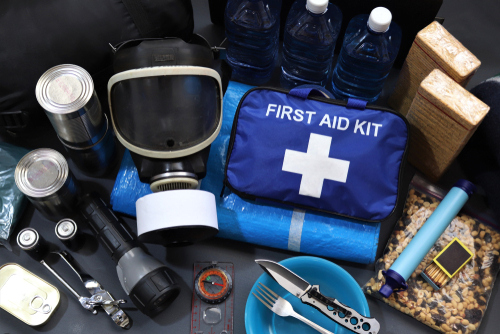
6. STOCKPILE FOOD AND OTHER SUPPLIES
During severe economic collapses, like the one experienced by Venezuela in current times, or the Great Depression of the 1930s, even things like basic food and other supplies can be in shortage.
Even if supplies are available, a hyperinflationary environment can make basic necessities completely unaffordable. It is always a good idea to keep a stockpile of food and other essential supplies (e.g., medicines, toiletries, paper supplies, tools, etc.) that can last you more than a year in tough times. This may also protect you from other crises such as natural disasters, war, etc.
One step further is to learn to grow your own food. If you have a small garden in which you could plant a few crops, start learning how to prepare the soil and grow some basic fruit and vegetables. Not only will it make you less reliant on a potentially failing economic system, but will be an extremely rewarding process too.
7. LEARN BASIC SKILLS
Basic DIY skills are invaluable during an economic crisis. Instead of paying someone to repair your car or fix your house, you can do it yourself for free. You could even earn some additional income by providing these services to others. Examples of basic skills that can save you money and bring great fulfilment during difficult times include things like:
Baking bread and making other foot items from scratch (e.g., pickles, jams, fermented vegetables, yoghurt, etc.)
Growing your own vegetables and herbs
Sewing
First aid and caring for a sick child
Mechanic work such as fixing cars, motorbikes, bicycles, etc.
Building and repairing household items such as furniture and shelves
Basic electrical and plumbing work
8. ESTABLISH STRONG CONNECTIONS
One of your most valuable resources are the people who are close to you. When times are difficult, it is important to work together with close friends and family to overcome the challenges.
You will have a much better chance of making it through compared to trying to tough it out alone. Start building strong relationships with those who are close to you, like neighbours, friends, and family. Having the mutual understanding that you can depend on each other in difficult times is a great comfort.
You can also practice the habit of mutual exchange (i.e., bartering), where you offer your skills in exchange for something that the other can give. This can help you circumvent the traditional economy and help you move more towards the “sharing economy”. This also reminds us of the importance of learning as many basic skills as possible, so that you may help others in need and receive their support in kind.
HOW TO SURVIVE DURING AN ECONOMIC COLLAPSE
Hopefully you will be well prepared to deal with an economic collapse when it comes having followed the above steps. However, it is impossible to perfectly predict how a collapse in the economy will play out, and you will need to deal with the situation that is presented to you at the time. Here are a few additional steps you may need to take when you are actually faced with an economic collapse:
1. DISCUSS THE SITUATION WITH YOUR HOUSEHOLD
The very first thing you should do is sit down with the members of your household and discuss the situation with them. Go over your finances together and work together to come up with a plan of how you will navigate these difficult times together.
It is important that you are all on the same page, but also to know that everyone has their own approach and attitude to dealing with money. How you resolve these differences and work together will have a big impact on your ability to deal with the challenging times, and strengthen your relationships in the process.
2. FURTHER REDUCE EXPENSES AS NEEDED
In preparation for a recession, you would have practiced living off less. When you are faced with an actual economic collapse, you may have to further adjust your spending habits to be able to cover your monthly expenses. In most cases, it is quite possible to maintain a good quality of life while cutting out unnecessary expenditures. Start by cutting out spending on all the things which are not necessary for you to live on, and finding ways to reduce the costs of the things you do need. Some ways that you may be able to reduce your spending include:
Cut out discretionary spending (i.e., stop buying things you can do without) like luxury items, new clothes that you don’t need, new gadgets, etc.)
Reduce transportation costs by carpooling, using public transport, walking or cycling, etc.
Reduce housing costs by moving to a cheaper area, subletting out part of your house, or even moving in with family until your financial situation improves.
Reduce food costs by cooking at home instead of going out to eat. Also refrain from buying too many luxury food items that you don’t really need and instead buy simple, healthy food.
3. GET MUTUAL SUPPORT FROM FRIENDS AND FAMILY
We spoke about the importance of building strong relationships when preparing for an economic collapse. Well, here is the time to lean on the solid bonds you have created by not being afraid to ask for support. You should also help and share your skills and resources with others who are in need.
4. PROTECT YOUR HOME AND FAMILY
Extreme economic collapses and recessions can lead to social degradation such as more violent crime, petty theft, scams, and so on. This has been clearly demonstrated in Venezuela and is one of the reasons why so many citizens have fled the country. You may need to take action to safeguard your home and protect your family from criminals and other dangers during a severe recession.
5. KEEP EARNING
If at all possible, make sure to keep the money flowing in. If you have a job, go the extra mile to prove that you are a valuable employee. You should be seen as the last person to be laid off in your employer’s eyes.
In the meantime, keep networking and working on generating alternative income streams so that you are not left stranded without any income if your employer does need to shut down.
6. DON’T STOP ENJOYING LIFE
Finally, and most importantly, don’t allow yourself to be ruled by fear and sadness. There is no reason to stop enjoying and appreciating life just because you are faced with economic difficulties.
Be grateful for the things you do still have and keep having fun in the ways you can with those you hold dear. You should try to see the situation as a challenge on your creativity and flexibility, and encourage friends and family to come up with inventive ways to have fun without spending money all the time.
CONCLUSION
Of all the disasters which can face a society, an economic collapse is one of the most challenging to deal with. Due to its nebulous nature and widespread impacts, it is very difficult to escape its effects. Being adequately prepared to deal with a sever economic downturn before it arises, and knowing how to respond when you are faced with it, is vital in order to make it through intact.
You will probably have to accept that you will be impacted one way or another, but the severity can be greatly reduced with the right approach. Most important of all is to continue living with joy and hope in the midst of the difficult times, and not get sucked into needless fear and anxiety.
If you have any dissatisfaction with my content, you can tell me here and I will fix the problem, because I care about every reader and even more so about your opinion!
World population is projected to reach 9–11 billion by 2050, raising concerns about food system security and sustainability. Modeling food systems are often a way to understand current and future dynamics. The most common model, first articulated by Malthus (Malthusian), shows population growth as an exponential function and food production as a linear function, concluding that human carrying capacity will be reached leading to mass starvation. Another prominent model was introduced by Boserup (Boserupian), which explains increases in food production as a function of population growth.
Methodology
Here, we explore which food systems dynamics exist at equilibrium and after perturbation. The model introduced explores food availability in an isolated village and then in a line of villages. The isolated village model includes three key parameters: maximum calorie production (a), food production resilience (b), and minimum calorie requirement per person (c). The multiple village model adds an additional parameter for trade.
Results
Isolated village populations are more resilient to famine than Malthusian theory predicts, suggesting that Malthus’ premise may be inaccurate. Predictably, across multiple villages increasing access and production reduce famine. However, under certain conditions large amounts of transport can lead to antagonist relationships leading to rapid changes in population.
Conclusion
Food systems under both production and access scenarios proved to be resilient to small perturbations, requiring a large catastrophe to induce mortality; this appeared to discount the Malthusian model. This model can create dynamics where different modes of famine relief apply, but here we see that a balanced approach of both access and production appears to be the most resilient to famine.
Background
Understanding the limitations of food systems that support human population growth has profound implications for natural resource management and agricultural productivity. Food security means the availability of sufficient food at all times for all people in order to ensure an active and healthy life, which is a challenge to humanity. It is broadly accepted that food security is a human right (Universal Declaration of Human rights article 25), yet food security is still a major problem worldwide. Food security is maintained when food systems are resilient (responsive to perturbations) to increases in population in addition to instability in production caused by natural disasters (e.g., floods, droughts), political strife, disruptions to transportation/distribution networks, lack of storage capacity, economic stress, and increasingly climate change. These challenges can work individually or interact, which may facilitate new interactions that may create new famines with different intensities.
Despite the consensus that famine is caused by complex local interactions, it is often simplified into Neo-Malthusian paradigm; or the Boserupian paradigm. The Malthusian paradigm is based on understanding human carrying capacity of environments. Therefore, once the population has exceeded the food production, catastrophic famine will ensue. The Boseruprian model looks at increasing population as a catalyst for agricultural intensification leading to increased productivity, however this perspective is less dominant in agricultural circles. A major debate in development has been on the best way to create food security, either neoliberal forms of governance (e.g., market integration) or food sovereignty approaches (e.g., agroecological/low-input mixed land use high human labor). Neo-Malthusian doctrine gains popularity every generation; it was most famously discussed in the 1960s and 1970s. These solutions are often more simply stated as: an ‘access’ paradigm; or a ‘production’ paradigm. The access paradigm suggests that we simply lack the appropriate infrastructure and political will to provide adequate food. The production paradigm suggests that we lack the technological capacity to produce enough food for everyone or that this technology has not diffused to those who need it. The access and production viewpoints have often been seen as antagonistic toward each other, with proponents of the different paradigms offering drastically different development strategies to alleviate famine. These viewpoints necessarily oversimplify the issue, allowing for an obfuscation of local dynamics, but make policy recommendations easier. These local dynamics include the social structure of communities that can have dramatic impacts on the amount of cooperation or antagonism within a community during a famine. This implies that there is wide parameter space when communities experience famine, both for recovery and for catastrophic failure.
Fig. 1
Recently, Neo-Malthusian doctrine has become common with worldwide population projected to increase 9–11 billion by 2050 and subsequent concerns about food security. In an effort to understand the cyclical interest in Malthusian doctrine, there has been an effort to understand stresses to historic agriculture systems and retrospectively understand the causes of specific famine events. The definition of famine has continuously evolved and includes mortality due to war, starvation, malnutrition, and disease under food stress. Defining famine continues to be a challenge as more information is available for human systems including: nutrition information; hungry season vs. crop failure; poverty; political instability; disease related to malnutrition; migration-related disasters; trade imbalances; natural disasters ; food hording ; and social stratification. Issues of attribution of the factors that cause lethal famine, are still up for debate, due to all starvation rarely being the cause of death reported on death certificates. Here, we aim to understand the dynamics of famine in a single location as well the dynamics of how famine events propagate through space and time through a simple mathematical model. This model is used to compare different paradigms of famine and famine recovery through simulation with simulation results being compared to historic famine events to assess reliability.
Materials and methods
Baseline village that is isolated and not in contact with other villages
Conceptualization of model
We approach this problem using a discrete model where the time steps can naturally be defined as harvest seasons. The model includes two variables: Pn and En. Pn represents the working human population at the nthℎ season while En represents the calories of excess food available at nthℎ season. Because the village is isolated, all of the food is locally produced and there is neither immigration to the village nor emigration from the village; hence any fluctuations in human population is exclusively due to death. We restrict our study to short periods of time, 0–5 years to see the immediate effects of famine upon a population. With this restriction, the new births will not provide meaningful impact on the food production as the children have not matured to a working age. Additionally, after natural disasters there is frequently increased fertility after the disaster that helps population recover.
The village can be thought of as a subsistence village, which can be broadly defined as agriculture where the majority of the output is consumed by the village rather than marketed for profit. In our first simulations, we assume the village is isolated, implying that there is no importing or exporting of food. Thus, all the food grown locally is the only food available for consumption. When we later consider multiple villages, we will relax this assumption and allow for importing and exporting of food between neighboring villages. Within this village there is no formal social structure, the model looks at the number of people needed to produce and maintain a population, rather than how those calories are distributed. In essence, this can be conceptualized as a village with a single social class, the working class.
The model also makes the assumption that production technology remains stable, i.e., advances in food production are negligible over the duration of the simulation. Though a technological breakthrough may improve quality of life for the villagers especially during a famine, the investment of labor and capital for a technological advancement may not be feasible for the current economical model of a village; it is simply easier to keep the current production technology and or methods. This phenomenon is what Boserup referred to as “technical inertia”. It is also plausible that a production system can become so specialized that it cannot adapt in response to such drastic perturbations as evidenced by the Rust Belt in the 1970s.
In each modeled village we consider a fixed, finite amount of land available for production. Using Malthus’ theory of diminishing marginal product, this will imply that the production system will eventually reach a plateau despite increasing input resources such as workers or seeds.
Determination of the excess of food available in the next season
We define the excess food to be the calories available after the individuals of a population have consumed their minimal calories needed per season. Therefore, excess food is the total calories produced minus the calories consumed. Assuming each individual consumes an average of c calories per season, we can say the total consumption by the entire population Pn at the nthℎ season is cPn.
The number of calories produced in a season depends on factors such as the number of workers available, the supply of seeds, and agricultural land availability. According to the economic concept of diminishing marginal product (DMP), the production function should eventually plateau, or approach a maximum, as one of these resources increases with the other resources fixed. In this model, the total amount of food produced is represented by a product of the availability of the workers and the supply of seeds available in a fixed area of land.
For the calories of food due to workers, we consider the function, p(Pn)=aPn1+bPn()=1, which increases monotonically from 0 and exhibits the desired plateau behavior as the number of people increases. The value ab represents the maximum production capacity of calories by the people and 1b1 represents the characteristic number of workers needed to saturate the production function.
To factor the supply of seeds into our production function, we desire a function that increases production as more seeds are available up to a certain maximum to satisfy the concept of DMP. Additionally, the function should always have a supply of seeds available as during times of shortage people are reluctant to use their entire supply of seeds. Assuming that seeds are proportional to the excess food supply, we propose the function s(En)=(1+tanh(fEn))()=(1+tanh()) to satisfy both of these conditions, where f is a positive constant that models how resilient the systems is to fluctuations in food supply. Greater values of f correspond to a more sensitive system while lesser values of f correspond to a highly resilient system. This functional form satisfies the DMP condition because it increases monotonically as seeds are more available (or as En increases) until an upperbound of 2, and a supply of seeds is always available as it approaches but never equals 0 during a food shortage (or as En becomes more negative).
By multiplying p(Pn)() and s(En)(), we obtain the total calorie production in the next season, aPn1+bPn(1+tanh(fEn))1+(1+tanh()) By subtracting the calories consumed in the previous season, we obtain the excess calories available in the next season: En+1=aPn1+bPn(1+tanh(fEn))−cPn+1=1+(1+tanh())− (Table 1).Table 1 Model parameters and the interpretation of their values. Parameters are constants with modifiable values that characterize a specific region’s food production
Determination of the human population in the next season
We assume the human population will not change if there is an excess of food (En>0>0) and will decrease if there is a shortage of food (En<0<0). Assuming the number of deaths is proportional to the shortage of food at a rate of d>0>0 deaths per calorie deficiency, we have
Pn+1={PnPn+dEnEn>0,En≤0.+1={>0,+≤0.
(1)
In summary, the model consists of the following system of difference equations:
In order to ease the analysis of the model, we reduce the number of parameters by non-dimensionalizing the model equations. We introduce non-dimensional variables Pn¯¯¯¯¯¯=bP¯= and En¯¯¯¯¯¯=bdEn¯= and let a¯¯¯=ad¯=, b¯¯=fbd¯=, and c¯¯=cd¯=. After all of these substitutions, we have the following non-dimensional model:
For the rest of this paper, we will drop the bar notation and the reader may assume that any reference to the model variables and its parameters are the non-dimensional variables and parameters as listed in Table 2. The non-dimensional parameter a can be interpreted as the ratio between the amount of calories produced by each person and the deficiency in calories leading to the death of a person. The non-dimensional parameter b is the typical surplus or shortage of food in the model, measured in terms of the food changes needed to induce significant increases or decreases in the saved seeds. It can be interpreted as a measure of sensitivity: low values of b mean that changes in food supply have minimal effect on the food production, which would be governed predominantly by the number of people in that case. If the value of b is high, it means that food production is governed not only by the number of people, but also by any food surplus or shortage in the past. The non-dimensional parameter c is similar to a, except that c is a measure of consumption instead of production by each person. The advantage of presenting non-dimensional population is that any subsequent changes can be interpreted as a proportion of the initial population, regardless of the specific numbers that may differ depending on the particular application of interest.Table 2 Model parameters with dimensions removed and their interpretation on how they affect the model
Equilibria of model
Equilibria are tuples, (P∗,E∗)(∗,∗), where neither P∗∗ nor E∗∗ change from one season to the next. The trivial solution for P∗∗ and E∗∗ is when there are neither people nor food, (0, 0). Non-trivial solutions solve the following equation:
E∗=aP∗1+P∗(1+tanh(bE∗))−cP∗.∗=∗1+∗(1+tanh(∗))−∗.
(4)
Observe that the values of a, b, and c affect the equilibrium values of the equation. Given set values for a, b, and c, one can use standard root-finding schemes to numerically solve for the non-trivial solutions (P∗,E∗)(∗,∗).
After finding the equilibrium for a given set of parameters a, b, and c, we simulate the model using initial values (P0,E0)(0,0) chosen from evenly spaced grid of points. We then record which points return to a non-trivial equilibrium and which return to the trivial equilibrium.
When famine strikes a village it can either trade or attack a neighboring village to reach a stable amount of food for its population
Justification for trade parameters
To study the effect of food transport between neighboring villages, we extend the isolated village model to incorporate a line of equally spaced villages. The food produced and the human population at each village are assumed to evolve in the same way as in the isolated model, except that we now allow food (but not humans) to move between adjacent villages. The only modification we need is in the expression for the excess food given in Eq. 2, where we add or subtract any transported food accordingly. Here, we consider a second-order central-difference scheme of a simple diffusive process, such that the excess food before trade Ei at the ithℎ village is adjusted by the net gain/loss of calories from/to its neighboring villages:
k[Ei−1−2Ei+Ei+1],[−1−2++1],
(5)
where k is a positive parameter measuring the rate of food transfer between adjacent villages. A large or small k, respectively, represents an infrastructure supporting efficient or poor trade. The model allows a village having more/less excess food than its adjacent villages to lose/gain through trade.
Now the excess food produced locally by the food system, Ei,,, and the human population, Pi,n,, at the ithℎ village will rely on the food after transfer Eneti,n, at the nthℎ time step.
To predict the global and long-term effect of a sudden and local famine event, we conducted a series of simulations as follows. Before famine strikes, the villages are assumed to have the same excess food and population values, which are obtained from equilibria in the isolated model. At the first time step, we introduce a decline in excess food at one village located at the origin. By reflective symmetry at the origin, all villages to the left are expected to behave in the same way as the villages to the right, so we only monitor the villages to one side. The resultant changes in excess food and human population along the line of villages were simulated over time. We terminated the simulation either when a village population went extinct or when a village sufficiently far away experienced the effect of famine at the origin.
Using the multiple village model, we simulate two competing paradigms for preventing famine, the production and access paradigm (see introduction). In each paradigm, the villages are all assumed to have the same initial population. To characterize the production paradigm, each individual has more resilient food production systems (lower b parameter), but inefficient food transportation infrastructure (lower k parameter). In contrast, villages in the access paradigm have unstable food production systems, but efficient food transportation to alleviate these individual deficiencies.
Results and discussion
Individual subsistence village with stable farming technology
We are exploring a specifically defined subsistence village with three parameters used to explore famine in an isolated village: maximum production of food (a), food production resilience due to seeds (b), and minimum calorie requirement per person (c). There are two qualitatively different cases depending on the three parameters: if b(a−c)≤1(−)≤1, then the village is famine resistant (Fig. 2a), however if b(a−c)>1(−)>1 then the village is famine susceptible (Fig. 2c). In the famine-resistant case, there was a large set of initial conditions where an isolated village was resilient to famine, implying that, while famine could continue for multiple seasons, populations could recover back to a stable state thus regaining equilibrium (Fig. 2a, c). This large set of initial conditions (shaded in yellow), where recovery from famine is possible, suggests that the system needs to be dramatically perturbed to cause famine. It is important to note that this simulation only takes into account death from starvation. Though famine makes people more susceptible to disease, much of the literature suggests that mortality may not directly result from lack of calories.
Fig. 2
It is possible to identify famines that are quickly resolved and those that persist through time by adjusting the value of the food production resilience due to seed supply, b and keeping all other parameter values constant, drastic differences in the response of the village due to famine were observed (Fig. 3). In this scenario, greater values of b correspond to lesser food production resilience and lower values of b correspond to a greater food production resilience. Though a higher value of b accommodates equilibria for larger population sizes and larger food production, we observe the village suffers both a greater loss of human life and longer recovery period when hit with a famine event at these higher values of b. Due to the contrast in duration of the famines, we classify the famine as chronic for the higher value of b and acute for the lower value of b.
Fig. 3
Multiple villages
A multiple village model was created by simulating different amounts of food transported between villages using the k parameter, with all other parameter values fixed (Fig. 4). Qualitatively there are three different outcomes. When there is insufficient transport between villages, the multiple village model behaves similarly to the isolated village model. We observe that the famine is spatially constrained to the center village (Village0Village0) affected as the population of adjacent villages’ (Village1Village1) remain in equilibrium. Even with relatively little transport between villages, the benefits of trade greatly improve the survival of Village0Village0. Compared to the isolated village model (Fig. 3), Village0Village0 retains 60%60% more of the initial population and recovers from famine about five seasons quicker. When there is a sufficient transportation of food between villages, famine is averted completely, due to the aid of adjacent villages, Village0Village0 recovers from famine within one season, avoiding any deaths due to starvation. However, when there is too much transportation between villages we observe a seemingly antagonistic scenario, where villages are in desperate need of food, alternating between states of surplus and shortage. In this scenario, the famine spreads catastrophically through space decimating villages in its wake over the course 30 seasons. This is qualitatively similar to patterns observed in long-term conflicts and places where aid has been ineffective. We also observe that famines progress over time in different ways under the ‘production’ and ‘access’ paradigms (Fig. 5). Both methods are able to alleviate famine, however the access seems to provide greater resiliency yet have less stability, presenting multiple options when identifying potential solutions (Fig. 5).
Fig. 4Fig. 5
Population dynamics: isolated village
Individual villages were resilient to famine, it was difficult to induce famines that caused large mortality or extinction of the population. This is consistent with the thought that complex interactions drive famine rather than single factors such as production. This is exemplified by the lack of relationship between production and death from famine in major famines of the twentieth century (Fig. 6). The expectation under both Neo-Malthusian doctrine and the ‘production’ paradigm is that a small isolated village should be very susceptible to famine, however, our results suggest that in a simple model of production an isolated village is more resilient than expected. This resiliency has impacts based on how to evaluate famine, and what interventions would be most appropriate. A limitation of this model is that it assumes isolated populations all participate in the subsistence economy; the limited economy provides a simplified version of a society but does capture the qualitative dynamics of a famine. Here we find that the small villages might be more resilient than expected from a simple Malthusian model and may in fact have dynamics more similar the Boserupian model. A limitation of the isolated model is the reliance on the subsistence economy creates a more closed system that would be expected in reality, but the dynamics of recovery provide insight into the real world.
Fig. 6
Population dynamics: multiple villages
To explore if increasing the size of a food network improved resilience, a group of villages laid out in a line was explored for resiliency. The model was set up such that a comparison could be made between the ‘production’ paradigm and the ‘access’ paradigm. While it is known that many factors influence trade, this model simply explores the magnitude of this effect. Those who favor the access paradigm point out that food transport is relatively straightforward, food aid has been a useful mechanism to alleviate famine, and that land tenure systems can be maintained if more land does not need to be brought into production. However, food systems contain points of vulnerability which influence food availability and nutritional quality such as; black markets, food waste, distance between people and markets. When trade is conducted a large range of distances are relevant as food travels 1500–3700 miles from production to market on average, but there are high value local markets where food travels less than 50 miles. The distance food travels to market which can account for 50%50% of costs associated with getting food to market. The distance food travels is important because as food travels intermediaries between producers and consumers can increase the price of food for consumers, increasing starvation in times of food insecurity. This model does not directly test for antagonistic interactions between villages, it assumes that if excess food is present it will be traded. This assumption limits the ability to test interactions that cause food insecurity due to political instability. In our model, we address famine amelioration through trade, assuming that if food is available in an adjacent village, trade will occur. This implies that multiple villages along the line both need to experience crop failure, for famine to cascade through space, as purchase is not explored we cannot determine if adding complexity to the economy would cause individual villages to go extinct at the expense of some villages surviving.
Cyclical nature of famine and the response of famine over time
Famine is both biological and a social phenomenon; this complex interaction causes many different responses. People who are vulnerable to famine create defined responses to minimize this vulnerability over time. Additionally, famines generally influences the young and the old, this may also have led to religious connection to fasting, which decreases the food intake of healthy individuals for a substantial portion of the year (e.g., Orthodox Christians and Orthodox Jews). When famines are acute, responses are frequently instantaneous in the form of disaster relief or migration, however if famine persists into a more chronic state then grassroots efforts at a smaller scale must fill in this food gap. Most prediction mechanisms are based on the idea of dealing with an acute disaster aid and is not focused on chronic malnutrition.
Famine impacts social groups differently in society changing famine dynamics. Long-term population cycles until the modern era seem to fit this cyclical dynamics, while there are many causes, famine certainly is one. Famine can be cyclical, for example, observed a strong correlation between war-peace cycles and population levels in response to climate. This implies under climate stress that there would be a strong seasonal variation in famine and food production. Famine is often described as complex interaction between markets, production, social norms, and the environment. Cyclical famines can be continued when simplistic explanations are used to develop policy solutions to famine, for example focusing on a technical solution without addressing social solutions. Conflict combined with periodic food shortages can lead to famine, especially when it is combined with a relatively inflexible agriculture sector (such as our model), leads to cyclical famine.
Historic examples of response to famine
Different parameter sets within the multi-village model identified scenarios where proximate villages behaved in both cooperative and competitive ways. This shows that there are multiple pathways to food security and that local dynamics will likely dictate which path is the best to pursue, and that there are qualitative similarities to historical famines can be represented by simple parameter sets (Table 3). One such example is the Norse settlements in Greenland where the Vikings had steady decline rather than abrupt extinction where the critical parameter was k (trade), as there was limited land for production due to the glaciated landscape. The changing amount of trade combined with inter-annual climate variation caused periodic famine leading to a long and steady decline, with intermittent increases in population due to migration. After large-scale trade stopped at the end of the 1300s, there were increasingly antagonistic relationships with the Thule Inuit, therefore the combination of decreased agricultural capacity, decreased trade, and increasing conflict led to a decline and extinction of the settlements. In other historic famines the critical parameter is different, for example in Somalia in 2012 the critical parameter was b (sensitivity to perturbation). In the 2012 famine there was a complex combination of factors that included inadequate production and limited access to aid that limited adaptive capacity. Long-standing structural problems due to the ongoing civil war that exacerbated a production shortfall, this was coupled with very high global grain prices, this caused a famine as there was limited adaptive capacity due to the confluence of events. However, the population quickly recovered, showing a surprising amount of resiliency even in an unstable situation. The resilience in this case was in population growth to drops in food production and the ability of food aid to ameliorate food production decreases. A final historic example is the great leap forward in China where there were over 30 million deaths, this is an example of the critical parameter being a (food production). Here population relocation and industrialization led to a decrease in agricultural production capacity. This lack of production and loss of farming expertise led to a widespread famine. This shows that while there are complex issues surrounding famine, they can be represented in a fairly simple manner, and that this model does not appear to match the catastrophic prediction of Malthusian dynamics.Table 3 Famine can occur for many reasons. Here, we explore the causes of historical famines and how they can be interpreted using the model parameters a, b, and k
From the simple to the complex: relating to the real world
Food production has steadily increased over the course of the twentieth century. Despite these increases, recent studies have expressed the idea that food production needs to nearly double by 2050 to keep pace with population. There is acknowledgement that famine is both spatially and temporally complex and that it is due to interactions. Most recent assessments of famine recognize that it is a complex situation that has to do with (1) food production; (2) food access and purchasing power; (3) sanitary conditions for preservation and utilization; (4) natural environment, and (5) political constraints. In general, the model constructed here shows that even under strong perturbation societies can rapidly reach new equilibria and maintain themselves. The multiple village model showed that famine could be ameliorated with either production or trade. This scenario also showed that famine did not propagate very far in space or time and that the system became more stable as more villages were added to the system. This favors the Boserupian model over than Malthusian model, which suggests that population collapse should occur.
Conclusions
Exploring through simulation how famine occurs in both individual villages and groups of villages is a powerful tool for understanding the qualitative dynamics of human population capacity. Food systems under both production and access scenarios proved to be resilient to small perturbations, requiring a large catastrophe to induce mortality. This appeared to discount the Malthusian model. Famines propagated in space, but tended to be temporally restricted, not spreading through different time steps (seasons of food production). This model can create dynamics where different modes of famine relief apply, but here we see that a balanced approach of both access and production appears to be the most resilient to famine. These simulations provide insight into the way the food system can be monitored. Understanding the best way to monitor food security is a major goal of the international community. Different metrics have been proposed, and subsequently revised. The metrics have been focused both on calorie production and nutritional value of those calories, often focusing on the economic conditions and public health indicators within households. Different disciplines focus on the different facets of food security focusing on the disciplinary emphasis (e.g., production, purchasing power, child malnutrition). Further, scale (global, national or local) has been used to measure food availability, accessibility, and waste . Another aspect of measurement has been metric aggregation. It has been a useful way to get large-scale data, but missing data have been a problem to widespread adoption . The metrics have done a good job at predicting overall food security and at warning for upcoming potential famines. Metrics have also been implemented across scale with regional assessments providing useful data. However, the metrics have not generally explored the resiliency of the system to shocks in the production or distribution networks. The resiliency of the food system is likely to be of increasing importance as climate is projected to threaten regional production in many areas of the globe as well as many of the world’s cities . Many of these will be due to climate change . Understanding the interconnected role of risks and resilience to those risks may help understand the recovery and extent to which indicators may be used to understand both. The resilience of a system to be able to respond to perturbations is an important metric for society. Famine has a lasting effect on those whom it impacts. However, if society can recover quickly, there is the potential to better plan for how to help people under a range of different circumstances.
The hard-frozen December morning silence was shattered by a reverberating howl. The ground seemed to come rushing towards him as equilibrium flew away like his misty breath. The spinning snowbank softened the body-blow but filled his eyes and mouth with dirty, re-plowed ice and gravel.
One second he was absent-mindedly shoveling the old, frozen-over snow fall from several days past, and the next he was thrown to the ground as the world spun and bucked like a rodeo mustang underneath him.
He was flailing his arms trying to hold onto something, anything, as the ground humped and twisted, shrieking in it’s agony beneath him. His thoughts and perhaps his screams were drowned out by the howling roar of a million freight trains filling the otherwise subdued winter morning air.
His mind was screaming, “Earthquake! earthquake!” Then the profanity came streaming out like a full on fire hose. Or maybe it wasn’t his mind screaming, he couldn’t tell.
Gasping for the breath stolen by the body slam to the snowbank, the burning hoarseness of his breathing belied the fact that he was the one screaming, unnoticed in that roaring, howling insanity totally filling the world around him.
As the world stopped spinning and the howling died down, he was able to hear other sounds, very much non-typical sounds for a cold winter’s day in December. The howling of dogs, and the excited clatter of chickens was first and foremost, the deep rumbling of the earth taking second stage to the excited animal world.
An odd crackling noise interspersed with pops and fizzles propelled him off his bruised side looking for the fire. The first tendrils of smoke coming from a shattered window made it clear what to do next.
Fire! fire! Someone shouted, but he couldn’t tell where it came from.
Running the thirty yards to the cabin was not easy in winter gear and Packs but adrenaline gave him the ability to reach the door in seconds, pushing aside the heavy oak and wrought-iron monster to survey the scene inside.
Because of preparedness training and planning, the damage was not as severe as it could have been. Sure, the windows were all broken or at least cracked but the double and triple panes had kept most of them at least weather proof.
The smoke was coming from the huge, black iron stove in the middle of the room. The pipe had burst loose from the top of the stove which was rapidly filling the room with the smell of burning pine. The acrid, stinging vapors burned his eyes as he jammed the stovepipe back into place.
Starting to turn, he was again slammed hard but this time the cause was obvious and licking his face. “Down!” Once was all it took but the big Labrador couldn’t control his shivering and querulous whining.
Bending at the knees and wrapping his arms around his big brown friend, he calmed the shaking, whining animal and himself as well. ” ‘s okay, Buddy, ‘s okay.” “It’s all over, Buddy,” “Let’s go see what happened.”
He had the strangest feeling at that moment, kind of a tingle or maybe a little buzz in his mind. Sort of like the after-affects of a heavy mushroom trip when reality isn’t quite screwed back into place yet. He brushed it off, and got up, sliding his hands one more time over the panting dog.
This time the feeling was way more pronounced, almost like an electric shock, (we okay?). “Huh?” He looked around the room searching for another person. (okay now?) He automatically replied to the question, “Sure, everything is okay now,” and stopped dead in his tracks.
He looked down into the pleading eyes of his Labrador friend and companion for over five years. “Uh, uh, uh” he couldn’t bring himself to say what he wanted to, just stuttered with the shocking realization of what had just taken place.
He knelt again, holding the big dog’s head cupped in his hands, staring into the large, liquid brown eyes. “Buddy, was that you?” The answer, tickling his mind like a tiny feather, was the last thing he heard as waves of blackness engulfed him, (me!)
If you have any dissatisfaction with my content, you can tell me here and I will fix the problem, because I care about every reader and even more so about your opinion!
The most important thing you should know about antibiotics!
Never expect a doctor to phone-in a prescription for an antibiotic without seeing you first. Why? To ensure your illness is in fact a bacterial infection, as viruses do not respond to antibiotics.
For example Influenza is a virus infection – this is why your doctor will never prescribe you antibiotics for this.
Knowing the difference between a viral and bacterial illness may save you time and money. Here are four tips to help you determine when an illness could be viral or bacterial. Take this advice only when you can’t see a doctor (when SHTF):
Location: A viral illness typically causes wide-spread symptoms. A bacteria usually causes site-specific symptoms, such as those involving the sinuses, throat, or chest.
Phlegm color: A virus may produce clear or cloudy mucous, if any. A bacterial illness typically causes colored phlegm (green, yellow, bloody or brown-tinged).
Duration of illness: Most viral illnesses last 2 to 10 days. A bacterial illness commonly will last longer than 10 days.
Fever. A viral infection may or may not cause a fever. A bacterial illness notoriously causes a fever (normal body temperature is 98.6, a fever is considered greater than 100 degrees Fahrenheit).
A person is no longer considered contagious once on an antibiotic for 24 hours and any fever has been resolved. (Source – Dr. Linda Petter)
If your symptoms do not resolve, or if at any time you develop a severe headache or neck pain, persistent nausea / vomiting or a fever, be sure to see a doctor promptly.
What Antibiotics to Stockpile
No antibiotic is effective against every type of microbe. Certain ones will kill aerobic bacteria, others are used for anaerobic bacteria, still others are effective against resistant strains, and certain people are allergic to or intolerant of various antibiotics.
Instead of buying 10 types of antibiotics (many having similar substances) you should consider 4-5 with totally different actions, so if the bacteria is resistant to one of them, you have 4 totally different “solutions” to try.
This, of course, only if you don’t have access to a clinic where they can test the bacterial resistance to these antibiotics first.
For example if you took Amoxicillin with no effect, there is no need to try other penicillin based antibiotics (Carbenicillin, Cloxacillin, Flucloxacillin, Oxacillin, Methicillin an so on) so you can exclude a wide range.
But the antibiotics listed bellow should work for most bacterial diseases, including Most Common Biological Weapons (like Anthrax – 90% mortality without treatment in the first 3-6 days).
The 3 Antibiotics You’ll Need
1. Clarithromycin
Clarithromycin is a macrolide antibiotic. It fights bacteria in your body.
Clarithromycin is used to treat many different types of bacterial infections affecting the skin and respiratory system. If the bacteria seems to be resistant to Amoxicillin, this is the next best thing one should try when SHTF.
Contains Erythromycin and can be substituted with. Don’t take both antibiotics at the same time.
Update – at the suggestion of Dr. M (comment area): Zithromax (also a macrolide antibiotic) is a very good (better in many ways) substitute for Clarithromycin. But it is less active against Helicobacter pylori.
2. Ciprofloxacin
Ciprofloxacin is an antibiotic in a group of drugs called fluoroquinolones.
Ciprofloxacin is useful for anthrax, urinary tract and prostate infections, diverticulitis and many forms of pneumonia and bronchitis.
3. Metronidazole
Metronidazole belongs to a class of antibiotics known as nitroimidazoles.
Metronidazole is used to treat parasitic and bacterial infections including Giardia infections of the small intestine, colon infections, liver abscess, vaginal infections (not yeast), fungating wounds, intra-abdominal infections, lung abscess and gingivitis.
How to store antibiotics?
Every antibiotic has its own particular decay rate, as proteins (oligopeptides) are subject to hydrolyzation, the main form of attack (heat and moisture are the enemy).
So, if you plan on long term storage, the individual foil packs are the best choice. Then pack them in sealed containers with dessicants to be sure.
For how long is it still safe to take antibiotics after the expiration date?
The American Medical Association (AMA) conducted a study and concluded that the actual shelf life of some products is longer than the labeled expiration date.
Manufacturers put expiration dates on for marketing, rather than scientific, reasons,” said Mr. Flaherty, a formal pharmacist at the FDA. “It’s not profitable for them to have products on a shelf for 10 years. They want turnover.”
With time, most antibiotics simply become less effective.
So maybe the question should be “for how long these antibiotics are expected to still have effects?”
Amoxicillin (tablets) – 5 years after the expiration date;
Clarithromycin and Doxycycline (tablets) – 5 years after the expiration date;
Ciprofloxacin (tablets) – 10 years after the expiration date;
Metronidazole (tablets) – 3 years after expiration date;
We live in perplexing times. It’s almost inconceivable to think that there’s a war being waged against food, an absolute and undeniable necessity of life. Yet, here we stand, on the precipice of what looks like a catastrophic agenda against global sustenance.
So, what’s this newfound hostility against the thing that keeps us alive?
Take a deep breath. Farming uses nitrogen, and suddenly, nitrogen is the new antagonist in the tale of global warming. The narrative is simple: eliminate nitrogen, save the world. Yet, in the name of “preservation,” entire segments of our food production are under siege.
Consider rice – a staple for half the world’s population. Renowned agencies claim, “Rice accounts for roughly 10% of global methane emissions,” emphasizing the urgent need to curtail its production. But the ramifications? Starvation for billions.
Look to the Netherlands for further evidence. Dutch farmers, the backbone of a nation that is a leading exporter of meat and agricultural products, are being chased off their lands. A staggering number, 3,000 farms, are forecasted to be confiscated in the coming years. The tragic fallout is evident, with a reported 20 to 30 farmers tragically ending their lives annually.
Our friends in Europe are no strangers to these baffling decisions either. The European Commission greenlit a strategy to compensate livestock farmers for halting their operations in certain areas – with a stipulation that they never resume their animal breeding activities. The implications are clear: a drop in global food availability and an inevitable spike in prices.
Remember Sri Lanka’s ill-fated venture into 100% organic farming? The island nation faced a humanitarian nightmare with a staggering 90% of its population on the brink of starvation.
And the Western leaders’ stance on agriculture? Eric Utter encapsulates it perfectly in American Thinker, “The attack on farming by Western leaders is shockingly negligent. It’s criminal.” Especially when such views ignore the glaring fact that while agriculture may account for 33% of the world’s greenhouse gas emissions, it simultaneously sustains every single human being on this planet.
Organizations like the World Economic Forum tout visions of a “farm-free future,” dreaming of a world where food is crafted in sterile labs and humans are herded into congested urban centers. Toss digital currency into this dystopian mix, and you have the ultimate formula for absolute dominance.
In our modern era, the recipe is simple: concoct a crisis, even if none existed.
Incite racial tension among children.
Reverse the progress women achieved over decades.
Worsen shortages and tamper with the money supply.
Tackle borders haphazardly.
Condemn specific foods, close farms, or incite wars to create famine.
Muzzle voices of dissent by labeling truth as “misinformation.”
A tactic reminiscent of Cloward and Piven: create a crisis, then implement severe measures to address that very crisis.
Our global food supply is now in peril, thanks to overblown reactions to this so-called “nitrogen issue“. But why this apathy? Sri Lanka, for instance, is an alarming testament to this flawed approach.
The truth remains that nitrogen is pivotal for plant metabolism. Without commercial nitrogen fertilizers, hunger was a dire reality in many corners of the world. If we shun these fertilizers, we voluntarily invite famine back into our lives. The idea of bug diets, ‘rewilding,‘ and organic farming might sound avant-garde, but they certainly won’t satisfy the global hunger.
It’s glaringly evident that this isn’t just about combating climate change. At its core, it’s an insidious bid for control.
In the profound words of Ayn Rand, “We can ignore reality, but we cannot ignore the consequences of ignoring reality.“
The world stands at a critical juncture.
It’s time to confront these disguised agendas and defend our plates.
After all, when the stakes are survival, there’s no room for compromise.
Recent world crises and the resultant weakening of the global economy has left many fearing the worst. There is talk of a global recession, or worse yet, a complete collapse of the economy.
While it is impossible to say whether such a severe economic downturn is upon us, understanding how to survive a potential economic collapse (whether now or in the future) could save you and your family when the times get tough.
WHAT IS AN ECONOMIC COLLAPSE?
An economic collapse is defined as a severe breakdown of the economy at a national, regional, or territorial level. It is a broad term used to describe bad economic conditions that are not part of the ordinary business cycle of expansion and contraction.
An economic collapse usually signals the start of a significant economic contraction, recession, or depression, which can last months or even many years.
WHAT CAUSES AN ECONOMIC COLLAPSE?
There are various events and circumstances that can trigger an economic collapse, which makes it difficult to attribute it to a single cause. An economic collapse can happen suddenly as a result of an unexpected crisis such as the onset of a war, natural disaster, political unrest, and various other events.
It can also be the culmination of a series of events or ongoing circumstances which signal a weakening and fragility of the economy.
WHAT ARE THE RESULTS OF AN ECONOMIC COLLAPSE?
The results of an economic collapse are equally difficult to predict, as the ripple effects of a severe economic downturn are widespread and impossible to accurately track. Some general and obvious results of an economic collapse are:
A rise in job loss and unemployment.
Loss of value of investment markets which results in the average investor losing significant value in their portfolio.
Slowing of production, and therefore less new innovation, fewer startups, and so forth.
A potential hyperinflationary environment in extreme cases where the cost of basic items increases dramatically.
An increase in poverty which can also lead to crime, civil unrest, and various other social issues.
Widespread business failures leading to shutting down of companies and laying off of staff.
HOW TO PREPARE FOR AN ECONOMIC COLLAPSE
Preparation is key in order to successfully survive an economic collapse. It is important to not become too complacent when the good times are rolling, as you never know when the situation may change for the worse.
Follow these practical guidelines to ensure you are well prepared :
1. KEEP AN EMERGENCY FUND
Having liquid cash safely deposited in a savings account with your bank can be a lifesaver in times of economic crisis. First of it all, it will retain its value while market linked assets such as equities deteriorate.
Secondly, it will provide you with the best liquidity so that you can quickly access your money during a time of extreme need. It is recommended to keep at least 3 – 6 months’ worth of expenses in an emergency fund.
2. BECOME DEBT FREE
The additional pressure of carrying debt if there is an economic collapse can put you in an extremely difficult situation. You should start working towards becoming debt free today.
This will reduce your monthly expenditure and will keep you from landing up in a precarious position should you lose your job in the future. Begin by paying off your highest interest debt such as credit cards and other short-term loans, and then move onto lower interest debts such as house mortgages.
3. CREATE ADDITIONAL INCOME SOURCES
The risk of losing your primary job is elevated during an economic recession or collapse. You can mitigate the negative consequences of this by creating additional sources of income now before the bad times are afoot.
We live in an age of boundless opportunities to make money on the side remotely. You can start your own web business or do freelance consulting work.
Even if you have a great job, it is well worth diversifying your income sources and establishing other ways to sustain yourself. Even a few hundred dollars a month can make a big difference in a time of need.
4. REDUCE UNNECESSARY SPENDING
Most people tend to spend recklessly when times are good and then suddenly try to adjust when there is a downturn or they lose their job. This is a big mistake for two reasons:
Firstly, if you make overspending a habit in your regular life, it becomes extremely difficult to adjust your spending habits when you need to do so. If you practice living with less even during the good times, it will be much easier during a financial squeeze.
Secondly, wasting unnecessary money on a regular basis means you have less to put into savings each month. We spoke about the importance of having an emergency fund, and living off less now can help you keep that fund growing for when the rainy day comes.
5. MAINTAIN A DIVERSIFIED INVESTMENT PORTFOLIO
Entire markets and industries can deteriorate during an economic collapse, while others might be more protected. Maintaining a diversified investment portfolio will ensure that you are not overexposed to one specific asset class, sector of the economy, or graphical region.
While your overall asset value might still decline significantly, you will be more protected from the risk of complete financial ruin if you keep your eggs in different baskets.
6. STOCKPILE FOOD AND OTHER SUPPLIES
During severe economic collapses, like the one experienced by Venezuela in current times, or the Great Depression of the 1930s, even things like basic food and other supplies can be in shortage.
Even if supplies are available, a hyperinflationary environment can make basic necessities completely unaffordable. It is always a good idea to keep a stockpile of food and other essential supplies (e.g., medicines, toiletries, paper supplies, tools, etc.) that can last you more than a year in tough times. This may also protect you from other crises such as natural disasters, war, etc.
One step further is to learn to grow your own food. If you have a small garden in which you could plant a few crops, start learning how to prepare the soil and grow some basic fruit and vegetables. Not only will it make you less reliant on a potentially failing economic system, but will be an extremely rewarding process too.
7. LEARN BASIC SKILLS
Basic DIY skills are invaluable during an economic crisis. Instead of paying someone to repair your car or fix your house, you can do it yourself for free. You could even earn some additional income by providing these services to others. Examples of basic skills that can save you money and bring great fulfilment during difficult times include things like:
Baking bread and making other foot items from scratch (e.g., pickles, jams, fermented vegetables, yoghurt, etc.)
Growing your own vegetables and herbs
Sewing
First aid and caring for a sick child
Mechanic work such as fixing cars, motorbikes, bicycles, etc.
Building and repairing household items such as furniture and shelves
Basic electrical and plumbing work
8. ESTABLISH STRONG CONNECTIONS
One of your most valuable resources are the people who are close to you. When times are difficult, it is important to work together with close friends and family to overcome the challenges.
You will have a much better chance of making it through compared to trying to tough it out alone. Start building strong relationships with those who are close to you, like neighbours, friends, and family. Having the mutual understanding that you can depend on each other in difficult times is a great comfort.
You can also practice the habit of mutual exchange (i.e., bartering), where you offer your skills in exchange for something that the other can give. This can help you circumvent the traditional economy and help you move more towards the “sharing economy”. This also reminds us of the importance of learning as many basic skills as possible, so that you may help others in need and receive their support in kind.
HOW TO SURVIVE DURING AN ECONOMIC COLLAPSE
Hopefully you will be well prepared to deal with an economic collapse when it comes having followed the above steps. However, it is impossible to perfectly predict how a collapse in the economy will play out, and you will need to deal with the situation that is presented to you at the time. Here are a few additional steps you may need to take when you are actually faced with an economic collapse:
1. DISCUSS THE SITUATION WITH YOUR HOUSEHOLD
The very first thing you should do is sit down with the members of your household and discuss the situation with them. Go over your finances together and work together to come up with a plan of how you will navigate these difficult times together.
It is important that you are all on the same page, but also to know that everyone has their own approach and attitude to dealing with money. How you resolve these differences and work together will have a big impact on your ability to deal with the challenging times, and strengthen your relationships in the process.
2. FURTHER REDUCE EXPENSES AS NEEDED
In preparation for a recession, you would have practiced living off less. When you are faced with an actual economic collapse, you may have to further adjust your spending habits to be able to cover your monthly expenses. In most cases, it is quite possible to maintain a good quality of life while cutting out unnecessary expenditures. Start by cutting out spending on all the things which are not necessary for you to live on, and finding ways to reduce the costs of the things you do need. Some ways that you may be able to reduce your spending include:
Cut out discretionary spending (i.e., stop buying things you can do without) like luxury items, new clothes that you don’t need, new gadgets, etc.)
Reduce transportation costs by carpooling, using public transport, walking or cycling, etc.
Reduce housing costs by moving to a cheaper area, subletting out part of your house, or even moving in with family until your financial situation improves.
Reduce food costs by cooking at home instead of going out to eat. Also refrain from buying too many luxury food items that you don’t really need and instead buy simple, healthy food.
3. GET MUTUAL SUPPORT FROM FRIENDS AND FAMILY
We spoke about the importance of building strong relationships when preparing for an economic collapse. Well, here is the time to lean on the solid bonds you have created by not being afraid to ask for support. You should also help and share your skills and resources with others who are in need.
4. PROTECT YOUR HOME AND FAMILY
Extreme economic collapses and recessions can lead to social degradation such as more violent crime, petty theft, scams, and so on. This has been clearly demonstrated in Venezuela and is one of the reasons why so many citizens have fled the country. You may need to take action to safeguard your home and protect your family from criminals and other dangers during a severe recession.
5. KEEP EARNING
If at all possible, make sure to keep the money flowing in. If you have a job, go the extra mile to prove that you are a valuable employee. You should be seen as the last person to be laid off in your employer’s eyes.
In the meantime, keep networking and working on generating alternative income streams so that you are not left stranded without any income if your employer does need to shut down.
6. DON’T STOP ENJOYING LIFE
Finally, and most importantly, don’t allow yourself to be ruled by fear and sadness. There is no reason to stop enjoying and appreciating life just because you are faced with economic difficulties.
Be grateful for the things you do still have and keep having fun in the ways you can with those you hold dear. You should try to see the situation as a challenge on your creativity and flexibility, and encourage friends and family to come up with inventive ways to have fun without spending money all the time.
CONCLUSION
Of all the disasters which can face a society, an economic collapse is one of the most challenging to deal with. Due to its nebulous nature and widespread impacts, it is very difficult to escape its effects. Being adequately prepared to deal with a sever economic downturn before it arises, and knowing how to respond when you are faced with it, is vital in order to make it through intact.
You will probably have to accept that you will be impacted one way or another, but the severity can be greatly reduced with the right approach. Most important of all is to continue living with joy and hope in the midst of the difficult times, and not get sucked into needless fear and anxiety.
Preppers have a term for the civil unrest and chaos that could follow an SHTF scenario, and it is “WROL.” WROL stands for “Without Rule of Law” and is the thing that survivalists prepare for especially. Images of ‘Mad Max’ come to mind, in a society where the society has broken down and it’s every man for himself.
However, what about all the places on the continuum that are this side of WROL, which are far more likely to be experienced? What about a scenario where the economy collapses or is on the verge of collapse and crime skyrockets, but we still have police trying their best to keep order?
Whatever situation we find ourselves in, we all want to know how to stay safe, and only the young studs among us are naive enough to think that they can be vigilant enough with their stockpile of guns to not have to worry.
There are two main strategies that I advocate for wiser men to employ in order to stay safe when the SHTF happens and you realize that you can’t walk around with a gun in your hand 24/7.
Strategy 1: Gray Man
This strategy says that you want to blend in and not attract attention. You don’t want to be the person that someone would remember in a crowd. If you wear drab clothing instead of expense stuff from “The North Face” and avoid camouflage and cool tactical clothing, then nobody will think twice about you.
By not dressing to be a victim or advertising that you are a prepper that has expensive gear, you will avoid the two biggest mistakes that people make to attract bad guys who want to rob you of nice stuff.
Strategy 2: The Dummy Wallet
If you are ever confronted by a man (or men) who want your wallet, there is absolutely no reason not to give it to them except for your pride. Whatever you have in your wallet cannot possibly be worth the bruises and possibly stitches and a trip to the urgent care center that will almost certainly result from a fight: even if you win.
Above everything else, preppers want to be smart. They want to be prepared so that they have no regrets and maybe can even say “I told you so” after they are proven right with all their preps.
It isn’t really smart to get into a fight to defend a wallet. A trip to the emergency room will set you back at least the cost of your insurance deductible plus ruin your day, or much worse.
If you have your money and credit cards in your front pocket in a money clip and have some expired credit cards and store loyalty cards and maybe $30 in cash in your wallet, you can cheerfully give the bad guy your wallet knowing that you’re not out much and go happily on your way.
The dummy wallet trick is what separates the men from the boys. Boys want to be tough and win fights. Men want to be smart and win fights by never having to engage in them in the first place.
Now, if an ounce of prevention is worth a pound of cure, what about preventing yourself from ever being caught without supplies and gear in case you are away from home when something strikes?
An emergency preparedness kit in your car trunk is worth a pound of cure and could even be worth your life, if it enables you to hunker down and stay put instead of risking a commute home when there is civil unrest and chaos and rioting in the streets.
If you have any dissatisfaction with my content, you can tell me here and I will fix the problem, because I care about every reader and even more so about your opinion!
With rising fears about the current debt crisis global, many people are worried for the economy and living conditions. The smart analysts admit that the economy will worsen and are learning how to survive a coming great depression.
If things really worsen you will want to be prepared. Here are 9 simple ways on how to survive the coming great depression.
1) Store Your Food.
Food is a necessity to life. Don’t become one of the panic merchants hunting for food when its too late. Most families don’t have enough food to last them 4 weeks in a recent study. So don’t become one of the statistics.
2) Store Clean Water.
You can survive without food for weeks, but without water you can perish quickly. Your body is made up of more than 80% water and some say it is the foundation to life. If the water is cut off to your home what is your plan? Make sure you are stocking water in case an emergency situation arises.
3) Store Sharp Tool.
Tools such as an axe are simple but effective when gathering firewood, and hunting. Without a sharp tool, you life can be very difficult. You will want to have this tool and a sharpener close by, especially if live in an area that experience power failures.
4) Keep Warm.
Store firewood, matches, lighters to help keep you and your family warm at night. If there was a true emergency situation, how can you light a fire without these tools. Also it is a good idea to store candles. They are extremely cheap and reliable if the electricity is somehow shut off.
5) Keep a radio handy.
In all major crisis’s you want to be able to look after your family right? So you will want to know what is going on in the outside world. If there is a major power failure how will you keep up to date. With a radio you are able to keep up to date with the latest news, and events.
6) Store toiletries.
Personal hygiene is a must in any situation, good or bad. Be sure to store plenty of toilet paper, shampoo, soap, toothbrushes, and other necessary products to get your through your daily hygiene rituals. We sometimes take these things for granted in our society. What would happen to you if one day all these items simply became unavailable?
7) Store Extra Gasoline.
This is a must in any situation, but especially if the economic situation gets worse. Inflation would creep in and send gas prices sky high, so stocking up on gas prices while they are cheap now will not hurt in the long run. Not only will you save money, but you will be well prepare if you have to move from one location to the other quickly, or need to travel somewhere urgently.
8) Make Good Friends With Neighbors.
Ever heard the saying two heads are better than one? Well you should get to know your neighbor yesterday. Forming small communities back in the great depression was how they each got by from day to day. For moral support and to help each other with food and water. This is a powerful way to get by hard times.
9) Have a Simple Backup Plan.
In today’s day and age, many people just simply rely on the government or other people. If the economy was to fail tomorrow these people would be in serious trouble. Have a failsafe backup plan for everything. If you rely on one system that is not designed for the conditions you are left with. You are bound to fail. Make sure you are ready today, and have several backup plans in case one of them systematically fails.
If you have any dissatisfaction with my content, you can tell me here and I will fix the problem, because I care about every reader and even more so about your opinion!
When I am asked how preppers stockpile food for an economic collapse or other emergency, I am often surprised by the reaction that people have. They naturally assume that I have a bunch of pallets of Army MRE’s or freeze-dried survival meals in the garage.
Don’t get me wrong, if I had a rich man’s bank account I might have a climate controlled bunker stockpiled with freeze-dried survival meals. But I live in the real world and as a Prepper Consultant I have to advise people who don’t have unlimited resources.
So how does a typical prepper stockpile food for an economic collapse or other “SHTF” (Sewage Hits The Fan) scenario? First, it is nothing as glamorous as what you might see on an episode of “Doomsday Preppers.”
Step one is to divide your thinking and your food storage into short-term and long-term. Short-term is thought of as the food storage you have to last you for up to 3 months. Long-term is considered food storage that will last you up to one year.
The thing about short-term food storage is that it includes all the items in your pantry that you eat every day. It is constantly rotated and used up before it goes out of date. There is nothing exotic or freeze-dried and certainly no Army MRE’s.
Long-term food storage may be freeze-dried, but that is some very expensive food. More likely, it is food that is in Number 10 cans that you can get from a LDS (Latter Day Saints, or “Mormon) church cannery. These foods are staples like wheat, flour, potato flakes and oats that will last in their cans for 10-20 years, so rotating them is not a major consideration.
The thing about these long-term food stores is that, since they are not “just-add-water” emergency / survival foods, you actually have to know how to cook.
So Job One for a serious prepper is that each week they want to be cooking at least one meal from items in their long-term food storage, to ensure that when the time comes, they will be already acclimated to using them.
Stockpiling food this way is both very practical and very economical and can be done step by step instead of requiring a single, budget-busting purchase of survival foods from some online store.
However, preppers do more than stockpile food for an economic collapse or other emergency. Preppers are also thinking about being stranded in their cars away from their supplies and are thinking about what they will do if the power grid goes down.
If one would wish to define America and Americans, the best way is to provide a category and framework in which wars play the most prominent role. Almost from the beginning of the discovery of the American continent there have been wars, in some cases “small wars” and in others great wars. However there are three major wars which are mostly referred to as boundaries by which United States evolved from a few haphazard colonies to a global power. The first, a refinery war that began to form an almost distinguished state is the War of Independence; in this war colonies got their independence from their one time British citizens.
The next war, which would be focused more upon, is the civil war. In this war the divided nation experiences the first major impact of racialization. There were disagreements between the white Anglo Saxon Protestants about the way the blacks and mostly slaves are treated. In the south, there was that image of a black slave as an inferior rouge character who is to be subdued and in some cases brutalized since it is not white, does not belong to the Anglo-Saxon origins and is in most cases heathen. That color-line created a war and in that war a complete and united American nation was given birth. They gathered around that ideal of American-ness and in that process those opponents were dealt with by guns.
The next war which is some how important as the last phase of American identity and self-conception of Americans as the people of the United States is the Second World War. Until mid-20th century the United States was preparing itself and was trying to have an understanding of itself as a nation. AS Philip Gleason (1980) said, this war “enhanced national unity and a common sense of national belonging”. Almost from the early days of the republic struggles around the ethno-racial line existed. The westward movement and the need to portrait Indians as “savage”, uncivilizable, masculine, and ignorant people so that they could unite Americans to win what Max Boot called the “savage wars of peace”, is an example of the continuing process of otherization.
Actually in the US, the demand for construction and often demonization of other ethnic and racial peoples is a permanent issue. What is interesting is the other side of this otherization which gives the opposite attributes cast upon the so-called savages to the white Anglo-Saxon generations. In its simple form evil versus good and these adjectives would go completely in different directions to construct two apparently different ethno-racial groups. Samuel Huntington very truly mentions wars as things which have a very significant impact on a nation’s return to and cementing of its primary self-conception. Worrying about the core American identity, he says (ibid):
External wars may stimulate controversies and disunity within countries…. If on the other hand, “barbarians” fundamentally threaten or are perceived to threaten the existence of the country, more positive consequences may follow…. This is certainly true for America.
He refers to American Civil War, Cold War and also the last but not the least “War on Terror” as three great times during which that sense of understanding oneself as American and as part of the United States was at its height. The last of these three, the newly introduced war on terror is the item to be studied in terms of situation of ethno-racial groups within and without the US. The wave of American nationalism and that sense of “all for one” is described by Huntington (2004):
Probably never in the past, was the flag as omnipresent as it was after September 11.it was everywhere: homes, business, automobiles, clothes, furniture, windows, and storefronts… telephone posts.
Now it seems that the United States is looking to expand that compliance that one was asked from Indians, Blacks, from another ethno-racial group in the Middle East. Simply, the compliance needs guns and guns need justifications. Justifications are again like the rest of the past cases. There is a need for construction/demonization of the Muslim/Arab groups to show them as savages in need of civilization. One example of this recurrent demonization theme is the term “Indian country” which is used in the American army to define the territory of Middle East.
By defining America in the global arena as the innocent against the evil and arrogant evil terrorists (who are highly likely to be Arab Muslims, of course) the United States Government is creating another ethno-racial line by which some are considered as American and others are anti-Americanists (and thus demons). This attempt is well accompanied by the past efforts of Orientalists who presented a picture of orient so useful to western civilization especially the European continent. Thus to bring the torches of civilization to the Middle East, the good fights with all its goodness against the other evil.
There are parallels and contrasts between US domestic and foreign policies. In terms of parallels, there are clashes among different ethno-racial groups within the US; that is, what is the construction of other identities in a broader and global level can be considered as parallel to the construction of some ethno-racial groups within the United States. As an example of this demonization, one could refer to Hispanic community as a newly defined others who have attacked the Americans’ self conception of themselves as people of White Anglo-Saxon Protestants. Huntington is one of those adhering and intensifying that difference and looks for dealing with the new threats to the US against the more cosmopolitan politicians like democrats of the 90s.
There is a contrast between what is going on in US domestic policy and US foreign policy. While there are attempts within the United States to remove all the barriers of the system in favor of an equal ethno-racial model and erase any signs of division among Americans, in terms of foreign policy there is something completely vice-versa. That division is now exported into the global scene and at the turn of the new millennium, it is Muslim Arabs (not to include Iranians) who are to bear the burden of otherization and demonization in the name of “War On terror”. The result for US domestics is highly likely to be unity, as argued before in this article.
However the writer believes that the division within the global arena will cause a division within the United States and there would be clashes between cosmopolitanism and American exceptionalism/ nationalism.